Efo Riro.
Yoruba Spinach and Pepper Stew
Ẹ̀fọ́ rírò · say it: EH-faw REE-raw
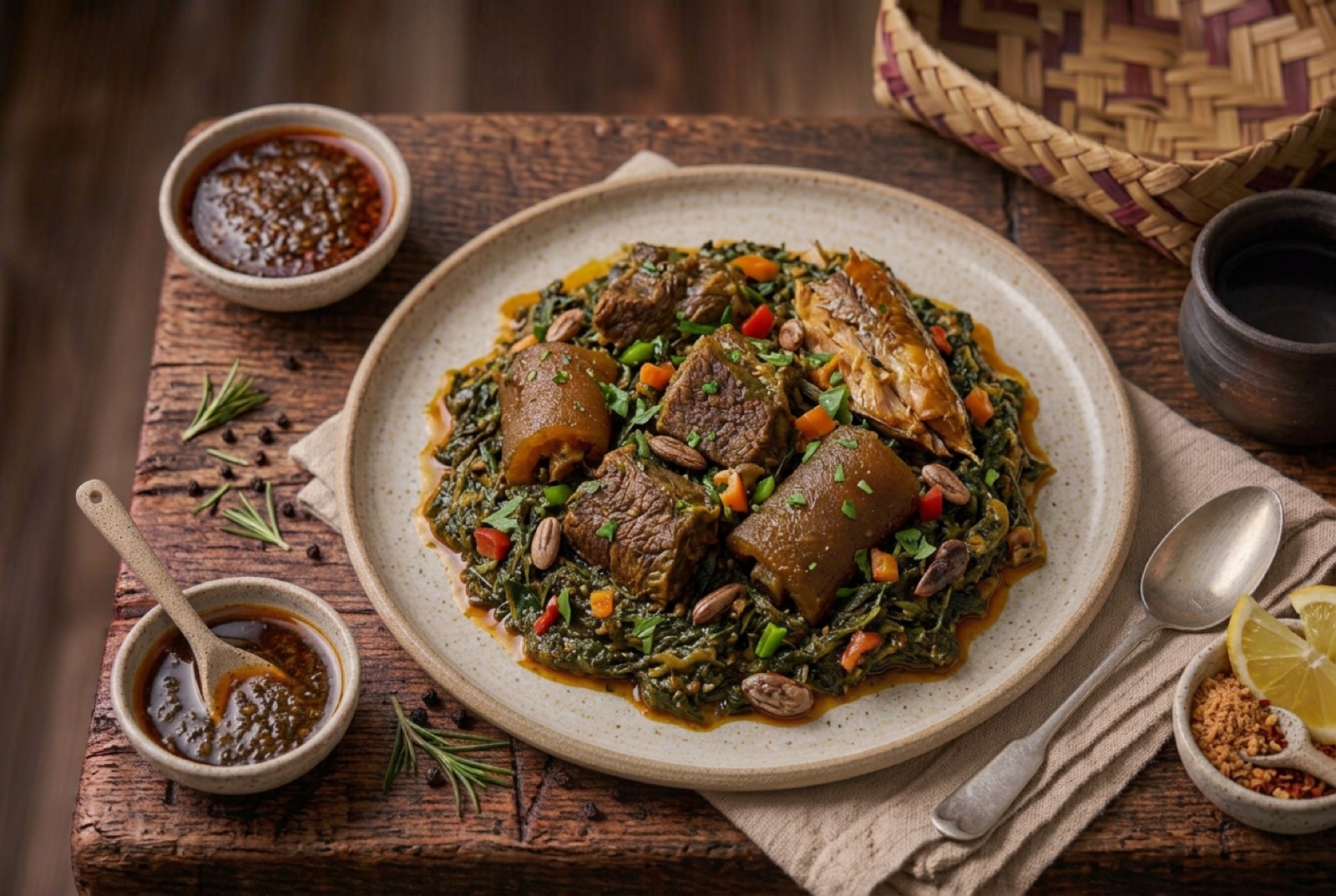
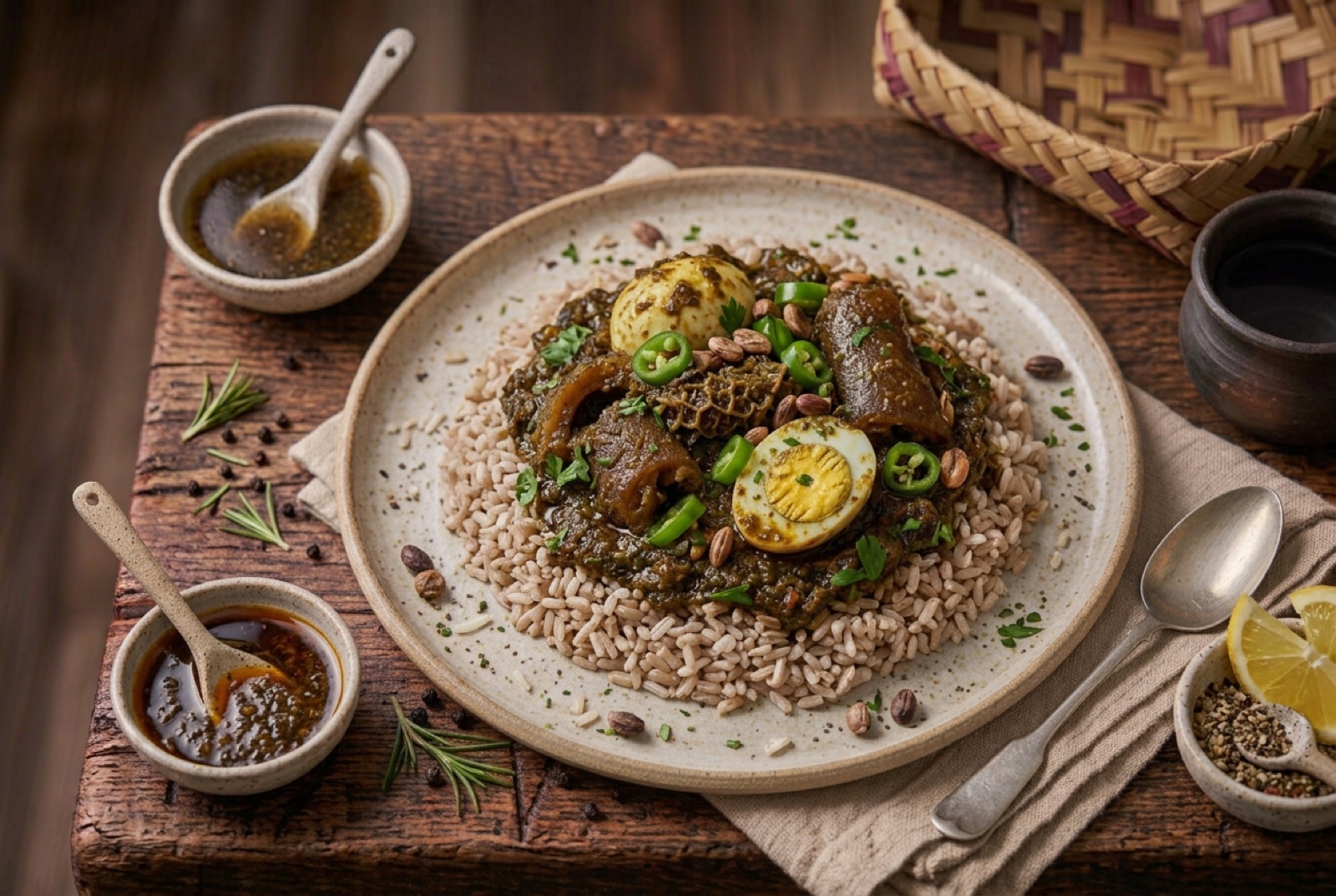
Efo riro is the Yoruba stewed-greens dish, and its name says what it is: efo means leafy vegetable, riro means stirred. Red peppers and scotch bonnets are fried in red palm oil until the oil separates, fermented locust beans and dried crayfish go in for depth, then beef, cow skin and smoked fish, and only at the very end a large quantity of shredded greens that collapse into the sauce in a couple of minutes. It should be thick enough to sit on a spoon, glossy with orange oil, and assertively savoury and hot. Watery efo riro is a fault, not a style.

- Gate
- NigeriaSouth-West
- Prep
- 30 min
- Cook
- 1 hr 10 min
- Total time
- 1 hr 40 min
- Serves
- 6
- Status
- Medium
- Nutrition / serving · estimated
- Calories 610 kcal
- Protein 44 g
- Carbs 15 g
- Fat 43 g
- Fiber 7 g
- Sodium 1050 mg
Why this recipe works.
- Keeps the sauce thick by draining the greens properly, which is where most versions turn into soup.
- Fries the pepper base to separation first, so the palm oil carries flavour instead of sitting on top as grease.
- Treats the assorted meats individually, cooking each to its own texture instead of boiling everything together.
- Explains what iru and ponmo actually contribute, so you can decide what to leave out with your eyes open.
Ingredients.
13 itemsFor the meat
For the base
To finish
Equipment
- Large heavy pot
- Blender
- Colander
- Separate pan for the ponmo
Instructions.
Cook the meats
Simmer the beef with the chopped onion, stock cubes and a little salt in barely enough water to cover for 45 minutes, until tender. Boil the ponmo separately for 40 minutes until it is springy and translucent, then drain and cut it into strips.
Tip Keep every drop of the beef liquid. It is the only stock this recipe uses.
Blend the peppers
Blend the red bell peppers, scotch bonnets and half the onion to a coarse purée, stopping while a little texture remains. Do not add water — the peppers carry more than enough of their own.
Reduce the pepper mix
Boil the purée in a wide pan over medium-high heat for 12 to 15 minutes, until it has visibly thickened, stopped throwing off steam in clouds and darkened from bright scarlet to a deeper red.
Fry in palm oil
Heat the palm oil in a large pot until it thins and brightens, about 2 minutes, then add the sliced onion and cook for 3 minutes. Tip in the reduced pepper mix, the iru and the crayfish, and fry for 12 to 15 minutes until the paste pulls away from the base of the pot and orange oil rises to the surface.
Tip Do not let palm oil smoke before the vegetables go in — it turns acrid and the whole pot tastes of it.
Add the meats and stock
Stir in the beef, ponmo and flaked smoked fish along with about 200 ml of the reserved beef stock. Simmer uncovered for 10 minutes so the meats take on the pepper base and the sauce reduces to a thick, spoonable consistency.
Stir in the greens
Turn the heat to low, add the squeezed greens and fold them through for 2 to 3 minutes only, until they have wilted into the sauce but still look dark green rather than grey. Taste for salt and heat.
Rest and serve
Take the pot off the heat and let it stand for 5 minutes so the oil settles into a glossy layer on top. Serve hot with amala, pounded yam or eba.
Tips from our kitchen.
- Wash the greens, shred them, then squeeze them dry in handfuls before they go anywhere near the pot. This one step decides the final thickness.
- Blend the peppers coarse rather than smooth. A little texture in the base holds the greens up instead of letting them slide apart.
- Rinse iru briefly and crush it between your fingers before adding, so its funk spreads through the pot rather than sitting in clumps.
- Boil ponmo separately for around 40 minutes until it is springy and translucent; added raw, it stays rubbery and never catches up.
- Add the greens off the boil and stir for two minutes only. Long-cooked leaves turn khaki and leach out everything that made them worth adding.
- If the pot still looks loose at the end, lift the solids out and reduce the sauce hard for a few minutes rather than letting the greens overcook.
Substitutions.
- Soko or ugu leaves → Mature spinach, chard, kale or collard greens
- Spinach is closest in flavour but holds the most water, so squeeze it hard. Kale and collards need an extra three or four minutes and give a firmer bite.
- Iru (fermented locust beans) → Half a teaspoon of dark miso or a dash of fish sauce
- Neither is a true match. Iru is pungent and slightly bitter as well as savoury, and its absence makes the stew cleaner and less obviously Yoruba.
- Ponmo (cow skin) → Extra beef, or omit
- Ponmo is bought for texture rather than taste. Without it the stew loses a chewy contrast but nothing in the flavour balance.
- Red palm oil → Half sunflower oil, half a teaspoon of sweet paprika for colour
- A visual approximation only. Palm oil has a grassy, slightly savoury weight that is a genuine part of the dish and is easy to buy at African and Caribbean grocers.
Variations.
- Efo elegusi
- Ground melon seed stirred into the same base along with the greens, giving a thicker, nuttier pot that sits somewhere between efo riro and egusi soup.
- Efo riro with seafood
- Prawns, periwinkles and fresh fish in place of the beef and cow skin, added in the last five minutes. Lighter, sweeter, and common in coastal Lagos households.
- Vegetarian efo riro
- Built on mushroom stock with fried oyster mushrooms replacing the assorted meat and smoked paprika standing in for the smoked fish. The palm oil and iru carry most of the character.
Storage & reheating.
Efo riro keeps 4 days refrigerated and thickens further as it chills, since the palm oil solidifies. Reheat gently in a pan until the oil loosens and the sauce loosens with it, adding a splash of stock only if it looks tight. It freezes for 3 months, though the greens go noticeably softer on thawing; if that matters, freeze the meat and pepper base alone and stir fresh greens through after reheating. Many Nigerian households portion a large pot into daily containers and simply reheat what they need.
Serve with
Amala, pounded yam, eba or plain white rice, with cold water or malt to drink.
The story behind Efo Riro.
Soko — Celosia argentea, sometimes sold as Lagos spinach — is the leaf this dish is built around in southwestern Nigeria, and shoko yokoto, ugu and even bitterleaf all stand in depending on the market. Outside West Africa, mature spinach is the usual substitute, and it works as long as you account for how much water it releases. What makes the dish Yoruba is not the leaf but the base underneath it: tatashe and rodo peppers fried in palm oil to the point of separation, and iru, the fermented locust bean that gives Yoruba cooking a pungent, almost cheesy undertone found nowhere in the Igbo repertoire.
The meat is described as assorted, and that word carries real meaning. A proper pot contains several textures rather than one — chunks of beef, shaki (tripe), ponmo (cow skin, boiled to a gelatinous chew), and smoked or dried fish, each contributing a different bite and each cooked long enough beforehand that its stock becomes part of the sauce. Ponmo divides opinion outside Nigeria, since it has almost no flavour of its own, but its slippery, springy texture is the thing many people are actually looking for in a spoonful. Leaving it out is allowed; pretending nobody misses it is not.
Efo riro sits at the centre of Yoruba home cooking and turns up wherever swallow is served: with pounded yam, amala, eba or semo, and increasingly with white rice as a weeknight shortcut. It is party food and Sunday food and also, in a large pot in the fridge, the food a household lives off for a week. The one recurring argument concerns tomato. Purists insist a true efo riro contains none at all, letting the red bell peppers do the work, while many cooks add a couple of tomatoes for sweetness and volume. This recipe leaves them out, which puts it on the traditional side of a small and entirely friendly dispute.
Questions, answered.
Why is my efo riro watery?
The greens were not drained. Leafy vegetables are mostly water and release it the moment they hit a hot pot, so wash, shred and then squeeze them dry in handfuls before adding. Adding stock to the base as well as wet greens compounds the problem. If it happens anyway, lift out the solids and reduce the sauce hard for a few minutes.
What is iru and can I cook efo riro without it?
Iru is fermented African locust bean, also called dawadawa in the north, sold as sticky dark clumps or dried granules. It gives Yoruba stews a pungent savoury depth similar in role to fermented soybean products elsewhere. You can leave it out and the stew still works, but it will taste cleaner and more generic, which is exactly what it will be.
What greens should I use outside Nigeria?
Mature spinach is the standard substitute and the closest in flavour, though it releases a lot of water. Chard, kale, collard greens and even frozen chopped spinach all work; frozen spinach in particular must be thawed and wrung out thoroughly. Avoid delicate baby leaves, which disintegrate completely in a stew this rich.
What is the difference between efo riro and egusi soup?
Both are palm oil-based Nigerian stews eaten with swallow, but egusi is thickened with ground melon seeds that cook into distinct curds, while efo riro is built on greens and a fried pepper base with no thickener at all. Efo riro is a Yoruba dish specifically; egusi is cooked across the whole country in many regional forms.
Do I have to use assorted meat?
No. Assorted meat means a mix of beef, tripe, cow skin and dried or smoked fish, chosen for contrasting textures as much as flavour. Cooking the stew with beef alone is perfectly reasonable and very common in kitchens outside Nigeria. Keep the smoked fish if you can, since it supplies savoury depth that plain beef does not.
You might also like.
All recipes →
Keep exploring Nigeria.
Nigeria has 9 more dishes in the atlas — Akara and Ayamase, and 7 more.
All Nigeria recipes Spinach recipes Bell pepper recipes Scotch bonnet recipes mainsoupgluten freedairy freehalal friendlyRecipe by The DishRoute Kitchen · published August 20, 2026 · updated August 20, 2026