Jollof Rice.
Nigerian Tomato and Pepper Rice
Jollof rice · say it: JOL-lof
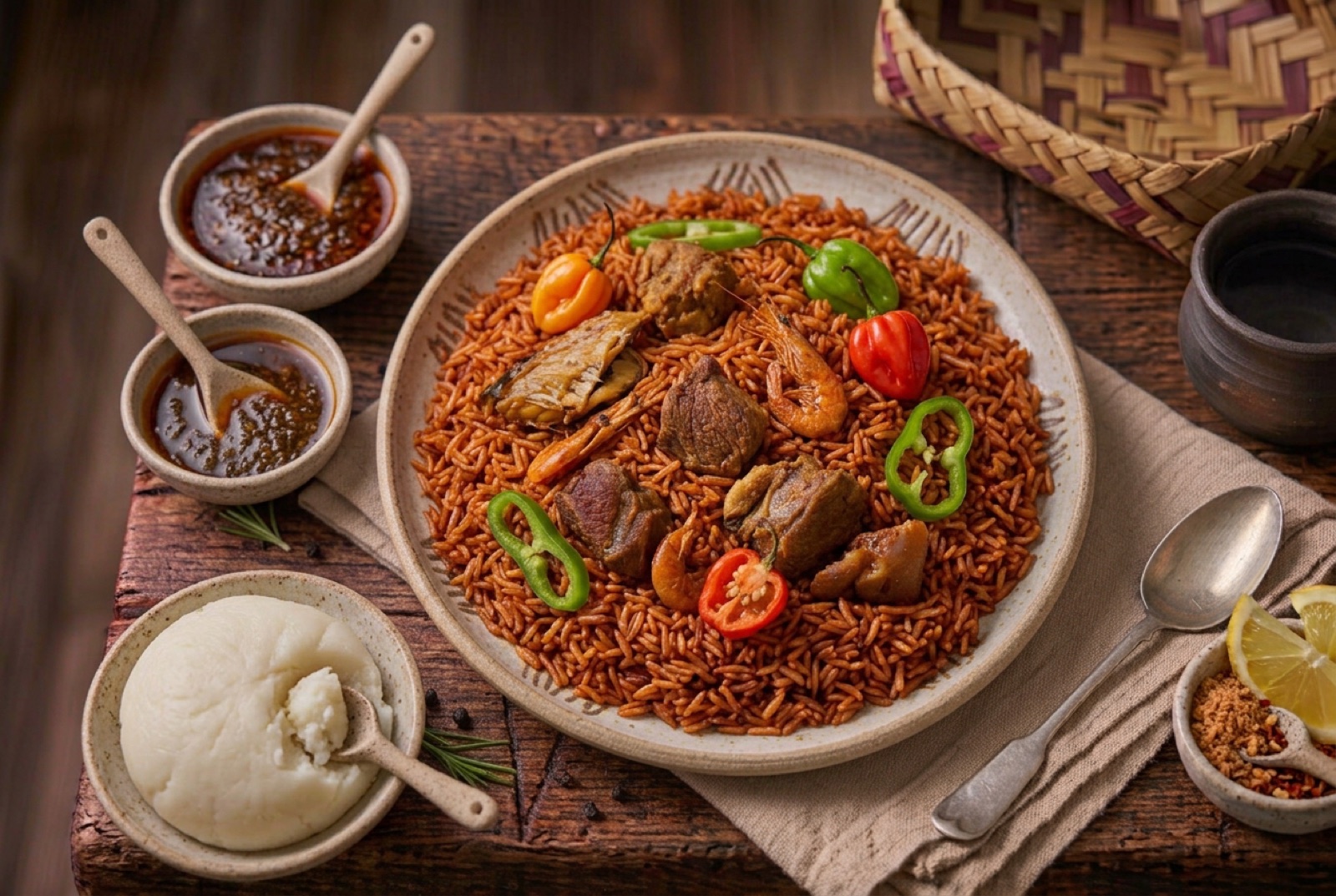
Jollof rice is a one-pot dish cooked entirely in its own sauce: tomatoes, red bell peppers, scotch bonnet and onion are blended raw, boiled down, then fried in oil until the mixture darkens and the fat separates. Stock goes in, then long-grain parboiled rice, and the pot is sealed so the grains steam until they have drunk the lot. The flavour is deeply savoury and tomato-forward, with thyme and curry powder sitting underneath and a chilli heat that builds instead of stinging. Nigerians judge a plate on two things: whether the grains stay separate, and whether the bottom layer has caught just enough to smell of woodsmoke.

- Gate
- Nigeria
- Prep
- 20 min
- Cook
- 1 hr 15 min
- Total time
- 1 hr 45 min incl. 10 min rest
- Serves
- 6
- Status
- Medium
- Nutrition / serving · estimated
- Calories 620 kcal
- Protein 11 g
- Carbs 98 g
- Fat 21 g
- Fiber 4 g
- Sugar 8 g
- Sodium 780 mg
Why this recipe works.
- Fries the pepper base to the oil-separation point and tells you exactly what that looks like, which is where most home jollof fails.
- Uses long-grain parboiled rice and the right liquid ratio, so the grains stay distinct instead of collapsing into a porridge.
- Builds the smoky bottom layer deliberately in the final minutes rather than hoping it happens.
- Honest that a firewood party pot cannot be copied on a hob, and clear about how close you can get.
Ingredients.
15 itemsFor the pepper base
For the rice
Equipment
- Heavy pot with a tight-fitting lid
- Blender
- Foil or baking paper for sealing the pot
- Fork for fluffing
Instructions.
Blend the pepper base
Blend the tomatoes, red bell peppers, scotch bonnets, the halved onion, garlic and ginger to a smooth purée with no more than a splash of water. You want a thick, pourable red liquid, not a chunky salsa.
Boil the base down
Pour the purée into a wide pan and boil it uncovered over medium-high heat for about 15 minutes, until it has reduced by roughly a third, stopped foaming and thickened enough to hold a brief trail when you drag a spoon through it.
Tip This step exists so the frying stage can actually fry. Skip it and you will be evaporating water for half an hour.
Fry the aromatics and paste
Heat the oil in a heavy pot over medium heat and cook the sliced onion for 5 minutes until soft and translucent. Stir in the tomato paste and fry for 3 minutes more, until it darkens from bright red to rust and smells sweet rather than tinny.
Fry the base to oil separation
Add the reduced pepper purée, the curry powder, thyme and bay leaves, and fry over medium heat for 18 to 20 minutes, stirring every couple of minutes. It is ready when the colour has deepened to brick, the raw tomato smell is gone, and oil pools visibly at the edges of the pot.
Tip The oil ring is the signal. If you cannot see it yet, the base is not finished, whatever the clock says.
Season the sauce
Pour in the stock, bring to a simmer and taste. Season with salt until the sauce is slightly saltier than you would want to eat on its own — 750 g of rice is about to absorb all of it and dilute the seasoning.
Add the rice and seal the pot
Rinse the rice until the water runs almost clear, drain it thoroughly and stir it into the sauce so every grain is coated. The liquid should sit level with the surface of the rice; top up with a little hot water if it does not. Lay a sheet of foil over the pot, press the lid down onto it and turn the heat to low.
Steam undisturbed
Cook for 25 to 30 minutes, opening once at the halfway mark to turn the rice over gently with a fork and check the liquid. It is done when the grains are tender with the faintest bite left, the pot sounds dry, and no free liquid pools when you push the rice aside.
Build the smoky bottom
Uncover, raise the heat to medium-high and leave the pot alone for 2 to 3 minutes, until you hear a light crackle and smell toasting rather than burning. Take it off the heat immediately, rest covered for 10 minutes, then fluff from the bottom so the caramelised layer is stirred through.
Tip Trust your nose over the timer. Toasted is the goal; acrid means you went too far and the whole pot will taste of it.
Tips from our kitchen.
- Boil the blended pepper mix down before frying it. If you skip that, you are frying and evaporating at the same time and the base never develops.
- Use long-grain parboiled rice, sold as easy-cook or golden sella. Basmati and jasmine absorb far faster and turn to mush in this method.
- Rinse the rice until the water runs almost clear, then drain it well — surface starch is what glues grains together.
- Seal the pot with a sheet of foil or baking paper under the lid. Escaping steam is the difference between cooked rice and crunchy rice.
- Resist stirring. Open once at the halfway point to turn the rice over with a fork, then leave it alone until it is done.
- Taste the sauce for salt before the rice goes in. Once the grains are absorbing, you can no longer season evenly.
Substitutions.
- Scotch bonnet peppers → Habanero, or half a scotch bonnet with the seeds removed
- Scotch bonnets bring a fruity perfume as well as heat, and habanero is the closest match. Chilli flakes give heat without the aroma, which is a noticeable loss.
- Long-grain parboiled rice → Ordinary long-grain white rice, with the stock reduced by about 100 ml
- It works, but the grains are softer and less forgiving. Check for doneness ten minutes earlier than the recipe says.
- Fresh red bell peppers → A jar of roasted red peppers, drained
- Sweeter and already soft, so shorten the boil-down. The colour is good; the fresh vegetal edge is missing.
Variations.
- Party jollof
- The same recipe cooked outdoors in a large pot over firewood, so wood smoke penetrates the rice and the base caramelises hard. The smokiness is the whole point and it comes from the fire, not from an ingredient.
- Coconut jollof
- Replace half the stock with full-fat coconut milk. The result is richer, slightly sweet and pale orange rather than red — a common Lagos variation rather than a foreign invention.
- Jollof spaghetti
- The identical pepper base used to cook spaghetti instead of rice, boiled briefly first then finished in the sauce. Standard Nigerian student and weeknight food.
Storage & reheating.
Jollof keeps 4 days refrigerated and is widely considered better on day two, once the pepper base has settled into the grain. Reheat covered with a splash of water or stock, either in a pan over low heat or in the microwave, so the rice re-steams rather than dries out. It freezes well for 3 months in portioned bags — spread it out to cool first so it does not clump into a single block. The scraped-up smoky bottom layer does not survive storage; eat that on the day.
Serve with
Fried plantain (dodo), grilled or peppered chicken, moi moi, and a plate of coleslaw to cut the heat.
The story behind Jollof Rice.
The name goes back to the Wolof of Senegambia and the medieval Jolof state, and the dish's clearest ancestor is thieboudienne, the Senegalese pot of fish, rice and tomato cooked in one vessel. From there some version of tomato-cooked rice spread along the coast, and every West African country now has its own — Ghana, Sierra Leone, Liberia, Cameroon, Togo, Gambia. The Nigerian one is defined by two choices: long-grain parboiled rice, which holds its shape through a long steam, and a pepper base fried much further than most cooks would dare.
Which country makes it best is a real and unresolved argument, and the Nigeria–Ghana version of it is the loudest. Nigerians point to the depth of the fried base, the smoky bottom-of-pot layer and the sheer volume in which the dish is produced at celebrations. Ghanaians answer that aromatic rice carries the sauce better, and that Nigerian jollof is a blunt instrument next to their spicing. It runs through social media, restaurant menus, national newspapers and the occasional diplomatic joke, and neither side has ever conceded anything. The one point both tend to grant is that the dish did not begin in either country — Senegambia has the older claim. Anyone who tells you the matter is settled is picking a side, so this recipe teaches the Nigerian method and leaves the verdict alone.
At home jollof is weekday food, cooked in a medium pot and eaten with fried plantain. At an owambe — a Nigerian party — it is something else: sacks of rice, drums of pepper base, and enormous pots set on firewood in the compound, where the wood smoke works its way into the grain and the bottom caramelises into the layer everyone quietly hopes to be served. That is party jollof, and no domestic hob fully reproduces it. What a home kitchen can do is fry the base properly, seal the pot, and let the last few minutes on higher heat build a toasted base of its own.
Questions, answered.
Which country invented jollof rice, Nigeria or Ghana?
Neither, most likely. The name traces to the Wolof people and the historic Jolof state in the Senegambia region, and Senegalese thieboudienne is the dish's closest ancestor. Nigeria and Ghana each developed a distinct version and argue endlessly over which is better, but that argument is about quality rather than origin, and it has never been settled.
Why did my jollof rice turn out mushy?
Usually too much liquid, the wrong rice, or stirring. Long-grain parboiled rice needs roughly its own volume of liquid and no more, because the pepper base already carries water. Rinsing off the surface starch, sealing the pot so steam does not escape, and turning the rice only once with a fork all help keep the grains separate.
How do I get the smoky flavour without cooking over firewood?
Let the pot sit on medium-high heat for the last two or three minutes once the rice is cooked, until you can smell toasting at the base and hear a faint crackle. That scorched bottom layer is stirred through and carries genuine smokiness. It is not identical to a wood fire, but it is the same mechanism and it is what most Nigerian home cooks rely on.
How spicy is Nigerian jollof rice?
Properly made, it is hot — scotch bonnets are used for both heat and their fruity aroma. You control it by how many you blend in and whether you keep the seeds and membranes. One deseeded scotch bonnet in a six-portion pot gives a warm background rather than a sharp burn, and you can always serve extra pepper sauce on the side.
Can I make jollof rice ahead of time?
Yes, and many Nigerian cooks prefer it that way. The finished rice reheats well for several days, and the pepper base can be made separately, refrigerated for up to five days or frozen for months, then reheated and used to cook fresh rice in under half an hour. Making the base in bulk is standard practice in Nigerian households.
You might also like.
All recipes →
Keep exploring Nigeria.
Nigeria has 9 more dishes in the atlas — Akara and Ayamase, and 7 more.
All Nigeria recipes Rice recipes Tomato recipes Bell pepper recipes maingluten freedairy freehalal friendlyRecipe by The DishRoute Kitchen · published August 20, 2026 · updated August 20, 2026