Imqaret.
Maltese Fried Date Pastries
Imqaret · say it: im-a-RET
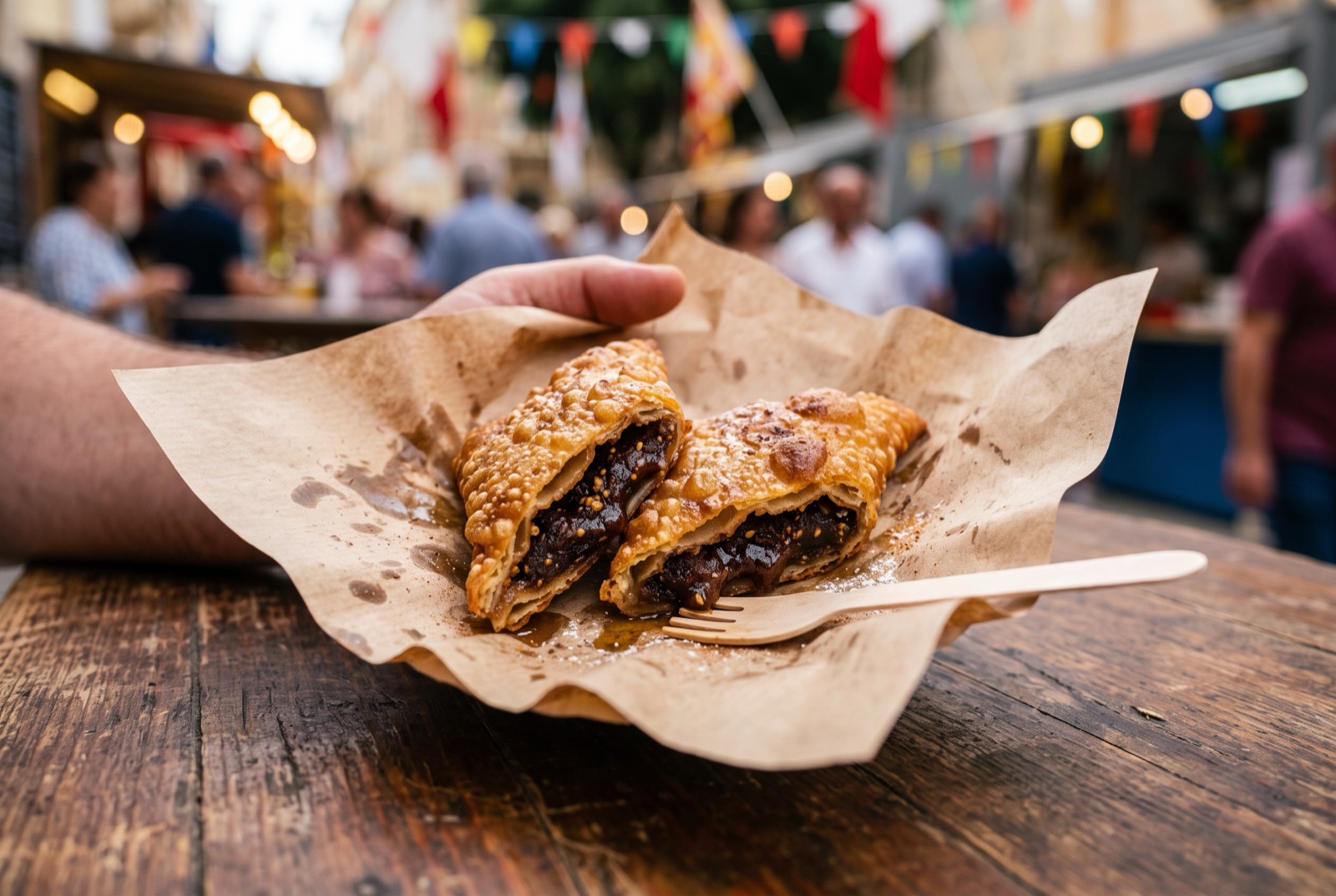
Imqaret are date pastries cut on the diagonal into diamonds, which is where the name comes from — imqaret means, roughly, the shaped or lozenged ones. A firm semolina-and-flour dough is wrapped around a dark paste of dates cooked with orange zest and juice, aniseed and cloves, rolled into a long log, cut into diamonds and deep-fried until the outside blisters and crisps while the filling stays soft and sticky. They are sold hot from carts and hatches, most famously outside the Valletta city gate, and eaten standing up in a paper cone.

- Gate
- Malta
- Prep
- 40 min
- Cook
- 35 min
- Total time
- 1 hr 45 min incl. 30 min rest
- Serves
- 20
- Status
- Medium
- Nutrition / serving · estimated
- Calories 215 kcal
- Protein 3 g
- Carbs 36 g
- Fat 7 g
- Fiber 3 g
- Sugar 19 g
- Sodium 65 mg
Why this recipe works.
- Cooks the dates down properly into a paste that will not tear the pastry when rolled.
- Semolina in the dough gives the sandy, crisp shell that plain flour alone cannot.
- Citrus is used at festa strength, which stops the date filling from tasting flat and cloying.
- Frying temperature is specified, which is what separates crisp from greasy here.
Ingredients.
14 itemsFor the pastry
For the filling
To fry
Equipment
- Heavy pan or deep fryer
- Kitchen thermometer
- Rolling pin
- Slotted spoon
Instructions.
Make the pastry
Rub the butter into the flour, semolina, sugar and salt until the mixture looks like coarse sand. Add the cold water a little at a time and bring it together into a firm dough without kneading it smooth. Wrap and rest in the fridge for 30 minutes.
Tip Keep the dough firm. A soft, overworked pastry stretches while you roll the log and splits along the seam in the fryer.
Cook the date filling
Put the chopped dates in a pan with the water, orange juice and half the zest and cook over low heat for 15 minutes, mashing with a wooden spoon, until the fruit collapses into a thick dark paste that holds a clear track when the spoon is dragged through it.
Finish and cool the filling
Beat in the remaining orange zest, the lemon zest, the ground aniseed, the cloves and the anisette if using. Spread the paste out on a plate and cool it completely to room temperature — warm filling softens the pastry from the inside and makes the logs impossible to cut cleanly.
Roll and fill the logs
Divide the pastry into four. Roll each piece into a strip about 10 cm wide and 3 mm thick. Lay a finger-thick rope of date paste down the centre, fold the long sides over to overlap and seal them with a wet fingertip, then roll the log seam side down and flatten it slightly.
Cut the diamonds
Cut each log on a sharp diagonal into pieces about 5 cm long, giving diamond shapes with the filling visible at both cut ends. Press the cut faces gently so the pastry hugs the filling, and keep the pieces on a floured tray until you fry them.
Fry in batches
Heat the oil to 170C and fry the imqaret six or seven at a time for 3 to 4 minutes, turning once, until the pastry is blistered and deep golden. Crowding the pan drops the oil temperature sharply and the pastry absorbs oil instead of crisping.
Tip Let the oil come back up to 170C between batches. The second batch is the one people usually ruin by not waiting.
Drain and serve hot
Lift the imqaret out with a slotted spoon and stand them on their edges in a colander to drain, rather than laying them flat on paper where the cut faces steam. Serve within a few minutes, while the shell still crackles and the date paste is molten.
Tips from our kitchen.
- Cook the date paste until a spoon dragged through leaves a clear track that closes slowly. Any wetter and steam bursts the pastry open in the oil.
- Let the filling cool completely before rolling. Warm paste softens the dough from the inside and the log tears along its length as you cut.
- Roll the dough thin, about 3 mm — thick pastry stays doughy in the middle because the frying time is set by the crust, not the centre.
- Seal the log with a wet fingertip and lay it seam side down. An unsealed seam opens in the fryer and the filling scorches into the oil.
- Fry at 170C, no hotter. Higher and the pastry colours before the inside heats through; lower and it drinks oil and turns heavy.
- Drain upright in a colander rather than flat on paper, so the cut faces stay crisp instead of steaming against the sheet.
Substitutions.
- Butter in the dough → Lard, block margarine or 80 ml olive oil
- The traditional Lenten version is made without dairy. Oil gives a slightly harder, sandier pastry that fries very crisp.
- Anisette → An extra teaspoon of ground aniseed, or orange juice
- The liqueur mainly reinforces the aniseed already in the filling, so leaving it out changes very little.
- Deep-frying → Baking at 190C for 20 minutes, brushed with oil
- A real departure — baked imqaret are drier and shorter, closer to a biscuit than the blistered fried shell. Common in home kitchens that avoid deep-frying.
Variations.
- Imqaret bl-anisette
- The date filling loosened with a tablespoon or two of anisette or another anise liqueur, which sharpens the aniseed and keeps the paste softer after frying.
- Baked imqaret
- Brushed with oil and baked rather than fried, producing a drier, biscuit-like pastry that keeps far better and is often made in larger batches for the house.
- Imqaret with ice cream
- A modern kiosk and restaurant version, serving two hot imqaret with a scoop of vanilla ice cream melting between them. Not traditional but now very common in Valletta.
Storage & reheating.
Imqaret are a street sweet and are meant to be eaten within minutes of frying, while the shell still crackles. They keep 2 days in an airtight tin but soften noticeably as the filling gives up moisture into the pastry; refresh them for 6 minutes at 180C to bring some crispness back. The uncooked filled logs freeze well for 2 months — freeze them whole, then cut into diamonds while still part-frozen, which gives much cleaner edges, and fry from frozen at a slightly lower 165C.
Serve with
Eaten hot from a paper cone, with strong black coffee or a glass of tea.
The story behind Imqaret.
The date is the giveaway. Malta grows almost no dates commercially, so the fruit arrived by trade and by rule from North Africa, and imqaret sit in the same family as the Tunisian and Algerian makroudh — semolina pastry, date paste, diamond cut, fried and often soaked in honey. The Maltese version dropped the honey soak in favour of a plainer fried pastry and picked up more citrus, but the relationship is obvious and worth stating plainly rather than claiming the sweet as an island invention. It is one of the clearest surviving traces of the centuries when Malta was governed from Ifriqiya and its language became Semitic.
What makes them Maltese now is where and how they are eaten. Imqaret belong to the street and to the calendar rather than to the restaurant. They are fried in front of you at village festas through the summer, alongside stalls of nougat and roasted nuts, and sold from a handful of permanent kiosks in Valletta that have been there long enough to be landmarks in their own right. They also appear in Lent and Holy Week, when the islands lean heavily on sweets made without dairy — a habit shared with kwareżimal, the Lenten almond biscuits, and one that explains why the traditional dough is often made with oil, margarine or lard rather than butter.
The filling is where households differ. Dates are always the base, chopped and cooked down with water until they collapse, but the aromatics move around: orange zest and juice almost always, lemon zest often, ground cloves and aniseed commonly, and a splash of anisette in versions made for adults. Some cooks add a spoonful of mixed peel or a grating of nutmeg. The dough stays deliberately plain and slightly sandy from the semolina, because its job is to fry crisp and provide contrast rather than to taste of much on its own. Eaten cold the next day they are pleasant but ordinary; the whole point is the ten minutes after they come out of the oil, when the shell is still crackling and the date paste inside is molten.
Questions, answered.
What does the word imqaret mean?
It refers to the shape. The pastries are cut on the diagonal from a long filled log, producing diamonds or lozenges, and the Maltese name describes that cut rather than the filling. The singular is maqrut, and the same root gives the name of the closely related North African sweet makroudh.
How are imqaret related to makroudh?
They share a direct ancestry. Makroudh, made across Tunisia and Algeria, is the same idea of a semolina pastry wrapped around date paste, cut into diamonds and fried, usually then soaked in honey. The Maltese version skips the honey soak, leans harder on orange and aniseed, and is eaten as street food rather than as a tray sweet, but it comes from the same North African tradition.
Why did my imqaret burst open while frying?
Either the date filling was too wet or the seam was not properly sealed. The paste must be cooked down until it holds its shape and leaves a clear track when a spoon is drawn through it, and the pastry log should be closed with a damp fingertip and laid seam side down before cutting. Overfilling is the third common cause, so keep the filling to a finger-thick strip.
Can imqaret be made without dairy?
Yes, and traditionally they often are. The dough works perfectly well with olive oil, lard or block margarine in place of butter, which is why imqaret are a common sweet during Lent in Malta when dairy is avoided. Using oil gives a slightly sandier pastry that fries very crisp.
When are imqaret eaten in Malta?
They are a year-round street sweet sold from kiosks, most famously by the Valletta city gate, but they are strongly associated with two moments: village festas through the summer, where they are fried on the spot alongside nougat stalls, and Lent and Holy Week, when dairy-free sweets are traditional.
You might also like.
All recipes →
Keep exploring Malta.
Malta has 9 more dishes in the atlas — Aljotta and Bigilla, and 7 more.
Recipe by The DishRoute Kitchen · published August 21, 2026 · updated August 21, 2026