Festival.
Sweet Fried Cornmeal Dumplings
Festival · say it: FES-tih-vul
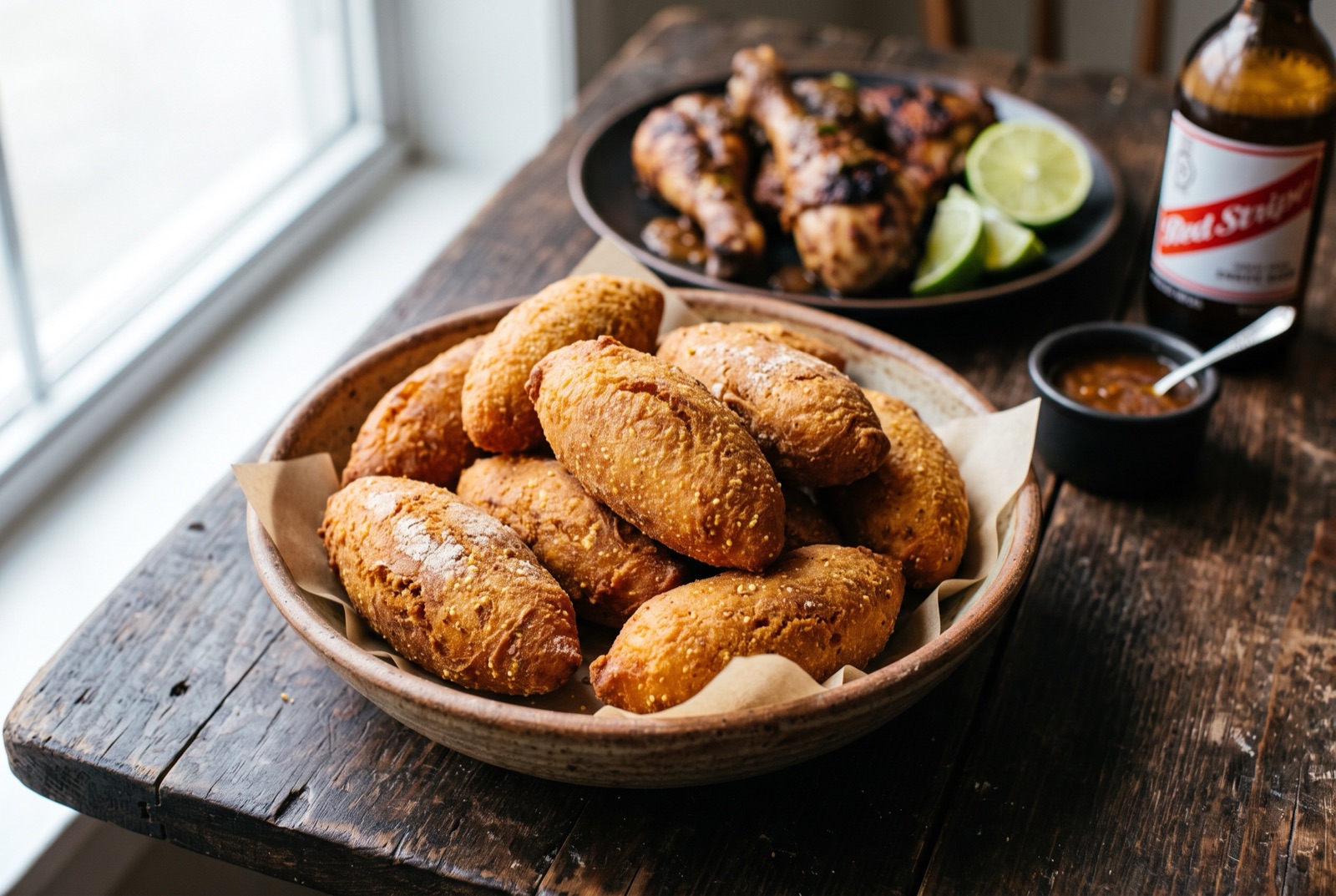
Festival is a sweet fried dumpling shaped into a short torpedo, made from a stiff dough of cornmeal, flour, sugar and a little nutmeg or vanilla, and fried in medium-hot oil until deep gold. Inside it stays soft and slightly cakey with the grit of cornmeal; outside it turns crisp and blistered. The sweetness is mild — this is not a doughnut — and its job is to sit beside something hot and salty, which is why it appears next to jerk chicken, escovitch fish and fried fish on every roadside plate in Jamaica. It takes about half an hour and needs no yeast, no proofing and no special equipment. The two things that decide the result are how stiff you make the dough and how hot you keep the oil.

- Gate
- Jamaica
- Prep
- 15 min
- Cook
- 20 min
- Total time
- 50 min incl. 15 min rest
- Serves
- 6
- Status
- Easy
- Nutrition / serving · estimated
- Calories 290 kcal
- Protein 5 g
- Carbs 40 g
- Fat 12 g
- Fiber 2 g
- Sugar 6 g
- Sodium 380 mg
Why this recipe works.
- A dough stiffness described by feel rather than by an exact water quantity, since cornmeal absorbs unpredictably.
- A short rest that lets the cornmeal hydrate, which is what stops the middle tasting sandy.
- A specific oil temperature and a visual cue, so the dumplings cook through instead of browning raw.
- Sweetness pitched for eating alongside salty jerk and fish, not as a dessert.
Ingredients.
10 itemsFor the dough
For frying
Equipment
- Mixing bowl
- Deep frying pan or small saucepan
- Tongs or a slotted spoon
- Paper towels or a wire rack
Instructions.
Mix the dry ingredients
Whisk the cornmeal, flour, sugar, baking powder, salt, nutmeg and cinnamon together in a bowl until evenly combined and no pockets of baking powder remain.
Bring the dough together
Stir in the melted butter, then add the milk a little at a time, mixing until a stiff dough forms. It should be firm enough to hold a thumbprint and come away from the bowl without sticking to your fingers.
Tip Hold back the last 30 ml of milk until you see how the cornmeal behaves — brands vary a lot in absorption.
Knead briefly and rest
Knead in the bowl for 1 minute until smooth, then cover and leave it 15 minutes. The dough will firm up noticeably as the cornmeal takes up the liquid.
Shape the festivals
Divide the dough into 12 pieces and roll each between your palms into a tapered finger about 10 cm long and 2.5 cm thick. Keep them even so they fry at the same rate.
Heat the oil
Pour oil into a deep pan to a depth of about 5 cm and heat to 165C, when a scrap of dough sizzles steadily and rises within a few seconds rather than browning instantly.
Fry in batches
Lower in four festivals at a time and fry 6 to 8 minutes, turning constantly with tongs, until they are an even deep gold all over and feel light and hollow when tapped.
Tip If they darken in under three minutes, the oil is too hot — pull the pan off the heat for a minute before continuing.
Check the first one
Drain on a rack and break one open. The inside should be pale gold, cakey and fully set, with no wet dough at the centre. Adjust the heat or time before frying the remaining batches.
Serve hot
Drain the rest on the rack and serve while still warm, piled beside jerk chicken or fried fish. They are at their best within the first hour.
Tips from our kitchen.
- Make the dough stiff, not sticky. It should feel like firm modelling clay and pull cleanly off your hands — a wet dough spreads in the oil and fries flat.
- Let the dough rest 15 minutes before shaping. Cornmeal needs that time to absorb water, and skipping it leaves a gritty centre.
- Roll each piece between your palms into a tapered finger about 10 cm long. Balls fry unevenly and stay raw in the middle.
- Keep the oil around 165C — cooler than you would use for chips. Too hot and the outside darkens in two minutes while the inside is still dough.
- Fry in small batches and turn them constantly with tongs so they colour evenly on all sides.
- Test the first one by breaking it open. The interior should be pale gold and cakey with no wet streak down the middle.
Substitutions.
- Fine cornmeal → Medium cornmeal or polenta ground finer in a blender
- Coarse polenta stays gritty even after resting. If it is all you have, soak it in the milk for 30 minutes before mixing.
- Milk → Coconut milk or water
- Coconut milk is common in Jamaican versions and makes them richer. Water works and keeps the recipe vegan alongside the sugar.
- Nutmeg → 1 tsp vanilla extract, or 1/2 tsp ground cinnamon
- All three appear in household recipes. Nutmeg is the most distinctly Jamaican, since the island grows it.
Variations.
- Fried dumpling (Johnny cake)
- The unsweetened savoury version made from flour alone, rounder and flatter. Served at breakfast with ackee and saltfish rather than with jerk.
- Boiled dumpling
- The same flour and cornmeal dough without sugar, rolled into discs or ropes and boiled in soup. Chewy rather than crisp.
- Coconut festival
- Made with coconut milk and a handful of grated coconut in the dough for a richer, more fragrant dumpling.
Storage & reheating.
Festival is best within an hour of frying, when the crust is still crisp. It keeps 2 days in a paper bag at room temperature — not plastic, which traps steam and makes it soggy — and reheats well at 180C for 8 minutes, which restores most of the crispness. Do not microwave it; it goes leathery. The raw dough can be made and shaped a few hours ahead, covered and refrigerated, then fried straight from cold with an extra minute in the oil.
Serve with
Jerk chicken, escovitch fish or fried fish — and a dab of hot pepper sauce for contrast.
The story behind Festival.
Festival is the fried descendant of a much older family of Caribbean dumplings, and cornmeal is the thread that runs through it. Maize came to the region from the Americas long before European arrival, and cornmeal dumplings — boiled, roasted in leaves, or fried — appear in various forms across the Caribbean and the American South. In Jamaica the boiled version is simply called dumpling or spinner and goes into soups; the fried, sweetened, elongated version is festival.
The name is comparatively recent and its origin is not documented with any certainty. The most commonly repeated explanation ties it to Jamaican celebrations and fairs where the dumplings were sold by vendors, and the word does carry an air of occasion food. It is fair to say the etymology is uncertain rather than settled, and Jamaicans themselves offer several versions. What is clear is that festival became inseparable from the jerk pan and the fish shack during the twentieth century, and any jerk order that arrives without one feels incomplete.
The shape matters more than it looks. Festival is rolled between the palms into a slightly tapered cylinder about the length of a finger, which gives it the ratio of crust to interior that people expect — long and thin enough to cook through before the outside darkens, thick enough to keep a soft cakey middle. A round ball fries unevenly and ends up raw in the centre. Every household adjusts the sugar and the spicing: some add vanilla, some grated nutmeg, some cinnamon, and the balance of cornmeal to flour ranges from equal parts to one to two, with more cornmeal giving a grittier, more rustic dumpling.
Questions, answered.
What is the difference between festival and fried dumpling?
Festival is sweetened, contains cornmeal, and is rolled into an elongated finger shape. Fried dumpling, also called Johnny cake, is plain flour with no sugar, shaped into a round flattened ball, and eaten at breakfast with savoury dishes like ackee and saltfish. Festival is the one served with jerk and fried fish, where its slight sweetness plays against the salt and heat.
Why is my festival raw in the middle?
The oil was too hot, or the dumplings were rolled too thick. Festival needs moderate heat around 165C for six to eight minutes so the heat reaches the centre before the crust darkens. Roll them no thicker than about 2.5 cm and no longer than 10 cm, and break the first one open to check before frying the rest.
How sweet is festival supposed to be?
Only lightly. It is a side dish for salty, spicy food, not a dessert, so the sugar should register as a soft background sweetness rather than the dominant flavour. Around two tablespoons of sugar for 300 g of dry ingredients is a typical balance. Sweeter versions exist and edge closer to a doughnut, which is a matter of household taste.
Can I bake festival instead of frying it?
You can bake them at 190C for about 20 minutes and they will be edible, but they are a different thing — drier, more like a cornbread finger, with none of the blistered crust that gives festival its character. Frying is what the dish is. If you want to reduce the oil, shallow fry in 2 cm rather than deep frying.
Do I need baking powder?
Yes, this dough relies on it. There is no yeast and no proofing, so baking powder is the only thing lifting the interior into a soft cakey crumb rather than a dense fried brick. Use fresh baking powder — a tin that has been open for a year loses much of its power, and stale powder is a common reason festival comes out heavy.
You might also like.
All recipes →
Keep exploring Jamaica.
Jamaica has 9 more dishes in the atlas — Ackee and Saltfish and Brown Stew Oxtail, and 7 more.
Recipe by The DishRoute Kitchen · published August 20, 2026 · updated August 20, 2026