Kalb el Louz.
Algerian Almond Semolina Syrup Cake
قلب اللوز · Qalb el louz · say it: kalb el LOOZ
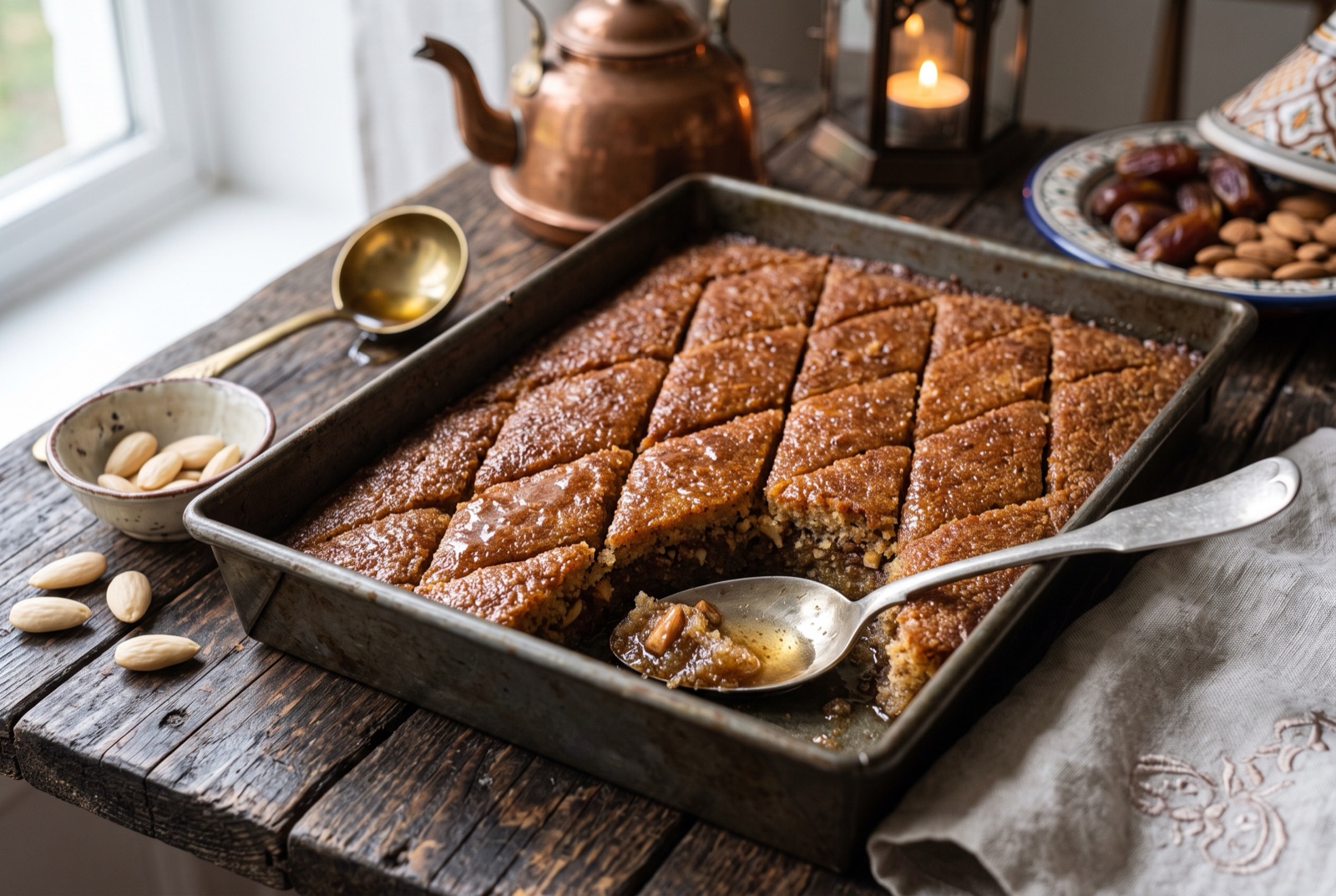
Kalb el louz is a semolina cake built in two layers with a seam of almond paste running through the middle — the name means heart of almond, and the almond really is the heart of it. The semolina is worked with butter and left to swell, so it bakes into a texture that is grainy and tender at once rather than cakey, and the moment the tray comes out of the oven a warm orange-blossom syrup goes over it and vanishes into the crumb. The result is very sweet, faintly floral, and heavy in the way a Ramadan dessert is supposed to be. One diamond with a glass of mint tea is a portion. Two is a decision.

- Gate
- Algeria
- Prep
- 30 min
- Cook
- 45 min
- Total time
- 2 hr 15 min incl. 1 hr rest
- Serves
- 12
- Status
- Medium
- Nutrition / serving · estimated
- Calories 480 kcal
- Protein 8 g
- Carbs 72 g
- Fat 19 g
- Fiber 3 g
- Sugar 44 g
Why this recipe works.
- The semolina is rested in butter and milk before baking, which is what gives the cake its tender grain instead of a sandy one.
- A real almond layer through the middle rather than ground almonds stirred into the batter, so each diamond has a visible seam.
- Syrup poured hot onto a hot cake, with a description of what full absorption actually looks like.
- Scored before baking, so the pieces come out clean and the syrup runs down into every cut.
Ingredients.
16 itemsFor the cake
For the almond layer
For the syrup
Equipment
- Baking tray or tin about 25 x 30 cm
- Small saucepan for the syrup
- Sharp knife
Instructions.
Coat the semolina in butter
Combine the semolina, caster sugar and salt in a large bowl, pour over the melted butter and rub it through with your fingertips for 3–4 minutes, until every grain is coated, the mixture holds together when squeezed, and it smells faintly nutty rather than floury.
Hydrate and rest
Stir in the warm milk and 1 tablespoon of orange blossom water and mix until evenly damp — the texture should be like wet sand, not a batter. Cover and leave for a full hour so the semolina swells and softens.
Tip Press a pinch between your fingers after an hour. It should feel plump and slightly yielding, with no hard grit in the centre.
Make the almond layer
Work the ground almonds with the 80 g of caster sugar, the softened butter and 2 tablespoons of orange blossom water until the mixture clumps when pressed and can be crumbled into coarse damp lumps. Heat the oven to 180°C and butter your tray.
Assemble and score
Press just over half the semolina mixture into the tray in an even layer, tamping it flat with the back of a spoon. Scatter the almond mixture evenly over it and press lightly, then cover with the remaining semolina and level the top. Score into diamonds with a wet knife, cutting right down to the base, and press a whole almond into the centre of each.
Bake
Bake for 40–45 minutes, until the surface is an even deep gold, the edges have pulled slightly from the tin, and the score lines have opened into visible channels. The cake should feel firm when pressed in the centre.
Make the syrup while it bakes
Bring the granulated sugar, water, honey and lemon juice to the boil in a saucepan, then simmer for 8 minutes until it thickens slightly and coats the back of a spoon in a thin film. Take it off the heat and stir in the last 2 tablespoons of orange blossom water. Keep it warm.
Flood the hot cake
The moment the tray comes out of the oven, ladle the warm syrup over it in three or four stages, waiting each time until the surface stops glistening before adding more. The tray will look briefly flooded and then drink it all. Leave it to stand for at least 4 hours, or overnight, before lifting out the diamonds.
Tips from our kitchen.
- Use coarse or medium semolina, not fine. Fine semolina turns the cake dense and pasty, and you lose the grainy bite the dessert is known for.
- Rub the butter into the semolina with your fingertips until every grain is coated and the mixture smells nutty. This waterproofs the grain slightly and stops it going gluey.
- Give the mixture the full hour to swell. Semolina that goes into the oven under-hydrated bakes hard and refuses to absorb syrup afterwards.
- Score all the way to the base of the tray before baking, using a knife dipped in water so it does not drag the surface.
- Have the syrup ready and warm before the cake comes out. Every minute the cake cools is absorption you will not get back.
- Leave the tray alone for at least four hours after syruping, ideally overnight. The texture only settles once the syrup has finished travelling through it.
Substitutions.
- Ground almonds → Ground blanched hazelnuts, or half almonds and half desiccated coconut
- Hazelnut changes the character noticeably but works. Coconut is a common household stretch when almonds are expensive, and the syrup carries it well.
- Orange blossom water → Rose water, at two-thirds the quantity
- Rose is stronger and more perfumed, so use less. Vanilla is not a substitute — it makes the cake taste generically Western rather than Algerian.
- Butter → Ghee, or a neutral oil
- Ghee is closer to the smen some families use and gives a deeper flavour. Oil works and makes the cake dairy-free if you also swap the milk for water, though the crumb is slightly less rich.
Variations.
- Kalb el louz with dates
- A layer of date paste, softened with a little orange blossom water, used instead of the almond seam. Cheaper, darker and very common in the south where dates are the local crop.
- Blended almond version
- The ground almonds mixed through the semolina rather than layered. Faster to assemble and more uniform, at the cost of the visible seam that gives the cake its name.
- Kalb el louz with a milk soak
- A cup of warm milk poured over the assembled tray and left to soak in before baking. Produces a softer, almost pudding-like cake that then takes on less syrup.
Storage & reheating.
Keeps a week at room temperature in a covered tray and does not need refrigeration, since the syrup preserves it. The texture is best from the second day onward, once the syrup has fully equalised through the crumb. Refrigeration makes the butter set hard and dulls the orange blossom, so only chill it in very hot weather and let the pieces come back to room temperature before serving. It freezes for two months, wrapped tightly in portions.
Serve with
Strong mint tea or unsweetened black coffee — the cake supplies more than enough sugar on its own.
The story behind Kalb el Louz.
This is a Ramadan cake above all else. Through the month it appears in bakery windows in enormous trays, cut into diamonds with a whole almond pressed into each one, sold by weight and eaten late at night after the evening meal has settled. Constantine has a particular reputation for it, as it does for most Algerian pastry work, but the cake is made across the country and there is no meaningful agreement on a single correct version — some families add a layer of almonds, some blend the almonds through the whole batter, some skip the milk soak, some scent the syrup with lemon as well as orange blossom.
Semolina-and-syrup cakes are a shared Mediterranean and Middle Eastern format, and kalb el louz has close relatives under other names across the region: basbousa, namoura, revani and various local sweets built on the same principle of a coarse grain cake flooded with sugar syrup. Trying to rank them by seniority is pointless — the technique follows the wheat and the sugar rather than any border. What is specific to the Algerian cake is the distinct almond layer, the coarse semolina rather than fine, and the heavy use of orange-blossom water, which came into North African sweets through the Andalusian tradition and remains the defining aroma of the country's pastry counter.
The temperature rule is where cooks get religious. The syrup must meet the cake while the cake is hot, so the semolina is still open and thirsty and absorbs the lot rather than sitting in a puddle. Pour syrup onto a cold cake and it stays on the surface, turning the top sticky and leaving the middle dry — the exact failure that makes people think they dislike the dessert. Done properly, the tray looks briefly flooded, and within twenty minutes the liquid has gone entirely into the crumb.
Questions, answered.
Why did my syrup sit on top instead of soaking in?
The cake was too cool, the syrup was too cold, or both. The absorption depends on a temperature difference and on the crumb still being hot and open. Pour warm syrup over the cake within a minute or two of it leaving the oven, in stages, letting each addition disappear before adding the next. If it pools, wait — it will usually go in over the following ten minutes.
Can I use fine semolina instead of coarse?
You can, but the result is a different and less interesting cake — denser, smoother and closer to a steamed pudding. Coarse or medium semolina gives the characteristic granular texture that holds syrup in its structure. If fine is all you have, reduce the resting liquid slightly and expect a heavier slice.
How sweet is it, and can I use less sugar?
It is very sweet, deliberately so — this is festival food designed to be eaten in small diamonds with unsweetened tea. You can reduce the syrup sugar by about a quarter without the cake failing, but going much lower changes the syrup's viscosity and it soaks in unevenly. Cutting smaller pieces is the more reliable adjustment.
Why score the cake before baking?
Because a baked semolina cake full of syrup is almost impossible to cut cleanly afterwards — the knife drags and the pieces crumble. Scoring into diamonds before it goes in sets the lines while the mixture is firm, and once syrup is poured over it runs down into the cuts and seasons the sides of every piece, not just the top.
Is kalb el louz the same as basbousa?
They belong to the same family of semolina cakes soaked in sugar syrup, found under different names right across the Mediterranean and Middle East, but they are not identical. Kalb el louz is defined by its layer of almond paste, its coarse semolina and its heavy orange-blossom scent; basbousa is usually a single uniform layer, often with coconut or yogurt. Neither can claim to be the original.
You might also like.
All recipes →
Keep exploring Algeria.
Algeria has 9 more dishes in the atlas — Algerian Chorba Frik and Bourek, and 7 more.
Recipe by The DishRoute Kitchen · published August 20, 2026 · updated August 20, 2026