Mandazi.
Coconut Cardamom Fried Dough
Mandazi · say it: mahn-DAH-zee
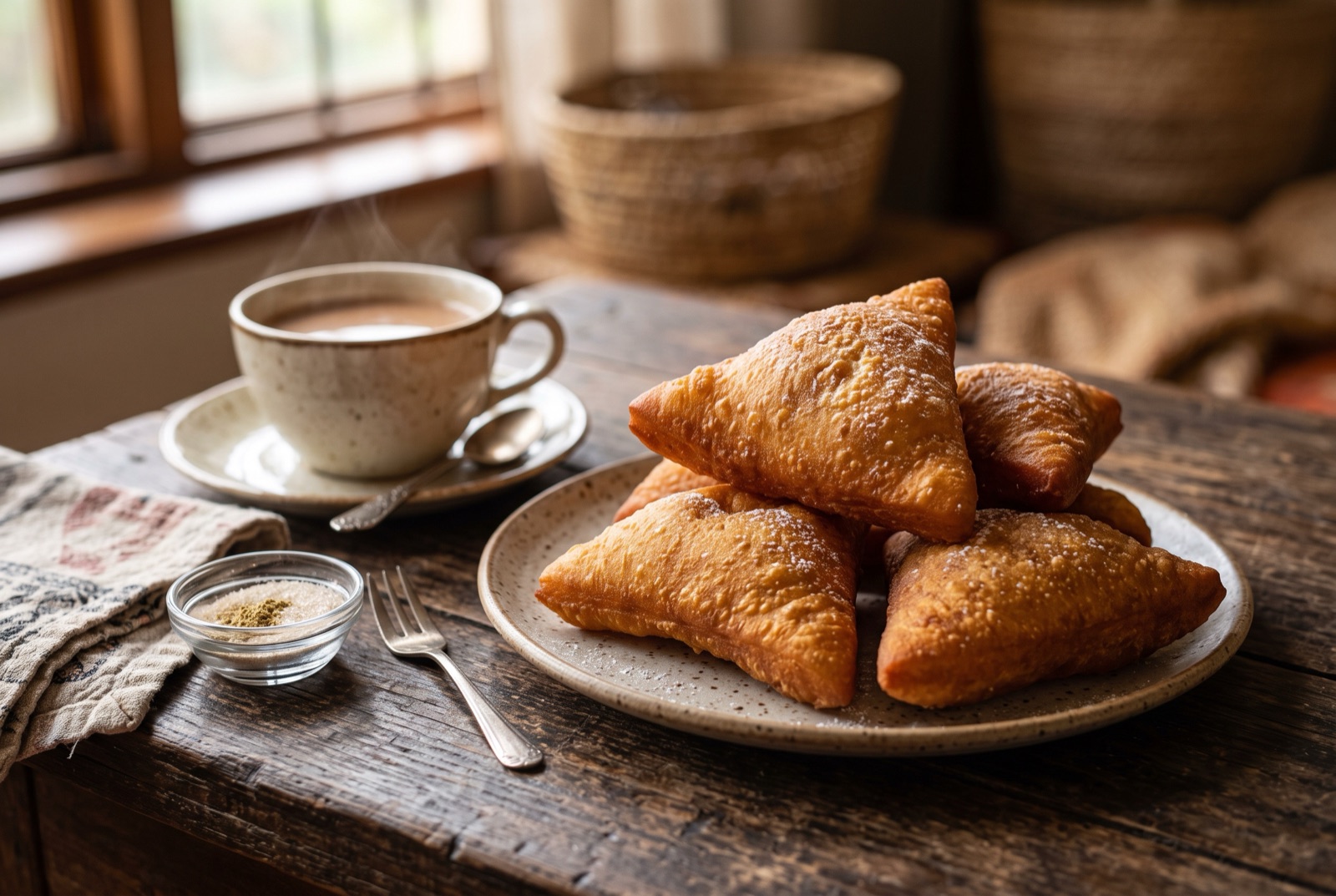
Mandazi are triangular fried breads made from a soft dough enriched with coconut milk and perfumed with ground cardamom, and they sit somewhere between a doughnut and a bread roll. They are only lightly sweet, which is the point: the sugar is there to support the cardamom rather than to make a dessert, so they work equally well with sweet milky tea or alongside a savoury bean stew. A properly made one puffs in the oil and comes out with a hollow centre, a thin crisp shell and a soft, faintly chewy crumb. They are best within an hour of frying, which is why Kenyan cooks make them in the afternoon and nobody has to be persuaded to eat them.

- Gate
- Kenya
- Prep
- 25 min
- Cook
- 20 min
- Total time
- 2 hr 15 min incl. 1 hr 30 min rest
- Serves
- 16
- Status
- Easy
- Nutrition / serving · estimated
- Calories 195 kcal
- Protein 4 g
- Carbs 30 g
- Fat 7 g
- Fiber 1 g
- Sugar 6 g
- Sodium 85 mg
Why this recipe works.
- Uses coconut milk and cardamom in the coastal proportions rather than the plainer upcountry shortcut.
- A yeasted dough with a proper rise, which is what makes the middle hollow instead of dense.
- Gives the oil temperature by a visible test as well as a number, since frying is where most batches fail.
- Includes the faster baking powder route honestly, and says what you give up by taking it.
Ingredients.
9 itemsEquipment
- Mixing bowl
- Rolling pin
- Deep heavy pan or wok
- Cooking thermometer
- Slotted spoon and cooling rack
Instructions.
Make the dough
Whisk the flour, yeast, sugar, cardamom and salt together, then pour in the warm coconut milk, the egg and 2 tablespoons of oil. Bring it together and knead for 8 minutes until smooth, soft and just tacky to the touch.
Tip The dough should feel softer than bread dough. If it tightens up, wet your hands rather than adding flour.
Prove until doubled
Cover the bowl and leave somewhere warm for 60 to 90 minutes, until the dough has doubled and a finger pressed into it leaves a dent that fills back only slowly. This rise is what creates the hollow centre later.
Roll and cut triangles
Knock the dough back and divide it into four. Roll each piece into a round about 8 mm thick, then cut it across twice to make four triangles, giving sixteen in total. Lay them on a floured tray with space between.
Rest the shapes
Cover the triangles loosely and let them sit for 20 minutes. They should look slightly swollen and feel airy when lifted — cold, tight dough goes into the oil and stays flat.
Heat the oil
Heat the frying oil in a deep pan to 170°C. Drop in a scrap of dough to check: it should sink, rise within about five seconds and be ringed with small steady bubbles rather than fierce spitting.
Fry in batches
Slide in three or four triangles at a time and spoon hot oil over their tops for the first few seconds. Fry for about 90 seconds a side, turning once, until they balloon and turn deep gold with a paler band around the middle.
Tip That pale band is the mark of a mandazi that rose properly in the oil.
Drain and serve warm
Lift them out with a slotted spoon and drain on a rack so the undersides stay crisp. Let the oil come back up to temperature between batches, and serve the mandazi warm with hot chai.
Tips from our kitchen.
- Keep the dough soft and slightly tacky. A firm dough fries into something closer to a biscuit than a mandazi.
- Roll to about 8 mm — too thin and they crisp without puffing, too thick and the centre stays raw while the outside browns.
- Fry at 170°C. A scrap of dough should sink, then rise and start bubbling within about five seconds.
- Slide them into the oil away from you and spoon hot oil over the top for the first few seconds; it encourages them to puff and rise.
- Turn each one only once. Repeated flipping deflates the pocket that is forming inside.
- Drain on a rack rather than paper. Paper traps steam underneath and the bottom turns soggy within minutes.
Substitutions.
- Dried yeast → 2 tsp baking powder, with no rising time
- This is the everyday upcountry method and takes an hour and a half off the recipe. The texture is more cakey and less hollow, and the flavour is plainer.
- Coconut milk → Whole milk, or milk with 2 tbsp desiccated coconut steeped in it
- Perfectly good and closer to inland mandazi, but the coconut is what makes these taste coastal.
- Ground cardamom → Crush 8 green cardamom pods and sieve out the husks
- Freshly crushed is far more aromatic than pre-ground powder, which fades fast in the jar.
Variations.
- Mahamri
- The coastal name for the yeasted coconut version, usually made richer and served with mbaazi, pigeon peas in coconut sauce, for breakfast.
- Plain upcountry mandazi
- Made with milk, sugar and baking powder and no cardamom. Faster, drier and the version most likely to be sold at an inland bus stop.
- Spiced mandazi
- Cardamom joined by a little cinnamon and grated nutmeg, sometimes with lemon or orange zest worked into the dough.
Storage & reheating.
Mandazi are at their best within an hour or two of frying and stay acceptable in an airtight container for 2 days, though they lose their crispness on the first evening. Refresh them in a 160°C oven for 5 minutes to bring back some of the shell; microwaving softens them but makes them tough as they cool. They freeze well for a month once cooled fully — reheat from frozen in a moderate oven for about 10 minutes. Raw shaped triangles can also be refrigerated overnight after their rise and fried in the morning straight from cold.
Serve with
Milky spiced chai, or a bowl of pigeon peas in coconut sauce for a coastal breakfast.
The story behind Mandazi.
Mandazi belong to the Swahili coast, and their coconut and cardamom character makes that origin obvious the moment you smell the dough. On the coast the yeast-raised version, richer and made with thick coconut milk, is usually called mahamri or mamri, and it is a Mombasa and Lamu breakfast staple served with a bowl of viazi vya nazi — potatoes in coconut sauce — or with mbaazi, pigeon peas cooked in coconut. That pairing of something fried and slightly sweet with a savoury coconut dish is completely normal there and slightly surprising to everyone else.
As the word travelled inland the recipe simplified. Upcountry mandazi are commonly made with milk or water and baking powder instead of coconut milk and yeast, sometimes without cardamom at all, and they are drier and plainer. Both are called mandazi in ordinary speech, and asking a Kenyan which is the real one usually produces a regional answer rather than a definitive one. The version here keeps the coastal ingredients because that is where the flavour is.
What is uniform across the country is the role. Mandazi are the default thing to make when guests arrive, the standard companion to chai at ten in the morning and again in the evening, the item stacked in glass cases at bus stations, and one of the cheapest hot foods available anywhere. Street sellers cut them into triangles because it is the fastest shape to get from a round of dough with no offcuts — divide the circle into quarters and every piece is the same size. The shape has become so standard that a round mandazi looks wrong to most Kenyans, whatever it tastes like.
Questions, answered.
Why are my mandazi flat and greasy?
The oil was too cool. Below about 160°C the dough absorbs fat before the surface sets, so it soaks rather than puffs. Test with a scrap: it should sink briefly, surface within five seconds and be surrounded by steady small bubbles. Frying too many at once also drops the temperature, so work in small batches and let the oil recover between them.
Why did they not puff hollow in the middle?
Usually underproved dough or dough rolled too thick. The yeast needs a full rise to generate the gas that inflates the pocket, and a piece thicker than about a centimetre cannot expand fast enough before the crust sets. Spooning hot oil over the top as each one goes in also helps them lift.
What is the difference between mandazi and mahamri?
Mahamri is the coastal Swahili version: yeast-raised, made with coconut milk and cardamom, and generally richer. Mandazi is the broader Kenyan term, and inland it usually means a simpler dough leavened with baking powder and made with milk or water. In everyday speech the words overlap, and many people use mandazi for both.
How sweet are they supposed to be?
Only mildly. Kenyan mandazi carry roughly a fifth of the sugar of a glazed doughnut, because they are eaten with sweet tea and sometimes with savoury coconut stews. If you want them sweeter, dust the hot mandazi with sugar rather than adding more to the dough, which affects both the rise and how quickly they brown.
Can I bake them instead of frying?
You can bake the same dough at 190°C for about 15 minutes and get a pleasant sweet roll, but it will not be a mandazi. The hollow centre and thin crisp shell both come from hot oil hitting the surface all at once, and no oven reproduces that. Air fryers give a slightly closer result than a conventional oven but still leave the crumb dense.
You might also like.
All recipes →
Keep exploring Kenya.
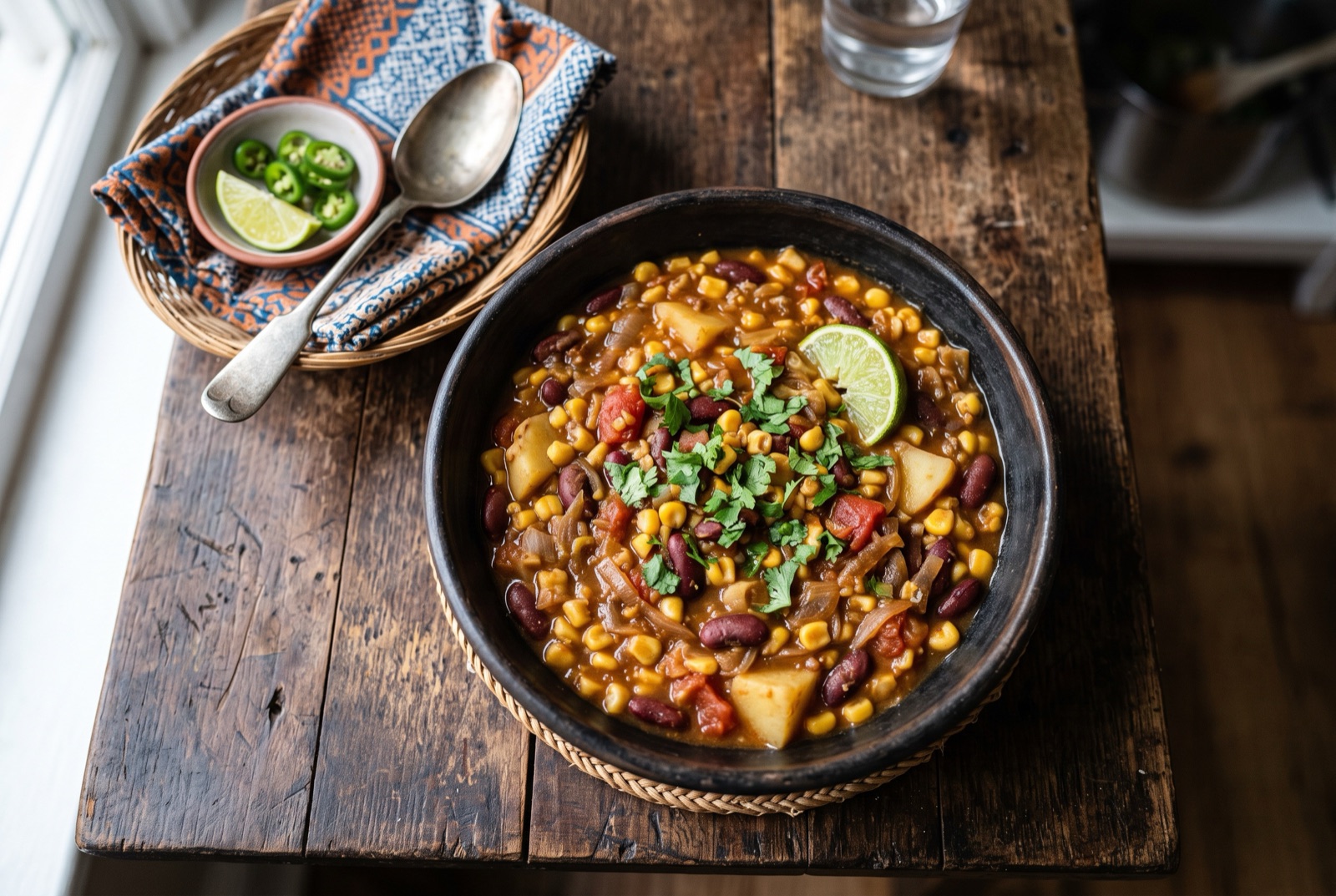
Kenya has 9 more dishes in the atlas — Githeri and Kenyan Chapati, and 7 more.
Recipe by The DishRoute Kitchen · published August 20, 2026 · updated August 20, 2026