Kiluvõileib.
Spiced Sprat Sandwich on Black Bread
Kiluvõileib · say it: KEE-loo-VUR-layb
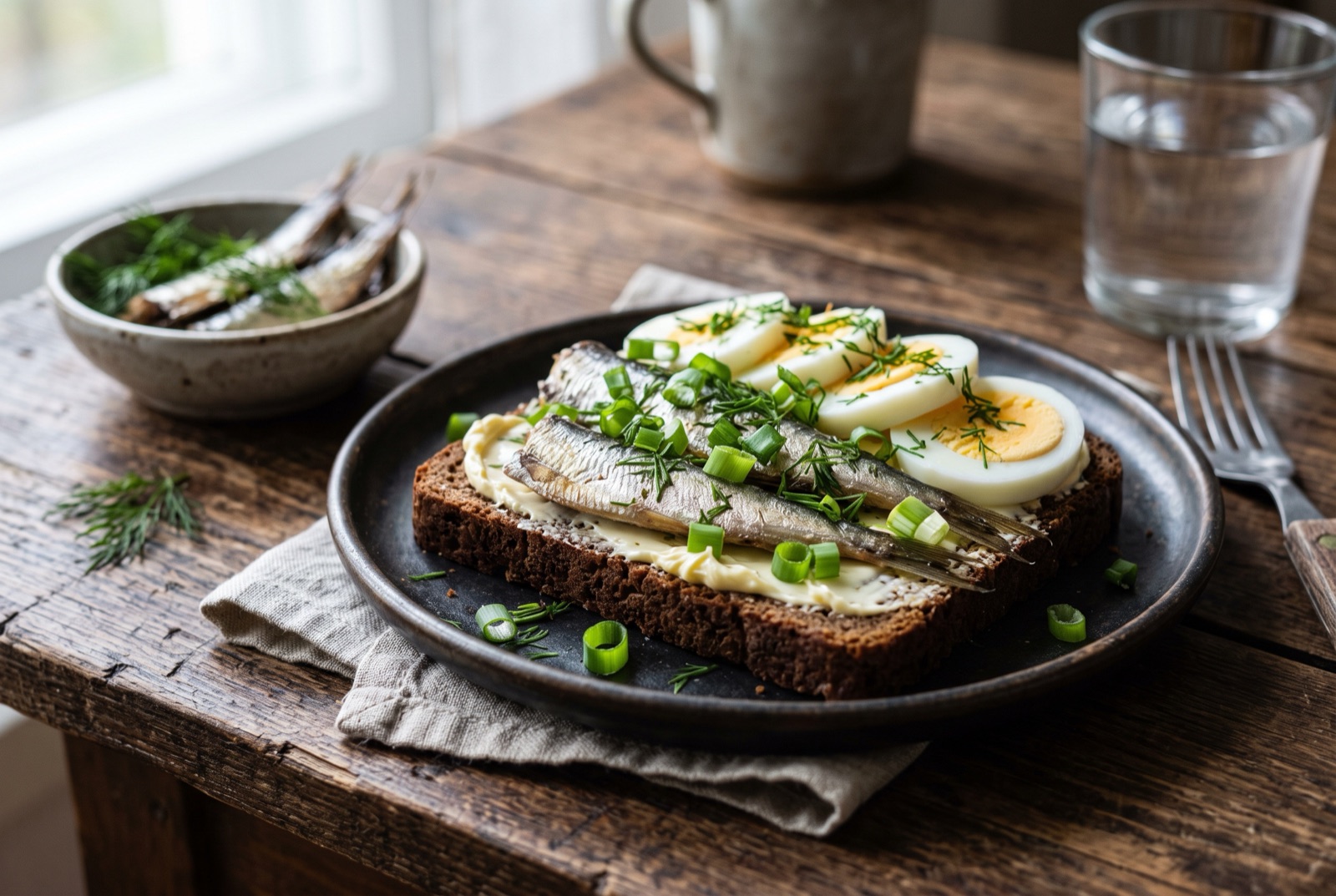
Kiluvõileib is an open sandwich of spice-cured Baltic sprats on buttered black rye bread, and it is the single most recognisable snack in Estonia. The sprats — kilu — are cured with salt, sugar, allspice, cloves and other warm spices rather than smoked, so they taste sweet, salty and faintly of gingerbread spice all at once. Against dense sour rye and a thick layer of cold butter, that combination works far better than the description suggests. Slices of hard-boiled egg and a scatter of spring onion or dill finish it. No cooking is involved beyond boiling an egg, and the whole thing takes five minutes.

- Gate
- Estonia
- Prep
- 10 min
- Cook
- 8 min
- Total time
- 18 min
- Serves
- 4
- Status
- Easy
- Nutrition / serving · estimated
- Calories 340 kcal
- Protein 17 g
- Carbs 28 g
- Fat 18 g
- Fiber 4 g
- Sodium 1250 mg
Why this recipe works.
- Gets the proportions right: thick cold butter, dense rye, and only two or three sprats per slice so the fish does not overwhelm.
- Explains what spiced sprat actually is, so you buy the right tin instead of ordinary smoked or brined fish.
- Assembled to order rather than in advance, which is the only way the bread stays firm under the oil.
- Five minutes from cupboard to plate, with a hard-boiled egg as the only thing that needs a pan.
Ingredients.
8 itemsFor the sandwiches
To finish
Equipment
- Small saucepan for the eggs
- Bread knife
- Fork
Instructions.
Boil and cool the eggs
Lower the eggs into boiling water and cook for exactly 8 minutes, then plunge them into cold water for 5 minutes. The whites should be firm and the yolks set but still bright yellow rather than chalky grey at the edge.
Butter the bread thickly
Cut the rye into thin slices, no more than a centimetre, and spread each one with a generous layer of cold butter right to the edges. This layer is structural as much as it is flavour, so do not go thin.
Tip Butter straight from the fridge, softened for a minute at the edge of the pack, spreads best on dense rye.
Drain the sprats
Lift the spiced sprats out of the tin with a fork and rest them on a plate for a few seconds so the excess curing oil runs off. Keep the fillets whole — they are fragile and should sit on the bread intact.
Assemble
Lay two or three sprats diagonally across each buttered slice, add a couple of egg slices and a slice of pickled cucumber if using, and press everything down very lightly so it holds together when picked up.
Finish and eat immediately
Scatter with spring onion, dill and a grind of black pepper, and serve at once while the bread is still firm underneath. Do not add salt — the sprats carry all the sandwich needs.
Tips from our kitchen.
- Use cold butter and spread it thick — a proper Estonian layer, not a scrape. It seals the bread against the sprat oil and keeps the base firm.
- Lift the sprats out of the tin with a fork and let the excess oil drain off for a few seconds, or the sandwich turns greasy rather than rich.
- Cut the bread thin, no more than a centimetre. Dense rye is heavy, and thick slices make the sandwich a chore to eat.
- Boil the eggs for eight minutes for a set but still bright yolk, then cool them in cold water so they slice cleanly without crumbling.
- Assemble at the last possible moment. Even ten minutes standing will start to soften the surface of the bread.
- A very thin smear of mustard or a spoonful of sour cream under the fish is common in Estonian households and sharpens the whole thing.
Substitutions.
- Estonian spiced sprats (kilu) → Tinned anchovies in oil, or Swedish ansjovis (which are actually spiced sprats)
- Swedish ansjovis are the closest thing available internationally — same fish, similar spice cure. Anchovies are saltier and less sweet, so use fewer.
- Estonian black rye bread → German Vollkornbrot, Danish rugbrød, or Latvian rupjmaize
- Any dense, dark, slightly sour rye works. Avoid light wheat bread, which goes soggy immediately and tastes wrong under the fish.
- Hard-boiled egg → Sliced pickled cucumber, or a spoonful of curd cheese
- Both are used in Estonia. Cucumber adds crunch and acid; curd adds creaminess without the richness of more butter.
Variations.
- Kilu with curd cheese
- Spread the rye with fresh curd or quark instead of butter, then add the sprats. Lighter and tangier, and popular as a breakfast version.
- Kilu and beetroot
- Add a layer of finely grated cooked beetroot under the fish. Sweet and earthy against the salt, and the colour makes it a party version.
- Warm kilu toast
- Toast the rye and melt a slice of cheese onto it before adding the sprats. Not classical, but a common winter snack in Estonian homes.
Storage & reheating.
Do not store assembled sandwiches; they are made and eaten within minutes, and the bread softens quickly under the fish oil. An opened tin of spiced sprats keeps 3 days refrigerated if transferred to a small glass jar with its oil poured over to cover — never leave them in an opened tin. Hard-boiled eggs keep 4 days unpeeled in the fridge, and the bread keeps close to a week wrapped in a cloth at room temperature, since dense rye stales far more slowly than wheat.
Serve with
A cold glass of kefir or buttermilk, or a shot of something stronger at a celebration. A plate of other open sandwiches — cured ham, egg and curd — as part of an Estonian buffet.
The story behind Kiluvõileib.
Kilu is the Baltic sprat, a small oily fish caught in enormous quantities along the Estonian coast, and the spice cure applied to it is a genuinely local tradition rather than an import. The method — salting the fish with a blend that typically includes allspice, cloves, coriander, black pepper, ginger and sometimes cinnamon or nutmeg — produces something quite unlike Scandinavian pickled herring or smoked sprat. It is closer in aroma to spiced cake than to fish preserve, and the resulting little fillets are dark, glossy and intensely savoury.
The sandwich itself is bound up with Estonian identity in a way few snacks manage. Kilu tins are a standard souvenir, spiced sprats appear on the buffet at every reception, and for decades the sandwich has been the thing Estonians hand a visitor with a glass of something cold. It also carries a Soviet-era memory: tinned kilu was one of the reliably available proteins in that period, and the sandwich was cheap, filling and everywhere. Estonians remember it fondly rather than resentfully, which says something about how good the fish actually is.
The bread matters as much as the fish. Estonian leib is a dark, dense, slightly sweet-sour rye sourdough with a tight crumb, and it does two jobs here: it stands up to the oily fish without going soggy, and its own sourness balances the sweetness in the cure. A light wheat sandwich loaf collapses under the same topping and tastes wrong besides. If you cannot find Estonian leib, any dense northern European rye — German Vollkornbrot, Latvian rupjmaize, Danish rugbrød — does the job. The butter is not optional either. It goes on cold and thick, and it acts as a barrier between the bread and the oil as much as it does a flavour.
Questions, answered.
What exactly are Estonian spiced sprats?
Kilu are Baltic sprats cured in salt and sugar with a warm spice blend that usually includes allspice, cloves, black pepper, coriander and ginger. They are not smoked and not pickled in vinegar. The result is a dark, soft, glossy fillet that tastes sweet-salty with a distinct baking-spice aroma, sold in flat tins across Estonia and the wider Baltic.
What can I use if I cannot find kilu?
Swedish ansjovis are the best substitute — despite the name they are spiced sprats cured in a very similar way. Failing that, tinned anchovy fillets in oil work, but they are considerably saltier and lack the sweetness of the spice cure, so use fewer per slice and consider adding a pinch of sugar to the butter.
Does the bread have to be rye?
Effectively, yes. Dense dark rye provides the sourness that balances the sweet spiced cure and the structure to hold oily fish without collapsing. Light wheat bread goes soggy within minutes and the flavour balance falls apart. Any northern European dense rye — German, Danish, Latvian or Estonian — will do the job properly.
Can I make these ahead for a party?
Prepare the components ahead but assemble at the last minute. Slice and butter the bread up to an hour before and keep it covered, boil and slice the eggs in advance, and have the sprats drained and ready in a bowl. Putting the fish on the bread early guarantees a soft, oily base by the time guests arrive.
How many sprats go on one sandwich?
Two or three fillets on a slice roughly ten centimetres square. The fish is strongly flavoured and quite salty, and the point of the sandwich is the balance between bread, butter and fish rather than a fish pile. If it tastes overwhelmingly salty, you have used too many.
You might also like.
All recipes →
Keep exploring Estonia.
Estonia has 9 more dishes in the atlas — Hapukapsasupp and Kama, and 7 more.
All Estonia recipes Eggs recipes Butter recipes Scallions recipes snackappetizerbreakfastpescatarianRecipe by The DishRoute Kitchen · published August 20, 2026 · updated August 20, 2026