Kringel.
Estonian Braided Cardamom Sweet Bread
Kringel · say it: KRING-el
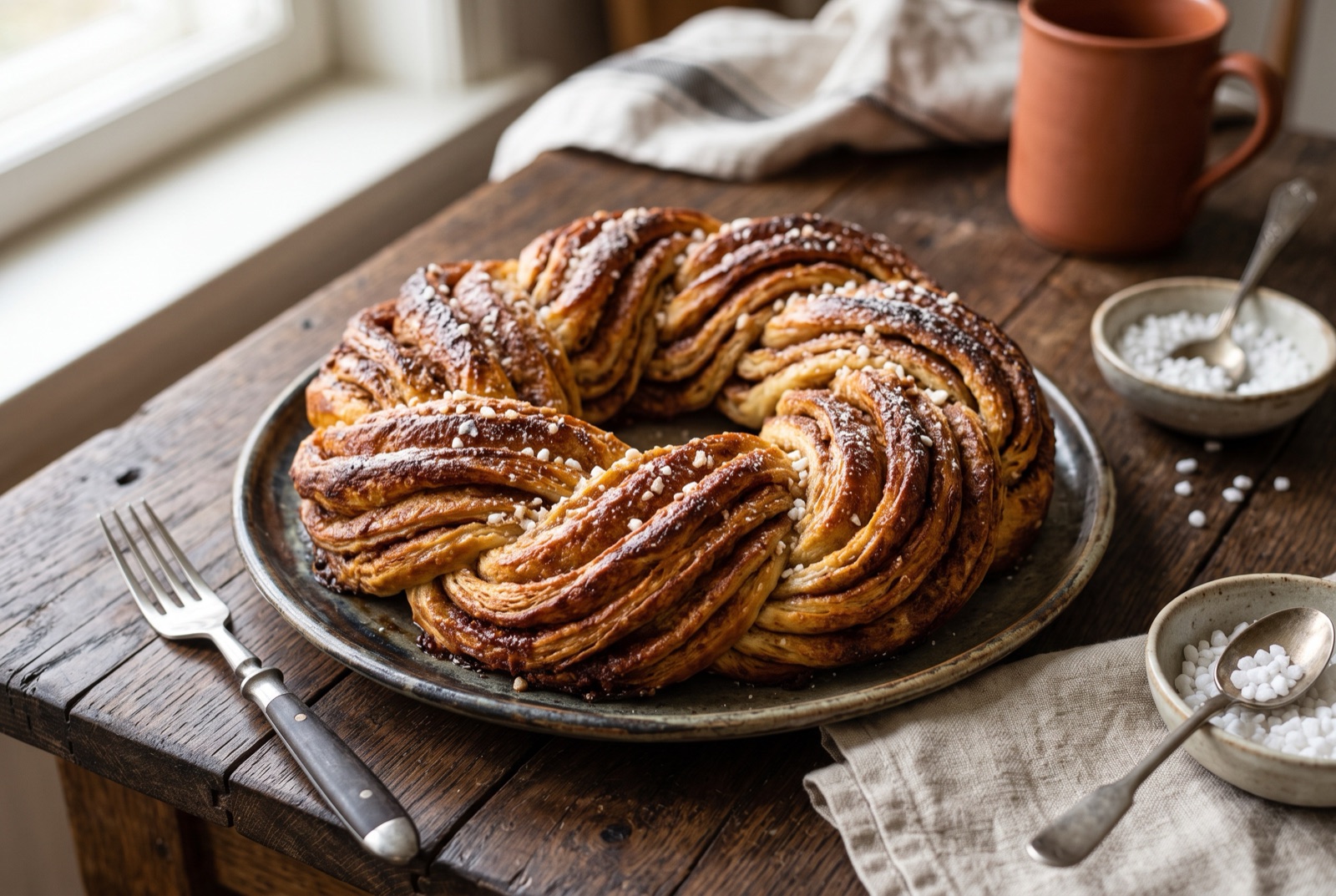
Kringel is a sweet yeasted wreath with its insides deliberately turned out: the filled dough log is cut in half along its length, then twisted cut-side up so the spiral of butter, sugar, cinnamon and cardamom is exposed all the way round. Baked, those cut edges caramelise into sticky, slightly crisp ridges while the crumb underneath stays soft and pull-apart tender. It is an Estonian coffee-table staple, made for birthdays and Sunday afternoons, and while it looks like advanced bakery work, the braid is a single simple move done twice. Cardamom is what makes it taste Baltic rather than generically cinnamon.

- Gate
- Estonia
- Prep
- 35 min
- Cook
- 30 min
- Total time
- 2 hr 50 min incl. 1 hr 45 min rest
- Serves
- 10
- Status
- Medium
- Nutrition / serving · estimated
- Calories 380 kcal
- Protein 7 g
- Carbs 53 g
- Fat 15 g
- Fiber 2 g
- Sugar 20 g
Why this recipe works.
- Chills the filled log before cutting, the single step that stops the twist collapsing into a buttery mess.
- Cardamom ground fresh from pods, which tastes nothing like the dusty pre-ground jar and is the whole point of the bread.
- A dough enriched enough to stay soft for two days without turning to cake.
- Written so the braid is described by what you see, not by a diagram you do not have.
Ingredients.
15 itemsFor the dough
For the filling
To glaze
Equipment
- Stand mixer with a dough hook, or a bowl and hands
- Rolling pin
- Sharp knife
- Large baking sheet
- Baking paper
Instructions.
Start the dough
Crumble the fresh yeast into the warm milk with a spoonful of the sugar and leave it 10 minutes, until the surface is foaming and smells clearly of bread. Add the flour, remaining sugar, egg, ground cardamom and salt and mix to a shaggy mass.
Tip The milk should feel neutral on your wrist. If it feels warm, wait — hot milk kills yeast outright.
Knead in the butter
Knead for 5 minutes, then add the softened butter a piece at a time and keep kneading for another 8–10 minutes. The dough is ready when it pulls cleanly away from the bowl, feels smooth and elastic, and stops sticking to your fingers.
First rise
Cover the bowl and leave the dough somewhere warm for about 75 minutes, until it has doubled and a finger pressed into it leaves a dent that fills back only slowly.
Roll and fill
Roll the dough on a floured surface into a rectangle roughly 50 by 35 cm. Spread the very soft butter right to the edges, then scatter the brown sugar, cinnamon, cardamom and the raisins if using evenly across the whole surface.
Tip Soft butter, not melted — melted butter soaks into the dough and runs out during baking.
Roll up and chill
Roll the rectangle up tightly from the long side into a firm log, pinching the seam closed. Lay it on baking paper and refrigerate for 15 minutes so the butter firms up before cutting.
Cut and twist
Slice the chilled log in half along its whole length with one confident stroke. Turn both halves cut side up, cross them over each other four or five times keeping the cut faces upward throughout, then bring the ends together into a ring and tuck them under.
Tip Twist directly on the baking paper — the wreath is too fragile to move once shaped.
Prove and glaze
Slide the paper onto a baking sheet, cover loosely and prove for 30 minutes, until the wreath looks visibly puffed and the strands have relaxed into each other. Brush the exposed dough with the egg wash and scatter over pearl sugar if using.
Bake to deep amber
Bake at 190°C for 28–32 minutes, until the cut edges are dark amber and sticky, the crust is glossy brown and the base sounds hollow when tapped. Cool on the tray for 10 minutes before moving it, then serve warm and let people tear pieces off.
Tips from our kitchen.
- Warm the milk to just above body temperature, no hotter. Anything approaching hot kills the yeast and the dough will never rise properly.
- Crush cardamom pods and grind the black seeds yourself. Pre-ground cardamom loses most of its aroma within weeks of milling.
- Chill the rolled log for 15 minutes before cutting it. Cold butter in the filling holds the layers together while you twist.
- Cut the log with a sharp knife in one confident pass rather than sawing, which drags the layers and smears the filling.
- Bake until the exposed sugar edges are properly dark amber. Pulled early, the cut faces stay pale and the caramel crunch never develops.
- Brush the hot wreath with a little melted butter as it comes out for a glossy finish and a softer crust.
Substitutions.
- Fresh cardamom pods → Ground cardamom, using half again as much
- Pre-ground loses aroma fast, so buy the smallest jar and use it generously. Still worth making with, just less fragrant.
- Whole milk → Oat or soy milk, plus an extra tablespoon of butter or oil
- Plant milks give a slightly less tender crumb, so the extra fat compensates. The dough behaves identically.
- Fresh yeast → 7 g instant dried yeast, mixed straight into the flour
- Instant yeast needs no proofing step. If using active dried yeast instead, wake it in the warm milk for 10 minutes first.
Variations.
- Raisin kringel
- Scatter raisins soaked in warm water or rum over the filling before rolling. The most common Estonian bakery version and a birthday standard.
- Almond kringel
- Spread a layer of almond paste under the cinnamon butter and press flaked almonds onto the glazed wreath before baking. Richer and closer to a festive cake.
- Savoury kringel
- Replace the sweet filling with garlic butter, herbs and grated cheese for the savoury version served at Estonian parties alongside drinks.
Storage & reheating.
Best on the day it is baked, and good for two days after, wrapped in a cloth or a paper bag at room temperature — never a sealed plastic box, which softens the caramelised edges to stickiness. Refresh a day-old kringel in a 160°C oven for 5 minutes to bring the crust back. It freezes well for 2 months either baked and cooled or as the shaped raw wreath; bake the frozen raw version straight from the freezer with 10 minutes added to the time.
Serve with
Strong black coffee, which is the only accompaniment most Estonians consider necessary. Fresh berries and whipped cream if the kringel is standing in for a birthday cake.
The story behind Kringel.
The kringel arrived in Estonia through the same route as much of its baking: the Baltic-German and wider Hanseatic pastry tradition that shaped urban Northern European kitchens for centuries. The word itself is cousin to the Danish kringle and the German Kringel, both originally meaning a knotted or ring-shaped baked good, and versions of the twisted sweet wreath appear across Scandinavia, the Baltics and northern Germany. Estonia adopted it thoroughly enough that it now reads as an Estonian cake rather than a borrowed one.
What is specifically Estonian is the occasion. Kringel is birthday food — often carried to the table with candles in it in place of a layer cake — and coffee-table food, sitting alongside the pot at afternoon gatherings where guests tear pieces off with their hands. Bakeries sell it plain, with raisins, or in a heavily filled version dense with almonds and candied peel, and the recipe passes between households in the way birthday cake recipes do everywhere: with a firm opinion attached about how much cardamom is correct.
The cut-and-twist technique is worth understanding rather than just following. Rolling a filled log and cutting it lengthwise exposes every layer of butter and sugar; twisting the two halves around each other keeps those layers facing up and outward, so during baking the sugar in the exposed spiral melts and caramelises directly against the oven heat instead of steaming inside the crumb. The result is a bread with two textures in every piece. The same trick is used in Nordic kanelsnurror and Balkan sweet breads, and once you have done it once, no written instruction is needed again. The only genuine difficulty is that the cut log is slippery and filling escapes; chilling the rolled log for fifteen minutes before cutting solves almost all of it.
Questions, answered.
Why do you cut the dough log in half lengthwise?
To expose the spiral of butter, sugar and spice. When the two cut halves are twisted together with the cut faces upward, that filling bakes in direct contact with the oven heat and caramelises into sticky ridges, instead of steaming invisibly inside the crumb. It is what gives kringel its two textures and its distinctive layered look.
My twist fell apart when I lifted it. What went wrong?
Almost certainly the log was too warm when you cut it. Soft butter in the filling turns the layers slippery and the strands unravel. Chill the rolled log for 15 minutes in the fridge before cutting, twist it on the baking paper you will bake it on, and slide the whole sheet onto the tray rather than lifting the wreath by hand.
Can I make kringel dough the night before?
Yes, and it improves the flavour. After kneading, cover the dough and refrigerate it overnight — the slow cold rise develops more depth than a quick warm one. Let it sit at room temperature for about 45 minutes the next morning before rolling, since cold dough resists stretching and tears.
How much cardamom is right?
Estonians disagree, but a teaspoon of freshly ground seeds for a single wreath gives a clearly perfumed bread without overwhelming the cinnamon. If you are using pre-ground cardamom from a jar that has been open a while, use half again as much, because the volatile aroma compounds fade quickly after grinding.
How do I know when the kringel is baked through?
The exposed cut edges should be deep amber and visibly caramelised, the surface a shiny golden brown, and the underside firm when you lift a corner. If you want certainty, the centre of the thickest strand should read about 90°C. A pale kringel is underbaked and will taste doughy in the middle even if the outside looks set.
You might also like.
All recipes →
Keep exploring Estonia.
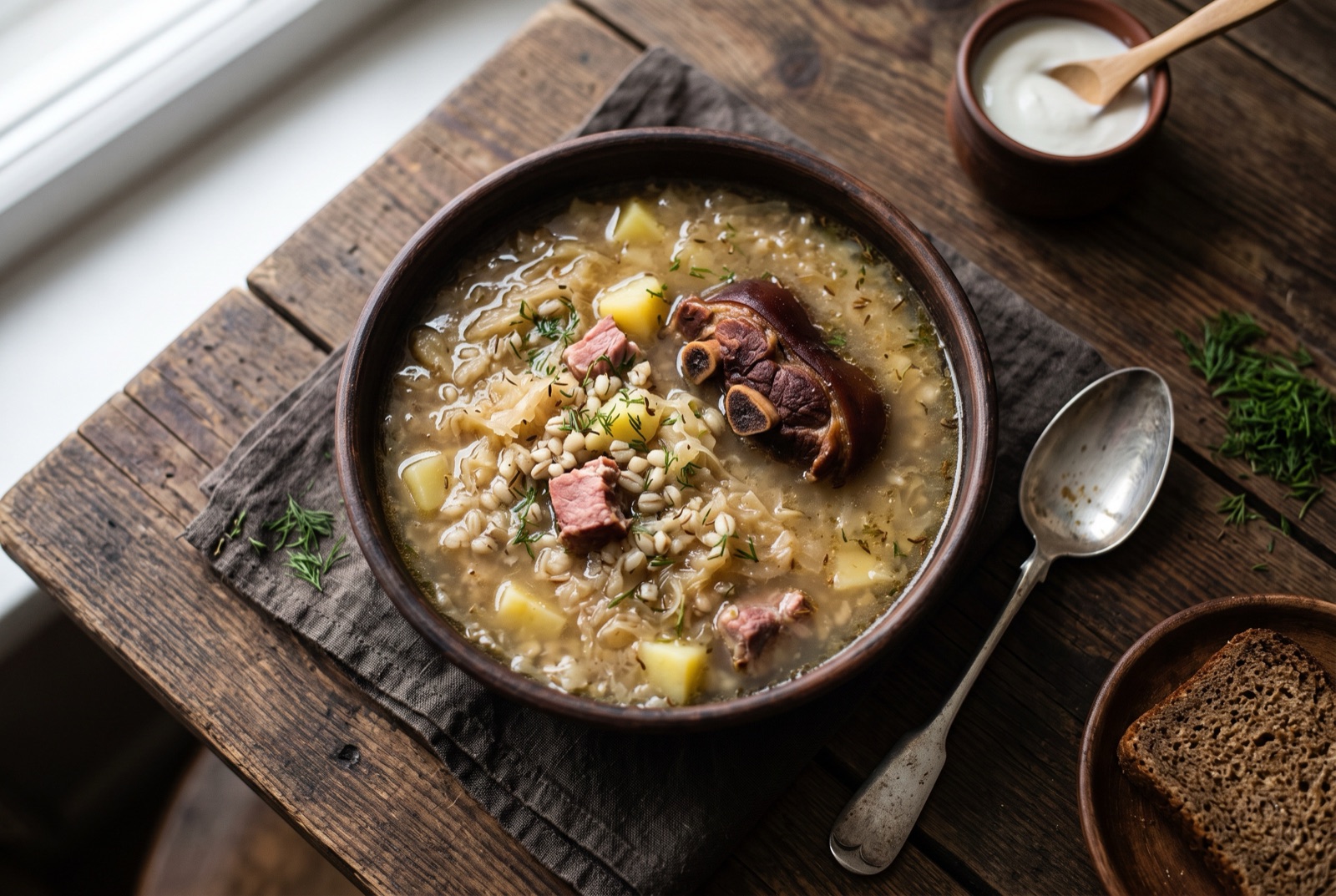
Estonia has 9 more dishes in the atlas — Hapukapsasupp and Kama, and 7 more.
Recipe by The DishRoute Kitchen · published August 20, 2026 · updated August 20, 2026