Leivasupp.
Sweet Estonian Rye Bread Soup
Leivasupp · say it: LAY-vah-soop
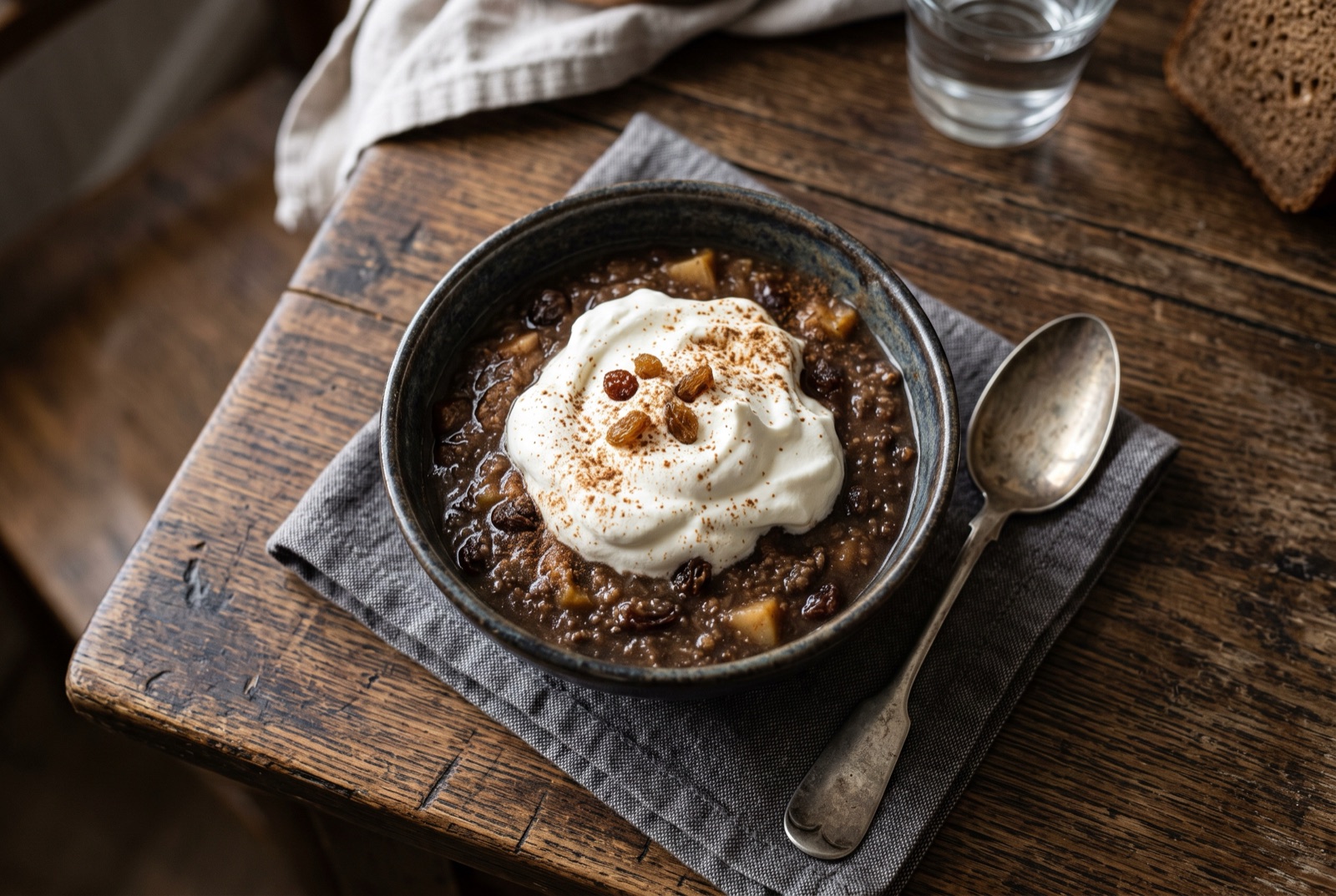
Leivasupp is a dessert made from stale bread, and it is far better than that sentence suggests. Dark rye is soaked, then simmered with apple, raisins, sugar and cinnamon until it collapses into a thick, glossy, near-black purée somewhere between a soup and a pudding. Chilled, it firms up enough to hold the shape of a spoon. The taste is deep and malty from the rye, sweet-sour from the apple, warmly spiced, and it wants a large spoonful of cold whipped cream on top to cut it. Estonians eat it as a dessert or a cold summer lunch, and every household has a jar of dried bread ends waiting for it.

- Gate
- Estonia
- Prep
- 15 min
- Cook
- 30 min
- Total time
- 4 hr 45 min incl. 4 hr rest
- Serves
- 6
- Status
- Easy
- Nutrition / serving · estimated
- Calories 400 kcal
- Protein 6 g
- Carbs 63 g
- Fat 14 g
- Fiber 6 g
- Sugar 38 g
Why this recipe works.
- Soaks the bread properly before cooking, so it breaks down completely instead of leaving chewy lumps in the purée.
- Balances the sweetness with grated apple and a squeeze of lemon rather than sugar alone.
- Chilled by design — the texture is loose and unimpressive hot, and sets into something far better cold.
- Turns a bag of stale rye ends into a dessert for six at almost no cost.
Ingredients.
11 itemsFor the soup
To serve
Equipment
- Large bowl for soaking
- Heavy saucepan
- Box grater
- Stick blender (optional)
Instructions.
Soak the bread
Put the torn rye in a large bowl, pour the hot water over and leave it for at least 30 minutes, pressing it down occasionally. The bread should end up completely saturated and falling apart when squeezed between your fingers.
Simmer with fruit and spice
Tip the bread and all its soaking liquid into a heavy pan with the grated apple, raisins, sugar, cinnamon, cloves, lemon zest strips and salt. Bring to a gentle simmer and cook for 25–30 minutes, stirring often as it thickens.
Tip Stir from the bottom regularly — this mixture catches and scorches easily once it starts to thicken.
Check the consistency
The soup is ready when it is dark, glossy and thick enough that a spoon dragged across the base leaves a trail that closes slowly. If it is still watery, cook it a few minutes longer uncovered; if too stiff, loosen with hot water.
Smooth it, if you like
Fish out the cloves and lemon zest, then blitz briefly with a stick blender or push through a sieve for a silky purée. Leave it as it is for the rustic version, which is equally traditional.
Balance and chill
Stir in lemon juice to taste and check the sugar — it should be clearly sweet with a sour edge behind it. Cool to room temperature, then refrigerate at least 4 hours until cold and set to a soft pudding thickness.
Serve cold with cream
Spoon the chilled soup into bowls or glasses, top each with a generous mound of softly whipped cream and scatter over toasted rye crumbs if using. Serve straight away, while the cream is still cold and holding.
Tips from our kitchen.
- Use genuinely dark, sour rye bread. Pale wheat bread gives a flat beige purée with none of the malty depth that makes this worth eating.
- Soak the bread in hot water for at least half an hour before cooking. Dry crusts thrown straight into the pan never fully dissolve.
- Grate rather than dice the apple so it melts into the purée and thickens it, instead of leaving cooked fruit chunks.
- Push the finished soup through a sieve or blitz it briefly if you want the smooth restaurant texture. Rustic and lumpy is equally traditional.
- Taste for acidity before chilling. Cold food reads as less sweet and less sour, so a squeeze of lemon at the end keeps it from turning cloying.
- Whip the cream to soft peaks only, so it collapses into the soup as it is eaten rather than sitting on top like a hat.
Substitutions.
- Stale black rye bread → Danish rugbrød, German pumpernickel, or Latvian rupjmaize
- Any dense dark sourdough rye works. Pumpernickel is sweeter and darker, so cut the sugar by about a third.
- Raisins → Chopped dried prunes, dried apricots, or dried cranberries
- Prunes give a darker, deeper result; cranberries add tartness and reduce the need for lemon.
- Whipped cream → Sour cream, thick yogurt, or vanilla ice cream
- Sour cream is the more traditional Estonian topping and its acidity balances the sugar better than sweetened cream.
Variations.
- Berry leivasupp
- Replace half the apple with blackcurrants, redcurrants or lingonberries. Sharper and more purple, and the standard summer version in Estonian households.
- With kvass or dark beer
- Replace a third of the soaking water with kvass or dark beer for a maltier, more grown-up flavour with a faint bitterness behind the sweetness.
- Layered dessert glasses
- Spoon the chilled soup into glasses in layers with whipped cream and toasted rye crumbs. How modern Tallinn restaurants serve it.
Storage & reheating.
Refrigerate up to 4 days in a covered container; it thickens considerably as it sits and can be loosened with a splash of water or apple juice. The flavour is at its best on day two, once the cinnamon and rye have fully merged. It freezes for 2 months and thaws surprisingly well, since there is no dairy in the soup itself — stir it hard after thawing to bring the texture back together, and always add the cream fresh rather than freezing it on top.
Serve with
Cold whipped cream or a spoonful of thick sour cream stirred in at the table. Toasted rye breadcrumbs scattered on top for a little crunch against the smooth purée.
The story behind Leivasupp.
Bread soup exists wherever bread was too valuable to throw away, from Italian pappa al pomodoro to German Brotsuppe, and leivasupp is the Estonian answer to the same problem. What makes it distinct is that Estonian bread is rye — dense, dark, sour and faintly sweet — so the leftover-bread dish came out as a dessert rather than a savoury soup. The malty sweetness already in leib does most of the work; the cook adds fruit, sugar and spice and lets time and heat do the rest.
Because rye keeps for a week and only stales rather than moulding quickly, Estonian households traditionally accumulated the dried ends and crusts in a bag or tin, and leivasupp was made when enough had gathered. The dish therefore has no fixed recipe: it depends on how dark the bread was, how sour, and what fruit was to hand. Apples in autumn, dried fruit in winter, fresh berries in summer. Some households add a splash of dark beer or kvass, some a strip of lemon peel, some cloves alongside the cinnamon.
It survives today mostly as nostalgia food and school-canteen memory, but it has also been picked up by the modern Estonian restaurant scene, where it reappears in glasses with sour cream ice cream and toasted rye crumbs — a fair reflection of how good the flavour actually is when the bread is decent. The one thing that decides success is that bread. A pale wheat loaf produces a beige, insipid mush with none of the malt or sourness the dish depends on. Genuine dark rye sourdough, ideally stale enough to be hard, is not a preference here but a requirement, and it is worth going to a bakery for.
Questions, answered.
What kind of bread do I need for leivasupp?
Dense dark rye sourdough — Estonian leib, Latvian rupjmaize, Danish rugbrød or German Vollkornbrot all work. It should be genuinely stale, ideally hard. Light wheat bread is not a substitute: it lacks the malty sweetness and sourness the dish is built on and produces a pale, bland mush instead of a dark, glossy purée.
Is leivasupp served hot or cold?
Cold, almost always. Hot from the pan the texture is loose and the flavour muddy, but after several hours in the fridge it thickens into something close to a set pudding and the spices come forward. Estonians serve it chilled with whipped or sour cream, both as a dessert and as a light summer meal in its own right.
How sweet should it be?
Noticeably sweet but not sugary — the rye and apple should still be tasteable behind it. Start with less sugar than the recipe suggests, taste after the soup has cooked down, and remember that chilling mutes sweetness, so what tastes correctly balanced while hot will taste flat when cold. A squeeze of lemon at the end sharpens it back up.
Can I make leivasupp smooth?
Yes. Blitz the cooked soup briefly with a stick blender or push it through a sieve for a silky, uniform purée. A rustic texture with visible bits of bread and raisin is equally traditional, so it comes down to preference. Do not over-blend, which can make the starch in the rye turn gluey.
Can I use fresh bread instead of stale?
You can, but dry it out first. Cut fresh rye into cubes and bake at 150°C for about 20 minutes until hard and slightly toasted, which concentrates the flavour and stops the soup turning pasty. Fresh soft bread used straight away releases too much soluble starch and gives a gummy result.
You might also like.
All recipes →
Keep exploring Estonia.
Estonia has 9 more dishes in the atlas — Hapukapsasupp and Kama, and 7 more.
Recipe by The DishRoute Kitchen · published August 20, 2026 · updated August 20, 2026