Kitfo.
Ethiopian Minced Beef with Spiced Butter
ክትፎ · Kitfo · say it: KIT-foh
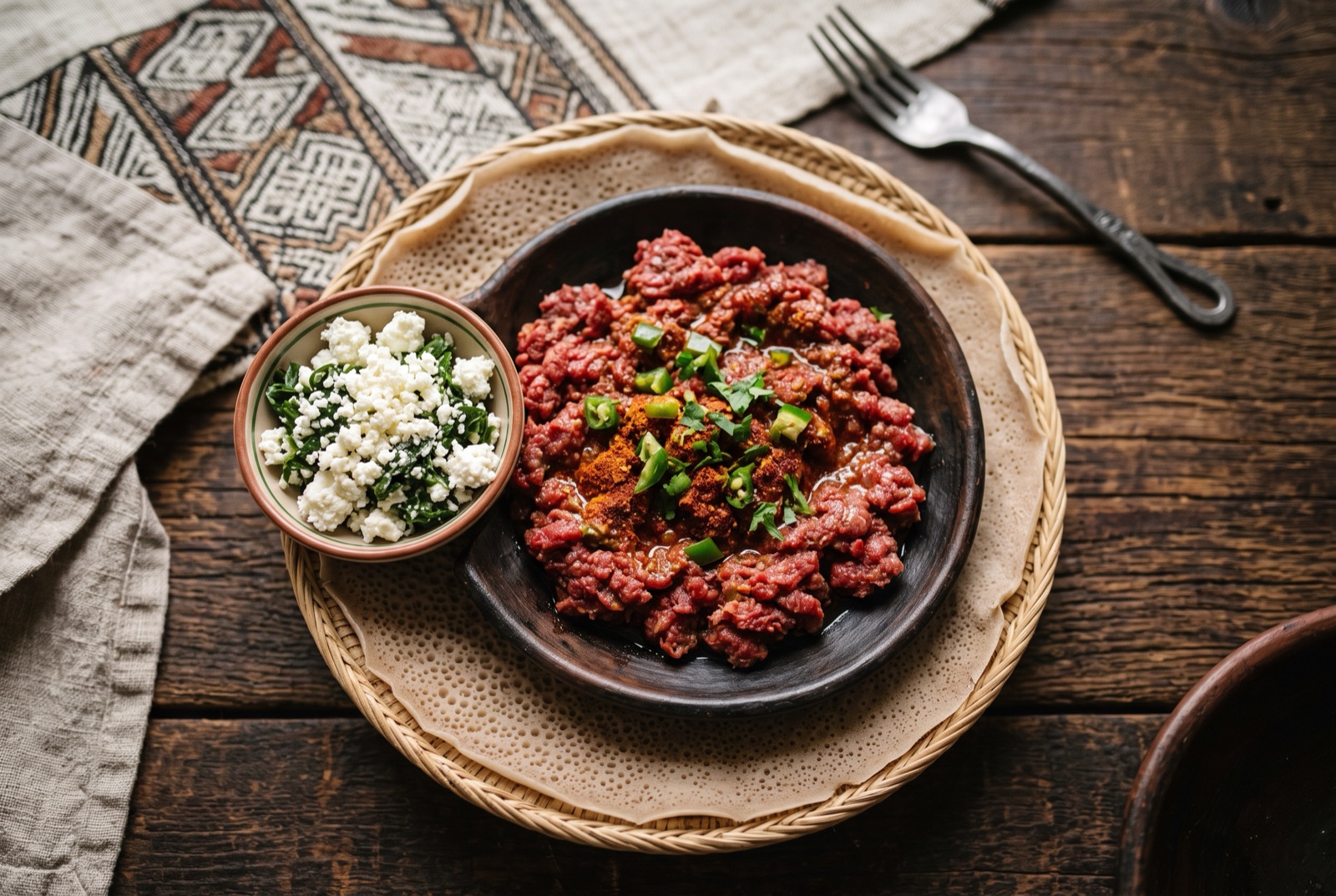
Kitfo is beef minced very fine with a knife and dressed — not cooked — in niter kibbeh and mitmita, the hot Ethiopian chilli blend built on bird's eye chilli, korarima and cloves. Warmed only to blood temperature, the meat stays deep red and silky, the butter coats every strand, and the chilli hits late and hard. It is rich in a way that needs the plain, cool things served next to it: crumbly fresh cheese, a mound of soft collard greens, and either injera or, in its home region, dense kocho bread. Ethiopians order it at three doneness levels, and the middle one — leb leb, barely warmed — is the one most people mean.

- Gate
- EthiopiaGurage
- Prep
- 35 min
- Cook
- 5 min
- Total time
- 40 min
- Serves
- 4
- Status
- Medium
- Nutrition / serving · estimated
- Calories 540 kcal
- Protein 41 g
- Carbs 6 g
- Fat 39 g
- Fiber 2 g
- Sodium 920 mg
Why this recipe works.
- Explains all three doneness levels and lets you choose one, rather than quietly cooking the dish and calling it kitfo.
- Hand-mincing technique spelled out, including why a food processor ruins the texture.
- Mitmita is given as a blend you can grind yourself, since it is far harder to buy than berbere.
- Straight about the food-safety side of raw beef instead of skipping past it.
Ingredients.
8 itemsFor the kitfo
To serve
Equipment
- Two heavy chef's knives
- Large chopping board reserved for raw meat
- Small saucepan
- Spice grinder or mortar
Instructions.
Firm and trim the beef
Put the beef on a plate in the freezer for 20 minutes until the surface is firm but not frozen. Trim away every trace of silverskin, sinew and fat — in a raw dish these read as unpleasant chew, and there is nothing to soften them.
Mince by hand
Cut the chilled beef into thin slices, then into narrow strips, then work over the pile with two heavy knives in an alternating rocking rhythm for 8–10 minutes. Stop when the meat looks like coarse mince with visible separate strands, not a smooth paste. Keep it cold and covered until you dress it.
Tip Scrape the pile back into the centre every minute or so — the outside dries out and stops getting cut.
Warm the spiced butter
Melt the niter kibbeh in a small pan over the lowest possible heat until it is just liquid and barely warm to a fingertip, around 40°C. Stir in the mitmita and ground cardamom and take it straight off the heat so the spices soften without frying.
Tip If the butter smokes or the chilli sizzles, let it cool right down and start again — hot fat will grey the meat on contact.
Dress the meat
Tip the mince into a wide bowl, pour over the warm spiced butter and the salt, and fold everything together with your hands or a spatula for about a minute, until every strand is glossy and the colour is even. Taste a small pinch and adjust the salt and mitmita.
Choose your doneness
For tere, serve now. For leb leb, return the dressed mince to the warm pan off the heat and turn it gently for 2–3 minutes, until the outer surfaces shade from red to dull pink and the centre stays raw. For yebesele, cook it over medium heat until uniformly browned through, about 6 minutes.
Plate and serve immediately
Mound the kitfo in the centre of a warm platter with the crumbled ayib on one side and the gomen on the other, so each mouthful can take a little of all three. Bring it to the table at once with injera or kocho and lemon wedges.
Tips from our kitchen.
- Buy a whole piece of very fresh lean beef and mince it the day you buy it. Pre-minced supermarket beef has far more exposed surface area and is not suitable for anything served raw.
- Chill the meat in the freezer for 20 minutes before mincing. Firm meat cuts cleanly under a knife; soft meat tears and smears.
- Two heavy knives worked in an alternating rocking rhythm are faster than one, and give a much better texture than any machine.
- Melt the niter kibbeh to just above body temperature and no further. If the butter is hot enough to sizzle, it cooks the outside of the mince and you have lost the point of the dish.
- Mitmita is considerably hotter than berbere and is not a substitute for it. Add half, taste, then decide — its heat builds for a good 30 seconds after the first bite.
- Season and dress the meat immediately before serving. Salted raw mince left to stand goes wet and grey within half an hour.
Substitutions.
- Ayib → Dry cottage cheese, quark, or fresh ricotta pressed briefly in a sieve
- Ayib is a mild, crumbly, barely salted fresh curd. Anything tangy, sharp or heavily salted fights the butter instead of cooling it, so avoid feta or cream cheese.
- Mitmita → 2 tsp cayenne + ½ tsp ground cardamom + ¼ tsp ground cloves + ½ tsp salt
- This approximates the heat and the aromatic top notes. Real mitmita also carries korarima and sometimes rue, which is what makes it taste specifically Ethiopian.
- Kocho → Injera
- Kocho, the fermented enset bread of the Gurage highlands, is essentially unavailable outside Ethiopia. Injera is what kitfo is served with everywhere else and works perfectly well.
Variations.
- Kitfo leb leb
- Warmed in the spiced butter until the surface of the mince turns dull pink while the inside stays raw. The default order in most Ethiopian restaurants and the version in this recipe.
- Kitfo yebesele
- Cooked right through, until the mince is uniformly brown and firm. Less silky and no longer raw, but a legitimate way to order it and the sensible choice if you have any doubt about the meat.
- Gored gored
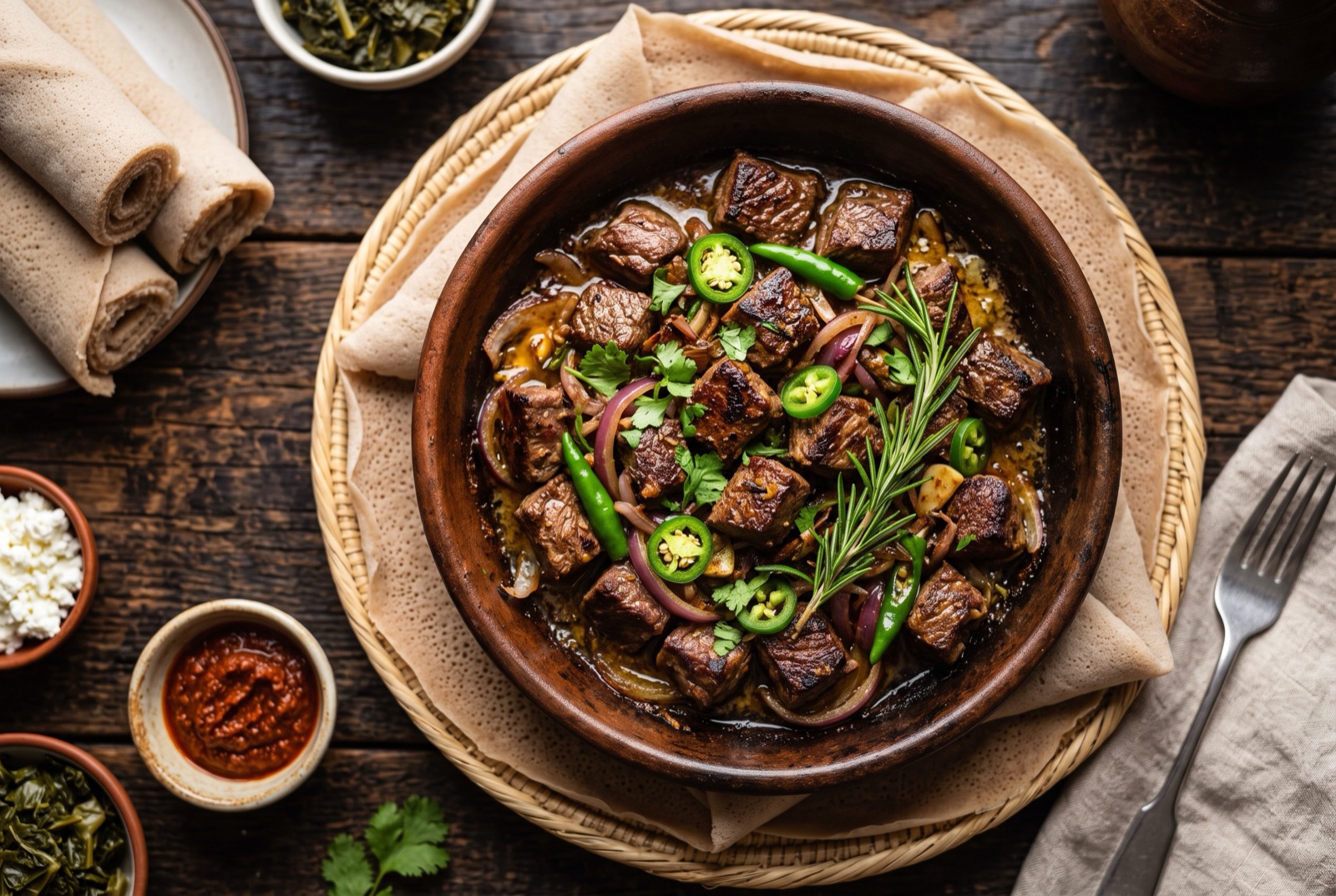
- The same idea in cubes rather than mince: raw beef cut into bite-sized chunks and tossed in niter kibbeh and awaze. Chewier, and served as its own dish rather than as a version of kitfo.
Storage & reheating.
Kitfo is a same-hour dish. Dressed raw mince should be eaten within an hour of mixing and never kept overnight, whatever the level of doneness — the surface area created by mincing makes it a poor keeper. If you have raw meat left over, cook it through fully into yebesele or into a quick tibs, refrigerate it, and eat it within 2 days. Do not freeze dressed kitfo: the butter separates on thawing and the meat weeps. Ayib and gomen keep separately in the fridge for 3 days.
Serve with
Ayib and gomen on the same plate, with kocho or injera — the fresh cheese and the greens are what make the richness manageable.
The story behind Kitfo.
Kitfo belongs to the Gurage people of south-central Ethiopia, and it travelled from there into restaurants across the country and the diaspora. In Gurage areas it is eaten with kocho rather than injera — a dense, slightly sour bread made from the fermented pulp of enset, the false banana that anchors agriculture in that part of the highlands. Ordering kitfo with kocho and ayib in Addis Ababa is a way of eating the dish in something close to its original arrangement.
The mincing is done with a knife, not a machine, and cooks who care about the dish are firm about it. Two heavy blades worked against each other on a board cut the muscle fibres cleanly; a grinder crushes and smears them, pressing out juice and leaving a pasty texture that the butter cannot rescue. The cut is lean by necessity — eye of round, top round or tenderloin, with every scrap of sinew and fat trimmed away, because raw fat in the mouth is unpleasant in a way that raw lean meat is not.
The three doneness levels are a real menu choice, not a Western accommodation. Tere is fully raw, dressed and served cold to just-warm. Leb leb is warmed briefly in the spiced butter so the outside of the mince turns from red to dull pink while the centre stays raw — the most common order. Yebesele is cooked all the way through, which turns kitfo into something closer to a spiced mince and is what cautious eaters and pregnant women are given. Raw meat dishes carry real risk, and Ethiopia has a documented tapeworm problem tied to them; a home cook outside the country should be buying whole muscle from a butcher they trust, mincing it the same day, and choosing honestly between the three levels rather than pretending the question does not exist.
Questions, answered.
Is it safe to eat kitfo raw at home?
It carries real risk, which is why the fully cooked version exists on Ethiopian menus. Raw beef can carry tapeworm and bacterial contamination, and mincing spreads anything on the surface right through the meat. If you want to eat it raw or barely warmed, buy a whole muscle cut from a butcher you trust, keep it cold, mince it yourself on scrupulously clean equipment and eat it immediately. Anyone pregnant, elderly, very young or immunocompromised should order it yebesele — cooked through.
What is the difference between mitmita and berbere?
Berbere is a complex red blend where chilli is one voice among fifteen or more, and it is cooked into stews. Mitmita is smaller, hotter and orange-red — mostly bird's eye chilli with korarima, cloves and salt — and it is used raw as a dressing or dip. Swapping one for the other changes the dish completely: berbere in kitfo tastes flat and dusty, mitmita in doro wat is punishingly hot.
Why mince the beef by hand instead of using a machine?
A knife severs the muscle fibres cleanly and leaves the meat in distinct strands that stay springy. A grinder or food processor crushes and smears the fibres, forcing out juice and producing a pasty, slightly grey texture that no amount of butter fixes. In a dish this simple the texture is most of what you are eating, so the ten minutes of chopping genuinely matter.
What is ayib and what can I use instead?
Ayib is Ethiopian fresh cheese, made by heating soured milk until it curdles and draining the curds — mild, crumbly, barely salted and served cool. Its job is to blunt the heat and richness of the meat. Dry cottage cheese, quark or drained ricotta all do that job; sharper cheeses do not, because they add a second strong flavour rather than a neutral one.
Can I prepare any of it in advance?
The niter kibbeh, the mitmita and the gomen can all be made days ahead, and the cheese can be drained in advance too. The beef cannot. Trim it in advance if you like, but mince, season and dress it only in the last few minutes before it goes to the table, because salted raw mince deteriorates quickly in both texture and colour.
You might also like.
All recipes →
Keep exploring Ethiopia.
Ethiopia has 9 more dishes in the atlas — Berbere and Doro Wat, and 7 more.
Recipe by The DishRoute Kitchen · published August 20, 2026 · updated August 20, 2026