Kjötsúpa.
Icelandic Lamb and Root Vegetable Soup
Kjötsúpa · say it: KYURT-soo-pa
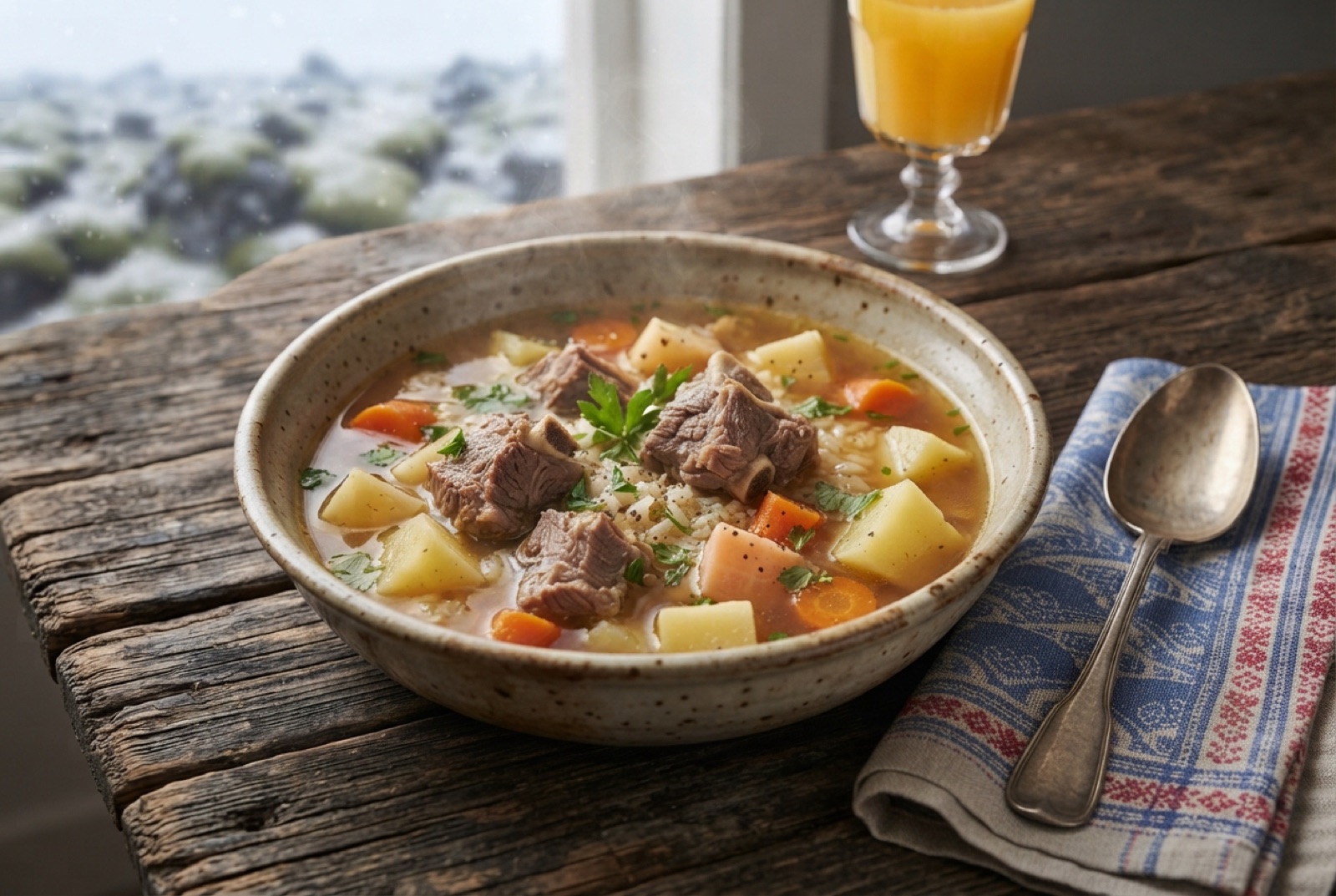
Kjötsúpa is a one-pot lamb soup that gets its flavour from bones and time rather than from browning, stock cubes or a spice rack. Cuts on the bone — neck, shoulder, shank — go into cold water, come slowly up to a simmer, get skimmed, and cook until the meat slides off. Then in go the root vegetables that Iceland can actually grow: swede above all, plus carrot and potato, with a scattering of rice or oats to give the broth body. The taste is clean, salty, mildly sweet from the swede and unmistakably of lamb. Icelanders eat it in enormous bowls with buttered rye bread, and it is the standard cooking-for-a-crowd dish for autumn gatherings.

- Gate
- IcelandNorth Iceland
- Prep
- 20 min
- Cook
- 1 hr 35 min
- Total time
- 1 hr 55 min
- Serves
- 6
- Status
- Easy
- Nutrition / serving · estimated
- Calories 430 kcal
- Protein 32 g
- Carbs 38 g
- Fat 16 g
- Fiber 6 g
- Sodium 820 mg
Why this recipe works.
- Starts the meat in cold water and skims properly, which is the difference between a clear golden broth and a cloudy grey one.
- Staggers the vegetables so the swede and carrot are tender at the same moment the potatoes are, instead of dissolving.
- Uses bone-in lamb for real body — no stock cubes, no browning, no shortcuts pretending to be depth.
- Scales cleanly from a family pot to a party pot, which is exactly how Icelanders cook it.
Ingredients.
13 itemsFor the broth
For the vegetables
To finish
Equipment
- Large stockpot
- Ladle or skimming spoon
- Sharp knife for the root vegetables
Instructions.
Start the meat in cold water
Put 1.2 kg of bone-in lamb into a large pot, cover with the cold water and bring it slowly up to heat over medium — this should take a good 20 minutes. Starting cold draws flavour out of the bones instead of sealing it in.
Skim
As the water approaches a simmer, grey-brown foam will collect on the surface. Lift it off with a ladle every few minutes for the first 15 minutes, until only clear liquid and a little clean fat remain. Do not stir during this stage.
Tip A wet spoon and patience here decide whether the finished broth is golden or grey.
Simmer the lamb
Add the onion, bay leaves, peppercorns and dried thyme. Hold the pot at the barest simmer, partially covered, for 60 minutes, until the meat pulls away from the bone with a fork but has not yet fallen apart.
Add the hard roots
Drop in the diced swede and the carrots and simmer for 15 minutes. The swede should be losing its raw edge but still firm at the centre when you test a piece against the side of the pot.
Add potatoes and rice
Add 600 g of potato chunks, the leek and the rice, and simmer a further 20–25 minutes, until the potatoes are tender all the way through and the rice has swollen and softened but has not yet burst.
Pull the meat and season
Lift out the lamb, strip the meat off the bones in generous chunks and return it to the pot, discarding bones, fat and gristle. Now salt the broth to taste — it should be clearly seasoned, since the vegetables and rice absorb a lot of it.
Serve
Ladle into deep bowls, making sure each one gets meat, a piece of every vegetable and plenty of broth. Scatter with parsley and serve with buttered rye bread on the side.
Tips from our kitchen.
- Skim patiently for the first 15 minutes. The grey foam that rises early is coagulated protein, and stirring it back in is what makes the broth murky.
- Never let the pot boil hard. A bare simmer keeps the broth clear and stops the meat from turning into dry threads.
- Cut the swede slightly smaller than the potato — it is denser and takes noticeably longer to become tender.
- Add the rice about 25 minutes before serving; any earlier and it swells into porridge and clouds the soup.
- Season the broth only at the end. It concentrates as it reduces, and salted-too-early kjötsúpa is a common and irreversible mistake.
Substitutions.
- Bone-in lamb neck or shoulder → Lamb shanks, mutton, or a leftover roast lamb bone with 400 g of diced shoulder
- Bone is the point. Boneless lamb makes a thinner, less gelatinous soup — if it is all you have, add a couple of chicken wings or a piece of lamb rib for body.
- Swede (rutabaga) → Turnip, celeriac, or parsnip
- None of them is a true match — swede is sweeter and denser than turnip and less aromatic than celeriac — but any of the three keeps the soup honest. Use turnip if you can only pick one.
- Rice → Rolled oats or pearl barley
- Oats are the older Icelandic option and thicken the broth more; add them 15 minutes before serving. Pearl barley needs a good 40 minutes, so put it in with the vegetables.
Variations.
- Kjötsúpa with cabbage
- A wedge of cabbage cut into ribbons and dropped in for the final 10 minutes. Very common in Icelandic homes and it makes the pot stretch further.
- Next-day thick version
- Reduced overnight in the fridge and reheated the following day, when the rice has swollen and the soup is nearly a stew. Many Icelanders prefer it this way and cook a day ahead deliberately.
- Smoked lamb kjötsúpa
- Made with leftover hangikjöt instead of fresh lamb, which turns the whole pot smoky. Cut the salt right back — smoked lamb brings plenty of its own.
Storage & reheating.
Refrigerate up to 4 days; the flavour genuinely improves on day two, though the rice keeps drinking the broth, so loosen it with water when reheating. Freeze for up to 3 months, ideally before the potatoes go in, since they turn mealy after thawing. Reheat gently to a simmer rather than boiling hard, and taste for salt again after reheating — it always needs a little.
Serve with
Buttered dark rye bread or flatkaka, and a glass of cold milk.
The story behind Kjötsúpa.
This is probably the oldest dish still eaten daily in Iceland, and its shape was dictated entirely by what the country had. There was no oven in a turf house and very little fuel to waste, but there was a pot over a fire, sheep meat on the bone, and whatever root crop had survived the summer. Everything went into water. Seasoning meant salt, which was itself expensive, and later dried herbs. The soup that resulted was not a first course but the whole meal, and it fed people doing hard outdoor work in a cold climate.
Swede — gulrófa — is the vegetable that makes it taste Icelandic rather than generically Nordic. It handles a short, cool growing season better than almost anything else, and the crop from the southeastern farms has enough of a reputation that Icelanders will name the district it came from. Its slight sweetness plays against the salt and the lamb fat, and a kjötsúpa made without it tastes noticeably flat. Potatoes joined later, once they became a real Icelandic crop, and the handful of rice or rolled oats is a thickener that turns broth into something substantial enough to count as dinner.
The soup is still tied to the sheep year. In September, when the flocks come down from the highland pastures for the réttir sorting, kjötsúpa is what gets cooked in vast pots for everyone who turned up to help, and it appears the same way at town festivals and community halls. It is also the dish Icelandic cooks reach for the day after a roast, since a leg bone and a few scraps make a perfectly respectable pot. Nothing about it is refined and nobody claims otherwise; it is simply reliable, cheap, and very hard to get wrong once you learn to skim.
Questions, answered.
What cut of lamb is best for kjötsúpa?
Bone-in cuts with connective tissue: neck, shoulder, shank or ribs. They release gelatine that gives the broth body, and the meat stays moist through a long simmer. Lean boneless cuts like leg produce a thin, watery soup and dry meat, so if you only have those, add a bone or two to the pot.
Why is my lamb soup cloudy?
Either it was boiled instead of simmered, or the foam was not skimmed off in the first 15 minutes. Start the meat in cold water, bring it up slowly, lift off the grey scum as it rises, and then keep the pot at the barest simmer with bubbles only at the edge. Cloudiness affects looks more than taste, but a clear broth is what Icelanders expect.
What is swede and can I leave it out?
Swede, also called rutabaga, is a dense yellow-fleshed root that is sweeter and firmer than turnip. It is the defining vegetable of kjötsúpa and grows well in Iceland's short season. You can substitute turnip, celeriac or parsnip, but leaving out the whole category makes the soup taste noticeably flat and one-dimensional.
Can I make kjötsúpa in advance?
Yes, and many Icelandic households prefer it the next day. Cook it fully, cool it quickly and refrigerate — the fat rises and sets so you can lift it off if you want a lighter soup. Reheat gently and add water, because the rice and potato continue absorbing broth overnight and it will have thickened considerably.
Is kjötsúpa spiced at all?
Barely. Salt is the main seasoning, sometimes with a bay leaf, peppercorns and a spoonful of dried mixed herbs — the packets sold in Iceland as súpujurtir are mostly dried thyme, parsley and lovage. The point of the dish is the taste of lamb and root vegetables, so heavy spicing works against it.
You might also like.
All recipes →

Keep exploring Iceland.
Iceland has 9 more dishes in the atlas — Fiskibollur and Hangikjöt, and 7 more.
Recipe by The DishRoute Kitchen · published August 19, 2026 · updated August 19, 2026