Kulajda.
South Bohemian Dill, Mushroom and Potato Soup
Kulajda · say it: KOO-lie-dah
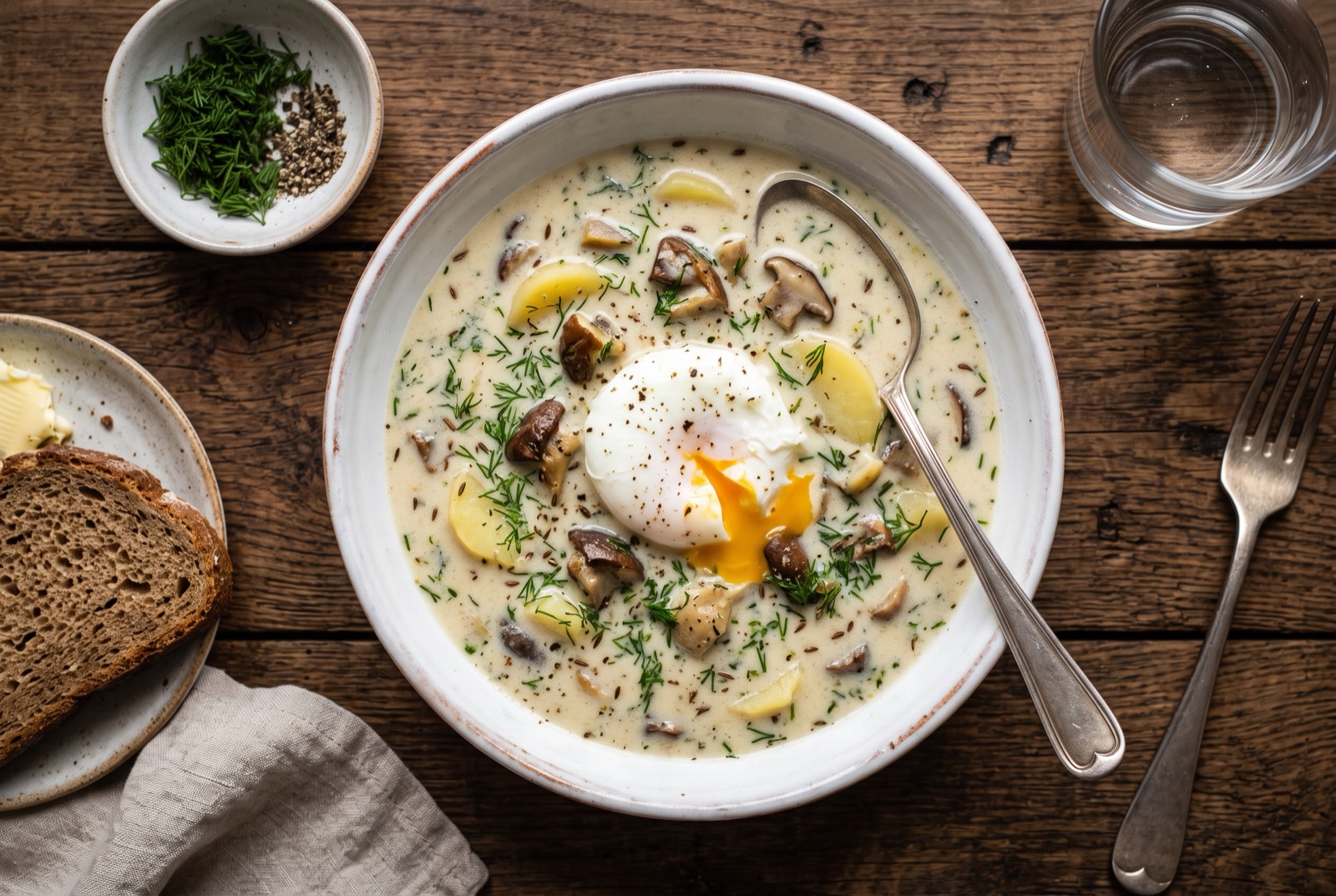
Kulajda is a creamy white soup built on potato and wild mushrooms, thickened with soured cream whisked with flour, and pushed decisively sour with vinegar and an amount of fresh dill that will feel like a mistake until you taste it. A poached egg goes into each bowl so that the yolk breaks into the soup as you eat. The flavour is the surprise: sweet from potato and cream, grassy from all that dill, sharp from the vinegar, earthy from the mushrooms, with caraway and bay underneath. It is a full meal in a bowl and takes under 40 minutes, which is why it appears on South Bohemian tables far more often than its restaurant reputation suggests.

- Gate
- CzechiaSouth Bohemia
- Prep
- 15 min
- Cook
- 30 min
- Total time
- 45 min
- Serves
- 4
- Status
- Easy
- Nutrition / serving · estimated
- Calories 380 kcal
- Protein 13 g
- Carbs 32 g
- Fat 23 g
- Fiber 4 g
- Sugar 5 g
- Sodium 620 mg
Why this recipe works.
- The soured cream is tempered with hot broth before it goes in, which is what stops the soup curdling into grains.
- Dried mushrooms are soaked and their soaking liquid used as part of the broth, so nothing forest-flavoured is thrown away.
- The vinegar goes in at the end and by taste, since cream brands vary enormously in how sour they already are.
- Poaching the eggs separately keeps the soup clean and white instead of cloudy with egg white.
Ingredients.
15 itemsFor the soup
To finish
Equipment
- Medium saucepan
- Whisk
- Wide shallow pan for poaching
- Fine sieve
Instructions.
Soak the dried mushrooms
Cover the dried mushrooms with 300 ml of hot water and leave for 20 minutes, until soft and swollen. Lift them out, chop them roughly, and strain the soaking liquid through a fine sieve or coffee filter to leave the grit behind — that liquid is the backbone of the soup.
Fry the fresh mushrooms
Melt the butter in a saucepan and cook the sliced fresh mushrooms over medium-high heat until they have given up their water and started to brown at the edges, about 8 minutes. Browning them now is what keeps them from tasting washed-out in the finished soup.
Simmer the potato base
Add the chopped soaked mushrooms, the diced potato, caraway, bay, allspice, the strained soaking liquid and the water. Season lightly with salt and simmer, uncovered, for 15 minutes, until the potato is tender but the cubes still hold their shape.
Poach the eggs
While the potatoes cook, bring a wide pan of water with a splash of vinegar to a bare tremble and poach the eggs for 3 minutes, until the whites are set and the yolks still liquid. Lift them into a bowl of warm water and leave them there.
Temper the cream
Whisk the flour into the cold soured cream until absolutely smooth, then ladle in three or four spoonfuls of the hot soup one at a time, whisking after each, until the mixture is warm and loose. Pour it back into the pot, whisking as you go.
Tip Cold cream added straight to a boiling pot is the single most common way this soup is ruined.
Thicken without boiling
Cook over low heat for 5 minutes, stirring, until the soup thickens enough to coat the back of a spoon and no longer tastes of raw flour. Keep it just below a simmer — a few lazy bubbles at the edge is as far as it should go.
Season sour and sweet
Off the heat, stir in almost all the dill, the vinegar and the sugar. Taste and keep adding vinegar a spoon at a time until the soup is definitely sour against the cream, then correct with salt and plenty of black pepper.
Serve with the egg
Ladle into warm bowls, lower a drained poached egg into the centre of each, and scatter the last of the dill over the top. Serve at once, telling anyone unfamiliar with it to break the yolk into the soup on the first spoonful.
Tips from our kitchen.
- Use far more dill than looks reasonable — a whole large bunch for four. Dill is the dominant flavour, not a garnish, and it collapses to almost nothing when it hits the hot soup.
- Whisk the flour into the cold cream until completely smooth before it goes anywhere near the pot. Any lumps at this stage will still be lumps in the finished soup.
- Temper the cream mixture: ladle hot broth into it a little at a time while whisking, then pour the warmed mixture back. Adding cold cream straight to a boiling pot is the classic way to split it.
- Add the vinegar off the boil and taste as you go. The soup should be clearly sour but not make you flinch — start with a tablespoon and work up.
- If using dried mushrooms, strain the soaking liquid through a coffee filter or fine cloth to leave the grit behind, then use it in the soup.
- Poach the eggs in a separate pan of vinegared water rather than in the soup itself, which stays clearer and looks far better in the bowl.
Substitutions.
- Wild mushrooms → 30 g dried porcini soaked in hot water, or 250 g chestnut mushrooms plus a spoon of the soaking liquid
- Cultivated mushrooms alone taste flat here — add at least a few dried wild ones for the forest note the soup is built on.
- Soured cream → Full-fat crème fraîche, or double cream with an extra splash of vinegar
- Higher-fat cream is far less likely to split. Avoid low-fat sour cream, which curdles almost on contact with heat.
- Poached egg → A soft-boiled egg, peeled and halved, lowered into the bowl
- Easier to time for a crowd, and the effect on the plate is nearly identical once the yolk is broken.
Variations.
- Kulajda with fried croutons
- Cubes of white bread fried in butter and scattered on top just before serving, which adds crunch against the soft potato.
- Mushroom-free spring kulajda
- Made in early summer before mushroom season with only potato, dill and cream. Lighter, sharper, and a fair reflection of what was actually in the pantry.
- Kulajda with smoked meat
- A few cubes of smoked pork simmered in the broth from the start. Not the classic, but common in households where the soup has to be the whole dinner.
Storage & reheating.
Keeps 2 days refrigerated, though the dill fades noticeably by the second day and you may want to stir in a fresh handful when reheating. Warm it gently over low heat and never let it boil, which will split the cream. Store the poached eggs separately in cold water and slip them into the hot soup at the last moment. Do not freeze: the cream separates on thawing and the potato turns mealy.
Serve with
Good rye bread for the bowl, and nothing else — kulajda is a course in itself.
The story behind Kulajda.
Kulajda belongs to South Bohemia, the region of fishponds, forests and small farms in the country's southern corner, and it is a soup built entirely from what that landscape hands over. Potatoes grow well in the poor soil, the pine and spruce forests produce mushrooms in enormous quantity from late summer, dill grows in every garden, and soured milk was a farm staple long before anyone bought cream in a tub. Nothing in the original version needed to be purchased.
The soup sits inside a wider Czech and Central European family of sour, cream-thickened soups — kyselo, bramboračka, koprovka — that use acidity where other cuisines would use fat or spice. Vinegar or soured milk was both a preservative and a seasoning, and the Czech palate that finds sweet-sour normal in a beef braise finds it equally normal in a soup. To a first-time eater the combination of cream, vinegar, dill and a poached egg reads as several unrelated ideas in one bowl. After a spoonful or two the logic becomes obvious: each element is answering the one before it.
Mushroom picking deserves a mention, because it is not a marginal hobby here but something close to a national sport. Czech families walk the forests from August onwards with baskets and knives, and the seasonal glut goes into soups, sauces, scrambled eggs and drying racks for the winter. A kulajda made in September with hříbky picked that morning is a different and better soup than one made in February with a handful of dried mushrooms — but the February version is entirely traditional too, and dried mushrooms concentrate rather than dilute the forest flavour. Both are how the dish is actually eaten.
Questions, answered.
Why did my kulajda curdle?
The cream went into liquid that was too hot, or the soup boiled after the cream was added. Always temper first, whisking hot broth into the cold cream a ladle at a time before returning the mixture to the pot, and keep the soup below a simmer from then on. Using full-fat soured cream or crème fraîche rather than a low-fat version makes it far more forgiving.
Can I use only shop mushrooms?
You can, but the soup loses the forest character that defines it. Chestnut or cremini mushrooms give texture and a mild savoury note, while dried porcini or other dried wild mushrooms give the deep earthy background. A handful of dried mushrooms soaked in hot water, plus their strained soaking liquid, costs little and transforms a soup made with cultivated mushrooms.
How sour should kulajda actually be?
Clearly sour — enough that it registers as a sour soup rather than a creamy one — but stopping well short of harsh. Because soured creams differ in acidity between brands and countries, add vinegar a tablespoon at a time and taste after each addition. If you overshoot, a pinch of sugar or an extra spoon of cream pulls it back.
Is kulajda vegetarian?
The classic version is, since it contains only potato, mushrooms, dill, cream, egg and seasonings. Watch two things: some cooks build it on meat stock rather than water or mushroom liquid, and some versions add smoked pork. Made with water or vegetable stock as written here, it is fully vegetarian.
Can I make it ahead for guests?
Yes, up to a point. Cook the potato and mushroom base a day ahead and refrigerate it, then reheat and add the cream, dill and vinegar just before serving so nothing splits and the dill stays green. Poach the eggs up to a day ahead too, keeping them in cold water and warming them for 30 seconds in hot water before they go into the bowls.
You might also like.
All recipes →

Keep exploring Czechia.
Czechia has 9 more dishes in the atlas — Bramborák and Hovězí Guláš, and 7 more.
Recipe by The DishRoute Kitchen · published August 20, 2026 · updated August 20, 2026