Bastilla.
Moroccan Sweet-Savoury Chicken Pie
بسطيلة · Bastila · say it: bahs-TEE-yah
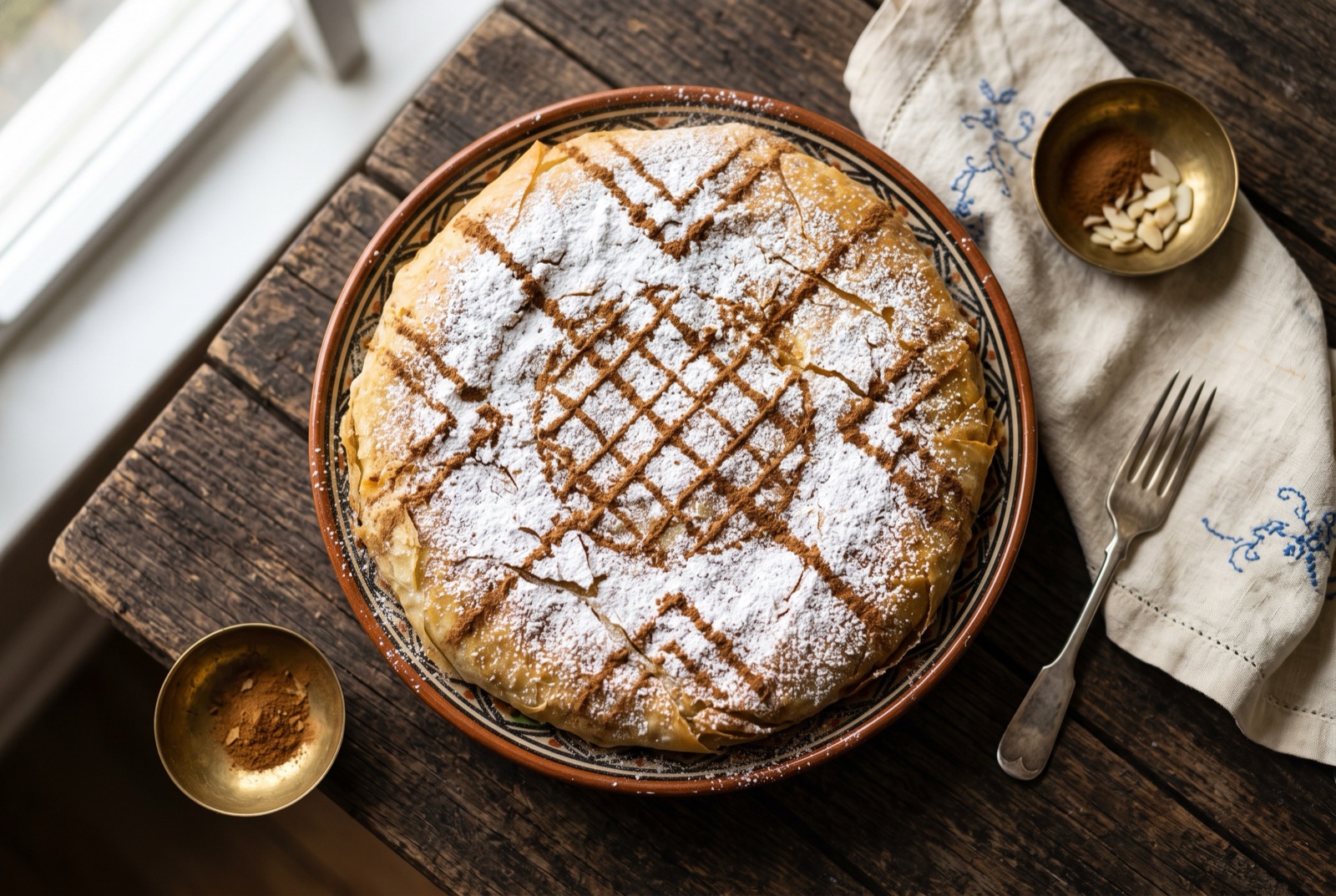
Bastilla is a round pie that tastes savoury, sweet and spiced in the same bite. Inside are three separate layers — shredded chicken cooked down in saffron, ginger and onion; a thick scramble of eggs set in the reduced cooking juices; and toasted almonds ground with sugar and cinnamon — each made on its own and stacked so they stay distinct. The pastry around them shatters when you cut into it, and the top is dusted with icing sugar and ruled with fine lines of cinnamon. The sweet crust against the peppery, lemony chicken is the whole idea, and it is far less strange on the tongue than it sounds on paper. This is banquet food: weddings, Eid, and the meal you cook when guests matter.

- Gate
- MoroccoFez
- Prep
- 55 min
- Cook
- 1 hr 30 min
- Total time
- 2 hr 40 min incl. 15 min rest
- Serves
- 8
- Status
- Takes skill
- Nutrition / serving · estimated
- Calories 610 kcal
- Protein 34 g
- Carbs 38 g
- Fat 36 g
- Fiber 4 g
- Sugar 11 g
Why this recipe works.
- Three fillings built and cooled separately, so the layers stay defined instead of merging into one damp mass.
- The egg layer is set in the reduced chicken broth, which is what stops the pie from tasting like a plain omelette in pastry.
- Clear on the warqa question — what filo does differently and how to compensate with sheet count and butter.
- Every stage can be made a day ahead, which turns a hard dish into an achievable one.
Ingredients.
23 itemsFor the chicken layer
For the egg layer
For the almond layer
To assemble
Equipment
- 28 cm round cake tin or ovenproof skillet
- Wide heavy pan with a lid
- Pastry brush
- Food processor or heavy knife for the almonds
Instructions.
Simmer the chicken
Melt the butter with the oil in a wide pan and add the chopped onions, ginger, turmeric, black pepper, cinnamon stick, saffron and its steeping water. Lay the chicken thighs on top, add the salt and 300 ml of water, cover and simmer for 45 minutes, turning once, until the meat pulls easily from the bone.
Tip The onions should melt into the liquid rather than stay in pieces — chop them finer than feels necessary.
Shred and reduce
Lift the chicken out and let it cool enough to handle. Discard skin and bones and shred the meat into strands with your fingers. Meanwhile boil the pan liquid hard, uncovered, until it reduces to a thick, glossy onion sauce that just barely moves when you tilt the pan.
Tip This reduction is the single most important step for a crisp pie. Under-reduce and the base goes soggy.
Make the egg layer
Stir the chopped cilantro and parsley into the reduced sauce, then pour in the beaten eggs and the lemon juice. Cook over low heat, stirring constantly, for 6–8 minutes until the eggs set into a thick, curdy scramble with no loose liquid pooling at the edges. Spread it on a plate to cool.
Toast and grind the almonds
Fry the blanched almonds in a dry pan or roast them at 180°C for 10 minutes until they are golden right through — break one open to check the centre has colour. Cool completely, then pulse with the icing sugar, ground cinnamon and orange blossom water to a coarse, sandy crumb, not a paste.
Line the tin
Brush a 28 cm round tin with melted butter and lay in filo sheets one at a time, buttering each, arranged like spokes so half of each sheet hangs over the rim. Build up at least four overlapping layers across the base, then butter two more sheets and lay them flat in the centre as reinforcement.
Build the three layers
Spread the shredded chicken over the base in an even layer and press it down. Cover with the cooled egg mixture, then scatter the almond crumb evenly over the top, right to the edges. Do not mix or swirl — the layers must stay separate.
Close the parcel
Fold the overhanging filo back over the filling one piece at a time, brushing each with butter and egg yolk wash as you go, so the top is sealed under several layers. Butter two final sheets, tuck them over the seam, and brush the whole surface generously.
Bake in two positions
Bake at 190°C on the lowest shelf for 20 minutes so the base sets and crisps, then move the tin to the middle shelf for a further 20–25 minutes until the top is deep bronze and the pastry sounds papery when tapped.
Rest, dust and serve
Let the pie stand for 15 minutes, then invert it onto a plate and turn it back upright so both faces stay crisp. Dust heavily with icing sugar and rule fine lines of ground cinnamon across the top in a lattice. Carry it straight to the table and cut into wedges.
Tips from our kitchen.
- Cool the fillings completely before assembling. Warm filling releases steam and steam is what turns a crisp base soggy.
- Reduce the chicken cooking liquid hard before adding the eggs — if it is loose, the egg layer will weep into the pastry overnight.
- Brush butter on every filo sheet, right to the edges. Dry patches tear during folding and burn during baking.
- Toast the almonds until they are properly golden inside, not just tanned outside. Under-toasted almonds taste raw against the cinnamon.
- Bake on the lower shelf first so the base sets, then move the pie up to bronze the top. A pale, soft underside is the most common failure.
- Dust with icing sugar only once the pie is on the serving plate and about to be carried out. On a hot crust it melts within a minute.
Substitutions.
- Warqa pastry → Filo pastry, using 2 sheets where you would use 1 warqa round
- Filo is drier and more fragile. Double the sheets, butter generously, and accept a slightly flakier, less chewy crust than the original.
- Pigeon → Chicken thighs, or a mix of thigh and breast
- Pigeon is the historic filling and has a deeper, gamier taste. Chicken thigh is what most Moroccan kitchens use now and is far easier to buy.
- Orange blossom water → A strip of orange zest simmered with the chicken, then removed
- Not identical — orange blossom is floral rather than citrusy — but it gives the almond layer a lift in the same direction.
Variations.
- Bastilla bil hout (seafood)
- Squid, shrimp and white fish with vermicelli in a garlicky tomato-chile sauce, no almonds and no sugar on top. A coastal favourite and a completely savoury pie.
- Individual bastillas
- Build six small parcels instead of one large pie. They bake in about 20 minutes, crisp up more thoroughly, and solve the problem of serving a big pie without it collapsing.
- Pigeon bastilla
- The original Fez version. Use four pigeons in place of the chicken and increase the simmering time; the meat is darker, denser and worth the effort if you can source it.
Storage & reheating.
Bastilla is best eaten within an hour of baking, while the crust still shatters. Leftovers keep 2 days refrigerated; reheat uncovered at 180°C for 12–15 minutes to drive off moisture and bring the pastry back, never in a microwave, which steams it limp. You can assemble the unbaked pie, wrap it well and freeze it for up to a month — bake from frozen at 180°C for 45–50 minutes. Store the three fillings separately in the fridge for up to 2 days if you are working ahead.
Serve with
Nothing heavy — a simple orange and cinnamon salad, or a plate of raw carrot and orange, cuts through the richness. Mint tea afterwards, never during: the pie is already sweet.
The story behind Bastilla.
Bastilla belongs to Fez, the old imperial city whose kitchens produced the most elaborate strand of Moroccan cooking. It is a dish of Andalusian descent — the culinary tradition carried across the strait by Muslims and Jews leaving Iberia — and the sweet-with-savoury combination, the almonds, the cinnamon and the layered pastry all sit comfortably in that lineage. The name itself is generally traced to Spanish pastilla, a small pastry, though how the word and the dish travelled is argued about rather than settled.
The traditional filling is pigeon, and in Fez you can still eat it that way. Chicken took over in most homes and restaurants for the obvious reasons of price and availability, and today a seafood bastilla filled with squid, shrimp and vermicelli in a chile-tomato sauce is common on the coast, especially around Casablanca. Purists in Fez consider the seafood version a modern invention; everyone else eats it happily. What all versions share is the structure — a filling that is fully cooked and cooled before it ever touches pastry, so the layers do not steam the crust from within.
The authentic wrapper is warqa, a paper-thin dough cooked by dabbing a soft, elastic ball against a hot flat griddle until a translucent film peels away. Making it well takes years, and most Moroccan home cooks buy warqa fresh from a specialist rather than attempt it. Outside Morocco, filo is the standard substitute and a reasonable one: it is thinner and more brittle than warqa, so it needs more sheets and more butter, but baked properly it delivers the same shattering crust. The pie is assembled in a wide round dish, the pastry overhanging so it can be folded back over the top like a parcel, and it goes into the oven until it is deep bronze on both faces. The final dusting is done at the last moment — icing sugar dissolves on a hot pie if you leave it standing.
Questions, answered.
What is warqa and do I have to make it?
Warqa is a paper-thin Moroccan pastry made by dabbing a soft, stretchy dough against a hot griddle so a translucent sheet peels off. It is genuinely difficult and most Moroccan home cooks buy it ready-made rather than make it. Outside Morocco, filo is the accepted substitute — use roughly two filo sheets for every warqa round and butter each one.
Why is my bastilla soggy underneath?
Two usual causes. Either the filling went in warm, so trapped steam soaked the base, or the egg layer was too wet because the chicken liquid was not reduced enough. Cool all fillings to room temperature before assembly, reduce the sauce until it barely runs, and start the bake on a low oven shelf so the base sets before the top colours.
Is bastilla supposed to taste sweet?
Yes, and the contrast is deliberate. The almond layer carries sugar and cinnamon, and the finished pie is dusted with icing sugar, all set against savoury saffron chicken and peppery eggs. If you want it less sweet, halve the sugar in the almond mix and dust the top lightly — but a fully savoury version is no longer bastilla.
Can I make it ahead for a dinner party?
Yes, and you should. Cook the three fillings up to two days in advance and refrigerate them separately. Assemble the pie on the day, up to six hours before baking, keep it covered in the fridge, then bake it fresh so it reaches the table crisp. Assembled unbaked pies also freeze well for a month.
Can I use chicken breast instead of thighs?
You can, but thighs are better here. Breast meat dries out over the long simmer and shreds into stringy fibres, while thigh stays moist and shreds into soft strands that hold the sauce. If you only have breast, cut the simmering time to about 25 minutes and check it early.
You might also like.
All recipes →
Keep exploring Morocco.
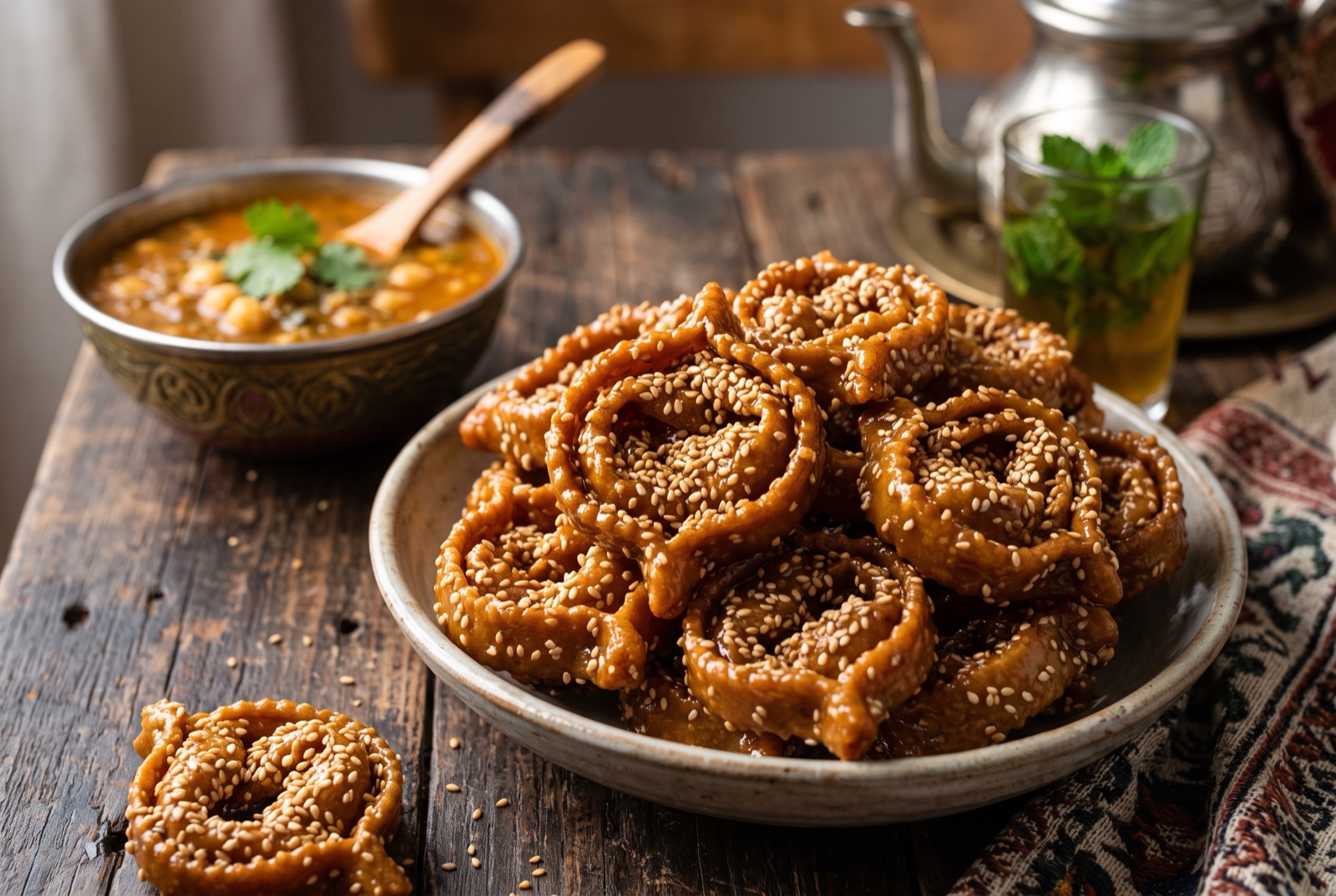
Morocco has 9 more dishes in the atlas — Atay bi Na'na and Chebakia, and 7 more.
Recipe by The DishRoute Kitchen · published August 19, 2026 · updated August 19, 2026