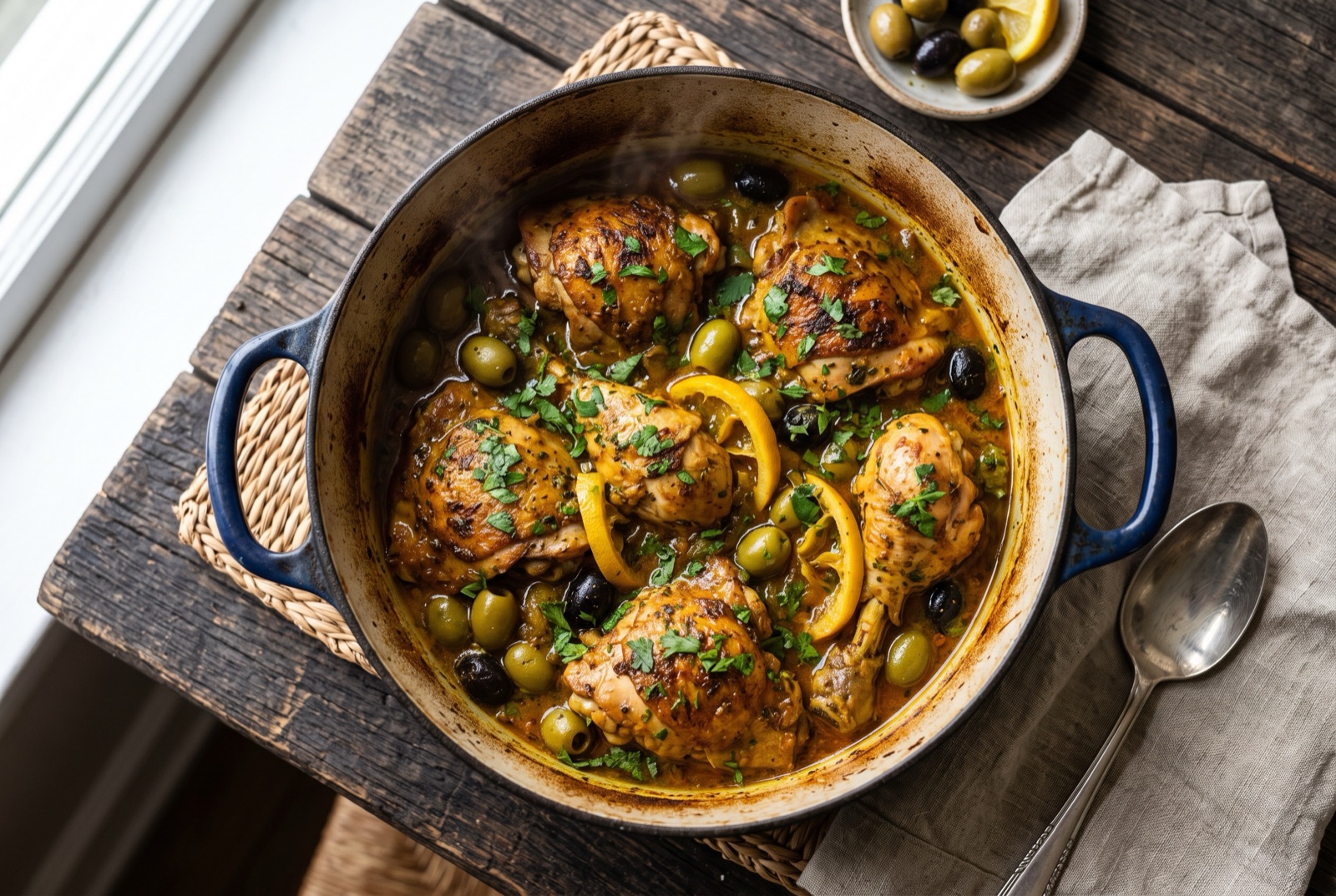
Chicken Tagine with Preserved Lemon and Olives.
طاجين الدجاج · Tajin djaj · say it: tah-ZHEEN d-ZHAZH
Chicken tagine with preserved lemon and olives is arguably Morocco's best-known dish: chicken braised slowly with onions, garlic, ginger and saffron until it nearly slips off the bone, finished with briny olives and the tender, fragrant rind of salt-cured lemons. The flavor is savory and gently spiced rather than hot — golden from turmeric and saffron, sharpened by the preserved lemon's salty, almost floral tang. In Morocco it cooks in a conical clay tagine over coals, but the pot is not what makes the dish: a Dutch oven with a tight lid traps steam and braises just as gently, and this recipe is written honestly for one. Serve it with crusty bread for the sauce — that part is not optional.

- Gate
- Morocco
- Prep
- 20 min
- Cook
- 1 hr 10 min
- Total time
- 2 hr incl. 30 min rest
- Serves
- 4
- Status
- Easy
- Nutrition / serving · estimated
- Calories 540 kcal
- Protein 41 g
- Carbs 13 g
- Fat 36 g
- Fiber 3 g
Why this recipe works.
- Written for the pot you own — a Dutch oven reproduces the tagine's sealed, gentle braise honestly, and the recipe says so instead of pretending clay is required.
- The mqualli base of ginger, turmeric and saffron bloomed in olive oil gives the sauce real depth, not just yellow color.
- Preserved lemon goes in late, so its perfume stays bright instead of boiling away.
- The sauce is reduced uncovered at the end until it coats the chicken — the step most home versions skip.
Ingredients.
14 itemsFor the tagine
For finishing
Equipment
- Dutch oven or heavy lidded pot
- Small bowl for steeping saffron
- Sharp knife
Instructions.
Marinate the chicken
Mix half the olive oil with the garlic, ginger, turmeric, black pepper and the saffron with its steeping water. Rub the paste all over 1.2 kg of chicken thighs and let them sit at room temperature for 30 minutes, until the meat is stained deep yellow.
Tip Marinating overnight in the fridge is even better — bring the chicken back toward room temperature before cooking.
Melt the onions
Warm the remaining oil in a Dutch oven over medium heat and cook 2 of sliced onions with a small pinch of salt, stirring often, until they collapse into a soft, pale-golden tangle that no longer holds its shape.
Braise gently
Nestle the chicken skin-side up into the onions, scraping every bit of marinade over it, and pour the water around the sides. Cover tightly and braise at a bare simmer until the meat is tender enough that a fork twists easily into the thickest thigh, about 45 minutes.
Tip Keep the heat low — the liquid should barely tremble. A hard boil toughens the chicken and breaks the sauce.
Add lemon and olives, reduce
Scatter in the slivered preserved lemon rind and the olives. Simmer uncovered, spooning sauce over the chicken now and then, until the liquid reduces to a glossy sauce that coats the back of a spoon and clings to the meat, 12–15 minutes.
Finish and serve
Taste the sauce and only now adjust the salt. Shower the tagine with the chopped cilantro and parsley and bring the whole pot to the table with warm bread, so everyone can mop the sauce directly from it.
Tips from our kitchen.
- Use bone-in thighs. Breasts dry out long before the sauce develops, while thighs get better the longer they braise.
- Rinse the preserved lemon and scrape out the flesh — the rind is the prize. Unrinsed, the dish can tip over into outright saltiness.
- Salt cautiously until the very end: preserved lemon and olives both carry serious salt, and the reducing sauce concentrates it further.
- Steep the saffron in a few spoonfuls of hot water for 10 minutes before it goes in; dropped in dry, half of it never releases its color or flavor.
- Let the onions cook down to a soft, almost melting tangle before the liquid goes in — they thicken the sauce more than any flour would.
Substitutions.
- Preserved lemon → Zest of 1 lemon + 1 tbsp juice + generous pinch of salt, added in the last 10 minutes
- An honest emergency stand-in, but it gives brightness without the fermented depth. Jarred preserved lemons keep for a year — worth buying.
- Saffron → Simply omit it and lean on the turmeric
- The dish stays genuinely good; you lose a layer of aroma, not the structure. Skip "saffron flavoring" products entirely.
- Green olives → Any firm, brine-cured olive except canned black California olives
- Violet or cracked green olives are closest to what Moroccan markets sell. Pitted saves work; unpitted taste slightly better.
Variations.
- Whole-bird tagine
- A cut-up whole chicken instead of thighs, the traditional family format — add the breast pieces 20 minutes after the legs so they finish together.
- With potatoes
- Tuck peeled potato quarters around the chicken for the last 30 minutes of the braise; they drink up the saffron sauce and turn it into a one-pot dinner.
- Kdra-style with chickpeas
- A cousin of this dish: extra onions cooked to a sweet mass, a handful of chickpeas, and butter in place of some oil for a richer, paler sauce.
Storage & reheating.
Keeps 3 days refrigerated and honestly improves overnight as the preserved lemon perfumes the sauce. Reheat gently on the stove with a splash of water, covered, until steaming through. Freezes well for up to 2 months — thaw overnight in the fridge, and stir in a little fresh herb after reheating to wake it up.
Serve with
Warm crusty bread or khobz for mopping the sauce — or couscous, though bread is the traditional partner for this tagine.
The story behind Chicken Tagine with Preserved Lemon and Olives.
In Morocco the word tagine means two things at once: the vessel and whatever is cooked in it. The vessel is clay — a shallow base and a tall conical lid whose shape does real work, catching the steam that rises off the food, condensing it against the cool peak, and dripping it back down so the stew braises in its own moisture with barely any added liquid. Traditionally it sits over a charcoal brazier at the gentlest possible murmur, sometimes for hours. The cooking method, in other words, is not the clay itself but what the clay achieves: a sealed, slow, self-basting braise. That is exactly what a heavy Dutch oven with a tight lid does on a modern stove, which is why this recipe uses one without apology — you lose the ritual and the tableside presentation, not the dish.
This particular tagine — chicken with preserved lemon and olives, in the style Moroccans call djaj mqualli — is one of the great classics of the repertoire, built on a yellow base of olive oil, ginger, turmeric and saffron. Its defining ingredient takes weeks to make and seconds to use: preserved lemons, whole fruit packed in salt until the rind softens and the harsh sourness mellows into something deep, salty and perfumed. It is the rind, slivered in near the end, that flavors the sauce; the flesh is usually scraped away. The olives — green or the violet mid-cure ones sold from market barrels — bring the answering brine.
At home in Morocco this is both everyday and occasion food: the pot lands in the middle of the table, everyone tears off bread, and each person works the section of the dish in front of them, mopping up sauce as they go. No plates, no cutlery, no ceremony beyond the shared pot — which is, in its way, the whole point of a tagine.
Questions, answered.
Do I need a clay tagine pot to make chicken tagine?
No. The conical clay pot condenses steam and returns it to the food, producing a gentle self-basting braise — and a heavy Dutch oven or any thick pot with a tight lid does the same job on a modern stove. Clay adds ritual and presentation, not a flavor a home cook would miss.
What are preserved lemons and can I substitute them?
Preserved lemons are whole lemons cured in salt and their own juice for several weeks, until the rind turns soft, deeply salty and floral. They are the signature flavor of this tagine. In a pinch, fresh lemon zest and juice with extra salt gives brightness, but not the fermented depth — jarred preserved lemons are sold in most large supermarkets and keep for months.
Is chicken tagine spicy?
No — this is a gently spiced dish, not a hot one. Ginger, turmeric, saffron and black pepper build warmth and aroma, and the sharpness comes from preserved lemon and olives rather than chile. Moroccan tables typically add heat separately, with harissa on the side, so each eater controls it.
Which olives are right for a Moroccan tagine?
Firm brine-cured olives — green, or the violet mid-cure ones — are the traditional choice, sold from barrels in Moroccan markets. Any good brined green olive works at home. The one poor fit is canned black California olives, which turn mushy and flavorless in a braise.
Why did my tagine come out too salty?
Almost always because the preserved lemon went in unrinsed with its flesh, on top of salted chicken and brined olives. Rinse the lemon, scrape away the pulp, use only the rind, and hold back added salt until the sauce has finished reducing — then season to taste at the end.
You might also like.
All recipes →
Keep exploring Morocco.
Morocco has 9 more dishes in the atlas — Atay bi Na'na and Bastilla, and 7 more.
Recipe by The DishRoute Kitchen · published August 18, 2026 · updated August 18, 2026