Zaalouk.
Moroccan Smoky Eggplant and Tomato Salad
زعلوك · Zaalouk · say it: zah-ah-LOOK
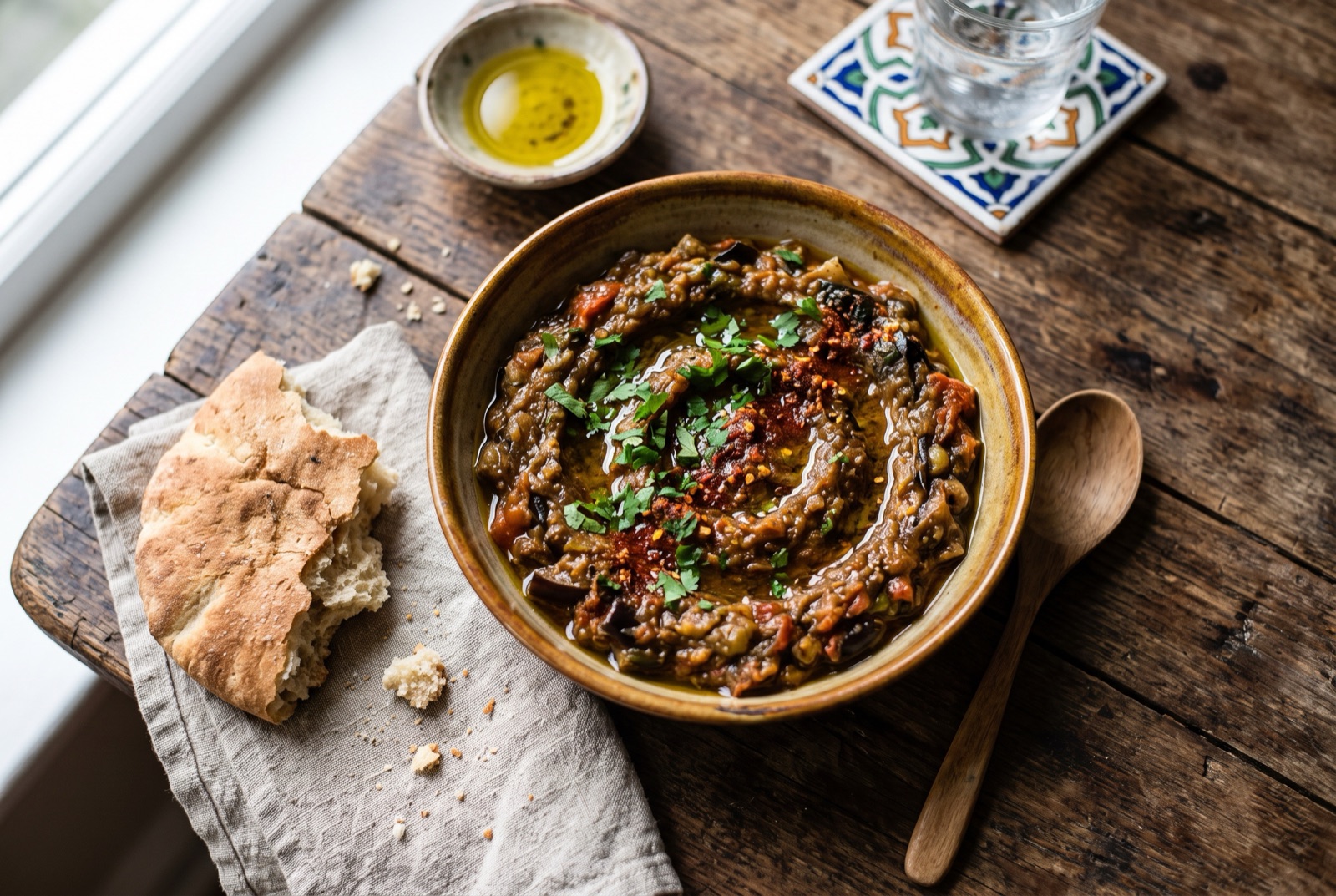
Zaalouk is a Moroccan cooked salad — really closer to a rustic dip — of eggplant charred until smoky, then simmered down with tomatoes, garlic, cumin, paprika and olive oil, and mashed into a soft, spreadable tangle. It tastes deep and mellow: smoke from the eggplant skin, sweetness from reduced tomato, warmth from the spices, and a bright edge of lemon and cilantro at the end. It is eaten warm or at room temperature, scooped up with bread rather than a fork. The only technique that matters is honest charring — the eggplant must blister and blacken, because that smoke is the flavor the whole dish is built on.

- Gate
- Morocco
- Prep
- 15 min
- Cook
- 35 min
- Total time
- 50 min
- Serves
- 4
- Status
- Easy
- Nutrition / serving · estimated
- Calories 180 kcal
- Protein 3 g
- Carbs 15 g
- Fat 13 g
- Fiber 7 g
Why this recipe works.
- Char-first method builds the smokiness that separates real zaalouk from stewed eggplant.
- Tomatoes reduce hard in the pan, so the salad is concentrated and silky, never watery.
- Texture is yours to choose — the mash-in-the-pan step lets you stop at chunky or go nearly smooth.
- Naturally vegan and gluten-free, and it tastes even better after a night in the fridge.
Ingredients.
11 itemsEquipment
- Tongs
- Wide sauté pan
- Colander
- Potato masher or fork
Instructions.
Char the eggplants
Prick the eggplants a few times and set them directly over a gas flame (or under a maximum broiler), turning with tongs every few minutes, until the skin is blackened and papery on all sides and the eggplants have visibly collapsed — 10–14 minutes. They should feel completely soft when pressed.
Tip Line the burner area with foil first; this step is gloriously messy.
Peel and drain
Let the eggplants sit until cool enough to handle, then split them and scrape the smoky flesh away from the charred skin. Leave the flesh in a colander for 5 minutes so the excess dark liquid drips away.
Start the tomato base
Warm the olive oil in a wide pan over medium heat and cook the garlic just until fragrant, about 30 seconds — no color. Add the tomatoes, cumin, paprika and a good pinch of salt and simmer, stirring now and then, until thickened and jammy, 8–10 minutes.
Add the eggplant and mash
Add the drained eggplant flesh to the pan and crush it into the tomatoes with a masher or fork, to as chunky or smooth a texture as you like. Cook, stirring, until the mixture is thick, glossy and beginning to leave a film on the pan, 8–10 minutes more — the oil should separate at the edges.
Tip Stop mashing while some eggplant strands survive — a little texture keeps it a salad rather than a purée.
Season and rest
Off the heat, stir in the cilantro, parsley and lemon juice, then taste for salt — it should be smoky, gently spiced and bright at the finish. Let it rest 15 minutes; zaalouk is at its best warm, not hot.
Serve
Spread onto a plate, draw a swirl through the top and finish with a thread of olive oil. Serve with warm bread for scooping, and a pinch of cayenne on top if you like heat.
Tips from our kitchen.
- Char the eggplant more than feels polite — the skin should be blackened and papery and the flesh completely collapsed. Under-charred eggplant gives bland, watery zaalouk.
- Drain the charred flesh in a colander for a few minutes; eggplant holds a surprising amount of bitter, smoky liquid you do not want in the pan.
- Reduce the tomatoes until the oil separates and pools at the edges — that sheen is the sign the salad is concentrated enough.
- Season at the end with lemon and salt together; the acidity wakes up flavors the long simmer has mellowed.
- Serve at warm room temperature, not hot — the smoke and spice read much clearer once the salad has settled for 15 minutes.
Substitutions.
- Fresh tomatoes → A 400 g can of chopped tomatoes
- Reliable in winter. Reduce a few minutes longer, since canned tomatoes carry more liquid.
- Charring over a gas flame → Oven broiler, as hot as it goes
- Broil whole pricked eggplants close to the element, turning until blackened all over — slightly less smoky, still very good.
- Cilantro → Flat-leaf parsley only
- For cilantro-averse eaters. The salad loses a little of its Moroccan accent but none of its structure.
Variations.
- Spicy zaalouk
- A teaspoon of harissa or a chopped fresh chile simmered in with the tomatoes — common in homes that like heat.
- Chunky with skin
- Leave some charred skin flecks in and mash only lightly, for a rougher salad with extra smoke and visual character.
- Zucchini zaalouk
- A recognized cousin made with zucchini instead of (or alongside) eggplant — lighter, greener, same spice logic.
Storage & reheating.
Keeps 4 days refrigerated in a sealed container with a film of olive oil over the top, and the flavor improves by day two. Serve at room temperature or rewarm gently in a pan. Freezes acceptably for 2 months, though the texture softens — stir well and refresh with lemon and raw olive oil after thawing.
Serve with
Warm crusty bread or Moroccan khobz for scooping, alongside olives and other cooked salads before a tagine.
The story behind Zaalouk.
Moroccan meals often begin with a spread of salades cuites — cooked salads — set out in small dishes alongside bread, and zaalouk is among the best loved of them. The idea is different from a leafy salad: vegetables are cooked down, seasoned assertively, dressed in olive oil, and served at whatever temperature the kitchen has arrived at, usually warm or ambient. A table might carry zaalouk beside taktouka (peppers and tomatoes), carrot salads, or olives, all eaten communally with pieces of khobz, the round everyday bread, before or alongside a tagine.
Zaalouk itself is defined by the meeting of eggplant and tomato under Morocco's standard spice pairing of cumin and paprika. The eggplant traditionally goes over live flame or coals until the skin blackens and the flesh collapses — the source of the dish's characteristic smokiness. That flesh is then crushed into a pan of tomatoes reducing with garlic and spices until the two vegetables stop being distinguishable and become one soft, glistening mass. Households differ on the details, as they always do: some peel the eggplant entirely, some leave flecks of charred skin in for looks and smoke; some like it chunky, some nearly puréed; some add a pinch of chile or a spoon of tomato paste for depth.
It is inexpensive, naturally vegan, and keeps for days, which explains its everyday ubiquity — but it also shows up on celebration tables, because the flavor punches far above the ingredient list. Eaten with good bread and a glass of mint tea, zaalouk makes a complete argument for the whole category of Moroccan cooked salads: humble vegetables, patient reduction, confident seasoning.
Questions, answered.
What is zaalouk served with?
Zaalouk is a Moroccan cooked salad served warm or at room temperature as a starter or side, almost always with bread for scooping — it functions like a dip. In Morocco it typically appears among several small cooked salads at the start of a meal, before or alongside a tagine or grilled meat.
How do I get the smoky flavor in zaalouk without a grill?
Char whole, pricked eggplants directly over a gas burner flame, turning with tongs until the skin is blackened all over and the flesh collapses — about 10–12 minutes. No gas? Use the broiler at maximum with the eggplants close to the element. The blackened skin perfumes the flesh; that char is where the smoke comes from.
Is zaalouk eaten hot or cold?
Traditionally warm or at room temperature, which is where its flavors read best — neither fridge-cold nor piping hot. It is often made ahead and left to sit, and like many cooked vegetable dishes it genuinely tastes better a few hours or even a day after cooking.
Is zaalouk the same as baba ghanoush?
No, though both start with charred eggplant. Baba ghanoush is a Levantine purée bound with tahini and lemon, eaten cool. Zaalouk is Moroccan, has no tahini, and is built on tomatoes reduced with garlic, cumin and paprika — it is chunkier, warmer-spiced, and served as a cooked salad rather than a purée.
Why did my zaalouk turn out watery?
Two usual causes: the charred eggplant was not drained, and the tomatoes were not reduced enough. Let the eggplant flesh sit in a colander for a few minutes before it joins the pan, then simmer the mixture until the liquid is gone and olive oil visibly separates at the edges — the salad should mound on a spoon, not slump.
You might also like.
All recipes →
Keep exploring Morocco.
Morocco has 9 more dishes in the atlas — Atay bi Na'na and Bastilla, and 7 more.
All Morocco recipes Eggplant recipes Tomato recipes Garlic recipes sideappetizervegangluten freedairy freenut freeRecipe by The DishRoute Kitchen · published August 18, 2026 · updated August 18, 2026