Greek Moussaka.
Eggplant and Béchamel Bake
Μουσακάς · Mousakas · say it: moo-sah-KAHS
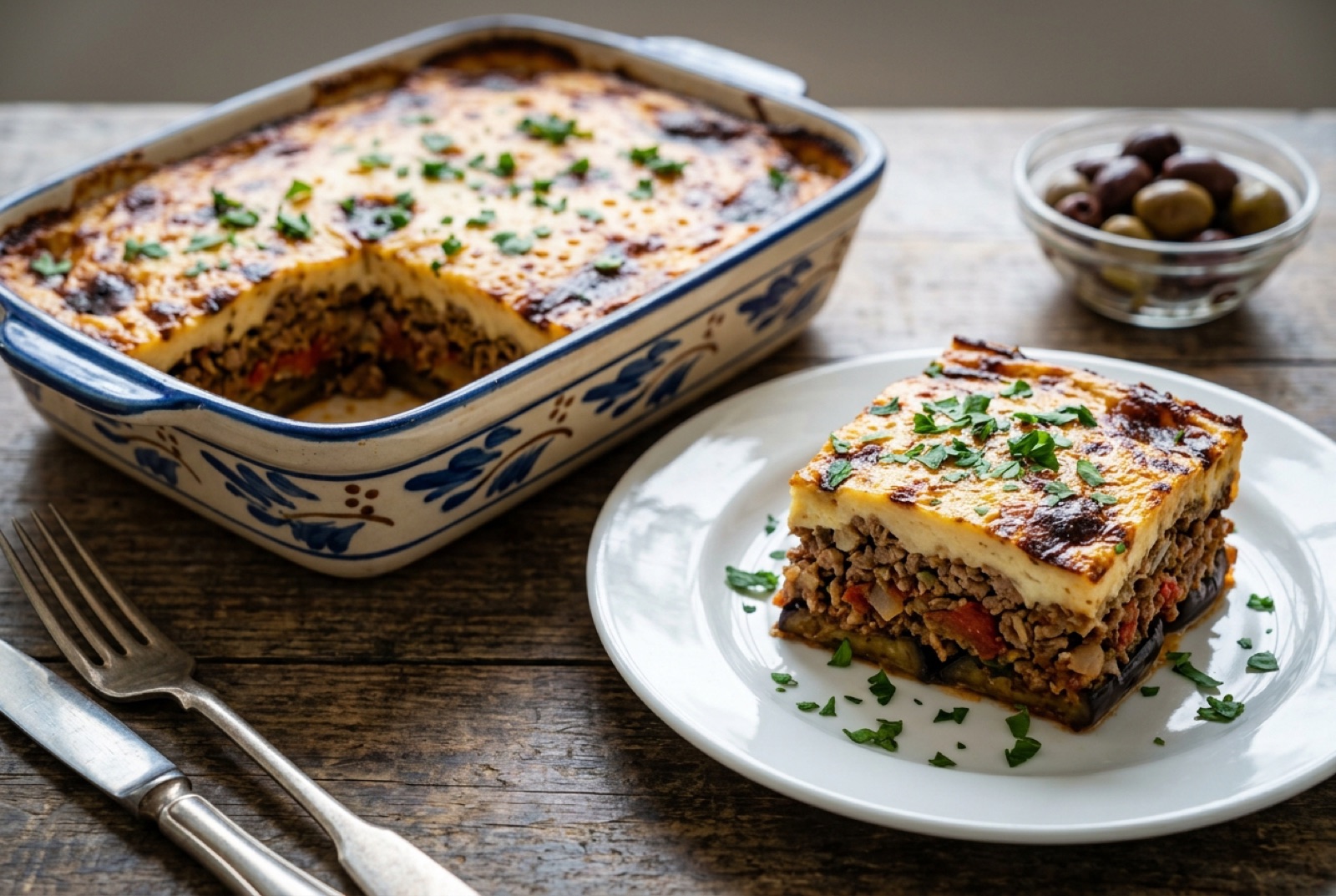
Moussaka is the layered casserole Greece brings out when it wants to impress: slices of fried eggplant and potato, a rich tomato-and-meat sauce warmed with cinnamon and allspice, and over it all a deep, custardy béchamel that bakes into a golden lid. Cut properly rested, a square holds its layers like a terrine — soft vegetables, savory-sweet meat, creamy top — and tastes far more than the sum of humble parts. It is unapologetically a project, but every component is simple on its own, and the whole thing is assembled hours or even a day before baking, which makes it one of the best make-ahead dishes in the Mediterranean.

- Gate
- Greece
- Prep
- 1 hr
- Cook
- 1 hr 30 min
- Total time
- 3 hr 15 min incl. 45 min rest
- Serves
- 8
- Status
- Medium
- Nutrition / serving · estimated
- Calories 540 kcal
- Protein 28 g
- Carbs 32 g
- Fat 33 g
- Fiber 6 g
Why this recipe works.
- A real béchamel finished with egg and cheese, thick enough to bake into a sliceable golden layer rather than a puddle.
- Eggplant is salted, then browned in a hot oven instead of shallow-fried — far less oil, no soggy layers.
- Cinnamon, allspice and red wine in the meat sauce give the warm, faintly sweet depth that marks a true Greek moussaka.
- Every component can be made a day ahead; assembly on the day takes ten minutes.
Ingredients.
19 itemsFor the vegetable layers
For the meat sauce
For the béchamel
Equipment
- Deep baking dish, about 23 x 33 cm
- Two sheet pans
- Large sauté pan
- Medium saucepan and whisk for the béchamel
Instructions.
Salt the eggplant
Lay the eggplant slices out, sprinkle both sides with the salt, and leave them 30 minutes until beads of moisture stand on the surface. Pat them thoroughly dry with a kitchen towel.
Tip Do not rinse — just pat hard. The salt that stays behind seasons the layer.
Roast the vegetables
Heat the oven to 220°C. Brush the eggplant and potato slices with olive oil on both sides, spread them on two sheet pans, and roast about 25 minutes, turning once, until the eggplant is soft and browned at the edges and the potatoes are just tender to a knife.
Make the meat sauce
Meanwhile, soften the onion in a little olive oil over medium heat until translucent, add the garlic for a minute, then brown 750 g of ground beef hard, breaking it up, until no pink remains and the bottom of the pan picks up brown patches. Pour in the wine and let it bubble almost completely away.
Simmer until thick
Add the tomatoes, cinnamon, allspice, bay leaf, salt and pepper, and simmer uncovered about 30 minutes, until the sauce is thick enough to hold its shape on a spoon with no free liquid pooling around it. Discard the bay leaf and taste for salt.
Tip This is the step that decides whether your moussaka slices or slumps — err on the side of too thick.
Make the béchamel
Melt the butter in a saucepan, whisk in the flour, and cook 2 minutes until it smells biscuity but has not colored. Add the warm milk in stages, whisking each addition smooth, and simmer gently, whisking, until the sauce heavily coats the back of a spoon. Off the heat, season with salt and nutmeg, then whisk a ladleful into the beaten eggs before whisking the egg mixture and half the cheese back into the pot.
Tip Tempering the eggs with hot sauce first keeps them from scrambling.
Assemble the layers
Lower the oven to 180°C. In a deep baking dish, lay the potatoes in one overlapping layer, then half the eggplant, then all the meat sauce spread level, then the remaining eggplant. Pour the béchamel over the top, smooth it to the corners, and scatter the rest of the cheese over it.
Bake until bronzed
Bake 45–50 minutes, until the top is deep golden brown with darker patches and the béchamel barely jiggles at the center when you nudge the dish. If the top is pale at the end, give it 2–3 minutes under the grill.
Rest before cutting
Rest the moussaka at least 30 minutes — up to an hour is better. It should be warm, not scorching, when you cut it; the first square is the cook's reward and should lift out with all its layers intact.
Tips from our kitchen.
- Salt the eggplant slices and let them sit 30 minutes, then pat dry hard. This seasons them through and collapses the sponge so they brown instead of drinking oil.
- Simmer the meat sauce until it is thick enough to mound on a spoon — a wet sauce turns the layers into soup and the slices will slump.
- The béchamel should coat a spoon heavily, like thick custard. Whisk a ladle of it into the beaten eggs before adding them back, or you will scramble them.
- Rest the baked moussaka at least 30 minutes, ideally an hour. Straight from the oven it collapses; rested, it cuts into clean squares. Tavernas bake it in the morning for lunch service.
- Grate a little nutmeg into the béchamel and a pinch of cinnamon into the meat — restraint here, the spices should be felt, not named.
- Use a deep baking dish, roughly 23 x 33 cm. Moussaka needs height; a shallow pan gives you a gratin, not a moussaka.
Substitutions.
- Ground beef → Ground lamb, or half lamb half beef
- Lamb is the more traditional choice in much of Greece and tastes noticeably richer. Beef is milder and cheaper — both are authentic somewhere.
- Kefalotyri cheese → Parmesan or pecorino
- Kefalotyri is a hard, salty Greek sheep's cheese. Parmesan is easier to find and works well; pecorino gets closer to the sheepy tang.
- Red wine in the sauce → An extra 100 ml of tomato passata plus a teaspoon of red wine vinegar
- The wine adds depth and acidity; the vinegar-passata swap approximates it and keeps the dish alcohol-free.
Variations.
- With zucchini
- Many Greek households add a layer of browned zucchini slices alongside (or instead of) the potato — common in summer when gardens overflow.
- Papoutsakia ("little shoes")
- The same meat sauce and béchamel baked inside halved, hollowed eggplants — moussaka's single-serving cousin, easier to portion for guests.
- Lenten moussaka
- For Orthodox fasting days, the meat is replaced with mushrooms and lentils and the béchamel is made with olive oil and plant milk — an old workaround, not a modern invention.
Storage & reheating.
Moussaka keeps 3–4 days refrigerated and many Greeks insist it is better on day two, once the layers have settled. Reheat squares in a 180°C oven for about 20 minutes, covered with foil; a microwave works but softens the top. It freezes well for up to 3 months, whole or in portions — thaw overnight in the fridge before reheating. You can also assemble it fully, refrigerate unbaked for a day, and bake it fresh.
Serve with
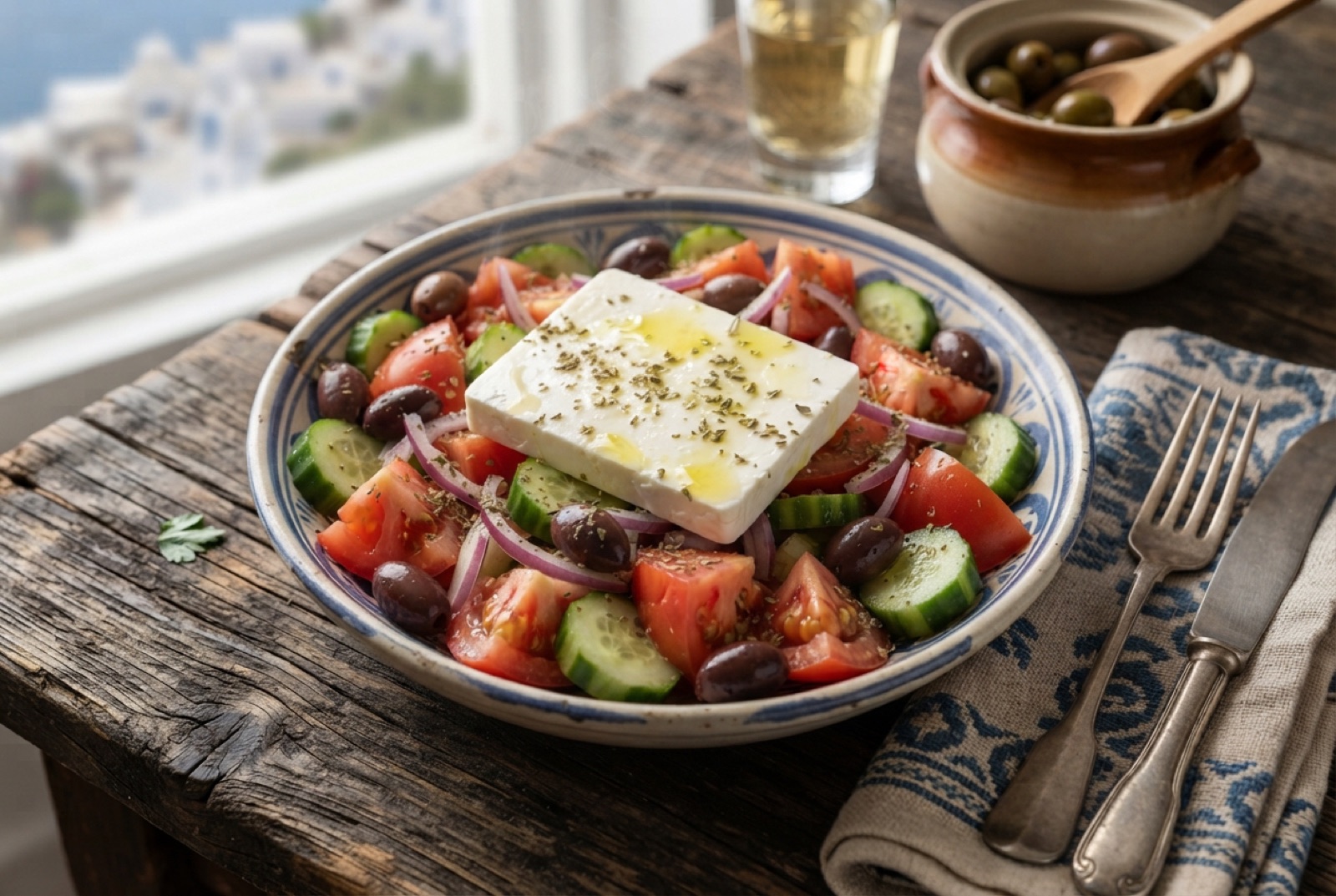
A horiatiki salad and crusty bread — the béchamel is rich, so the table wants something sharp and fresh beside it.
The story behind Greek Moussaka.
The moussaka family is Ottoman. Dishes of that name — layered or sautéed combinations of eggplant, tomato and minced meat — exist across the former empire, from Turkey and the Levant to the Balkans, and the word itself comes through Turkish from the Arabic musaqqa'a, roughly "moistened" or "chilled". In most of that world, moussaka still means a fairly rustic eggplant-and-meat dish with no white sauce anywhere in sight.
The moussaka the world knows — the tall, béchamel-crowned casserole — is a twentieth-century Greek invention with a named author. Nikolaos Tselementes, a Greek chef trained in the kitchens of Europe, published enormously influential cookbooks in the 1920s and 1930s with a deliberate agenda: to bring French technique into the Greek home kitchen, which he felt had drifted too far toward its Ottoman inheritance. His moussaka added a proper sauce béchamel — often enriched with egg and cheese — over the old eggplant-and-meat base, and the result colonized the country. His books became the standard wedding gift for Greek brides for decades, "Tselementes" became the generic Greek word for a cookbook, and his moussaka became the moussaka.
That history explains the dish's split personality: an Eastern heart (eggplant, olive oil, cinnamon in the meat) under a Western hat (the béchamel). It also explains why arguments about the "authentic" version are unwinnable — the potato layer, the choice of lamb or beef, whether to add zucchini, all vary by island, village and grandmother. What does not vary is the occasion. Moussaka is not a Tuesday dish in Greece; it is Sunday food, name-day food, the thing a taverna is judged on, made in a huge pan because it makes no sense to make a small one.
Questions, answered.
Is moussaka Greek or Turkish?
Both, honestly. The eggplant-and-minced-meat dish family is Ottoman and exists across Turkey, the Levant and the Balkans under the same name. The specific version with a thick béchamel topping — what most of the world pictures as moussaka — is Greek, popularized by the chef Nikolaos Tselementes in the 1920s, who deliberately added French technique to the older dish.
Should moussaka have potatoes in it?
It varies by household and region in Greece, and both camps consider themselves correct. A bottom layer of potato slices is very common — it soaks up juices, keeps the base from going soggy and stretches the dish — but eggplant-only moussaka is equally traditional. This recipe includes the potato layer; simply omit it and add another layer of eggplant if you prefer.
Can I make moussaka ahead of time?
Yes — it is arguably designed for it. Assemble the whole dish, cover and refrigerate it unbaked for up to 24 hours, then bake straight from the fridge, adding about 10 extra minutes. Alternatively bake it fully, rest it and reheat portions later; the flavor and the structure both improve after a night in the fridge.
Why did my moussaka fall apart when I cut it?
Almost always one of two reasons: the meat sauce was too wet, or the dish was cut too soon. The sauce should be reduced until thick and jammy before layering, and the baked moussaka needs at least 30 minutes of rest — ideally an hour — so the layers set. In Greek tavernas it is baked in the morning and served warm, not hot, for exactly this reason.
Is moussaka made with lamb or beef?
Either, depending on where in Greece you ask. Lamb (or a lamb-beef mix) is the older, richer choice and remains common; plain ground beef is at least as widespread in home kitchens today because it is cheaper and milder. The cinnamon-allspice-tomato seasoning is the constant — the meat under it is negotiable.
You might also like.
All recipes →
Keep exploring Greece.
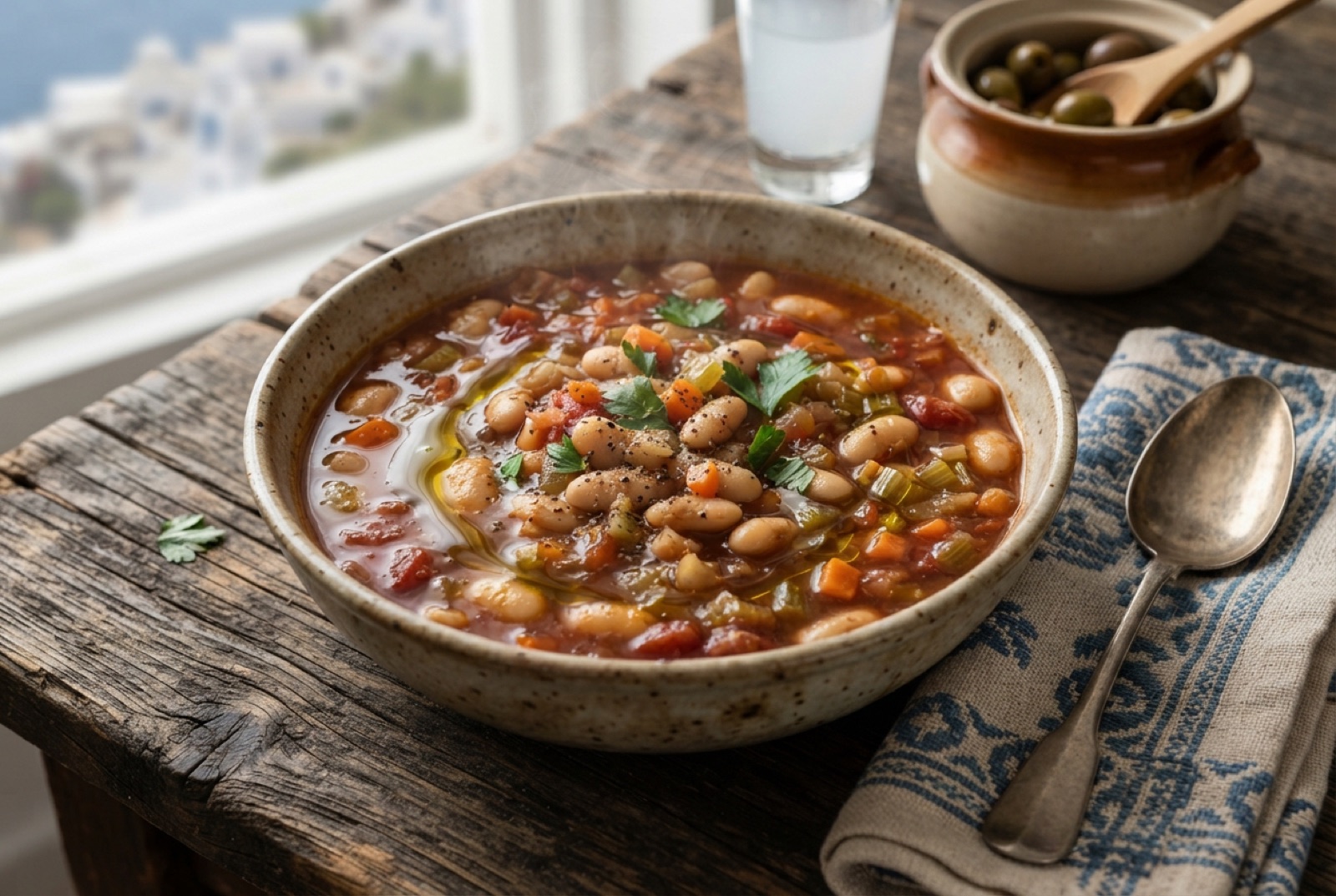
Greece has 9 more dishes in the atlas — Fasolada and Galaktoboureko, and 7 more.
Recipe by The DishRoute Kitchen · published August 18, 2026 · updated August 18, 2026