Horiatiki, the Real Greek Village Salad.
Χωριάτικη σαλάτα · Horiatiki salata · say it: ho-ree-AH-tee-kee
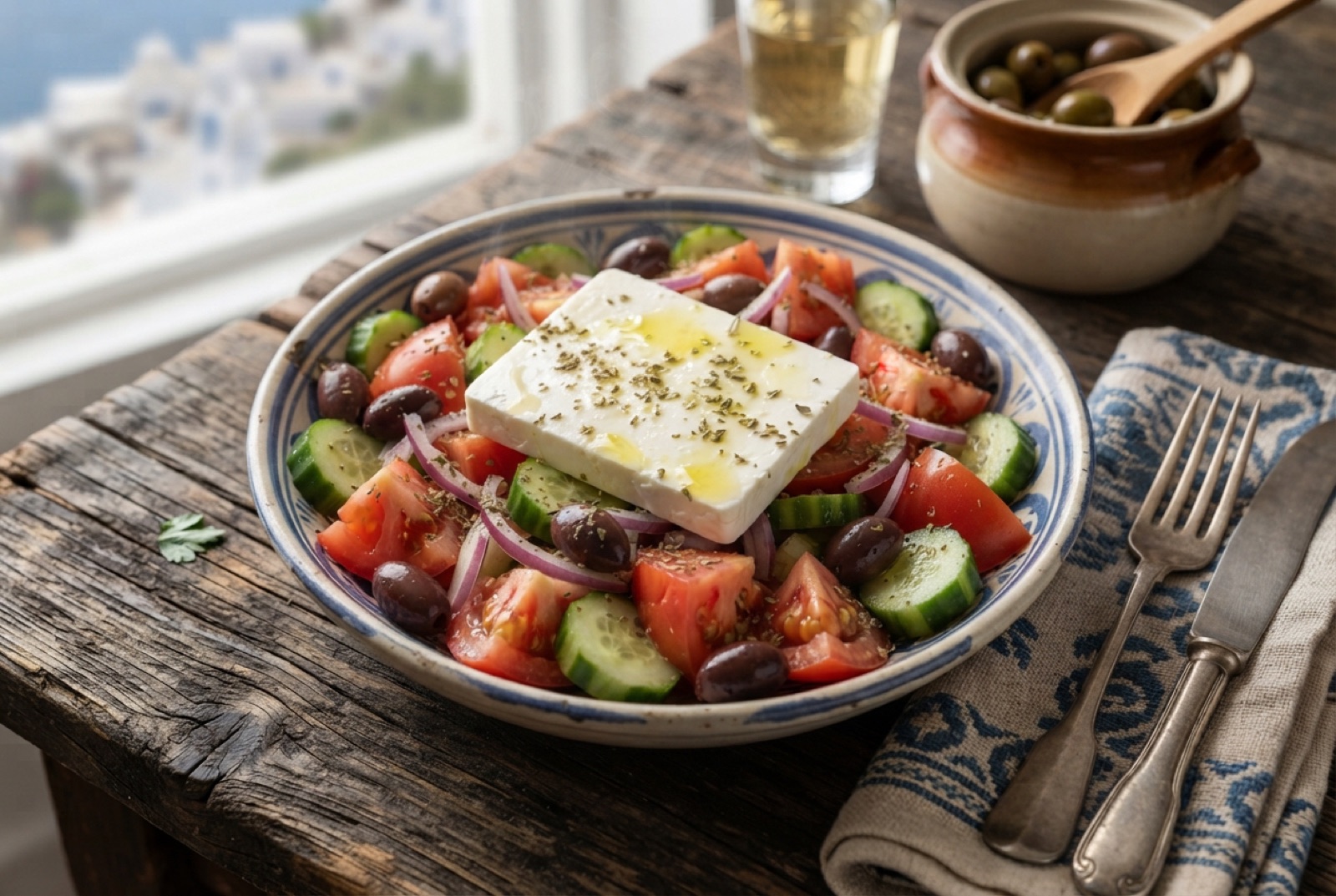
Horiatiki — "village salad" — is what Greeks actually mean by Greek salad, and the first thing to know is what it is not: there is no lettuce in it, anywhere, ever. It is chunks of ripe tomato and cucumber with red onion, green pepper and Kalamata olives, crowned with a whole slab of feta, showered with dried oregano and drowned generously in olive oil. Nothing is tossed with a whisked dressing; the tomato juices and oil mingle in the bottom of the bowl into a sauce you mop up with bread — many Greeks would tell you that puddle is the best part. It succeeds or fails entirely on the tomatoes, which makes it a five-minute dish that cannot be faked out of season.

- Gate
- Greece
- Prep
- 15 min
- Cook
- 0 min
- Total time
- 15 min
- Serves
- 4
- Status
- Easy
- Nutrition / serving · estimated
- Calories 260 kcal
- Protein 9 g
- Carbs 12 g
- Fat 21 g
- Fiber 3 g
Why this recipe works.
- The authentic taverna build — no lettuce, no crumbled cheese, no whisked vinaigrette — as it is actually served in Greece.
- Salting the tomatoes first pulls out their juice to create the bread-mopping sauce at the bottom of the bowl.
- Onion is soaked briefly in cold water so it bites without burning.
- Honest about the one non-negotiable: it is only worth making with genuinely ripe tomatoes.
Ingredients.
10 itemsEquipment
- A sharp knife
- One wide, shallow serving bowl
Instructions.
Tame the onion
Soak the onion rings in a bowl of cold water while you prepare everything else, until they lose their raw sting but keep their crunch — about 10 minutes. Drain and shake dry.
Cut and salt the tomatoes
Cut the tomatoes into rough wedges over the serving bowl so no juice is lost, season them with salt, and let them sit until the bottom of the bowl starts to glisten with their juices. This puddle becomes the dressing.
Tip Big careless chunks, not neat dice — horiatiki should look like it was cut by someone hungry.
Build the salad
Add the cucumber, drained onion, pepper rings and olives to the tomatoes and turn everything over gently with your hands, just until the vegetables are mingled and coated in tomato juice.
Crown with feta and dress
Lay the 200 g slab of feta whole on top of the vegetables. Scatter the oregano over the cheese and salad, rubbing it between your fingers, then pour the 4 tbsp of olive oil over everything until the surface glistens, adding the vinegar if using.
Rest briefly and serve
Let the salad stand about 5 minutes, until the oil and tomato juices have pooled visibly at the bottom of the bowl, then bring it to the table with bread. Each person cuts into the feta as they serve themselves.
Tips from our kitchen.
- Buy tomatoes by smell and weight — they should be heavy, fragrant at the stem, and soft enough to dent. Out of season, make a different salad; horiatiki cannot be rescued by technique.
- Cut everything in big, careless chunks. Dainty dice is wrong here — wedges of tomato, thick half-moons of cucumber, wide rings of onion.
- Use real Greek feta in brine (PDO if you can find it), and lay it on top in a slab. Pre-crumbled "salad cheese" is drier, saltier and blander.
- Dried Greek oregano (rigani) is the signature aroma — rub it between your fingers as you scatter it to wake it up.
- Be braver with the olive oil than feels reasonable. A proper horiatiki glistens, and the oil-tomato puddle at the bottom is meant for bread.
- Serve at room temperature. Fridge-cold tomatoes have no smell and no flavor.
Substitutions.
- Kalamata olives → Any good brined black olive, unpitted
- Unpitted olives keep more flavor and are how they are served in Greece. Avoid canned pitted black olives — they taste of nothing.
- Green bell pepper → Thin-skinned pale green peppers, or simply omit
- In Greece the pepper is often a thin, sweet variety. Some village versions skip pepper entirely; the salad survives fine without it.
- Red wine vinegar → A squeeze of lemon, or nothing at all
- Plenty of Greeks add no acid whatsoever — ripe tomatoes bring their own. Taste before you add any.
Variations.
- With capers
- On Santorini and other Cycladic islands, a spoonful of capers (sometimes caper leaves) goes in — a briny island signature worth copying.
- Kritiki with dakos
- The Cretan cousin: the same salad over barley rusks that soak up the tomato juice, often with local mizithra instead of feta.
- With purslane
- In summer some villages add a handful of purslane (glistrida), a lemony succulent green — a garden weed promoted to ingredient, and still not lettuce.
Storage & reheating.
Horiatiki is at its best the moment the oil hits it and does not really keep — the salt draws the vegetables' juices and by the next day everything is soft and swimming. If you must, store leftovers covered in the fridge up to a day and eat them cold with bread, or strain and repurpose the vegetables into a sandwich. Better plan: cut the vegetables ahead, but salt, dress and add the feta only at the table.
Serve with
Crusty bread for the juices, alongside anything grilled — or as a light lunch on its own with olives and a glass of white wine.
The story behind Horiatiki, the Real Greek Village Salad.
The name gives away the idea: horiatiki means "of the village," a farmer's plate assembled from whatever the garden and the pantry held in high summer — tomatoes and cucumbers picked that morning, onion, the barrel of brined olives, the barrel of feta, oil from the family's trees. Nothing about it needed a recipe, which is why its precise origin is murky. The version served in every taverna today is usually traced to the mid-twentieth century; a commonly told account has tavernas popularizing the feta-topped salad during the tourism boom of the 1960s, partly because it showcased cheap local abundance. However it settled into its canon, the canon is now firm, and deviations are noticed.
The slab of feta on top is not garnish but architecture. Served whole rather than crumbled, it lets each person cut off as much as they want with each forkful, and it announces that the cheese is real — feta has been a protected designation of origin in the EU since 2002, legally made in Greece from sheep's milk or a sheep-goat blend, brined until tangy and firm. Crumbling the cheese into the salad is what happens abroad; in Greece the white block arrives intact, often with an extra flourish of oregano and oil across its back.
Horiatiki is also a calendar. Greeks largely refuse to make it in winter, because a January tomato is an insult to the dish — the salad appears when tomatoes are heavy and split-skinned, roughly May to October, and it appears at nearly every meal in that window. On the islands it lands on the table before you have finished ordering, with bread and oil, as automatic as water. Lettuce salads exist in Greece too (marouli, in winter and spring) — they are simply a different dish, and confusing the two is the fastest way to reveal you learned Greek salad somewhere else.
Questions, answered.
Does authentic Greek salad have lettuce?
No. Horiatiki, the salad Greeks mean by "Greek salad," contains no lettuce at all — it is tomato, cucumber, onion, pepper, olives and feta. Lettuce-based Greek salads are an invention of restaurants abroad. Greece does eat lettuce salads (marouli salata), but that is a separate winter-and-spring dish, not horiatiki.
Should the feta be crumbled or in one piece?
One piece. In Greece the feta arrives as an intact slab laid over the vegetables, usually dusted with oregano and drizzled with oil, and each diner cuts into it as they eat. Crumbling it beforehand is the export-version habit — not a crime, but it changes the salad's character and usually means less, and worse, cheese.
What dressing goes on a Greek salad?
Strictly speaking, none — no whisked vinaigrette is prepared. The salad is seasoned in the bowl: salt, dried oregano, a generous pour of good olive oil, and optionally a small splash of red wine vinegar. The oil mixes with the salted tomatoes' juices at the bottom of the bowl and becomes the dressing, which is traditionally mopped up with bread.
Is Greek salad gluten-free and vegetarian?
Yes to both as written: it is vegetables, olives, feta, oregano and olive oil, with no gluten-containing ingredient (the bread served alongside is separate — skip it or use gluten-free bread). It is vegetarian but not vegan because of the feta; some feta is made with animal rennet, so strict vegetarians should check the label or choose a vegetarian-rennet cheese.
Can I make Greek salad in winter?
You can, but Greeks generally will not, and they have a point — the salad is mostly raw tomato, so a mealy winter tomato leaves it flavorless no matter what you do. If ripe tomatoes are unavailable, the honest options are good cherry tomatoes (the most reliable out-of-season choice) or a different salad until summer.
You might also like.
All recipes →
Keep exploring Greece.
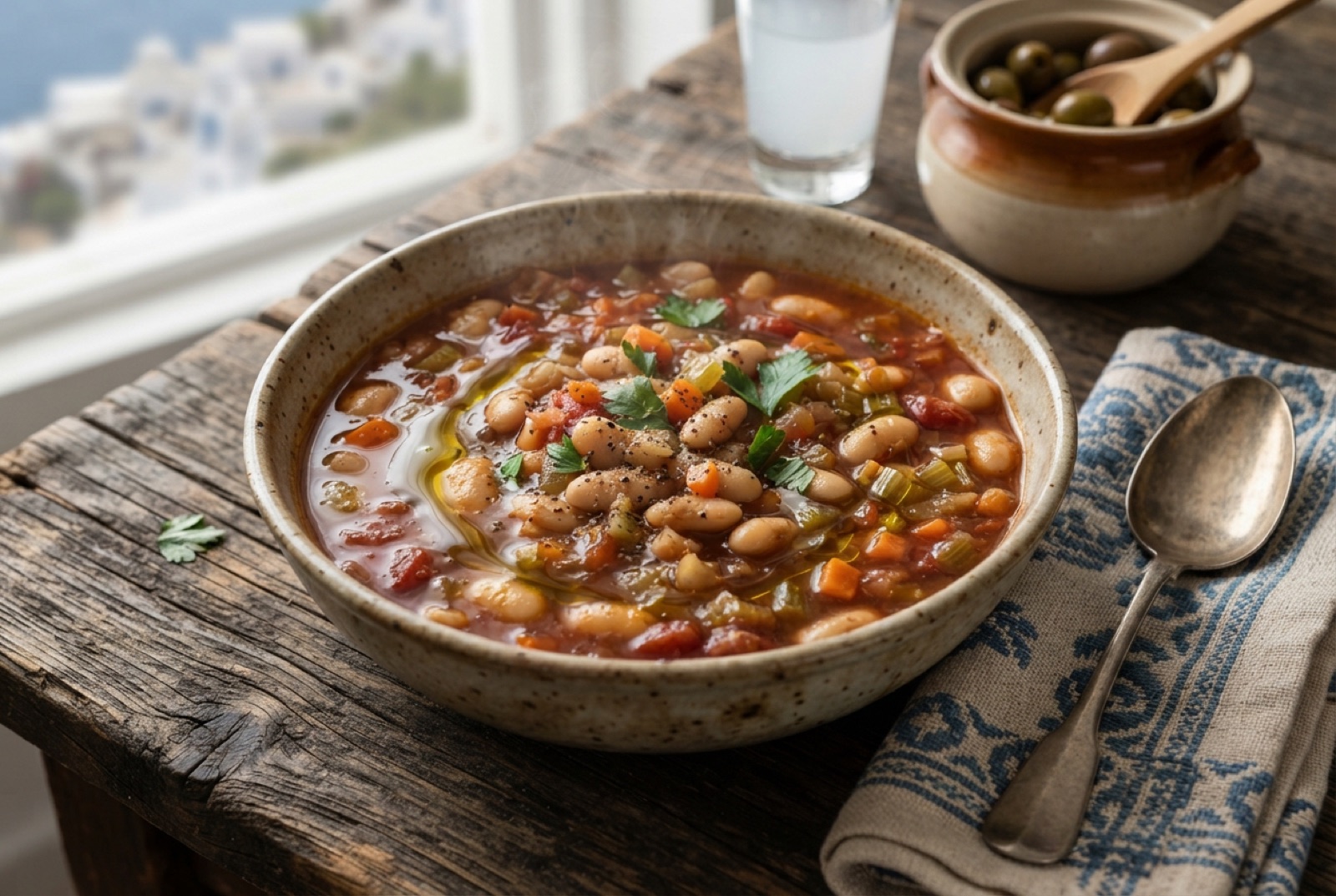
Greece has 9 more dishes in the atlas — Fasolada and Galaktoboureko, and 7 more.
Recipe by The DishRoute Kitchen · published August 18, 2026 · updated August 18, 2026