Mukimo.
Kikuyu Green Mash with Maize and Beans
Mũkimo · say it: moo-KEE-moh
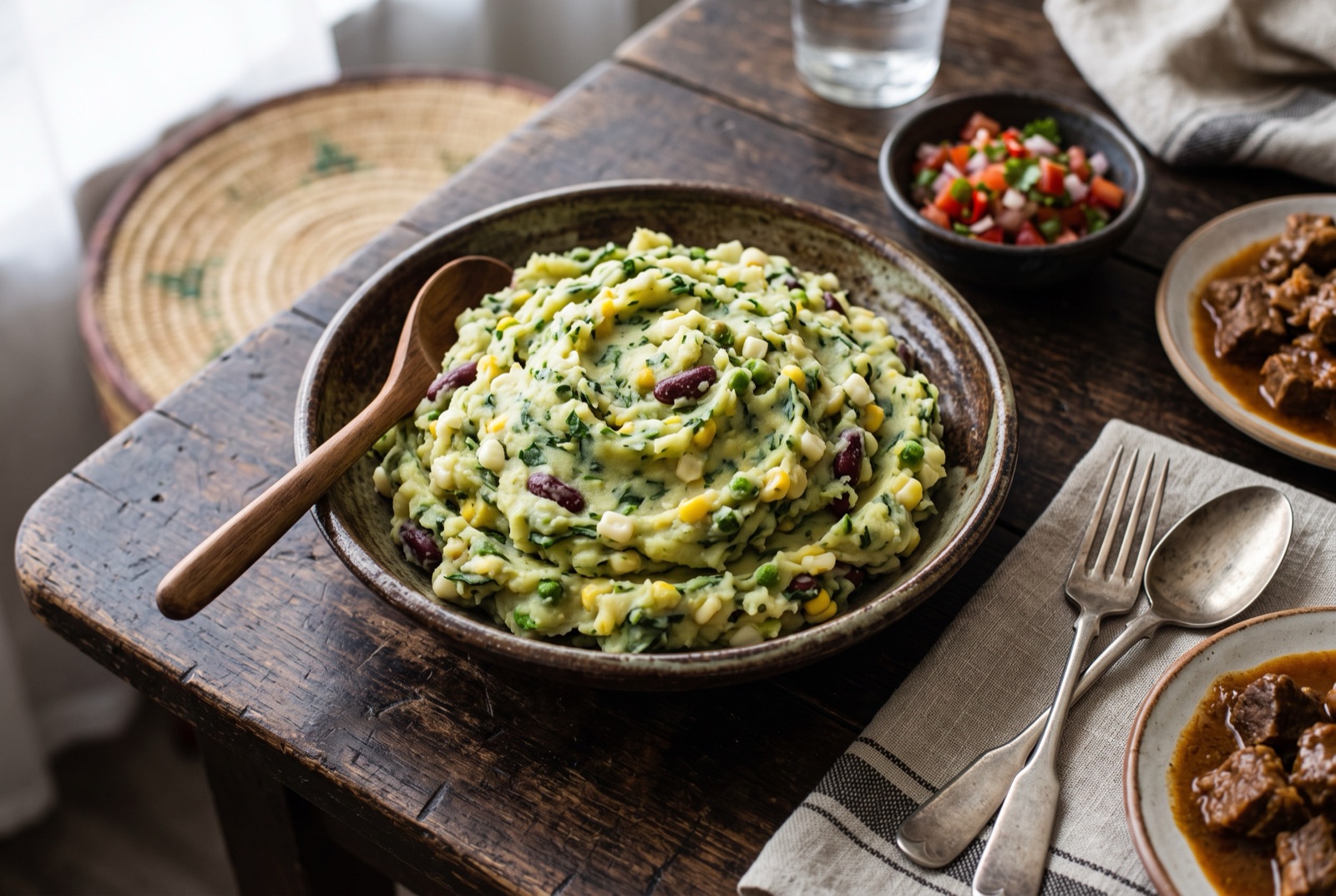
Mukimo is a mash rather than a stew: floury potatoes crushed together with soft beans, whole maize kernels and enough green leaves and peas to stain the entire bowl a soft sage colour. It is not smooth. The point is the contrast between the creamy potato and the things that refuse to break down — kernels that pop between the teeth, beans that stay whole, peas that burst. The flavour is gentle and vegetal, more about texture and the sweetness of maize than about seasoning, which is why it is almost always served next to something assertive like grilled goat or a dark beef stew. Kikuyu households mound it high on the plate and press a hollow into the top for sauce.

- Gate
- KenyaCentral Kenya
- Prep
- 20 min
- Cook
- 30 min
- Total time
- 50 min
- Serves
- 6
- Status
- Medium
- Nutrition / serving · estimated
- Calories 340 kcal
- Protein 12 g
- Carbs 62 g
- Fat 6 g
- Fiber 11 g
- Sodium 340 mg
Why this recipe works.
- Cooks the components in the right order so the potatoes are floury and the greens are not stewed to nothing.
- Mashes rather than whips, which keeps the potato light instead of turning it gluey.
- Gets the colour from real greens rather than food dye, and says how much you actually need.
- Gives usable substitutes for pumpkin leaves, which are almost impossible to buy outside East Africa.
Ingredients.
8 itemsEquipment
- Large pot
- Potato masher or wooden pestle
- Colander
Instructions.
Boil the potatoes
Put the quartered potatoes in a large pot, cover with cold salted water and bring to the boil. Simmer for 18 to 20 minutes, until a knife slides into a piece with no resistance and the edges look slightly ragged.
Cook peas and greens
In a second pan, boil the peas for 4 minutes, then add the chopped greens and cook 2 minutes more, until the leaves have collapsed and turned a deeper green. Drain, keeping a mug of the cooking water, and chop the greens finely on a board.
Tip Do not cook the greens longer than this. Overcooked leaves turn khaki and drag the whole mash grey.
Dry the potatoes
Drain the potatoes and return them to the hot empty pot over low heat for a minute, shaking occasionally, until the surfaces look dry and floury and no steam is rising. Mash them roughly with a hand masher — leave some texture.
Fold everything together
Add the maize, beans, peas and chopped greens to the potato along with the butter, and work the mixture with the masher rather than a whisk until the colour is even and pale green throughout. Splash in the reserved green cooking water a little at a time if it feels stiff.
Tip Stop as soon as the colour is uniform; every extra stroke pushes the potato towards glue.
Season and check texture
Season generously with salt and pepper and taste twice, since starch mutes salt. The finished mukimo should hold a shape on a spoon but not be dry or crumbly, with kernels and beans clearly visible in the mash.
Mound and serve
Pile the mukimo onto plates in a dome and press a hollow into the top with the back of a spoon. Fill the hollow with stew or the juices from grilled meat and serve while hot.
Tips from our kitchen.
- Choose floury potatoes — a waxy variety stays firm and gives a lumpy, wet mash rather than a fluffy one.
- Drain the potatoes and let them steam dry in the hot pan for a minute before mashing; residual water dilutes everything.
- Never use a blender or food processor. Potato starch cells rupture under blades and the mash turns into wallpaper paste.
- Add the greens finely chopped and hot, straight from their blanching water, so the colour transfers evenly through the mash.
- Season assertively and taste twice — starch swallows salt, and an underseasoned mukimo tastes of very little.
- Serve it mounded with a well pressed into the top; the hollow is where the stew or grilled meat juices go.
Substitutions.
- Pumpkin leaves → Spinach, chard leaves, or African nightshade (managu) if you can find it
- Spinach is the practical stand-in and gives the same colour, though pumpkin leaves have a rougher texture and a slightly grassier taste.
- Dried maize kernels → Tinned sweetcorn or hominy, drained
- Sweetcorn is sweeter and softer than the dried field maize used in Kenya. Hominy is closer in bite if you can get it.
- Cooked kidney beans → Any tinned bean — rosecoco, pinto or borlotti
- The bean is not the point here; that it stays whole in the mash is. Avoid anything that collapses, such as butter beans.
- Green peas → Frozen peas added at the very end
- Frozen peas are perfectly acceptable and hold their colour better than fresh ones that have been sitting around.
Variations.
- Mukimo wa ngwaci
- Made with sweet potato in place of some of the white potato, which gives a sweeter mash and an orange cast that fights the green.
- Green banana mukimo
- Boiled green bananas mashed in with the potato, common where matoke is grown. Denser, stickier and slightly tangy.
- Restaurant irio
- The version served with nyama choma across Nairobi: smoother, greener, often with more peas and a knob of butter worked through at the end.
Storage & reheating.
Mukimo keeps 3 days refrigerated but stiffens considerably as the starch sets. Reheat it in a pan over low heat with a splash of milk or the water the greens were cooked in, breaking it up with a wooden spoon until it loosens. Microwaving works but heats unevenly, so stir it halfway. Leftovers are also excellent shaped into patties, dusted lightly in flour and fried until a crust forms — a common way to use up yesterday's bowl. It does not freeze well; the potato turns grainy and weeps water on thawing.
Serve with
A dark beef or goat stew, or grilled meat, with plenty of sauce spooned into the hollow on top.
The story behind Mukimo.
Mukimo belongs to the Kikuyu kitchen of the central highlands, where the ingredients are simply what grows: potatoes on the volcanic slopes around Mount Kenya, maize and beans intercropped in the same shambas, and pumpkin vines whose leaves are picked young for greens long before any pumpkin is cut. The name comes from the Kikuyu verb for mashing, and the traditional tool is a heavy wooden pestle worked in a deep pot, which crushes without whipping — a distinction that matters, because potato beaten too hard turns to glue.
It occupies a specific ceremonial place. Mukimo is wedding food, prepared in quantity for the negotiations and celebrations around a Kikuyu marriage and carried out in large basins, and it turns up at initiations, church functions and Christmas tables for the same reason: it feeds many people from cheap ingredients and looks generous when mounded. The green colour is part of that presentation, which is why cooks push the quantity of leaves further than flavour alone would require.
The relationship with irio is a fair source of confusion, and worth stating honestly rather than resolving falsely. Irio in Kikuyu means food in the general sense, and it has come to be used, especially in Nairobi restaurants and abroad, for the same mashed mixture of potato, maize, beans and greens. Many people treat the two words as interchangeable; others insist mukimo is the specific mashed dish and irio is the broader term or a slightly different, less green preparation. Ask two cooks and you will get two answers, both delivered with confidence. What nobody disputes is the composition and the method: boil everything separately or in sequence, mash it together while hot, and serve it with something to spoon over the top.
Questions, answered.
What is the difference between mukimo and irio?
The honest answer is that it depends who you ask. Irio simply means food in Kikuyu and is widely used, especially in restaurants, for this same mash of potato, maize, beans and greens. Some cooks treat the words as synonyms, others reserve mukimo for the specific mashed dish. The ingredients and method are the same either way, so you will not go wrong ordering or cooking either.
Why did my mukimo turn out gluey?
You worked the potato too hard, most likely with a blender, food processor or electric mixer. Potato starch turns elastic when it is beaten, and once that happens nothing brings it back. Use a hand masher or a wooden pestle, stop as soon as the mixture is combined, and accept that a slightly lumpy mukimo is the correct one.
What gives mukimo its green colour?
Leafy greens mashed in while hot — traditionally young pumpkin leaves, sometimes African nightshade — plus the peas. The colour is meant to run right through the mash rather than sit in streaks, so chop the greens finely and fold them in thoroughly. Some commercial kitchens boost it with food colouring, which is unnecessary if you use enough leaves.
Can I make mukimo ahead for a crowd?
Yes, and it is standard practice for large gatherings. Cook and mash it up to a day ahead, keep it refrigerated, then reheat gently with a little liquid and check the seasoning again before serving. Mash it slightly wetter than you want it, since it firms up as it cools and again as it reheats.
Is mukimo a main dish or a side?
Both, depending on the table. With maize, beans and peas in it, mukimo is filling and nutritionally reasonable enough to eat alone as a vegetarian meal. In its usual role it is the starch on a plate with grilled meat or a stew, where it plays the part that mashed potato or ugali would elsewhere.
You might also like.
All recipes →
Keep exploring Kenya.
Kenya has 9 more dishes in the atlas — Githeri and Kenyan Chapati, and 7 more.
Recipe by The DishRoute Kitchen · published August 20, 2026 · updated August 20, 2026