Choila.
Newari Spiced Grilled Buffalo
छोयला · say it: CHO-ee-lah
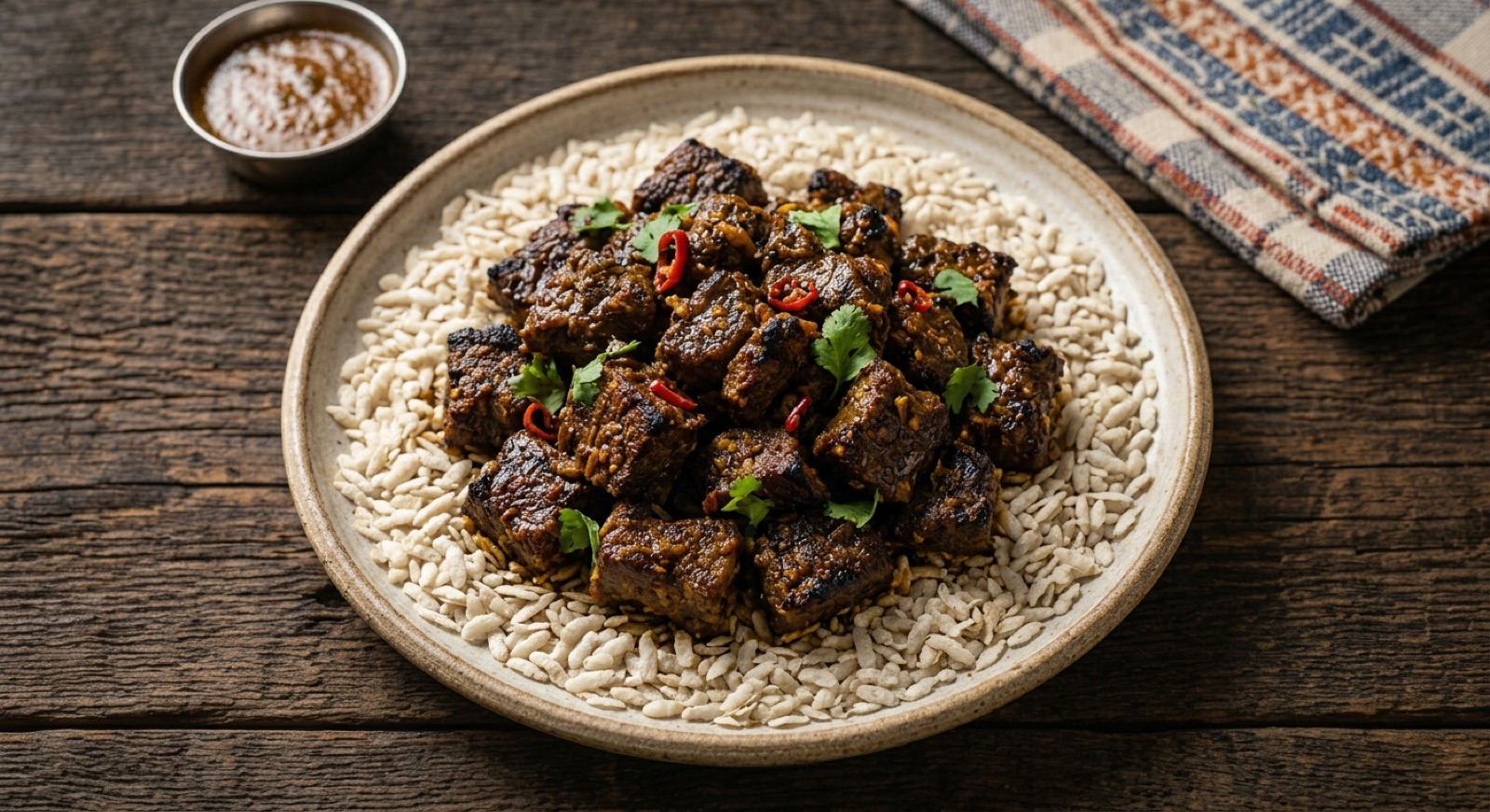
Choila is grilled meat dressed while the dressing is still smoking. Buffalo, or more often chicken outside Nepal, is cooked over direct flame until the outside is properly charred, cut into rough cubes, and tossed with raw ginger, garlic, chile, timur and turmeric — then mustard oil is heated until it smokes and poured straight over the lot so the spices sizzle and half-cook on contact. The result is smoky, hot, sharply pungent from the mustard oil and tingly from the timur, and it is eaten at room temperature rather than hot, with beaten rice and a glass of the local rice spirit. It is Newari party food, and it does not do subtle.

- Gate
- NepalKathmandu Valley
- Prep
- 20 min
- Cook
- 20 min
- Total time
- 55 min incl. 15 min rest
- Serves
- 4
- Status
- Medium
- Nutrition / serving · estimated
- Calories 420 kcal
- Protein 36 g
- Carbs 6 g
- Fat 28 g
- Fiber 2 g
- Sodium 780 mg
Why this recipe works.
- Insists on real char, which is the flavour most home versions of choila are missing.
- The smoking mustard oil step is explained with a clear visual cue rather than a vague instruction.
- Works with buffalo, chicken or duck and tells you what each one changes.
- Balanced so the dish is fiercely flavoured but still edible by the plateful, not just a chile challenge.
Ingredients.
15 itemsFor grilling
For the dressing
To finish
Equipment
- Charcoal grill, gas flame or heavy cast iron pan
- Small pan for heating the mustard oil
- Heatproof mixing bowl
- Sharp knife
Instructions.
Season and grill
Rub the meat with turmeric and salt. Grill over the hottest coals or in a cast iron pan preheated until it is almost smoking, 4 to 6 minutes a side, until the surface is blackened in patches and the smell turns properly smoky.
Tip Do not chase evenness. Uneven blackening is what choila should taste like.
Rest, then cube
Let the meat rest 5 minutes so the juices settle, then cut it into rough 2 cm cubes across the grain. Tip the cubes and any resting juices into a heatproof bowl.
Pile on the raw aromatics
Add the minced garlic, ginger, sliced green chiles, chile powder and roasted cumin on top of the meat without stirring. Keeping them in a heap means the hot oil hits them directly instead of running to the bottom of the bowl.
Smoke the mustard oil
Heat the mustard oil in a small pan over high heat until it thins, shimmers and sends up a visible wisp of smoke and the raw sharp smell disappears. Throw in the fenugreek seeds and let them darken for 5 seconds only.
Tip Fenugreek goes bitter almost instantly. Count to five and pour.
Pour and toss
Pour the smoking oil straight over the heap of aromatics — it should hiss loudly and the garlic should turn pale and fragrant on contact. Toss everything hard so every cube is coated in orange-red oil.
Season and rest
Stir in the lemon juice, ground timur and salt to taste. Let the bowl sit at room temperature for at least 15 minutes so the char, oil and spices fuse — it tastes noticeably better than it did straight after mixing.
Finish and serve
Fold through the sliced red onion and cilantro just before serving so they stay crisp. Serve at room temperature with a bowl of beaten rice alongside, and eat it with your fingers.
Tips from our kitchen.
- Char over the hottest heat you have. Blackened edges are correct; a pale grilled surface makes bland choila.
- Cut the meat after grilling, never before — small pieces dry out over flame and lose their juice.
- Heat the mustard oil until it visibly wisps smoke and its raw pungency disappears, then pour immediately.
- Add the timur last and off the heat; its citrus note evaporates with any real cooking.
- Let the dressed meat sit at least 15 minutes before serving so the char, oil and aromatics fuse.
- Serve at room temperature. Hot choila tastes muddled — the flavours only line up once it settles.
Substitutions.
- Buffalo → Chicken thigh, duck breast, or beef skirt
- Chicken choila is standard in restaurants and easiest at home. Duck is the traditional festival alternative. Beef skirt is closest in texture to buffalo.
- Mustard oil → Neutral oil plus 1 tsp English mustard powder stirred in off the heat
- An approximation, not a match. Mustard oil is the defining pungency of the dish and Indian and Nepali grocers carry it cheaply.
- Timur → Toasted, ground Sichuan peppercorns
- The same numbing genus with a slightly different aroma. Do not replace it with black pepper, which changes the dish entirely.
Variations.
- Haku choila
- The dark roasted version — meat grilled hard over flame, heavier on chile and timur, and the one most often meant when someone just says choila.
- Manaa choila
- Made with boiled rather than grilled meat and a gentler dressing, often served to elders and children at the same feast.
- Mushroom choila
- A modern Kathmandu vegetarian take using charred king oyster mushrooms, which take smoke and mustard oil surprisingly well.
Storage & reheating.
Choila keeps 2 days refrigerated and is arguably better on the second day once the mustard oil has fully permeated the meat. Bring it back to room temperature before serving — straight from the fridge the oil congeals and the flavours flatten. Do not reheat it in a pan, which cooks the raw aromatics and dulls the timur. It does not freeze usefully; the texture of the meat turns stringy.
Serve with
Chiura (beaten rice), a wedge of raw ginger, black soybeans and cold beer or aila.
The story behind Choila.
Choila belongs to the Newar people of the Kathmandu Valley, whose cuisine is one of the most elaborate and least exported in South Asia. Newar feasts — the samay baji plate, the long bhoj banquets that accompany weddings and festivals — are built around cold or room-temperature items eaten together with beaten rice: choila, bara lentil cakes, sanya khuna fish aspic, black soybeans, boiled egg, ginger, and a wedge of the valley's fierce achar. Nothing arrives in courses, everything sits on the plate at once, and the eating goes on for hours alongside aila, the home-distilled spirit.
Buffalo is the traditional meat, and that is not incidental. The Newar butchering tradition uses essentially every part of the buffalo, with different cuts and organs assigned to different dishes across the feast, and the community is one of the very few in South Asia with a deep buffalo cuisine of its own. Cows are protected in Nepal; water buffalo is not, and its dark, dense meat carries char and mustard oil better than beef would. In practice, three versions circulate: haku choila made with roasted meat, manaa choila with boiled meat and a milder dressing, and the very traditional raw version served at certain rituals, which is not something to attempt at home.
What makes choila taste like choila rather than like a grilled meat salad is the sequence. The meat has to be genuinely charred, not gently cooked, because that bitterness is a load-bearing flavour. The aromatics have to go on raw. And the mustard oil has to be heated past its smoke point before it hits the bowl — raw mustard oil is acrid and unpleasant, while smoking oil turns nutty and pungent in a way that cooks the garlic and chile in the same instant it lands on them. Home cooks without a charcoal grill can get most of the way with a screaming-hot cast iron pan or a blowtorch pass, and the recipe below says so honestly rather than pretending an oven will do.
Questions, answered.
Do I need a charcoal grill to make choila?
No, but you need serious direct heat. A cast iron pan preheated until it is almost smoking, a gas flame with the meat held on a fork, or a blowtorch pass over grilled meat all produce usable char. An oven will not, because it cooks the meat through before the surface blackens, and char is the flavour the dish is built on.
Why does the mustard oil need to smoke?
Raw mustard oil has a harsh, sinus-clearing pungency that tastes acrid in a finished dish. Heating it to the smoke point mellows that into a nutty, still-pungent aroma, and pouring it smoking over the raw garlic, chile and spices cooks them instantly on contact — which is the whole technique of the dressing.
Is choila served hot or cold?
At room temperature, which surprises most first-timers. It is a feast-plate item meant to sit alongside beaten rice and other cold dishes for hours, and its flavours are actually clearer once the meat has cooled and absorbed the dressing. Serving it hot off the grill muddles the timur and the raw aromatics.
How spicy should choila be?
Traditionally very. Newari choila is one of the hotter dishes in Nepali cooking and the chile is not a background note. That said, the heat should sit behind the smoke and the mustard oil rather than erase them, so start with half the chile, taste after the oil goes in, and add more from there.
Can I make choila ahead for a party?
Yes, and you should. Grill and dress it up to a day ahead, refrigerate, then pull it out an hour before guests arrive so it comes back to room temperature. Add the fresh cilantro and a final pinch of timur just before serving so the top layer still smells bright.
You might also like.
All recipes →
Keep exploring Nepal.
Nepal has 9 more dishes in the atlas — Aloo ko Achar and Aloo Tama, and 7 more.
All Nepal recipes Chicken recipes Ginger recipes Garlic recipes appetizergluten freedairy freenut freeRecipe by The DishRoute Kitchen · published August 20, 2026 · updated August 20, 2026