Ovocné Knedlíky.
Czech Fruit-Filled Quark Dumplings
Ovocné knedlíky · say it: OH-vots-neh KNED-lee-kee
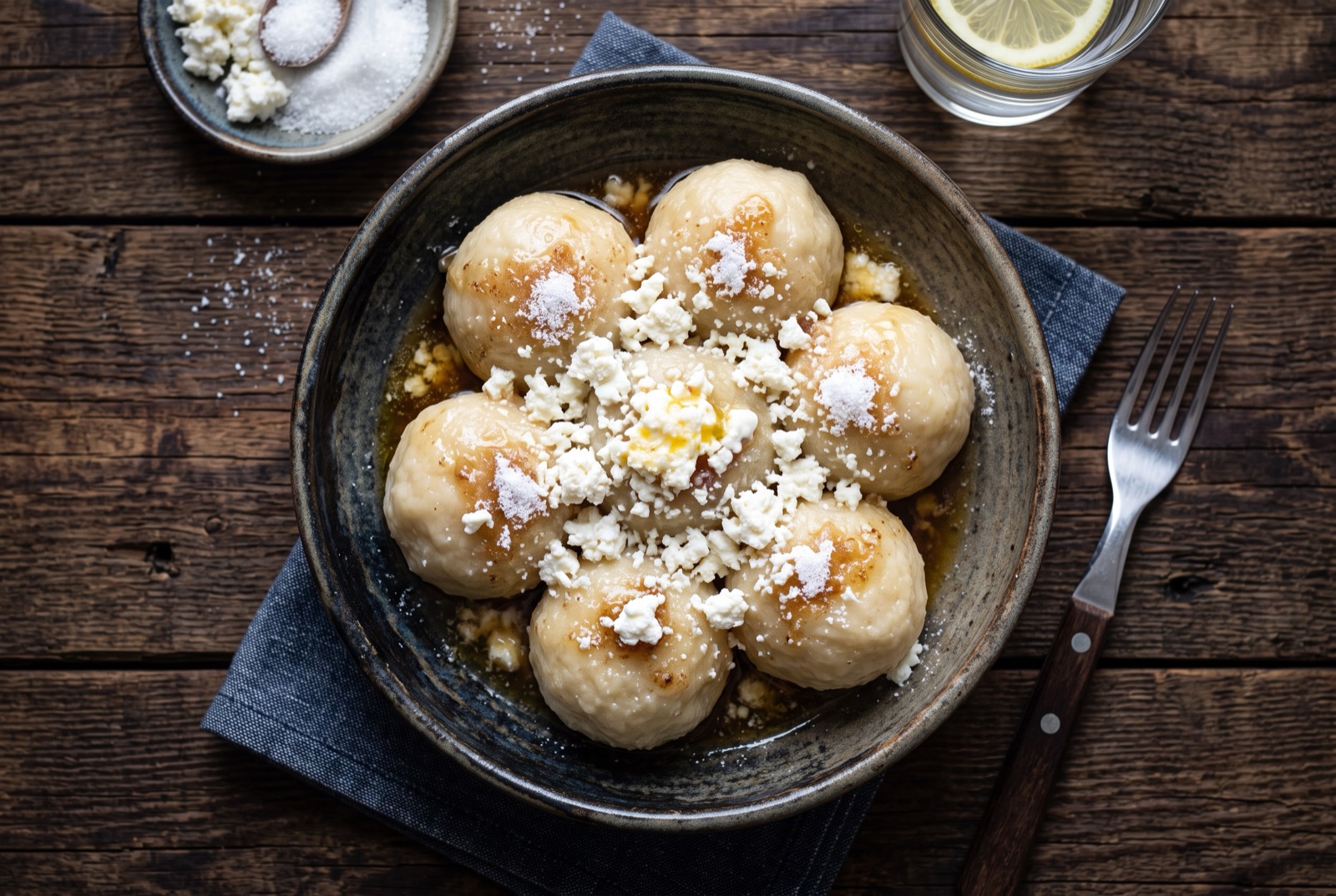
Ovocné knedlíky are whole stoned plums or apricots wrapped in a soft dough made with quark, boiled for a few minutes and served hot under melted butter, crumbled tvaroh and a heavy dusting of icing sugar. Cut one open and the fruit inside has collapsed into hot, tart juice that runs into the butter on the plate. The dough is mild and pillowy, the fruit is sharp, the butter and sugar mediate between them. What surprises visitors is that Czechs eat this as the entire meal — a plate of four or five dumplings and nothing else — usually in high summer when the plum and apricot trees come in all at once.

- Gate
- CzechiaBohemia
- Prep
- 30 min
- Cook
- 20 min
- Total time
- 1 hr 20 min incl. 30 min rest
- Serves
- 4
- Status
- Medium
- Nutrition / serving · estimated
- Calories 690 kcal
- Protein 21 g
- Carbs 88 g
- Fat 29 g
- Fiber 5 g
- Sugar 45 g
- Sodium 380 mg
Why this recipe works.
- Quark dough rather than yeast, so the dumplings can be made and eaten within an hour and are far harder to tear.
- A resting step for the dough that makes it dramatically easier to seal around whole fruit without cracks.
- Clear instructions on the boil — the point where most fruit dumplings burst open and lose their filling.
- Honest about serving size and role: this is dinner in Czechia, and the recipe is portioned as a main course.
Ingredients.
11 itemsFor the dough
For the filling
To finish
Equipment
- Wide deep pan
- Slotted spoon
- Fine sieve for the icing sugar
Instructions.
Make the quark dough
Beat the drained quark with the egg, melted butter and salt until smooth, then work in the flour and semolina to a soft, slightly tacky dough. Stop as soon as it comes together — extra kneading makes the dough tough and rubbery once boiled.
Rest the dough
Wrap the dough and leave it at room temperature for 30 minutes. It will stop springing back when you press it, which is what makes wrapping fruit possible without tearing thin patches.
Prepare the fruit
Slit each plum down one side and prise the stone out, keeping the fruit whole. Push a sugar cube into the cavity if you like, and press the fruit gently closed again.
Wrap the dumplings
Divide the dough into sixteen pieces and flatten each into a disc about 8 cm across in your floured palm. Sit a plum in the centre, bring the edges up and over, pinch them together firmly, then roll the dumpling between your hands until the seam disappears entirely.
Tip Hold each finished dumpling up to the light. Anywhere the fruit shows through is a hole waiting to open in the pan.
Boil gently in batches
Bring a wide pan of lightly salted water to a gentle rolling simmer and lower in four or five dumplings at a time. Stir once so nothing settles on the base, and cook for 7–8 minutes from the moment they surface, keeping the water moving but never letting it boil hard.
Test one from the first batch
Cut the first dumpling open. The dough should be matte and cooked all the way through with no glossy raw band above the fruit, and the fruit should be soft and running with juice. Adjust the timing for the remaining batches if needed.
Butter them straight from the water
Lift the dumplings out with a slotted spoon, let them drain for a moment, and pour melted butter over them immediately while the surfaces are still wet — this is what stops them going sticky and gluing together on the plate.
Finish with curd and sugar
Crumble the remaining quark thickly over the dumplings and sift a heavy layer of icing sugar on top, more than seems reasonable. Serve at once, with extra melted butter on the table.
Tips from our kitchen.
- Drain the quark if it is at all wet. Wet quark means wet dough, and wet dough means dumplings that split in the water.
- Rest the dough for 30 minutes before shaping. It relaxes and stops springing back, which is what causes thin patches and leaks.
- Flatten the dough in your palm, sit the fruit in the middle and bring the edges up and over, pinching firmly. Roll each finished dumpling between your hands to erase the seam.
- Keep the water at a gentle rolling simmer, never a hard boil. Violent water knocks dumplings against each other and splits the seams.
- Cook in batches with room to move. Crowded dumplings stick together and tear when you separate them.
- Pour the melted butter over the moment they leave the water, before the surface dries — that is what stops them going tacky on the plate.
Substitutions.
- Quark (tvaroh) → Full-fat ricotta pressed dry, or dry curd cottage cheese blitzed smooth
- Whatever you use must be thick and dry. Anything wet will need extra flour and will give you a tougher dough.
- Fresh plums → Apricots, halved and stoned peaches, or a spoonful of thick jam
- Very juicy fruit like strawberries is the hardest to contain. If using jam, freeze the spoonfuls first so they hold shape while you wrap them.
- Curd cheese topping → Toasted breadcrumbs fried in butter, or a heavy spoonful of thick soured cream
- Buttered breadcrumbs are a completely traditional alternative and give the dish crunch instead of creaminess.
Variations.
- Yeast dough dumplings
- The older method: a soft enriched yeast dough, risen and then wrapped around the fruit. Lighter and fluffier, but slower and much more fragile in the water.
- Potato dough dumplings
- Made with riced boiled potato and flour. Chewier and denser, popular in Moravia, and the sturdiest option if your fruit is large or very juicy.
- Poppy seed finish
- Ground poppy seed mixed with icing sugar instead of curd cheese — the other great Czech sweet topping, and a natural match for plums.
Storage & reheating.
Eat them the day they are made; the dough firms up considerably in the fridge and the fruit continues to leak into it. Leftovers reheat acceptably in a steamer for 5 minutes, or sliced and fried in butter until the cut faces are golden, which is arguably better than the original. Uncooked dumplings freeze well: open-freeze them on a floured tray, bag them once solid, and boil from frozen with 3 extra minutes. Do not freeze them after cooking, as the dough turns gummy.
Serve with
Nothing. In Czechia this is the whole meal, four or five dumplings to a plate, with more butter on the table.
The story behind Ovocné Knedlíky.
Sweet main courses are not a novelty in Czech cooking but a category. Alongside fruit dumplings there are lívance (thick pancakes), buchtičky se šodó (small buns in vanilla sauce) and dukátové buchtičky, all of which turn up as lunch rather than dessert, and all of which appear in school canteens to the day. The logic is old and agricultural: eggs, flour, milk and fruit were what a household had, meat was for Sunday, and a filling sweet plate was a perfectly respectable dinner.
The dumpling is the Czech obsession applied to fruit. Where the savoury version wraps bread cubes in yeast dough to soak up sauce, this one wraps whole fruit in a tender dough that has to be soft enough to eat and strong enough to survive boiling. Three doughs compete for the job. Quark dough — tvarohové těsto — is the most popular now: quick, soft, slightly tangy, and forgiving. Yeast dough is the older version, lighter but slower and more fragile. Potato dough is the sturdiest, favoured in Moravia and for larger fruit, and it tastes noticeably more substantial.
Season dictates the filling. Plums in late summer and early autumn are the classic and to many the only correct choice; apricots come earlier, strawberries in June are a matter of taste, and blueberries need to be tied up in dough rather than wrapped around. In some households a sugar cube or a small piece of cinnamon is pushed into the cavity where the stone was, which melts into syrup while the dumpling boils. The finishing is not negotiable: melted butter first, then crumbled tvaroh, then far more icing sugar than seems sensible.
Questions, answered.
Why do my dumplings burst in the water?
Almost always a sealing or temperature problem. Pinch the seams firmly and then roll each dumpling between your palms until you cannot see the join, and check for thin patches where the fruit shows through. Then keep the water at a gentle simmer rather than a rolling boil, and cook in batches so the dumplings are not knocking into each other.
What is quark and what can I use instead?
Quark, or tvaroh in Czech, is a fresh unripened curd cheese, thick and mildly sour, sold in tubs across Central and Northern Europe. If you cannot find it, full-fat ricotta pressed dry in a sieve or muslin is the closest match, and dry curd cottage cheese blitzed smooth also works. The important quality is dryness, not the exact cheese.
How do I know when they are cooked?
They float, and then they need a little longer. A dumpling rises to the surface after about four minutes but the dough just above the fruit is still raw at that point, so give it another three to four minutes at a simmer. To be sure, sacrifice one from the first batch and cut it open — the dough should be uniformly matte, with no glossy raw patch.
Can I use frozen fruit?
Yes, and it makes wrapping easier because frozen fruit is firm and does not leak while you work. Wrap it straight from the freezer without thawing and add two or three minutes to the boiling time. Expect a little more liquid inside the finished dumpling, since freezing breaks down the fruit cell walls.
Is this really eaten as a main course?
Yes. Sweet main courses are a normal category in Czech cooking, served for lunch or dinner rather than after one, and fruit dumplings are the summer flagship. A portion is four or five dumplings per adult with nothing alongside. Serving them as a small dessert after a large meal is possible but would strike most Czechs as an odd use of them.
You might also like.
All recipes →
Keep exploring Czechia.
Czechia has 9 more dishes in the atlas — Bramborák and Hovězí Guláš, and 7 more.
Recipe by The DishRoute Kitchen · published August 20, 2026 · updated August 20, 2026