Patacones Panameños.
Twice-Fried Green Plantains
Patacones · say it: pah-tah-KOH-nehs
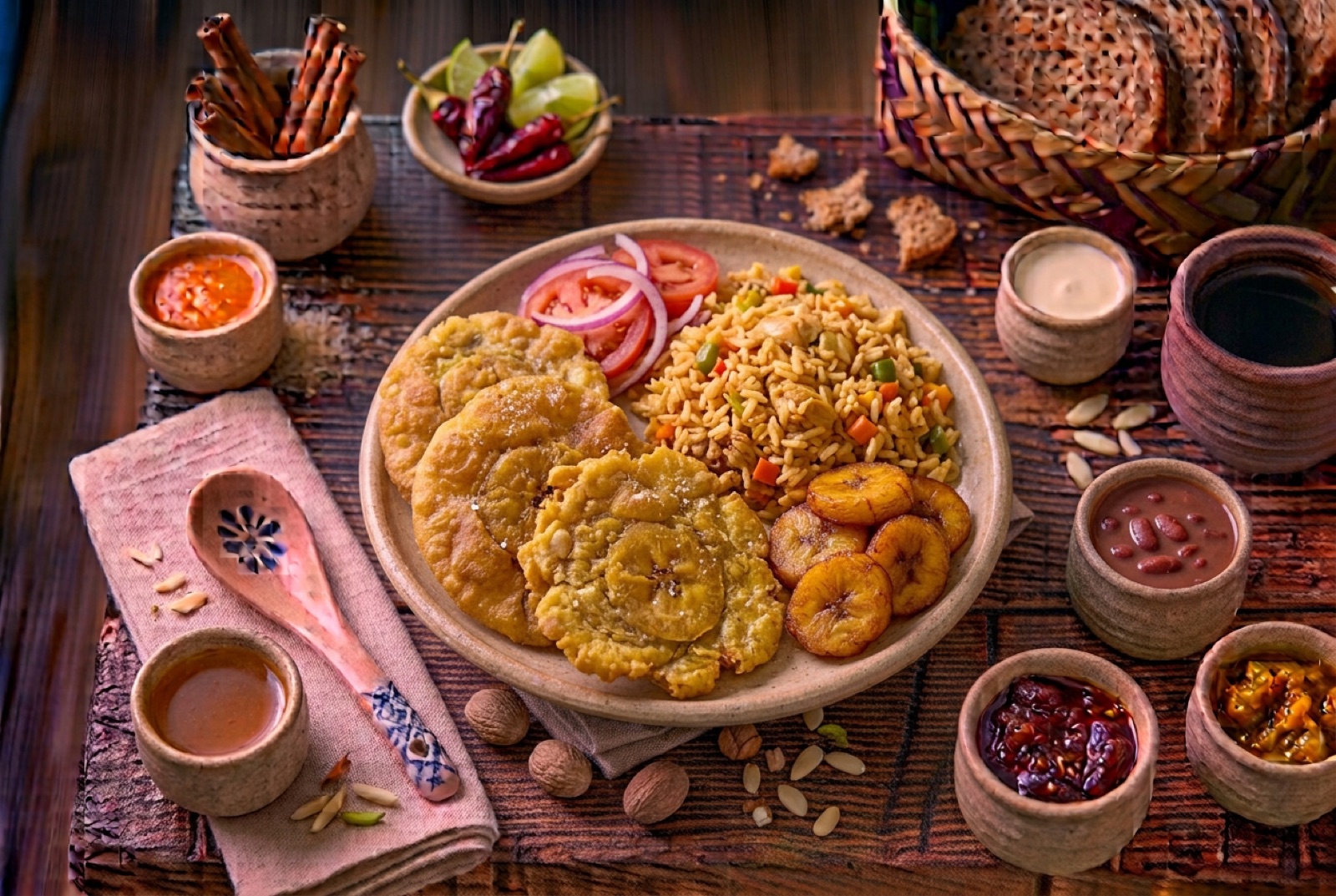
A patacón is a green plantain cooked twice for two different reasons. The first fry, at a gentle heat, cooks the starchy flesh through until it gives under a thumb but takes no colour. The disc is then flattened — with a wooden press, the bottom of a glass or a plate — and returned to hotter oil, where the increased surface area crisps the outside into something that snaps while the inside stays dense and faintly sweet. Salted the moment it comes out, a good patacón is crunchy at the ragged edge and almost creamy in the middle. In Panama it is not a snack you make occasionally; it is the default starch on the side of the plate, the thing that arrives with fried fish, with ropa vieja, with a bowl of ceviche as an edible spoon.

- Gate
- PanamaNationwide
- Prep
- 15 min
- Cook
- 25 min
- Total time
- 40 min
- Serves
- 4
- Status
- Easy
- Nutrition / serving · estimated
- Calories 285 kcal
- Protein 2 g
- Carbs 44 g
- Fat 12 g
- Fiber 3 g
- Sugar 18 g
- Sodium 420 mg
Why this recipe works.
- Two distinct oil temperatures, which is the actual difference between a crisp patacón and a chalky one.
- The salted garlic water dip seasons the plantain through rather than only on the surface.
- Cutting thick rounds gives a patacón with a creamy centre instead of a dry crisp.
- Works with a glass and a plate — no special press needed, though a tostonera is faster.
Ingredients.
7 itemsFor frying
For the dip
To serve
Equipment
- Heavy deep pan or Dutch oven
- Tostonera, or a flat-bottomed glass and a plate
- Slotted spoon
- Kitchen thermometer
Instructions.
Peel and cut
Cut the ends off each plantain and score the skin lengthwise along its ridges, deep enough to reach the flesh. Lever off the skin in strips, then cut the plantain into rounds about 3 cm thick, cutting straight across rather than on the diagonal.
Tip Green plantain sap stains badly and is hard to wash off — rub a little oil on your hands and the knife blade before you start.
Make the dipping water
Stir the salt into the warm water until it dissolves, add the crushed garlic and set the bowl beside the stove. This is what seasons the plantain internally and helps the second fry blister the surface.
First fry, low and slow
Heat the oil to about 150C in a heavy deep pan. Fry the rounds in batches for 5 to 6 minutes, turning once, until they are pale gold and a spoon pressed against one sinks in easily. They should not brown at this stage.
Tip Crowding drops the oil temperature hard. Fry in two or three batches and let the oil come back up between them.
Press them flat
Lift the rounds onto a board or kitchen paper. While they are still hot, press each one to about 5 mm thick with a tostonera, or by standing a round between two sheets of baking paper and leaning on it with a flat-bottomed glass.
Tip If a round cracks apart at the edges instead of spreading, it was undercooked — put the rest back in the low oil for another two minutes.
Dip and second fry
Raise the oil to about 190C. Dip each pressed disc into the garlic salt water for one second, shake off the excess firmly, and slide it into the hot oil. Fry 2 to 3 minutes, turning once, until deep gold and blistered at the edges.
Tip Wet discs spit, so lower them in away from you and keep the pan no more than a third full of oil.
Salt and serve immediately
Drain briefly on a rack rather than kitchen paper so the undersides stay crisp, and scatter flaky salt over them while the surface is still glistening. Serve within minutes, with lime wedges and chile sauce on the side.
Tips from our kitchen.
- Buy plantains that are hard and fully green with no yellow at all. Any yellowing means sugar, and sugar burns before the disc crisps.
- Score the skin along its ridges with a knife rather than trying to peel it like a banana, then lever it off in strips with your thumb.
- First fry at about 150C until pale and yielding, second at about 190C. One temperature for both fries gives you either raw centres or burnt edges.
- Press firmly but stop at 5 mm. Pressed thinner they turn into crisps; left thicker they stay doughy inside.
- The dip between fries should be brief — one second in and straight out. A soaked disc spits violently and goes soggy.
- Salt them the second they leave the oil while the surface is still wet, or the salt will not stick at all.
Substitutions.
- Green plantain → Very unripe yellow-green plantain
- Fry it slightly cooler and watch it closely — even a little sugar means it colours much faster and can be dark outside while still firm inside.
- Neutral frying oil → Lard or a mix of oil and lard
- Traditional in inland Panama and noticeably richer, but it smokes at a lower temperature so keep the second fry closer to 180C.
- Garlic in the dipping water → Plain salted water, or salted water with a squeeze of lime
- Lime adds a faint sourness that suits patacones served with fish, and is common on the Caribbean coast.
Variations.
- Patacón con todo
- A single large plantain split lengthwise, pressed into a plate-sized disc and loaded with shredded beef, cheese and sauce — restaurant food rather than home food.
- Tajadas
- Ripe plantain sliced on the diagonal and fried once until dark and sweet. Not a patacón at all, but the other plantain that turns up on the same Panamanian lunch plate.
- Patacones as ceviche scoops
- Pressed thinner, closer to 3 mm, and fried until fully brittle so they work as a cracker for ceviche or shredded chicken.
Storage & reheating.
Patacones are best within minutes of frying and genuinely poor the next day — they go leathery in the fridge and no reheating brings the snap back properly. If you need to work ahead, do the first fry, press the discs, and keep them uncovered at room temperature for up to 4 hours or frozen flat on a tray for a month; fry them from frozen straight into hot oil without thawing. Fully fried patacones can be revived for about 4 minutes in a 200C oven, which restores maybe three quarters of the crispness. Do not stack them hot in a covered container — the trapped steam softens them within minutes.
Serve with
Ceviche, fried fish, ropa vieja or sancocho, with ají chombo sauce and lime wedges alongside.
The story behind Patacones Panameños.
Plantains reached the Americas with Portuguese and Spanish shipping in the sixteenth century, carried from West Africa where the twice-frying technique already existed, and they took to the Caribbean lowlands immediately. What made them essential in Panama is that they crop year round in a climate with no meaningful winter, they travel badly bruised without spoiling, and a green plantain is starch rather than fruit — closer in kitchen terms to a potato than to a banana. On an isthmus where wheat has to be imported and potatoes only grow well in the Chiriquí highlands, that mattered.
Panama does not own this dish and does not pretend to. The same preparation is patacones in Colombia, Ecuador and Venezuela, tostones in Cuba, Puerto Rico and the Dominican Republic, and bannann peze in Haiti, and the differences between them are small — thickness of the cut, whether the discs are dipped in salted water or garlic water between fries, how hard they are pressed. What is distinctly Panamanian is how constantly they appear. A fonda lunch of rice and stew comes with patacones on the edge of the plate without anyone asking. Fried fish at a beach shack near Chame or on the Caribbean side arrives on a bed of them. They are the standard scoop for ceviche in Panama City, and the standard base for the plate-sized patacón topped with shredded beef or shrimp that restaurants now build as a starter.
The technique is honest and unglamorous, and it rewards patience in exactly one place: the first fry. Panamanian cooks fry the rounds slowly, sometimes at little more than a shimmer, because a plantain that is still hard in the centre will crack apart when pressed and will stay chalky no matter how long the second fry goes on. The second fry is the opposite — hot and quick, three minutes at most. Between the two, some households dip the pressed discs briefly in salted water with a crushed clove of garlic, which seasons them all the way through and drives a burst of steam into the oil that opens up the surface. It is not universal, but it is common enough in Panama and Colombia that plenty of cooks consider it the whole trick.
Questions, answered.
What is the difference between patacones and tostones?
There is no difference in method — both are green plantain rounds fried, flattened and fried again. The name changes by country: patacones in Panama, Colombia, Ecuador and Venezuela, tostones in Cuba, Puerto Rico and the Dominican Republic. Panamanian versions are often cut a little thicker and are sometimes dipped in salted garlic water between the two fries.
Why are my patacones hard in the middle?
The first fry was too short or too hot. That stage is meant to cook the starch through at a low temperature, around 150C, until the round gives easily when pressed with a spoon and is still pale. If it takes colour before it softens, the outside sets while the centre stays raw, and no amount of second frying will fix it.
Can I make patacones in an air fryer?
You can, but they are a different thing. Brush the rounds generously with oil, cook at 180C for about 10 minutes, press, brush again and cook a further 8 minutes at 200C. The result is drier and more uniform in texture, without the shattered crisp edge that deep frying gives, and it will not fool anyone who grew up eating them.
How do I peel a green plantain?
Cut off both ends, then run a knife lengthwise through the skin along each natural ridge, going deep enough to reach the flesh but no further. Lever the strips of skin away with your thumb or the back of the knife. Green plantain skin is thick and does not pull away like a banana, and the sap stains hands and boards, so many cooks oil their hands first.
What oil should I fry patacones in?
Any neutral oil with a high smoke point works — sunflower, canola, corn or soybean. You need enough depth for the rounds to float freely, about 3 cm in a heavy pan. Lard or a lard and oil mixture is traditional in parts of inland Panama and gives a richer flavour, but it smokes lower so the second fry should stay near 180C.
You might also like.
All recipes →
Keep exploring Panama.
Panama has 9 more dishes in the atlas — Arroz con Guandú y Coco and Carimañolas, and 7 more.
All Panama recipes Plantain recipes Garlic recipes sidesnackstreet foodvegetarianvegangluten freedairy freeRecipe by The DishRoute Kitchen · published August 21, 2026 · updated August 21, 2026