Peixinhos da Horta.
Portuguese Battered Green Beans
Peixinhos da horta · say it: pay-SHEEN-yoosh dah OR-tah
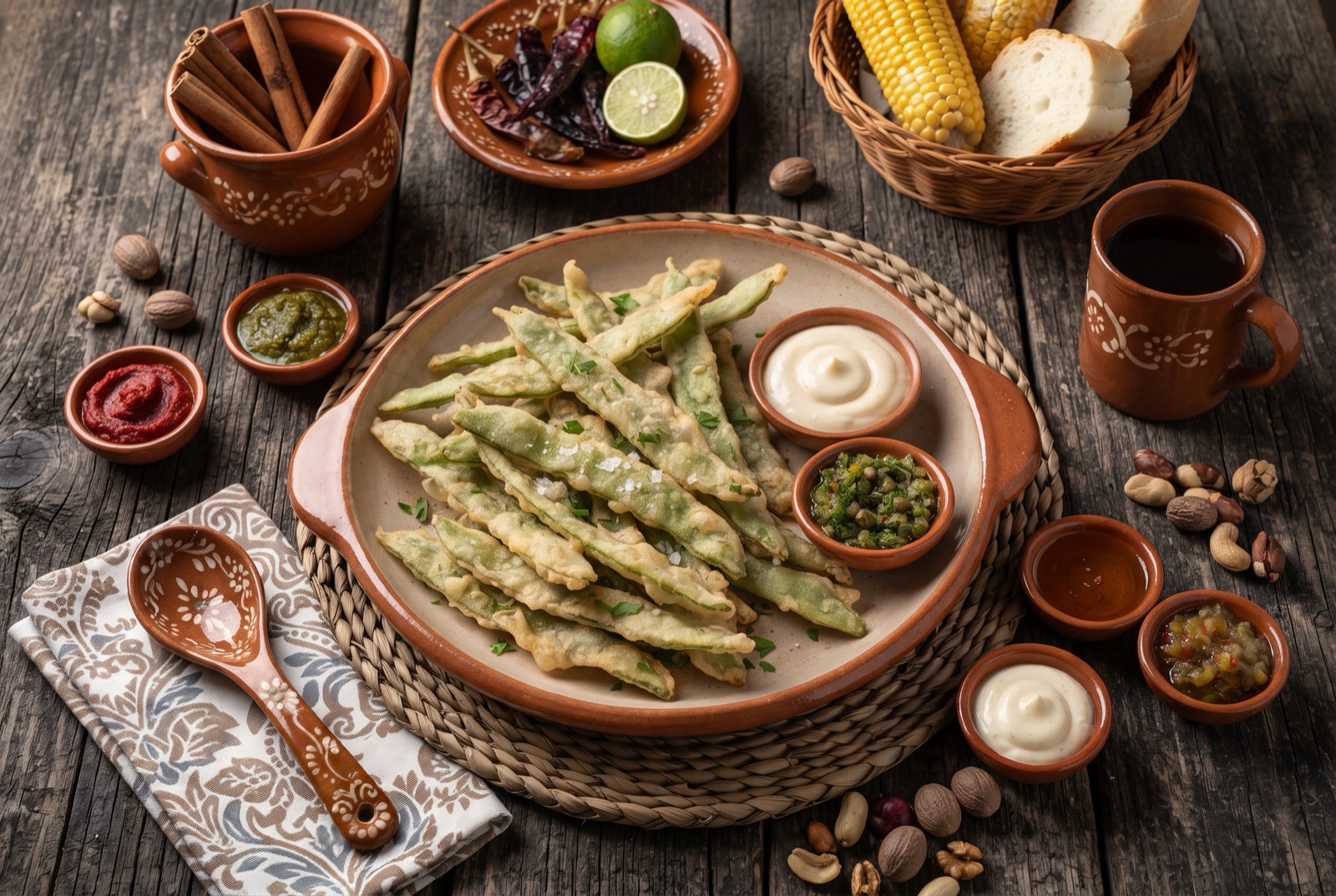
The name means "little fish of the garden", and it is a joke about substitution: on fast days when meat was forbidden and fish was scarce, green beans were battered and fried until they looked and ate like small fried fish. The beans are blanched briefly so they stay bright and snap, then dragged through a loose batter of flour, egg and cold liquid and dropped into hot oil, where the coating puffs into an uneven, blistered shell. Inside, the bean is still green and squeaky; outside it is crisp, light and barely browned. Eaten hot with a squeeze of lemon and nothing else, they disappear faster than you can fry them, which is why nobody in Portugal has ever made a small batch.

- Gate
- PortugalLisbon and central Portugal
- Prep
- 20 min
- Cook
- 15 min
- Total time
- 1 hr 5 min incl. 30 min rest
- Serves
- 4
- Status
- Easy
- Nutrition / serving · estimated
- Calories 290 kcal
- Protein 8 g
- Carbs 34 g
- Fat 14 g
- Fiber 5 g
- Sugar 4 g
- Sodium 620 mg
Why this recipe works.
- The batter is built cold and mixed briefly, so it fries into a light, blistered shell instead of a thick doughy jacket.
- Blanches the beans first, which fixes the two usual failures at once — raw beans inside a cooked coating, and dull khaki colour.
- Gives the oil temperature and the visual tells for it, since the whole dish stands or falls on frying heat.
- Includes a genuinely good eggless version rather than treating vegans as an afterthought.
Ingredients.
11 itemsFor the beans
For the batter
To fry
To serve
Equipment
- Deep saucepan or wok for frying
- Kitchen thermometer
- Slotted spoon or spider
- Wire cooling rack
Instructions.
Blanch the beans
Bring a large pan of well-salted water to a rolling boil and drop in the beans for 90 seconds, until they turn vivid green and bend without snapping. Lift them straight into a bowl of iced water to stop the cooking and hold the colour.
Dry them completely
Drain the beans and lay them out in a single layer on a clean tea towel, patting the tops dry as well. Leave them to air-dry for 10 minutes while you make the batter — any water left on the surface will push the coating off in the pan.
Mix a cold, lumpy batter
Whisk the flour, baking powder, salt and paprika together, make a well, and pour in the beaten egg and the ice-cold water. Stir just until it comes together into the texture of thin cream — 10 seconds of mixing, with a few flour streaks still visible. Rest it in the fridge for 20 minutes.
Tip Resist smoothing out every lump. A perfectly smooth batter has been overworked and will fry chewy.
Heat the oil
Pour the oil into a deep pan to a depth of about 5 cm and heat to 175–180°C. Without a thermometer, drop in a teaspoon of batter: it should sink briefly, then rise and sizzle steadily within two seconds. Violent bubbling means the oil is too hot.
Dip and fry in small batches
Hold each bean by the stem end, draw it through the batter and let the excess run back into the bowl, then lower it into the oil. Fry six or seven at a time for about 2 minutes, turning once, until the coating is puffed, blistered and pale gold rather than brown.
Tip Between batches, let the oil come back up to temperature — 30 seconds is usually enough.
Drain, salt and serve at once
Lift the beans onto a wire rack, never onto paper towel, and scatter flaky salt over them while they are still glistening. Pile them onto a plate with lemon wedges and take them to the table immediately, then start the next batch.
Tips from our kitchen.
- Use flat romano or helda beans if you can find them. Round green beans work, but the broad flat pods are traditional and hold much more batter.
- Keep the batter cold and slightly lumpy. Overmixing develops gluten and gives you a chewy coating; a few dry flour streaks in the bowl are a good sign.
- Dry the blanched beans thoroughly on a towel. Water on the surface makes the batter slide off and spits violently in the oil.
- Fry at 175–180°C. Below that the batter drinks oil and goes greasy; above it, the coating browns before it has puffed.
- Fry in small batches of six or seven beans. Each one you add drops the oil temperature, and a crowded pan is the most common reason for soggy results.
- Salt them the second they come out of the oil, while the surface is still hot enough for the salt to stick.
Substitutions.
- Flat romano beans → Round green beans, asparagus spears, or thin strips of courgette
- The method is identical. Anything with a bit of structure and not much water works; avoid watery vegetables like tomato.
- Egg in the batter → An extra 30 ml of cold sparkling water, plus half a teaspoon of baking powder
- This makes a fully vegan version with a lighter, crisper coating. The egg version is a little more golden and slightly richer.
- Cold water → Cold lager or sparkling water
- The bubbles add lift and the beer adds a faint malty note. Whatever you use must be fridge-cold — the temperature contrast with the oil is what makes the batter puff.
Variations.
- Batter leavened with yeast
- An older method: a teaspoon of yeast in the batter, rested an hour until it bubbles. The coating puffs dramatically and tastes faintly of bread — closer to how this was made before baking powder was common.
- Peixinhos de courgette
- Courgette cut into batons and battered the same way, salted for ten minutes first to draw out water. A summer version when the beans are past their best.
- Served with garlic mayonnaise
- Not traditional but very common in modern tascas — a sharp garlic and lemon aioli alongside instead of just lemon wedges.
Storage & reheating.
These do not keep, and pretending otherwise leads to disappointment — the coating softens within a few minutes of leaving the oil and is limp by the time it is cold. Fry only what you will eat straight away. If you must hold them for a short while, keep them on a wire rack in a 120°C oven for up to 15 minutes, never on paper towel, which traps steam and makes the underside soggy. The blanched, dried beans can be prepared several hours ahead and refrigerated, which is the only useful head start.
Serve with
Lemon wedges, a cold beer or a glass of vinho verde, and other petiscos if this is the start of a longer table.
The story behind Peixinhos da Horta.
This is one of the very few Portuguese dishes whose descendants are more famous than the original. The widely accepted account is that Portuguese traders and Jesuit missionaries in Nagasaki during the sixteenth century brought battered, deep-fried vegetables with them, cooked on the church calendar's abstinence days. The Latin term for those periods, quatuor tempora — the Ember Days — is generally given as the source of the Japanese word tempura. Japanese cooks refined the technique into something lighter and more precise over the following centuries, until tempura became a Japanese art form in its own right and the Portuguese ancestor faded into a home-cooked appetiser. The etymology is the standard explanation and rests on reasonable evidence, though the fine detail of who cooked what for whom in Nagasaki is not the kind of thing that survives in documents.
In Portugal the dish never went upmarket, and that is part of its charm. It belongs to Lent and to Fridays, to a cuisine built around Catholic fasting rules that shaped an enormous amount of Iberian cooking — and to the practical reality of a country where inland households had ready access to a vegetable garden and much less access to fresh fish. Flat romano beans are the traditional choice because their broad shape genuinely resembles a small flat fish once battered, which is the whole gag.
Today they turn up as a petisco — a small plate to eat with a drink — in tascas and at family lunches, usually piled on a plate with lemon wedges and eaten standing up before anyone sits down. Some cooks add a pinch of baking powder or a little beer for extra lift, some leaven the batter with yeast and let it rest an hour, and the argument over whether egg belongs in the batter at all is ongoing and unresolved. All of them agree on two points: the batter must be cold, and the beans must be eaten within about ninety seconds of leaving the pan.
Questions, answered.
Is this really the origin of tempura?
It is the widely accepted account. Portuguese traders and missionaries in sixteenth-century Nagasaki cooked battered, fried vegetables on Catholic abstinence days, and the Japanese word tempura is generally traced to quatuor tempora, the Latin name for the Ember Days. Japanese cooks then developed the technique into something considerably lighter and more refined than the original. The broad story is well supported; the finer details are not documented in a way anyone can prove.
Why does my batter fall off the beans?
Almost always surface moisture. Blanched beans hold water in every crease, and batter cannot grip a wet surface. Dry them properly on a clean towel, and if you are still having trouble, toss them in a light dusting of plain flour before dipping — the dry flour gives the batter something to hold onto.
Can I make these in an air fryer?
Not successfully. A wet batter needs to be surrounded by hot oil to set instantly into a shell; in an air fryer it drips off the beans and bakes onto the basket. If you want a lower-fat version, the closest workable option is a dry coating of flour, egg and breadcrumbs, which air-fries reasonably well but is a different dish.
What oil should I fry in?
Any neutral oil with a high smoke point — sunflower, rapeseed or peanut. Portuguese kitchens often use olive oil for frying, which is entirely traditional and gives a distinctly greener flavour, but use a regular olive oil rather than an expensive extra virgin, which burns lower and is wasted at frying temperature.
Do I have to blanch the beans first?
Yes, if you want them cooked. The batter sets and browns in about two minutes, which is not long enough to cook a raw bean through, so without blanching you get a crisp shell around a squeaky raw interior. Ninety seconds in boiling salted water followed by an ice bath cooks them just enough and locks in the bright green colour.
You might also like.
All recipes →
Keep exploring Portugal.
Portugal has 9 more dishes in the atlas — Arroz de Marisco and Bacalhau à Brás, and 7 more.
All Portugal recipes Flour recipes Eggs recipes Olive oil recipes appetizersnackvegetariandairy freenut freeRecipe by The DishRoute Kitchen · published August 19, 2026 · updated August 19, 2026