Caldo Verde.
Portuguese Green Soup
Caldo verde · say it: KAHL-doo VEHR-deh
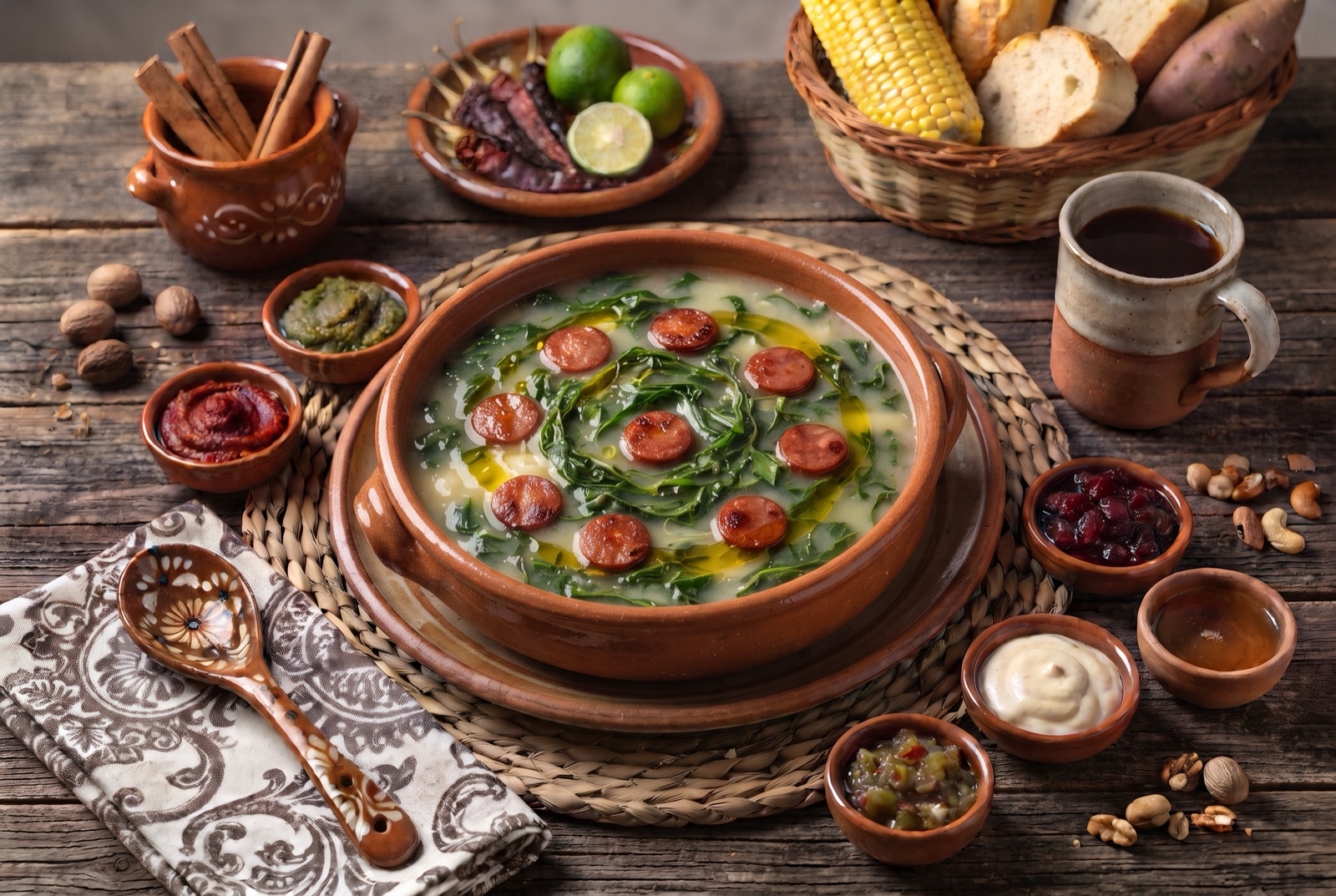
Caldo verde is the soup Portugal reaches for at midnight festivals, family lunches and everything in between: potatoes simmered until they collapse into a naturally creamy broth, then a tangle of dark greens sliced so thin they cook in minutes, and a few coins of garlicky chouriço for smoke and fat. There is no cream and no stock cube — the body comes entirely from the potatoes, the perfume from good olive oil. It tastes clean, gently sweet from the potato, faintly bitter from the greens, with the chouriço landing like punctuation. It is also one of the easiest soups in the European repertoire: one pot, cheap ingredients, and the only technique that matters is slicing the greens properly.

- Gate
- PortugalMinho
- Prep
- 20 min
- Cook
- 35 min
- Total time
- 55 min
- Serves
- 4
- Status
- Easy
- Nutrition / serving · estimated
- Calories 340 kcal
- Protein 11 g
- Carbs 36 g
- Fat 18 g
- Fiber 6 g
Why this recipe works.
- Body from potatoes alone — no cream, no flour, just simmering and a whisk or masher.
- The thin-ribbon cut is explained properly, which is the single technique that defines the soup.
- Chouriço is seared separately so it stays firm and smoky instead of boiling pale.
- One pot, pantry ingredients, and about 45 minutes from peeling to table.
Ingredients.
8 itemsFor the base
For finishing
Equipment
- Large soup pot
- Potato masher or whisk
- Sharp knife for shredding the greens
- Small frying pan for the chouriço
Instructions.
Shred the greens
Stack the stemmed leaves, roll them into a tight cigar, and shave off ribbons 2–3 mm wide with your sharpest knife. Fluff them apart — you want a loose green tangle, not clumps — and set aside.
Tip Do this first, while your hands are clean and the board is dry. It is the only fiddly part of the recipe.
Sweat the aromatics
Warm 2 tbsp of the olive oil in a large pot over medium heat and cook the onion and garlic with a pinch of salt until soft, translucent and sweet-smelling, without letting them brown, about 6–8 minutes.
Simmer the potatoes
Add 700 g of potatoes, the water and a generous teaspoon of salt. Bring to a boil, then simmer uncovered until the potato chunks slump and break apart when pressed against the side of the pot, about 20 minutes.
Mash the base
Take the pot off the heat and mash or whisk the potatoes directly in the broth until the soup turns pale, thick and creamy with only fine grains of potato left. Taste and correct the salt — it should taste fully seasoned before the greens go in.
Sear the chouriço
While the potatoes simmer, fry the chouriço coins in a dry pan over medium heat until their edges crisp and the fat runs orange, 2–3 minutes per side. Set the coins aside and keep the rendered fat.
Tip Searing separately keeps the sausage firm and smoky; boiled in the soup it turns pale and rubbery.
Cook the greens
Return the soup to a brisk boil, drop in all the shredded greens at once and cook uncovered until they are tender but still bright green with a slight bite, 3–5 minutes. Do not walk away — a few minutes too long and the color dies.
Finish and serve
Ladle into bowls, top each with chouriço coins and a little of their rendered fat, and finish with a thread of the remaining raw olive oil. The surface should glisten green and gold. Serve hot with corn bread.
Tips from our kitchen.
- Slice the greens as thin as you can manage — roll the leaves into a tight cigar and shave off ribbons 2–3 mm wide. Thick strips turn the soup swampy and need longer cooking than the broth can forgive.
- Use a floury potato variety that breaks down willingly; waxy salad potatoes fight the mashing and leave the broth thin.
- Do not blend the soup silky-smooth in a machine unless you like it that way — the traditional texture is rustic, mashed or roughly whisked, with a little potato grain left in it.
- Add the greens only once the potato base is finished, and keep the boil brisk and short — they should hit the bowl still bright green with a slight bite.
- Finish each bowl with a thread of your best olive oil. It is not garnish; it is the seasoning that pulls the soup together.
Substitutions.
- Couve galega (Galician cabbage) → Collard greens, or curly kale
- Collards are the closest match in texture and flavor and what Portuguese emigrants themselves use abroad. Kale works too — slice either just as thin.
- Portuguese chouriço → Spanish chorizo (the cured kind) or another smoked garlicky sausage
- Spanish chorizo is more paprika-forward but very close. For a meat-free pot, skip it and lean on smoked paprika bloomed in the olive oil.
- Olive oil finish → There is no good substitute
- A peppery extra-virgin olive oil is a core flavor here, not a garnish — this is the one place not to economize.
Variations.
- Meat-free caldo verde
- Leave out the chouriço and warm ½ tsp smoked paprika in the olive oil before sautéing the onion — the soup keeps its smoky backbone and becomes fully plant-based.
- Festival style
- Serve in small mugs with a slice of broa (Portuguese corn bread) balanced on top, the way it is handed out at June street festivals in the north.
- Heartier winter pot
- Simmer a whole piece of chouriço in the broth from the start, then slice it into the bowls — richer and smokier, at the cost of the sausage's firm bite.
Storage & reheating.
The potato base keeps 3–4 days refrigerated and freezes well for up to 2 months. The greens are best added fresh: if you plan for leftovers, store the base and cook a new handful of ribbons into each reheated pot. Reheat gently on the stove; already-cooked greens go army-green in the microwave but the flavor holds.
Serve with
Thick slices of broa or any dense corn bread, plus a glass of young red wine — the Minho table setting.
The story behind Caldo Verde.
Caldo verde comes from the Minho, the green, rain-soaked northwest corner of Portugal, where smallholdings have long grown couve galega — Galician cabbage — a tall, open-leafed brassica that stands in the garden like a small palm tree and gets picked leaf by leaf through the year. The soup began as subsistence food: potatoes and greens were what the land gave, and a slice or two of cured sausage was how a little pork went a long way. From those farm kitchens it spread south until it belonged to the whole country.
What makes it caldo verde and not just cabbage soup is the cut. The leaves are rolled into tight cigars and shaved into ribbons a couple of millimeters wide — in Portuguese markets you can still buy couve already shredded by machine into green confetti, sold by the bag specifically for this soup. Cut that fine, the greens need only a few minutes in the pot, keeping their color and a slight bite against the smooth potato base.
The soup carries real cultural weight. It is the traditional pot at Santos Populares, the June street festivals for Saint Anthony and Saint John, ladled out alongside grilled sardines; it appears at weddings in the small hours to close the party; and in 2011 it was declared one of the Seven Wonders of Portuguese Gastronomy by public vote. Emigrant communities carried it to Brazil, France and New England, swapping in collards or kale where couve galega does not grow — a substitution this recipe makes openly, because the soul of the dish is the method, not the botany.
Questions, answered.
What greens are used in authentic caldo verde?
Traditionally couve galega, a tall loose-leafed Galician cabbage grown across northern Portugal and sold pre-shredded in Portuguese markets specifically for this soup. Outside Portugal it is rarely available, so collard greens are the standard substitute — kale also works. Whatever the leaf, it must be sliced into very thin ribbons.
Is caldo verde made with cream?
No. Caldo verde contains no cream, milk or flour — its silky body comes entirely from floury potatoes simmered until they fall apart and are then mashed or roughly whisked into the broth. Olive oil, added at the end, supplies the richness. That makes the base naturally light despite its creamy texture.
Can I make caldo verde vegetarian or vegan?
Easily. The base — potato, onion, garlic, olive oil, water — is already plant-based; only the chouriço sausage is not. Skip it and bloom ½ teaspoon of smoked paprika in the olive oil before sautéing the onion to keep a smoky note. The result is a fully vegan soup that still tastes recognizably Portuguese.
Why do my greens need to be sliced so thin?
Because the greens cook for only a few minutes in the finished potato broth. Ribbons 2–3 mm wide soften in that time while staying bright green with a slight bite; wide strips would need ten minutes or more, turning both the greens and the soup a dull olive color. The fine cut is the defining technique of caldo verde.
When do Portuguese people eat caldo verde?
Constantly, and at every register: as a weeknight supper, as the opening course of a long lunch, ladled out at the June Santos Populares street festivals alongside grilled sardines, and traditionally in the small hours at weddings to close the celebration. It was voted one of the Seven Wonders of Portuguese Gastronomy in 2011.
You might also like.
All recipes →

Keep exploring Portugal.
Portugal has 9 more dishes in the atlas — Arroz de Marisco and Bacalhau à Brás, and 7 more.
Recipe by The DishRoute Kitchen · published August 18, 2026 · updated August 18, 2026