Piri-Piri Chicken.
Frango Piri-Piri
Frango piri-piri · say it: FRAHN-goo pee-ree pee-ree
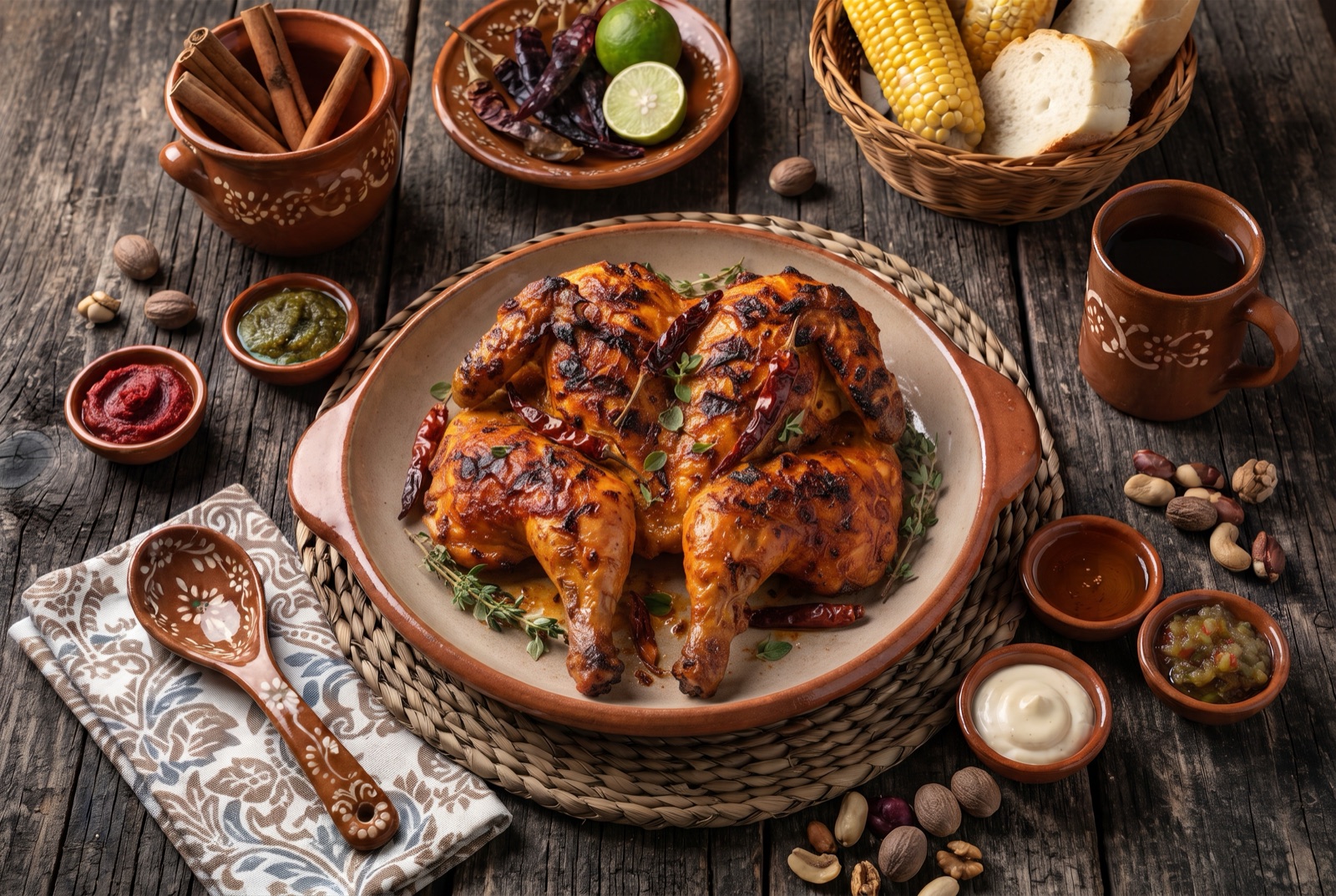
Frango piri-piri is a whole chicken split flat, marinated in a loose red paste of crushed chiles, garlic, lemon, paprika and olive oil, then grilled or roasted hot until the skin blisters and the marinade chars at the edges. The flavor is bright before it is hot: lemon and vinegar up front, garlic and paprika underneath, and a chile burn you control entirely by how many bird's eye chiles go into the blender. Spatchcocking is the key move for home cooks — the flattened bird cooks evenly in about 45 minutes, the skin crisps everywhere, and there is maximum surface for the marinade to cling to and catch. Extra sauce gets brushed on at the table, the way every Portuguese grill house does it.

- Gate
- Portugal
- Prep
- 25 min
- Cook
- 50 min
- Total time
- 5 hr 15 min incl. 4 hr rest
- Serves
- 4
- Status
- Medium
- Nutrition / serving · estimated
- Calories 560 kcal
- Protein 48 g
- Carbs 4 g
- Fat 39 g
Why this recipe works.
- Spatchcocking gives even cooking, all-over crisp skin and a 45-minute roast instead of an hour-plus.
- One blender marinade doubles as the table sauce — half marinates, half gets brushed on at serving.
- Heat is fully adjustable: the chile count is yours, and the recipe tells you what each level tastes like.
- Works identically on a charcoal grill or in a hot home oven, with the finish step keeping the char either way.
Ingredients.
11 itemsFor the chicken
For the piri-piri sauce
Equipment
- Kitchen shears (for spatchcocking)
- Blender or mortar and pestle
- Rimmed sheet pan with rack, or charcoal grill
- Basting brush
- Meat thermometer (recommended)
Instructions.
Blend the piri-piri sauce
Blend the chiles, garlic, lemon juice, paprika, olive oil, vinegar, oregano, salt and bay leaf until you have a loose, brick-red sauce flecked with chile. Taste it: it should be sharp, garlicky and hot enough to make you blink. Pour half into a clean jar and refrigerate — that half never touches raw chicken.
Spatchcock and season
Cut along both sides of the backbone with shears, remove it, flip the bird and press hard on the breastbone until it cracks and the chicken lies flat. Dry the skin with paper towels and season all over with 1 tsp salt.
Tip Ask your butcher to spatchcock the bird if shears feel daunting — it is a ten-second job for them.
Marinate
Coat 1.5 kg of chicken on both sides with the marinade half of the sauce, working it under the skin of the breast where you can. Cover and refrigerate at least 4 hours, ideally overnight.
Roast
Heat the oven to 220°C. Pat the skin dry again, set the chicken skin-side up on a rack over a tray, and roast until the skin is deep amber and the marinade has darkened at the edges, 40–45 minutes — juices at the thigh should run clear, 75°C on a thermometer at the thickest point.
Char the finish
Switch to the broiler/grill setting, brush the bird with a spoonful of the reserved clean sauce, and give it 3–5 minutes close to the element until the skin blisters and spots black in places. Watch it constantly — the line between char and burnt is about a minute.
Tip On a charcoal grill, skip the oven entirely: skin-side up over medium coals about 40 minutes, then flip briefly for the char.
Rest and cut
Rest the chicken 10 minutes on a board, then cut it into quarters through the joints. The meat should pull from the bone with gentle pressure and the juices should pool clear, not pink.
Sauce and serve
Squeeze fresh lemon over the cut pieces, brush or spoon more of the reserved sauce over the top, and serve hot with fries or rice and the rest of the sauce in a bowl on the table.
Tips from our kitchen.
- Always split the sauce before it touches raw chicken: half for the marinade, half reserved clean for basting and the table.
- Marinate at least 4 hours and ideally overnight — the lemon and vinegar need time to season the meat, not just paint it.
- For medium heat use 4–5 bird's eye chiles for a whole chicken; 2 keeps it family-mild, 8 or more is grill-house hot. Taste the sauce — it should make you blink, not cough.
- Dry the skin with paper towels after marinating and before it hits the heat; wet skin steams instead of blistering.
- If roasting in the oven, finish under a hot grill/broiler for the last few minutes until the skin spots black in places — that char is the churrasqueira flavor.
- Rest the chicken 10 minutes before cutting so the juices settle, then squeeze fresh lemon over the cut pieces, not just the whole bird.
Substitutions.
- Fresh bird's eye (piri-piri) chiles → Fresh red Thai chiles, or 1–2 tsp crushed red pepper flakes soaked in the lemon juice
- Thai chiles are botanically close and widely sold. Flakes work in a pinch but give a flatter, less fruity heat.
- Whole chicken, spatchcocked → Bone-in, skin-on thighs and drumsticks
- Cheaper and even harder to overcook. Same marinade, roughly 35 minutes at the same temperature.
- Red wine vinegar → White wine vinegar or cider vinegar
- Any sharp wine-based vinegar works; skip harsh distilled white vinegar if you can.
Variations.
- Charcoal churrasqueira style
- Grill the spatchcocked bird skin-side up over medium coals, weighted with a foil-wrapped brick, turning once — smokier and closer to the Algarve grill houses.
- Piri-piri prawns
- The same sauce is a classic on large shell-on prawns in Mozambique and Portugal alike — marinate 30 minutes and grill 2–3 minutes a side until pink and charred at the edges.
- Extra-lemon Algarve style
- Double the lemon and halve the paprika for a sharper, paler sauce; some Guia grill houses lean this way and let the charcoal supply the color.
Storage & reheating.
Cooked chicken keeps 3 days refrigerated; reheat uncovered in a 200°C oven so the skin re-crisps rather than steaming in a microwave. The clean (never-touched-raw-chicken) sauce keeps a week refrigerated in a jar and improves after a day. Raw marinated chicken can be frozen up to 2 months — thaw overnight and cook as written.
Serve with
Thin fries or simple rice, a tomato-onion salad, and the reserved piri-piri sauce on the table — the full grill-house order.
The story behind Piri-Piri Chicken.
Piri-piri is the Swahili word for the small, ferociously hot bird's eye chile, and its route to the Portuguese table runs through empire. Chiles are American plants; Portuguese ships carried them from the New World along their trade routes in the sixteenth century, and in southeastern Africa — in what are now Mozambique and Angola, then Portuguese colonies — the plant naturalized and local cooks made it their own. The habit of grilling chicken basted with a piri-piri sauce of chiles, garlic, citrus and oil grew up in that colonial contact zone, and it is honest to say the dish belongs to both shores: Mozambican and Angolan kitchens shaped it, and Portuguese settlers and returnees carried it back to Portugal, especially after the colonies won independence in 1975.
In Portugal it found a natural home in the churrasqueira, the charcoal grill house where chickens turn over open flame all day and are sold with fries, rice and a bottle of house piri-piri oil. The town of Guia in the Algarve is famous for them, its restaurants dedicated almost entirely to frango piri-piri. From there the dish went global a second time: Portuguese emigrants and South African chains built on the same Mozambican-Portuguese tradition made piri-piri chicken familiar from Johannesburg to London.
At home the dish is simpler than its history. There is no single canonical sauce — every grill house guards its own ratio of chile to garlic to lemon — which means your version, adjusted to your own heat tolerance, is not a compromise but participation in the tradition. What is non-negotiable is live heat on the skin and lemon at the end.
Questions, answered.
What does piri-piri mean and where is the dish from?
Piri-piri is Swahili for the bird's eye chile. The chile is originally American; Portuguese ships spread it along their trade routes in the 1500s, and it naturalized in southeastern Africa. The grilled-chicken dish grew out of Portuguese colonial contact with Mozambique and Angola, and today it belongs to both African and Portuguese cooking — in Portugal it is the signature of charcoal grill houses called churrasqueiras.
How spicy is piri-piri chicken?
As spicy as you make it. Bird's eye chiles are genuinely hot, but the sauce dilutes them with olive oil, lemon, garlic and paprika, and the chile count is the only variable: 2 chiles for a whole chicken is mild, 4–5 is a warm medium, 8 or more matches a serious grill house. Taste the finished sauce before it touches the chicken and adjust.
What is spatchcocking and do I have to do it?
Spatchcocking means cutting out the chicken's backbone with kitchen shears and pressing the bird flat. It is worth the two minutes: a flat chicken cooks evenly in about 45 minutes, exposes all the skin to direct heat so it crisps everywhere, and takes marinade over a much larger surface. If you prefer, bone-in thighs and legs work with no butchery at all.
Can I make piri-piri chicken without a grill?
Yes — a hot oven does the job well. Roast the flattened, marinated bird at 220°C on a rack over a tray, then finish under the broiler/grill element for the last few minutes until the skin blisters and chars in spots. You lose a little charcoal smoke but keep the crisp skin, the char and all of the sauce's brightness.
Is there one authentic piri-piri sauce recipe?
No — and Portuguese grill houses are proud of that. Every churrasqueira keeps its own ratio of chile, garlic, lemon, vinegar, paprika and oil, often as a house secret, and Mozambican and Angolan versions differ again. The constants are bird's eye chiles, garlic, acid and oil applied to chicken over live heat; the proportions are yours to tune.
You might also like.
All recipes →

Keep exploring Portugal.
Portugal has 9 more dishes in the atlas — Arroz de Marisco and Bacalhau à Brás, and 7 more.
Recipe by The DishRoute Kitchen · published August 18, 2026 · updated August 18, 2026