Salade Niçoise.
Tuna, Egg and Olive Salad from Nice
Salada nissarda · say it: sah-LAHD nee-SWAHZ
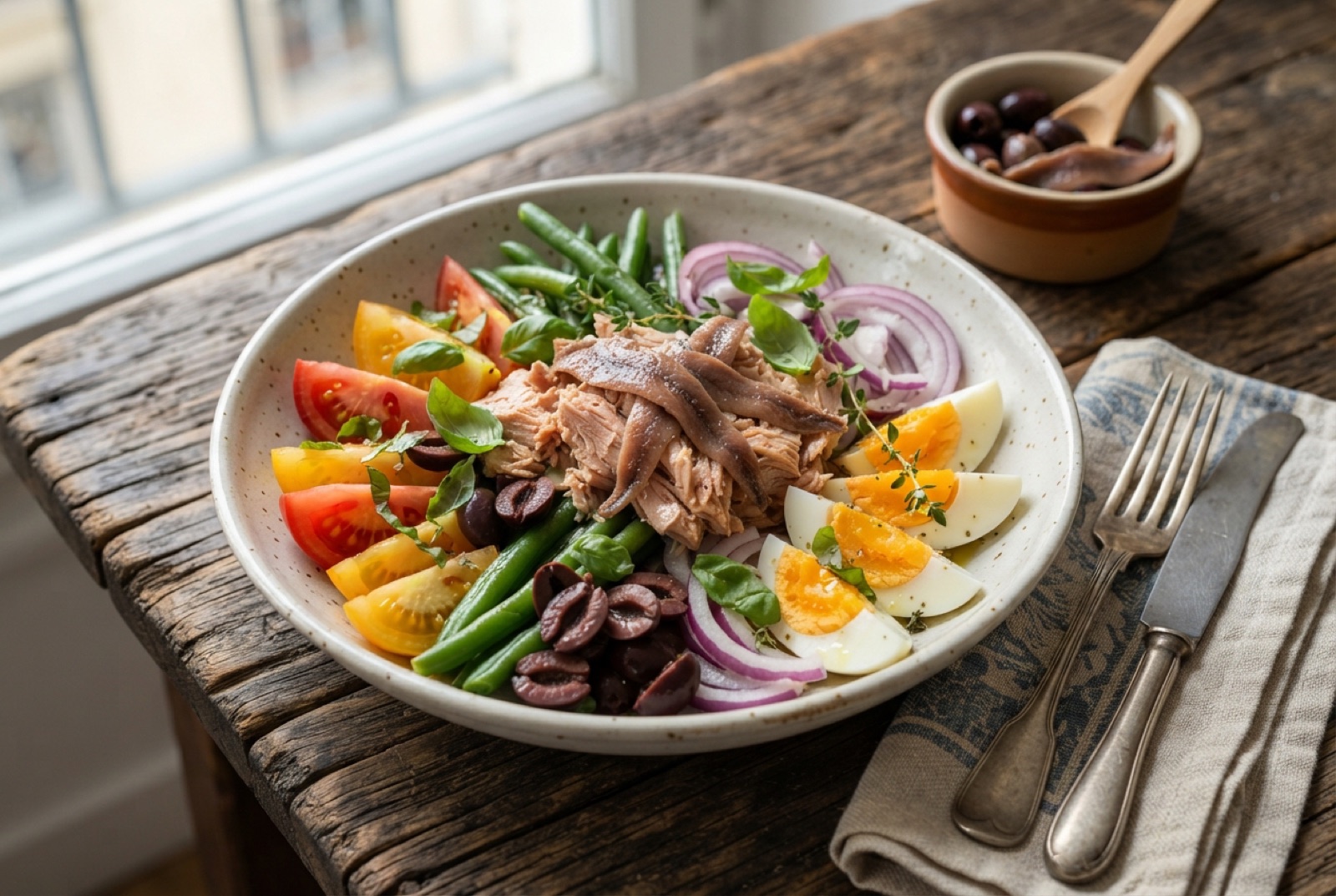
Salade niçoise is a plate of raw summer vegetables, hard-boiled eggs and preserved fish from the coast around Nice, seasoned with salt, rubbed garlic and olive oil. Nothing is cooked except the eggs, and there is no vinaigrette in the strict version — the tomatoes give up their own juice, the olives and anchovies bring salt, and the oil binds it. The result is sharp, salty and unexpectedly rich, and it depends almost entirely on the quality of three things: the tomatoes, the oil and the fish. Made in August with tomatoes that smell of tomato, it is one of the best cold dishes in French cooking. Made in February with pale supermarket ones, it is not worth doing.

- Gate
- FranceNice, Provence
- Prep
- 25 min
- Cook
- 10 min
- Total time
- 35 min
- Serves
- 4
- Status
- Easy
- Nutrition / serving · estimated
- Calories 420 kcal
- Protein 26 g
- Carbs 12 g
- Fat 30 g
- Fiber 5 g
- Sugar 7 g
- Sodium 980 mg
Why this recipe works.
- Follows the Niçois original — nothing boiled but the eggs — with the potato-and-bean version explained rather than dismissed.
- Tomatoes are salted first so they release juice that becomes half the dressing instead of pooling at the bottom.
- A jammy-yolk egg method timed to the minute, so the yolk stays bright and creamy rather than chalky and grey-rimmed.
- Built around pantry fish, so it comes together in twenty minutes with no cooking beyond a pan of water.
Ingredients.
15 itemsFor the salad
To top
To finish
Equipment
- Small saucepan for the eggs
- Sharp knife
- Wide shallow serving bowl or platter
Instructions.
Salt the tomatoes
Cut 600 g of tomatoes into thick wedges, spread them in a bowl and scatter over the flaky salt. Leave for 10 minutes, until beads of juice collect in the bottom of the bowl and the cut faces look glassy rather than dry.
Tip Keep that juice. Mixed with the olive oil at the end it becomes the only dressing the salad needs.
Boil the eggs
Lower the eggs into a pan of boiling water and cook for exactly 8 minutes for a jammy yolk, or 9 minutes for firm. Move them straight into iced water and leave for 5 minutes before peeling — the shock sets the shells loose and keeps the yolks yellow instead of grey-ringed.
Prepare the raw vegetables
Slice the green pepper as thinly as you can manage, cut the cucumber into half-moons, and slice the spring onions on the diagonal. If using artichokes, shave them straight into the bowl so they do not brown; the broad beans go in raw and whole.
Rub the bowl with garlic
Cut the garlic clove in half and rub the cut face firmly all around the inside of a wide serving bowl until the surface smells clearly of garlic, then discard the clove. This perfumes the salad without leaving raw garlic in anyone's mouth.
Build the salad
Tip in the tomatoes with all their juice, then scatter over the pepper, cucumber, spring onions, olives and any artichokes or beans. Spread them out rather than piling them so every serving gets some of each.
Top with the fish and eggs
Break the tuna over the vegetables in large forkfuls, lay the anchovy fillets across the top, and halve or quarter the peeled eggs and nestle them in cut-side up. Do not stir at any point from here — this is a composed salad, not a tossed one.
Oil, season and serve
Pour the olive oil generously over everything, grind on black pepper, and tear the basil over the top. Taste one tomato wedge before adding more salt — between the anchovies and the olives it is usually already there. Serve at once, with bread.
Tips from our kitchen.
- Salt the tomato wedges and let them sit for ten minutes before assembling. The juice they release, mixed with the oil, is the dressing the salad is meant to have.
- Buy the best canned tuna you can — the kind packed in olive oil in a jar, in large solid pieces. Watery flaked tuna in brine collapses into paste and tastes of tin.
- Rub the inside of the serving bowl with a cut garlic clove instead of chopping garlic into the salad. You get the perfume without raw garlic hijacking every bite.
- Use a fruity, peppery extra virgin olive oil and pour it on generously at the last moment. With no vinegar in the classic version, the oil is the flavour, not just the lubricant.
- Keep everything cool but not fridge-cold. Tomatoes served straight from the fridge taste of almost nothing; give them twenty minutes on the counter first.
- Assemble in layers and do not toss. Tossing bruises the tomatoes, breaks the eggs and turns a composed salad into a wet heap.
Substitutions.
- Canned tuna in olive oil → Anchovy fillets alone, or a fresh tuna steak seared rare and sliced
- Anchovy-only is arguably the older version and needs no other salt. Seared fresh tuna is the restaurant approach — good, but a different, richer dish.
- Niçoise olives → Small black Kalamata or Taggiasca olives
- Avoid the soft, pitted, jet-black canned olives — they taste of the can and add nothing but colour.
- Small purple artichokes → Marinated artichoke hearts from a jar, drained and quartered
- Raw baby artichokes are hard to find outside the Mediterranean. Jarred hearts are a fair stand-in as long as they are not swimming in vinegar.
- Fresh broad beans → Frozen broad beans, thawed and double-podded, or omit entirely
- Only worth including in spring when they are small and sweet enough to eat raw. Large starchy beans need cooking, which the classic version avoids.
Variations.
- The potato-and-bean version
- Warm boiled new potatoes and briefly blanched green beans added to the plate. Common everywhere outside Nice, and what most restaurants serve — heartier, and a legitimate meal rather than a starter.
- Pan bagnat
- The same ingredients packed into a split round loaf rubbed with garlic and oil, wrapped tightly and pressed for an hour until the bread absorbs the juices. The original beach lunch of Nice.
- Seared tuna niçoise
- A thick tuna steak crusted with pepper, seared 90 seconds a side and sliced over the salad while still cool in the middle. The restaurant version, and worth doing when the fish is very fresh.
Storage & reheating.
This is a salad to eat within an hour of assembling — salted tomatoes keep weeping and the eggs dull as they sit. If you need a head start, prepare the components separately: eggs boiled, peeled and refrigerated up to 2 days; vegetables cut and covered up to 4 hours; olives, tuna and anchovies straight from their jars. Assemble and oil only at the table. Leftovers are best repurposed into a pan bagnat the next day, where the softened tomatoes are an advantage rather than a fault.
Serve with
Plenty of bread for the oil and tomato juice left in the bowl, and a cold rosé from Provence.
The story behind Salade Niçoise.
Nice was Italian for most of its history and only became French in 1860, and its food still reads as Ligurian more than Provençal: olive oil rather than butter, anchovy as a seasoning, basil, chard, chickpea flour. Salade niçoise belongs to that kitchen. It began as poor food eaten out of hand — vegetables from a garden, cured fish from a jar, oil, and bread to push it around the plate. Its close relative, the pan bagnat, is the same ingredients pressed inside a round loaf until the bread soaks through, and it is still what people in Nice actually take to the beach.
The great argument concerns cooked vegetables. Jacques Médecin, mayor of Nice and author of a fiercely protective book on the city's cooking, laid down the rule most often quoted: no potatoes, no green beans, nothing boiled except the eggs, because a salad of raw vegetables in high summer needs no help. Against that stands the version that the rest of the world learned, with warm potatoes, blanched haricots verts and seared fresh tuna, which travelled through French restaurant cooking and mid-century American cookbooks until it became the default idea of the dish. Both versions have long histories, and calling either one fake is a bigger claim than the evidence supports. What is fair to say is that they taste quite different, and that the Niçois original is lighter, saltier and much faster.
The other running dispute is tuna against anchovy. Older accounts suggest anchovy came first, being cheaper and always in the pantry, with tuna arriving as canned fish became affordable. Today most versions in Nice use both, or let the cook choose, and the salad is assembled rather than tossed — tomatoes salted in advance, everything else laid over the top, oil poured on at the table. It is composed food that looks careless, which is roughly how the coast likes to present itself.
Questions, answered.
Does a real salade niçoise have potatoes and green beans?
It depends whose rules you follow. The Niçois purist version, most famously argued by Jacques Médecin, contains no cooked vegetables at all — only raw summer produce, eggs and preserved fish. The version with warm potatoes and blanched green beans spread through French restaurants and international cookbooks and is now what most people expect. Both have been made for a long time; they simply taste different, and this recipe gives the raw original with the additions listed as a variation.
Should I use tuna or anchovies?
Either, or both, and Nice does not agree with itself on this. Anchovy is probably the older choice since it was the cheap preserved fish always in the house, while canned tuna became common later. If you use both, go lighter on each so the salad does not turn overwhelmingly salty. Whichever you pick, quality matters more than quantity — good oil-packed fish in whole pieces, not shredded fish in brine.
Why is there no vinegar in the dressing?
Because the salad already has acidity from ripe tomatoes and salt from olives and anchovies, and the traditional dressing is simply good olive oil poured over the top. Adding vinegar makes it taste like a generic composed salad and flattens the tomatoes. If your tomatoes are underripe and dull, a small squeeze of lemon is a more sympathetic correction than vinegar.
How do I get eggs with a soft, bright yolk?
Lower fridge-cold eggs into already boiling water, cook for exactly 8 minutes for a just-set jammy yolk or 9–10 minutes for fully firm, then move them straight into iced water for 5 minutes. The cold shock stops the cooking and prevents the grey-green ring, and it also makes the shells peel far more easily.
Can I make salade niçoise ahead for a party?
Prepare the parts ahead but assemble at the last minute. Boil and peel the eggs up to two days early, cut the vegetables a few hours before and keep them covered in the fridge, and have the fish and olives ready. Salt the tomatoes and pour on the oil only when you are ready to put it on the table, or you will serve a bowl of pink liquid with things floating in it.
You might also like.
All recipes →
Keep exploring France.
France has 9 more dishes in the atlas — Baguette and Bœuf Bourguignon, and 7 more.
All France recipes Tomato recipes Tuna recipes Eggs recipes appetizermaingluten freedairy freepescatarianRecipe by The DishRoute Kitchen · published August 19, 2026 · updated August 19, 2026