Quiche Lorraine.
Smoked Bacon and Cream Tart
Quiche lorraine · say it: keesh loh-REN
Quiche lorraine is a savoury tart: a crisp shortcrust case holding smoked bacon suspended in a custard of eggs, cream and a scrape of nutmeg, baked until it puffs slightly and settles with a faint wobble at the centre. The flavour is plain in the best sense — salt and smoke from the lardons, sweetness from the cream, and a rich, softly set texture that is closer to a baked custard than to scrambled eggs. It works warm from the oven, at room temperature two hours later, and cold from the fridge the next morning, which is most of the reason it has stayed in constant rotation in French kitchens for a century.
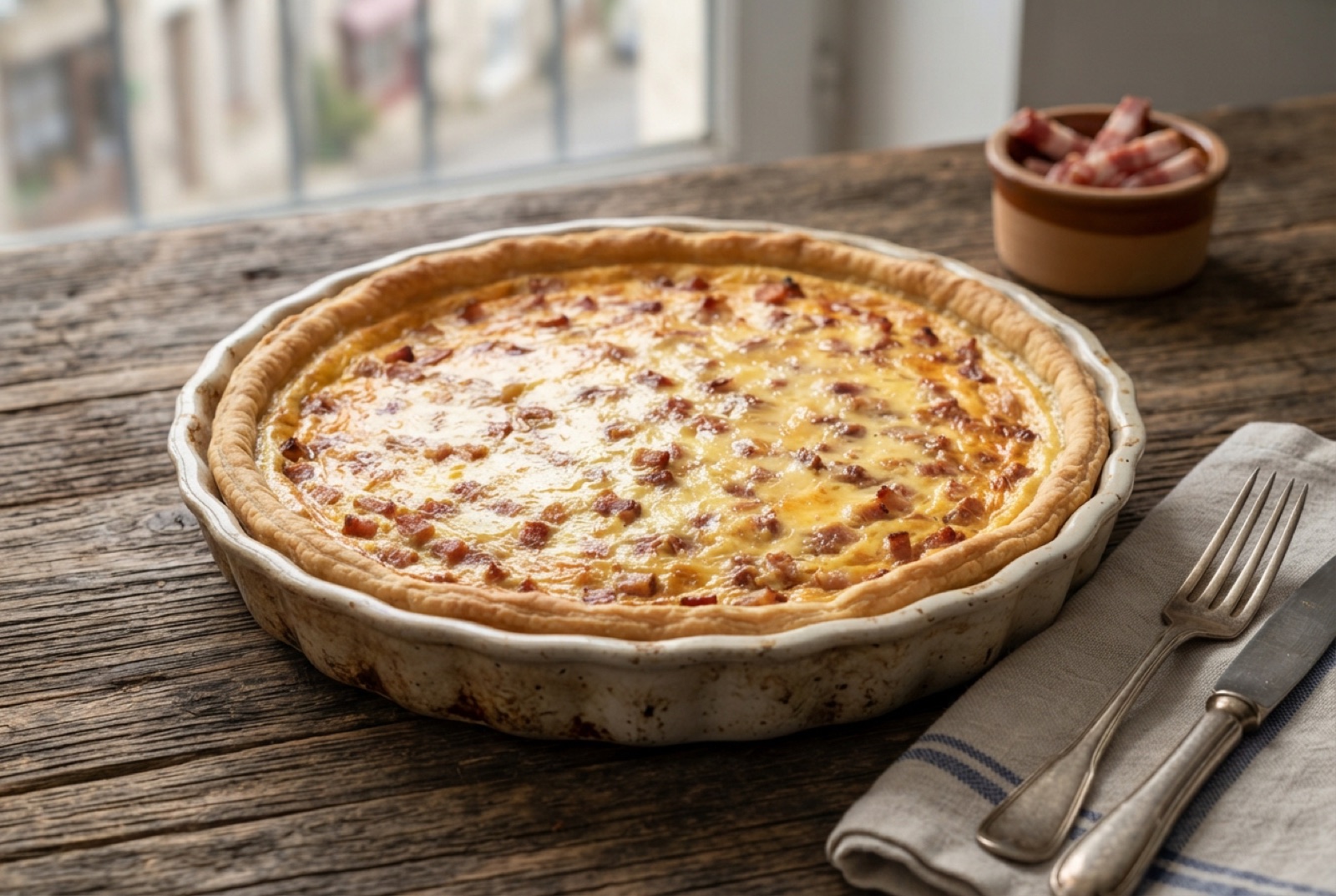

- Gate
- FranceLorraine
- Prep
- 30 min
- Cook
- 55 min
- Total time
- 2 hr 45 min incl. 1 hr 20 min rest
- Serves
- 6
- Status
- Easy
- Nutrition / serving · estimated
- Calories 545 kcal
- Protein 17 g
- Carbs 28 g
- Fat 40 g
- Fiber 1 g
- Sugar 3 g
- Sodium 690 mg
Why this recipe works.
- Blind-baked and egg-washed shell, so the base stays crisp under the custard instead of going pale and damp.
- Custard ratio calibrated to set softly and stay silky — enough cream for richness, enough egg for structure, no rubbery slice.
- Straight about the cheese question: what the Lorraine original contains, and what to call it if you add Gruyère anyway.
- A pastry method that works in a warm kitchen, with the resting steps that actually stop shrinkage.
Ingredients.
12 itemsFor the pastry
For the filling
Equipment
- 24 cm loose-bottomed tart tin
- Rolling pin
- Baking beans or dried pulses
- Whisk
Instructions.
Rub the pastry together
Rub the cold butter into the flour and salt with your fingertips until the mixture looks like coarse breadcrumbs with a few flatter flakes still visible. Stir in the egg yolk, then add the cold water a spoonful at a time until the crumbs just clump when squeezed in your palm.
Tip Stop the moment it holds together. Kneading it smooth turns the pastry tough and makes it shrink in the tin.
Chill the dough
Press the dough into a flat disc, wrap it, and refrigerate for at least 30 minutes so the butter firms and the flour hydrates evenly. It should feel solid but still dent under a firm thumb before you roll it.
Line the tin and chill again
Roll the dough out to about 3 mm on a lightly floured surface and lift it into a 24 cm tart tin, pushing it gently into the corner without stretching it. Trim the edge leaving 1 cm overhanging, prick the base all over with a fork, and freeze for 20 minutes until hard to the touch.
Tip Leaving the overhang lets the pastry shrink a little without pulling below the rim; trim it flush after baking.
Blind bake the shell
Line the chilled case with baking paper, fill to the top with baking beans, and bake at 190°C for 20 minutes. Lift out the paper and beans and bake for a further 8–10 minutes, until the base looks dry and sandy and the rim is light gold.
Seal the base
Brush the hot shell all over with a little beaten egg taken from the filling eggs and return it to the oven for 2 minutes, until the egg film sets to a dull sheen. Turn the oven down to 175°C. Trim the overhanging pastry level with the rim using a small knife.
Brown the lardons
Fry the lardons in a dry pan over medium heat for 6–8 minutes until the fat runs and the edges are crisp and deep brown. Tip them onto kitchen paper and blot well — any clinging fat or moisture will muddy the custard.
Mix the custard
Whisk the remaining eggs and extra yolk with the cream and milk until completely smooth but not foamy, then season with nutmeg, black pepper and just a little salt. Whisking in air makes the quiche puff up dramatically and collapse into a crater.
Fill and bake
Scatter the lardons evenly over the pastry base, add the Gruyère if using, then pour the custard in slowly, stopping a few millimetres below the rim. Bake at 175°C for 30–35 minutes, until the surface is set and lightly freckled but the centre still shivers when you tap the tin.
Tip Fill the tart on a pulled-out oven shelf. Carrying a brimming quiche across the kitchen never ends well.
Rest before slicing
Leave the quiche in its tin for at least 20 minutes before unmoulding — the custard finishes setting as it cools and slices cleanly only once it has. Serve warm or at room temperature with a sharp green salad.
Tips from our kitchen.
- Keep the butter and water genuinely cold and stop mixing while the dough still looks shaggy. Overworked pastry develops gluten and shrinks down the sides of the tin as it bakes.
- Rest the dough twice: once after mixing and once after lining the tin. The second chill is the one that prevents slumping, and most people skip it.
- Blind bake fully, then brush the hot shell with a little beaten egg and return it for 2 minutes. That seals every crack against the wet custard.
- Cook the lardons until they are properly browned and drain them well. Wet bacon releases water into the custard and dilutes the set.
- Pull the quiche out when the centre still wobbles like set jelly if you nudge the tin. It carries on cooking for several minutes and a firm centre in the oven means a dry slice on the plate.
- Let it rest at least 20 minutes before cutting. Hot custard has not finished setting, and the first slice will slump onto the plate.
Substitutions.
- Smoked bacon lardons → Diced pancetta, smoked ham, or thick-cut streaky bacon in batons
- Aim for pieces with some fat. Very lean ham gives salt but none of the richness that makes the filling work.
- Heavy cream → Half cream and half whole milk, or crème fraîche thinned with milk
- The custard sets slightly firmer and tastes lighter. Going all milk makes it noticeably watery and more prone to weeping.
- Homemade shortcrust → A 300 g block or sheet of ready-made all-butter shortcrust
- A genuinely reasonable shortcut. Buy all-butter rather than vegetable-fat pastry — the difference in the finished tart is obvious.
Variations.
- Quiche vosgienne
- The cheese version: 100 g of grated Gruyère or Comté scattered over the lardons before the custard goes in. Common everywhere, just not the Lorraine original.
- Quiche aux poireaux
- Leeks cooked slowly in butter until sweet and completely soft, used instead of or alongside the bacon. Cook them dry — any residual water thins the custard.
- Individual tartlets
- The same quantities in six 10 cm tins. Blind bake for 12 minutes and bake filled for 18–20; useful for a buffet, and the pastry-to-custard ratio is higher.
Storage & reheating.
Keeps 3 days covered in the fridge and is genuinely good cold, which is how a lot of French households eat the leftovers. To restore the crust, reheat slices in a 160°C oven for 12–15 minutes rather than a microwave, which steams the pastry soft. The baked quiche freezes for 2 months: cool completely, wrap whole or in slices, and reheat from frozen at 160°C for 25–30 minutes. Raw pastry also freezes well, so it is worth making a double batch and lining a spare tin.
Serve with
A sharply dressed green salad — frisée or lamb's lettuce with a mustard vinaigrette cuts the richness exactly.
The story behind Quiche Lorraine.
The word quiche comes from Alsatian German Kuchen, meaning cake, which tells you where Lorraine sits: on the frontier between French and German cooking, with a language and a larder shaped by both. The early tart was rustic and made with bread dough rather than pastry, spread with a mixture of eggs and cream — a migaine, in local dialect — and baked in a bread oven after the loaves came out. Bacon came in because smoked pork was the everyday preserved meat of the region. Cheese did not, and this is the one point on which people from Lorraine are genuinely firm: the classic quiche lorraine has eggs, cream and lardons, and nothing else.
The version most of the world eats has cheese in it, usually Gruyère or Emmental, and the French have a name for that too — quiche vosgienne, or simply quiche au fromage. It is a perfectly good tart and nobody will stop you making it, but it is a different recipe wearing the same name, which happened as quiche spread outward through the twentieth century and picked up additions at every stop. By the time it reached English-speaking countries the name had loosened to mean almost any egg tart, and quiche acquired a reputation as either sophisticated or faintly ridiculous depending on the decade, neither of which had much to do with what people actually eat in Nancy or Metz.
What has not changed is its place at the table. Quiche in France is not a special-occasion bake; it is what you buy by the slice from a boulangerie for lunch, what you make when guests come and you need something that does not need timing, what turns up with a green salad and a glass of wine on a Sunday evening. The technique that matters is the same as it was in the bread ovens: a case that stays crisp under a wet filling, and a custard cooked gently enough to set rather than curdle.
Questions, answered.
Does a real quiche lorraine have cheese in it?
No. The traditional Lorraine recipe is eggs, cream and smoked lardons in a pastry case — nothing more. Adding grated Gruyère or Emmental makes a tart the French call quiche vosgienne, and while it is widespread and perfectly good, it is technically a different recipe. This version gives the original; the cheese is listed as an optional addition if you want it.
Why is the bottom of my quiche soggy?
Almost always an under-blind-baked shell. The case must be baked until the base is dry, sandy and pale gold before any filling goes near it, then sealed with a brush of beaten egg and given two more minutes in the oven so the egg cooks into a waterproof film. Wet filling ingredients make it worse, so drain the lardons and cook off any vegetable liquid completely.
Why did my custard curdle or weep liquid?
Too much heat, too much time, or both. Egg custard sets around 80°C and starts to squeeze out its liquid above that, which shows as puffing, cracking and a pool of water under the slice. Bake at a moderate 170–180°C and take the quiche out while the centre still trembles. An oven running hot is a common hidden cause — check it with a thermometer if this keeps happening.
Can I make quiche lorraine ahead of time?
Yes. It can be baked a day in advance and served at room temperature or gently reheated, and many people think it tastes better on day two once the flavours have settled. You can also blind bake the shell up to two days ahead and keep it in the tin, then fill and bake on the day for the crispest possible base.
Can I use milk instead of cream?
You can, but expect a different tart. Cream carries fat, which keeps the custard tender and helps it stay smooth; all-milk custard sets firmer, tastes leaner and is much more likely to weep. If you want to lighten it, half cream and half whole milk is the sensible compromise and still gives a silky set.
What size tin should I use?
These quantities are for a 24 cm loose-bottomed tart tin about 3 cm deep, serving six. A 20 cm tin will be too full — hold back about a quarter of the custard. A 28 cm tin will give a shallow quiche that bakes 8–10 minutes faster, so start checking early.
You might also like.
All recipes →
Keep exploring France.
France has 9 more dishes in the atlas — Baguette and Bœuf Bourguignon, and 7 more.
Recipe by The DishRoute Kitchen · published August 19, 2026 · updated August 19, 2026