Pupusas.
Salvadoran Stuffed Corn Cakes
Pupusas de queso con frijol · say it: poo-POO-sahs
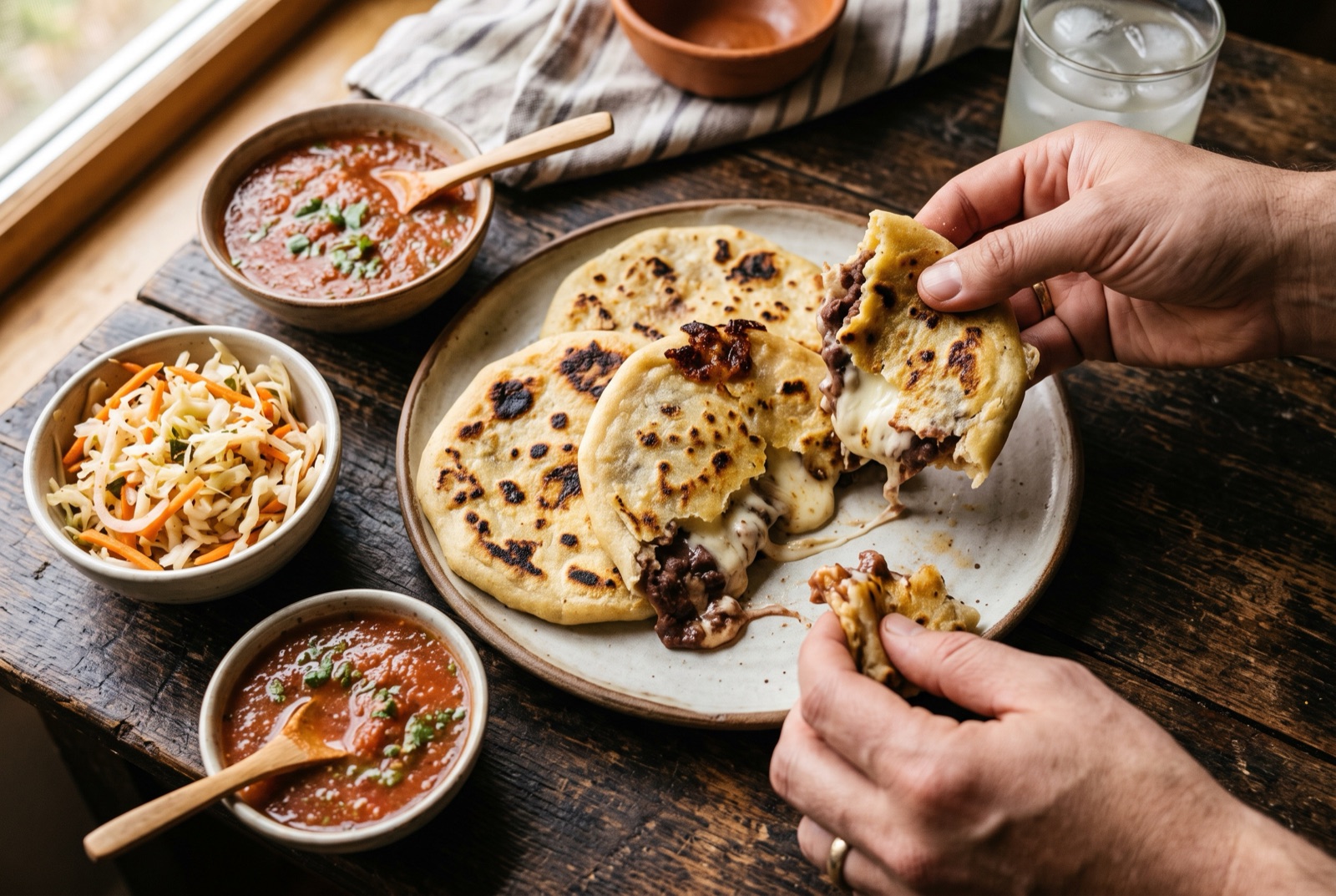
A pupusa is a disc of corn masa sealed around a filling and cooked dry on a hot griddle until it puffs, blisters and starts leaking cheese at the edges. The outside stays tender rather than crisp — closer to a thick fresh tortilla than to a fried patty — while the inside turns molten. The classic pairing is cheese with refried red beans, salty against earthy, and it is never served alone: a tangle of vinegary curtido and a ladle of thin, barely seasoned tomato salsa go on top of every bite to cut the richness. This is El Salvador's national dish and its national evening meal, cooked to order at pupuserías that only open once the sun drops.

- Gate
- El SalvadorCentral Valley
- Prep
- 35 min
- Cook
- 30 min
- Total time
- 1 hr 15 min incl. 10 min rest
- Serves
- 4
- Status
- Medium
- Nutrition / serving · estimated
- Calories 520 kcal
- Protein 22 g
- Carbs 62 g
- Fat 21 g
- Fiber 9 g
- Sodium 780 mg
Why this recipe works.
- Uses masa harina and a hydration ratio that stays pliable, so the discs seal instead of cracking at the rim.
- Beans are fried down to a thick, spreadable paste — wet filling is the main reason home pupusas burst.
- Gives the two doneness signals that matter: dark freckling on the surface and a lazy hiss of cheese at the seam.
- Cheese and bean version is fully vegetarian and does not pretend to be a compromise — it is a standard order in El Salvador.
Ingredients.
11 itemsFor the dough
For the filling
To cook
Equipment
- Heavy flat griddle, comal or large cast-iron pan
- Mixing bowl
- Small bowl of oiled water for your hands
Instructions.
Fry the beans down
Soften the onion and garlic in the oil over medium heat until translucent and sweet-smelling, about 5 minutes. Add the drained beans and mash them in the pan, splashing in reserved bean liquid, until you have a thick dark paste that holds a ridge when you drag the spoon through it.
Tip Stop while it is still spreadable but not runny — this is the single biggest factor in whether your pupusas stay sealed.
Mix the fillings
Cool the bean paste, then divide it and the mixed cheeses into 12 portions. Roll each into a rough ball about the size of a walnut, pressing a spoonful of beans and a pinch of cheese together for the classic queso con frijol combination.
Mix and rest the masa
Stir 500 g of masa harina with the salt, then work in the warm water with your hands until you have a smooth dough with the feel of soft modelling clay. Cover and rest 10 minutes, then test: flatten a small ball between your palms and check the edge stays smooth. Cracks mean it needs another splash of water.
Fill and flatten
Wet your palms with the oiled water. Roll a golf-ball of masa, press a deep well into it with your thumb, seat a filling ball inside and pinch the dough closed over the top. Pat the sealed ball flat between your palms, turning it as you go, until it is 12 cm across and about 8 mm thick.
Tip If a crack opens and filling shows, pinch on a pea of spare masa and smooth it over — a leaking pupusa welds itself to the griddle.
Griddle until freckled
Cook on a dry medium-hot griddle for 3–4 minutes a side. They are ready to turn when the underside is dry to the touch and marked with dark tan freckles; on the second side the pupusa should swell slightly and hiss where cheese seeps out at the rim.
Tip No oil in the pan. Pupusas are griddled, not fried, and added fat makes the surface leathery.
Serve them hot
Stack the finished pupusas under a clean cloth while you cook the rest, then serve immediately with a mound of curtido and a jug of thin tomato salsa. Eat with your hands, piling slaw onto each torn piece.
Tips from our kitchen.
- Keep a small bowl of water with a splash of oil next to you and wet your palms between every pupusa; masa sticks to dry hands and tears every time.
- Rest the masa 10 minutes after mixing. The flour keeps absorbing water, and dough that felt right immediately will feel dry by the fifth pupusa.
- Do not overfill. Roughly one part filling to two parts masa by volume — more than that and the seam splits and the filling welds itself to the griddle.
- The griddle should be medium, not screaming hot. Too hot and the outside freckles before the cheese has melted; the inside stays chalky.
- Grate the cheese and mix mozzarella with a crumbly fresh cheese. Mozzarella alone melts into rubber; queso fresco alone will not stretch.
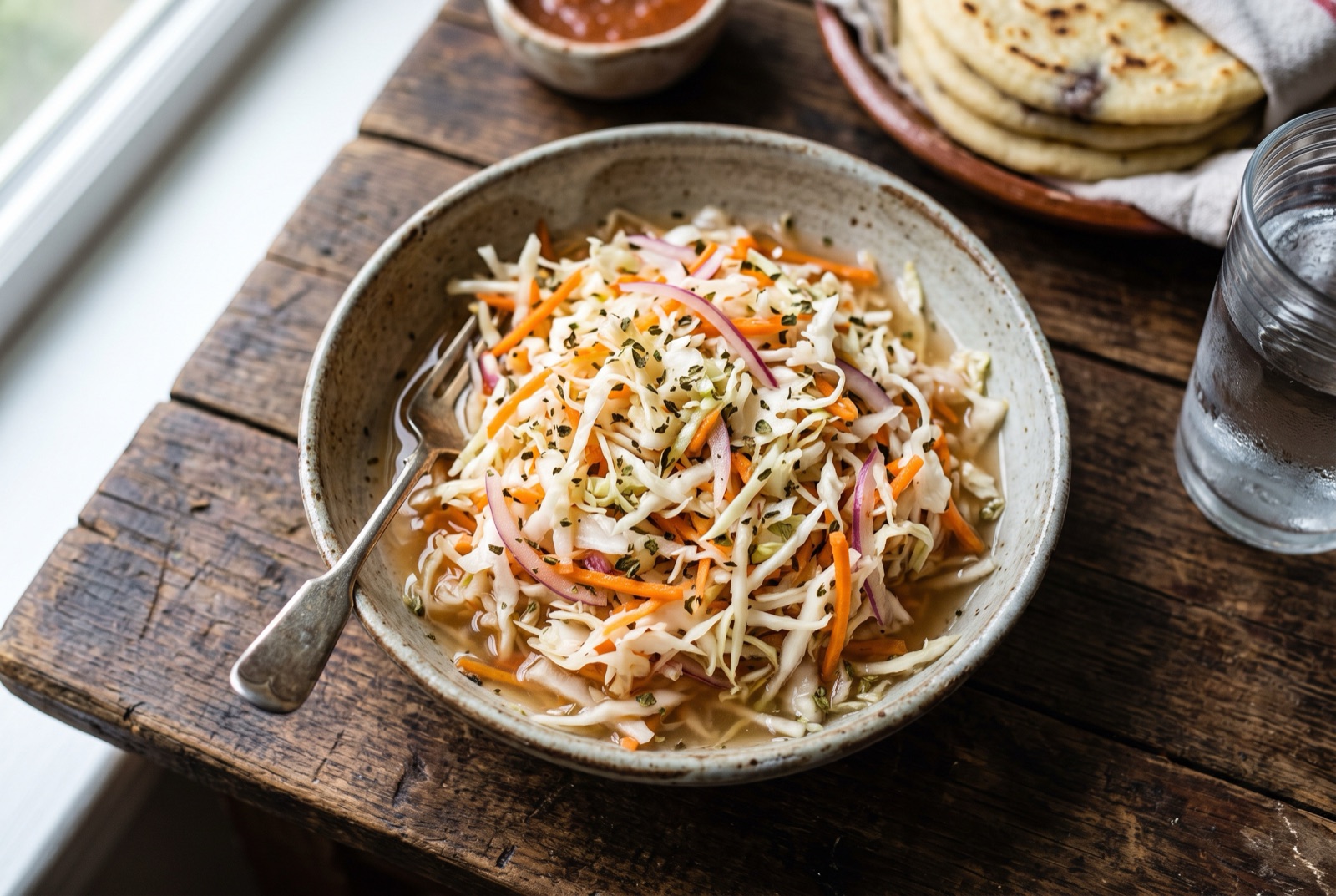
- Make the curtido at least a day ahead. Pupusas without it are noticeably heavy, and the slaw needs time in the brine to lose its raw edge.
Substitutions.
- Quesillo (Salvadoran melting cheese) → Low-moisture mozzarella mixed with queso fresco or mild feta
- Quesillo is stretchy and lightly sour. The mozzarella brings the stretch, the fresh cheese brings the salt and crumble; on its own neither behaves.
- Frijoles de seda (red silk beans) → Small red beans, pinto or black beans
- Silk beans purée smoother than most, but any soft-cooked bean will work once it is fried down properly. Keep some cooking liquid to loosen the paste.
- Masa harina → Fresh masa from a tortillería, if you can get it
- Fresh masa gives a noticeably better texture and needs little or no added water. Ordinary cornmeal or polenta will not work at all — it has not been nixtamalised.
Variations.
- Pupusa revuelta
- The most ordered version: cheese, refried beans and finely ground chicharrón mixed together, so each bite carries all three.
- Pupusa de queso con loroco
- Cheese studded with loroco flower buds, which taste green and faintly like artichoke. Sold frozen or in brine at Latin American grocers.
- Pupusas de arroz
- The Olocuilta style, made with rice flour instead of corn masa. Paler, thinner and slightly crisper at the edge, with a cleaner flavour.
Storage & reheating.
Cooked pupusas keep 3 days refrigerated and freeze well for 2 months. Reheat straight from cold on a dry griddle over medium heat for 3–4 minutes a side until the outside is hot and freckled again and the cheese moves when you press the centre — the microwave makes them tough and steamy. Uncooked filled pupusas can be frozen flat on a tray, then bagged; cook them from frozen over slightly lower heat for a couple of extra minutes a side.
Serve with
Curtido and a jug of thin tomato salsa — both are considered part of the dish, not optional condiments.
The story behind Pupusas.
Pupusas are old. Archaeologists working at Joya de Cerén, the farming village buried by volcanic ash around the sixth century and now a UNESCO site, found griddles and food remains that point to filled masa cakes being made in this part of Central America long before the Spanish arrived, and the word itself comes from Nahuat-Pipil. What is certain is that the dish never left: through colonisation, coffee booms, civil war and mass emigration, the pupusa stayed the thing Salvadorans cook when they want to eat like themselves. In 2005 the country made it official, declaring pupusas the national dish and giving them a national day on the second Sunday of November.
Regional pride runs deep. Olocuilta, on the highway to the airport, built an entire economy out of pupusas de arroz — made with rice flour instead of corn, paler, slightly crisper, and defended by locals as the superior article. Elsewhere corn masa is the rule. Fillings mark the map too: quesillo, the stringy fresh cheese; chicharrón ground to a paste rather than left in chunks; frijoles; loroco, the aromatic flower bud that grows on a vine and tastes faintly of artichoke and green olive; ayote, jalapeño, spinach. The revuelta — cheese, beans and chicharrón together — is the standard order.
The social shape of the dish matters as much as the recipe. Pupuserías are evening places, often a single woman at a comal with a stack of plastic chairs around her, and you order by number rather than by name: "tres revueltas, dos de queso con loroco." They arrive on the plate with tongs of curtido and a jug of salsa, and you eat them with your hands while they are too hot to eat with your hands. Salvadoran migration has carried that whole ritual to Los Angeles, Washington DC and Toronto, where the pupusería is often the first place a community plants a flag.
Questions, answered.
Why do my pupusas keep splitting open?
Almost always too much filling, or filling that is too wet. The masa needs to close completely over the ball of filling with no thin patches, so use about a third as much filling as dough by volume and make sure refried beans are thick enough to hold their shape on a spoon. Sealing the dough fully before you flatten it also helps — patch any crack with a pinch of spare masa.
Can I use cornmeal or polenta instead of masa harina?
No. Masa harina is corn that has been cooked in an alkaline lime solution, dried and ground — that process, nixtamalisation, is what lets the dough bind. Cornmeal and polenta are simply ground raw corn and will crumble apart no matter how much water you add. Look for masa harina labelled for tortillas or tamales.
Are pupusas gluten-free?
Corn masa pupusas contain no wheat, so they are naturally gluten-free provided your masa harina is milled in a facility that avoids cross-contamination. Check the packet if you are cooking for someone with coeliac disease. Rice-flour pupusas from Olocuilta are gluten-free too.
What exactly is curtido and do I have to make it?
Curtido is shredded cabbage, carrot and onion left in a hot vinegar brine with oregano for a day or more until it turns tangy and slightly fermented. It is not a garnish — Salvadorans consider a pupusa without it incomplete, because the acidity cuts through the cheese and masa. A quick version made an hour ahead is better than none.
Can I make the dough in advance?
Yes, up to a day ahead. Keep it tightly covered in the fridge, then let it come back to room temperature and knead in a splash of warm water before shaping — refrigerated masa always stiffens. If it cracks at the edge when you flatten a test disc, it needs more water.
You might also like.
All recipes →
Keep exploring El Salvador.
El Salvador has 9 more dishes in the atlas — Casamiento and Curtido, and 7 more.
All El Salvador recipes Mozzarella recipes Queso fresco recipes Black beans recipes street foodmainvegetariangluten freeRecipe by The DishRoute Kitchen · published August 20, 2026 · updated August 20, 2026