Samlor Korko.
Khmer Mixed Vegetable and Fish Stew
សម្លរកកូរ · say it: som-LAW ko-KOR
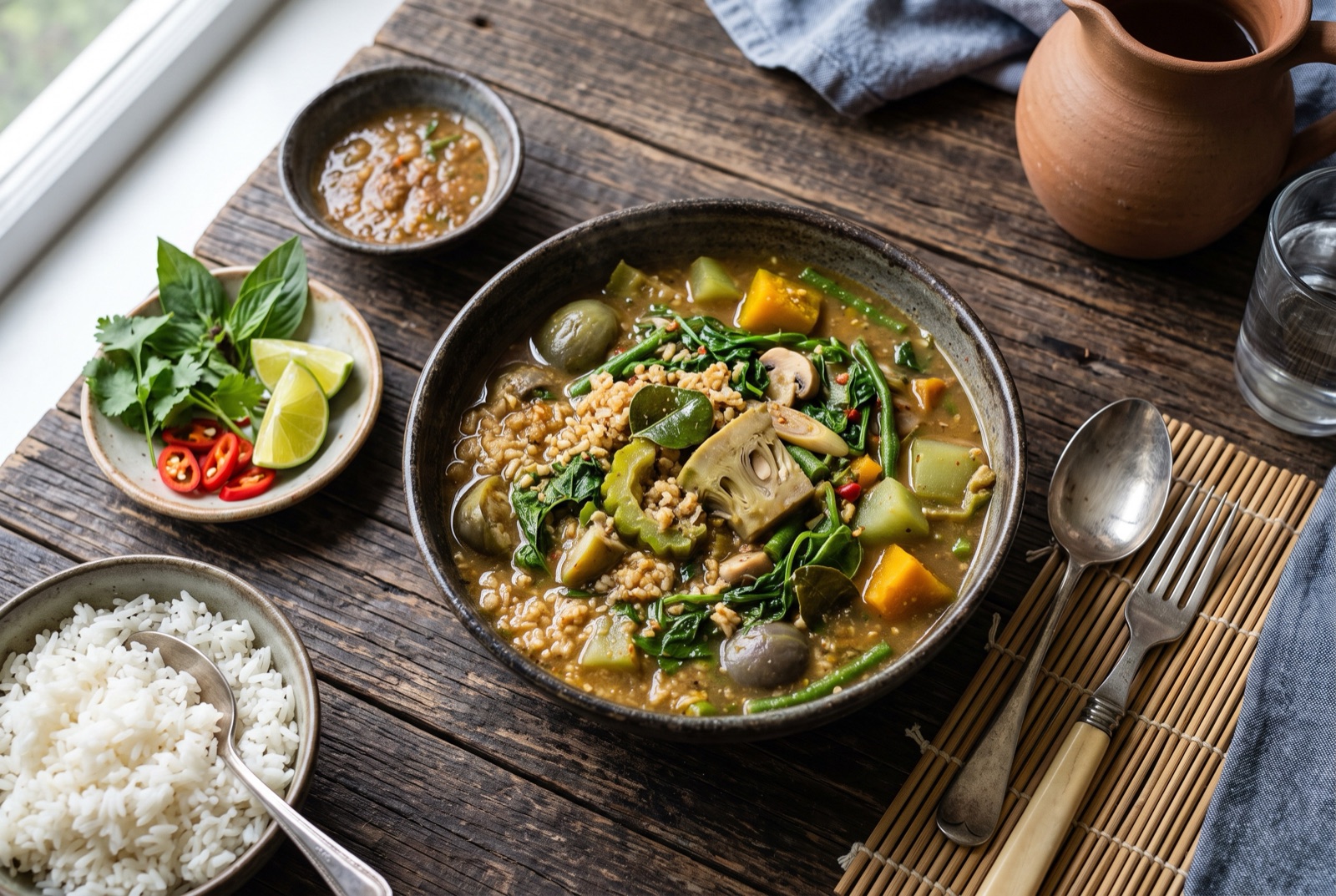
Samlor korko is a thick, murky, deeply savoury stew that looks like nothing and tastes like everything. A dozen vegetables — green jackfruit, pumpkin, green papaya, long beans, eggplant, moringa leaves, whatever the garden holds — go into a pot with kroeung, prahok and fish or pork, and are simmered until the softer ones fall apart and thicken the broth. Toasted rice, ground to a coarse powder, is stirred in near the end and gives the stew its signature slightly gritty body and a nutty smell. The flavour is savoury and faintly bitter, salty from fermented fish, sweetened only by the vegetables. The name comes from the verb korko, to stir, because the pot needs constant attention as everything breaks down.

- Gate
- CambodiaTonlé Sap Basin
- Prep
- 35 min
- Cook
- 45 min
- Total time
- 1 hr 20 min
- Serves
- 6
- Status
- Medium
- Nutrition / serving · estimated
- Calories 330 kcal
- Protein 24 g
- Carbs 33 g
- Fat 11 g
- Fiber 7 g
- Sugar 9 g
Why this recipe works.
- Toasted rice powder made from scratch, which is what gives korko its body and its aroma.
- A vegetable list organised by cooking time, so nothing turns to mush while something else stays raw.
- Explains where the bitterness comes from and how to dial it up or down without breaking the dish.
- Realistic substitutions for green jackfruit, moringa and prahok, with what each swap actually costs you.
Ingredients.
20 itemsFor the toasted rice
For the kroeung
For the stew
To season
Equipment
- Large heavy pot
- Dry frying pan for the rice
- Mortar and pestle or spice grinder
Instructions.
Toast and grind the rice
Dry-fry the jasmine rice in a pan over medium heat, shaking constantly, for 6–8 minutes, until the grains are deep gold and the kitchen smells of popcorn. Tip out to cool, then grind to a coarse, sandy powder in a mortar or spice grinder.
Tip Stop the moment the colour goes from gold to brown. Burnt rice powder makes the whole pot taste acrid.
Pound the kroeung
Pound the lemongrass, turmeric, galangal, garlic, shallots and lime leaves in a mortar until you have a damp yellow paste with no visible fibres. Start with the lemongrass and add the softer ingredients as it breaks down.
Fry the paste
Heat the oil in a heavy pot over medium heat and fry the kroeung for 5 minutes, stirring, until it darkens and oil pools at the edges. Stir in the prahok and cook 2 minutes more, until the sharp fermented smell mellows into something rounder.
Start the hard vegetables
Pour in the stock, bring to a simmer and add the jackfruit and green papaya. Cook for 15 minutes, until the jackfruit yields to a knife but still holds its shape.
Add squash and thicken
Add the pumpkin and eggplant and simmer 10 minutes, then stir in the toasted rice powder and cook 5 minutes more, stirring often, until the broth turns cloudy and thick enough to leave a brief trail behind the spoon.
Tip Once the rice powder is in, the pot needs stirring every couple of minutes or it will catch on the base.
Finish with fish and greens
Slide in 500 g of fish chunks, the long beans and the moringa or spinach, and simmer gently for 6–8 minutes, until the fish flakes and the beans are tender but still green. Season with fish sauce, palm sugar, salt and pepper and serve over rice.
Tips from our kitchen.
- Toast the rice in a dry pan over medium heat and keep it moving until the grains are deep gold and smell like popcorn — pale rice adds no flavour and burnt rice makes the whole pot bitter.
- Add vegetables in three waves by hardness: roots and jackfruit first, squash and eggplant next, leaves and beans in the final five minutes.
- Stir often once the rice powder goes in. It sinks and catches on the base of the pot within a couple of minutes if you walk away.
- Use prahok sparingly the first time. It is powerfully fermented, and you can always stir in more after tasting but you cannot take it out.
- The stew should be thick enough that a spoon leaves a trail for a second before closing over. Loosen with stock rather than water so it does not thin out in flavour too.
- Fry the kroeung until the oil separates before any liquid goes in, or the paste tastes raw and grassy through the whole stew.
Substitutions.
- Green (unripe) jackfruit → Canned young jackfruit in brine, rinsed, or chayote
- Canned young jackfruit is widely stocked and behaves similarly, though it softens faster — add it with the second wave rather than the first.
- Moringa leaves → Spinach, watercress or pea shoots
- Moringa is faintly bitter and slightly grassy; watercress gets closest to that bite, spinach is the mildest option.
- Prahok → 2 tbsp fish sauce plus 1 tsp shrimp paste, or 1 tbsp miso for a vegetarian pot
- Shrimp paste gives fermented depth from a different direction. Miso works surprisingly well if you are going meat-free.
- Green papaya → Kohlrabi, daikon or firm cucumber
- You want something that holds a slight crunch through a long simmer. Daikon is the closest in texture.
Variations.
- Korko with pork ribs
- Pork ribs instead of fish, browned first and simmered for 45 minutes before the vegetables go in. Richer and more common in the dry season.
- Vegetarian korko
- Built on mushrooms and fried tofu with miso and soy in place of prahok and fish sauce, keeping the toasted rice and the full vegetable list.
- Korko with smoked fish
- A Tonlé Sap version using dried or smoked freshwater fish, which turns the whole stew smokier and much saltier.
Storage & reheating.
Korko is better on day two once the vegetables have surrendered fully to the broth, and keeps 3 days refrigerated. It thickens considerably as it sits because of the rice powder, so add stock when reheating and stir over low heat so the base does not catch. It freezes for 2 months, though the leafy greens turn to threads — if you plan to freeze a batch, hold back the leaves and add fresh ones when you reheat. Reheat on the hob rather than in a microwave, which heats it unevenly and scorches the starch.
Serve with
Steamed jasmine rice, and a saucer of sliced chile in fish sauce for anyone who wants more edge.
The story behind Samlor Korko.
Ask Cambodians which dish is most theirs and a lot of them will say samlor korko rather than the more famous amok. The argument is that amok has cousins in Thailand and Laos while korko does not — it is a stew of whatever the countryside provides, seasoned with prahok, thickened with roasted rice, and cooked in every province with a different set of vegetables. Nothing about it is designed for a restaurant menu, and that is precisely the point.
It is also survival food with a long memory. The vegetable list is deliberately open: unripe jackfruit, green papaya, banana flower, pumpkin, taro stems, moringa leaves, water spinach, bitter melon, wild greens gathered from the edges of the rice fields. Nothing needs buying; almost everything can be grown, foraged or traded, and the stew stretches a small piece of fish or pork across a family. Cambodians who lived through the Khmer Rouge years and the famine that followed have a complicated relationship with a stew built from whatever grows, and korko carries that weight alongside its status as a national dish.
The toasted rice deserves attention. Raw rice is dry-fried in a pan until the grains turn golden and smell like popcorn, then pounded to a coarse meal. Stirred into the pot it thickens without making the stew glossy or gluey the way cornflour would, and adds a toasted aroma that runs underneath everything else. The same technique appears in Lao and Isaan cooking, where the powder is called khao khua. Between that, the prahok and the bitterness of the greens, samlor korko is not a dish that flatters newcomers — it is one you grow into, and Khmer cooks are entirely unapologetic about it.
Questions, answered.
What does toasted rice powder do in this stew?
It thickens the broth and adds a nutty, toasted aroma. Because it is dry-roasted whole grain rather than refined starch, it gives body without the gloss or slipperiness of cornflour, and leaves a faint grain in the texture that is part of the dish. The same ingredient appears in Lao and northeastern Thai cooking, where it is called khao khua.
Is samlor korko supposed to taste bitter?
A mild bitterness is correct and comes from the greens — moringa, bitter melon, sometimes young papaya leaves. It is balanced against the salt of prahok and the sweetness of pumpkin. If it is unpleasantly bitter, you either used too much bitter melon or over-toasted the rice. Add a little palm sugar and more squash to bring it back into balance.
Can I make samlor korko without prahok?
Yes. Substitute two tablespoons of fish sauce plus a teaspoon of shrimp paste for a similar fermented depth, or a tablespoon of miso for a vegetarian version. The stew will taste cleaner and less pungent. Cambodians would say something essential has gone, and they have a point, but the result is still a good soup.
Which vegetables can I use if I cannot find the traditional ones?
Almost any mix of firm and leafy vegetables works, which is the spirit of the dish. Aim for a hard root or squash for body, something with crunch that holds up, a green bean for texture and a leafy green for bitterness. Pumpkin, sweet potato, daikon, green beans, eggplant, cabbage and spinach make a good supermarket version.
Why does my stew keep sticking to the bottom of the pot?
The rice powder settles and scorches if the stew is not stirred. Once it goes in, stir every couple of minutes and keep the heat low enough that the surface barely moves. Using a heavy-based pot rather than a thin one makes a large difference, because thin pans create hot spots that catch the starch immediately.
You might also like.
All recipes →
Keep exploring Cambodia.
Cambodia has 9 more dishes in the atlas — Amok Trey and Bai Sach Chrouk, and 7 more.
All Cambodia recipes White fish recipes Pumpkin recipes Lemongrass recipes soupmaingluten freedairy freepescatarianRecipe by The DishRoute Kitchen · published August 20, 2026 · updated August 20, 2026