Somlar Kari.
Khmer Coconut Chicken Curry
សម្លការី · say it: som-LAH kah-REE
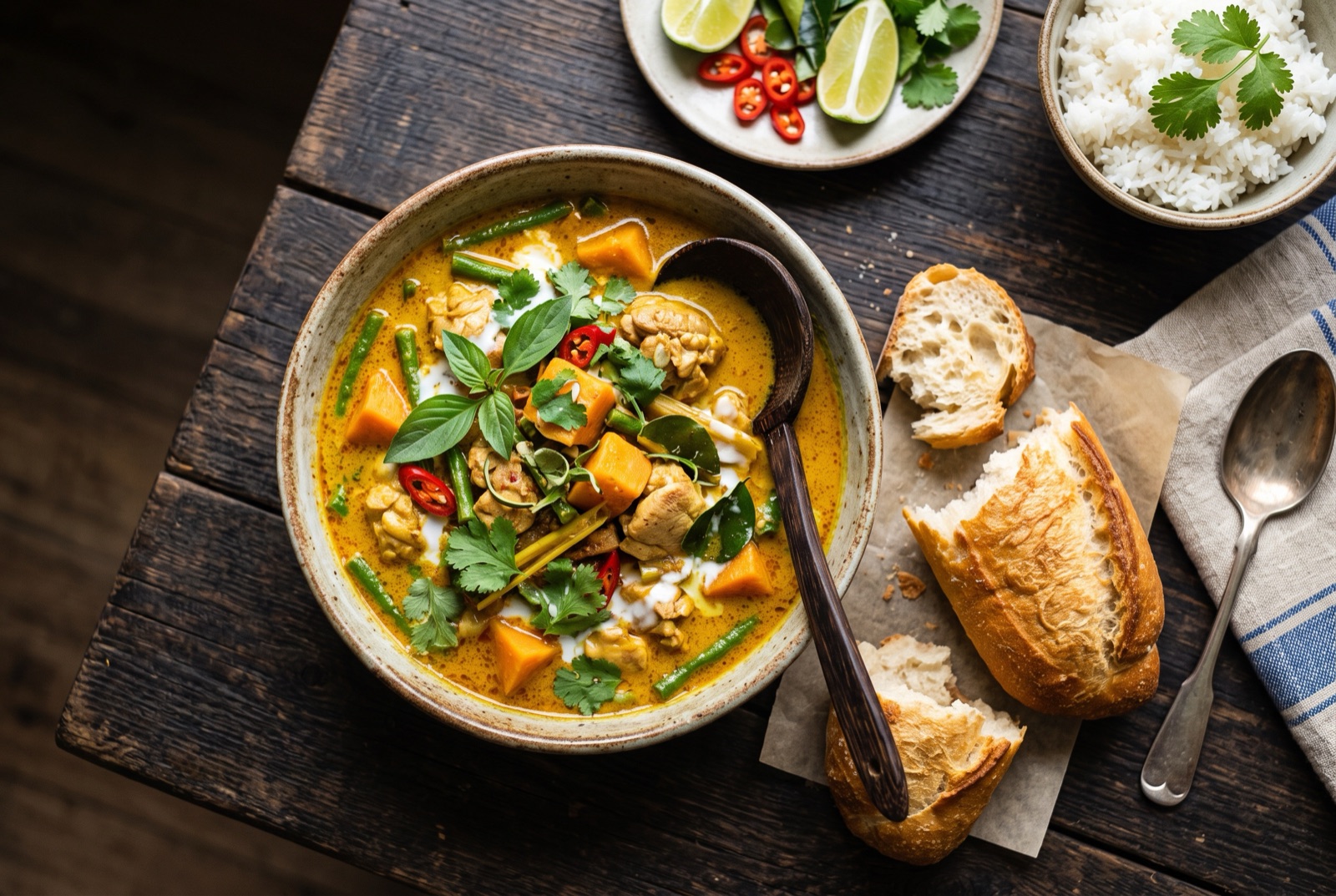
Somlar kari is the curry Cambodians make for weddings, holidays and Sunday lunches, and it is noticeably gentler than anything across the Thai border. Kroeung and a small amount of red curry paste are fried in coconut cream until the fat splits out orange, then chicken, sweet potato and long beans go in and simmer until the potato is on the edge of collapse and starts thickening the sauce. It tastes sweet-savoury and heavily perfumed — lemongrass, lime leaf, coconut, the caramel note of palm sugar — with only a background warmth from chile. What surprises visitors is the bread: this is one of the few Southeast Asian curries habitually eaten with a French baguette torn up and dunked, and it works.

- Gate
- CambodiaPhnom Penh
- Prep
- 25 min
- Cook
- 40 min
- Total time
- 1 hr 5 min
- Serves
- 4
- Status
- Medium
- Nutrition / serving · estimated
- Calories 610 kcal
- Protein 38 g
- Carbs 34 g
- Fat 37 g
- Fiber 5 g
- Sugar 14 g
Why this recipe works.
- Blooms the paste in coconut cream until the oil splits — the step that separates a fragrant curry from a bland one.
- Balanced for real Khmer proportions: kroeung leads, chile supports, palm sugar rounds it out.
- Sweet potato is cut in two sizes so some of it dissolves into the sauce and some stays in whole pieces.
- Works equally with baguette or rice, and explains why Cambodians reach for the bread.
Ingredients.
16 itemsFor the kroeung
For the curry
To season
Equipment
- Heavy pot or Dutch oven
- Mortar and pestle or blender
- Sharp knife
Instructions.
Make the kroeung
Pound the lemongrass, turmeric, galangal, garlic, shallots and lime leaves to a coarse damp paste in a mortar, or blitz in a small blender with a spoonful of coconut cream to get it moving. Scrape down the sides until no fibres remain.
Bloom the paste
Spoon the thick coconut cream into a heavy pot over medium heat and let it bubble until it looks oily and slightly grainy. Add the kroeung and red curry paste and fry, stirring, for 5–8 minutes, until orange oil separates at the edges and the raw grassy smell turns toasted and sweet.
Tip If the paste starts sticking and darkening too fast, drop the heat rather than adding liquid — you want it frying, not steaming.
Brown the chicken
Add 800 g of chicken thigh chunks and turn them in the paste for 3–4 minutes, until every piece is coated in orange and the outsides have turned opaque. Do not let the pot cool down enough to release a pool of liquid.
Simmer with the roots
Pour in the thin coconut milk, add the sweet potato and onion wedges, and bring to a lazy simmer. Cook uncovered for 20–25 minutes, until the small dice of sweet potato has dissolved into the sauce and the chunks are tender to a knife tip.
Add the beans and season
Stir in the long beans and cook 4–5 minutes more, until they are bright green and still have a slight snap. Season with fish sauce, palm sugar and lime juice, tasting between additions — aim for sweet first, then salty, then a lift of sour at the back.
Rest and serve
Take the pot off the heat and let it stand 5 minutes so the sauce thickens and settles. Serve in bowls with a torn baguette for dunking or a plate of jasmine rice, with lime wedges and sliced chile on the table.
Tips from our kitchen.
- Do not shake the coconut milk cans. You want the thick cream from the top to fry the paste in — that separated fat is what carries the aromatics.
- Wait for the oil to break out of the paste before adding anything else. It takes 5–8 minutes and the pan smell changes from raw and green to toasted and sweet.
- Cut half the sweet potato into small dice and half into chunks. The small pieces melt and thicken the sauce; the chunks stay intact.
- Chicken thighs, not breast. Breast turns dry and stringy in a 25-minute simmer while thigh meat only gets more tender.
- Season at the end with fish sauce, palm sugar and lime in small increments — the curry should land sweet first, salty second, sour last.
- If the sauce looks thin at the end, mash a few pieces of sweet potato against the side of the pot instead of adding starch.
Substitutions.
- Fresh kroeung → Jarred Khmer kroeung, or 2 tbsp Thai red curry paste plus extra lemongrass and turmeric
- Thai paste is much hotter and saltier — use half as much as you would in a Thai curry and add a teaspoon of ground turmeric to get closer to the Khmer profile.
- Long beans (snake beans) → Green beans, cut in 5 cm lengths
- Green beans cook slightly faster, so add them 2 minutes later than the recipe says.
- Sweet potato → Taro, pumpkin or waxy potato
- Taro is the more traditional choice in Cambodia and breaks down more, giving a thicker, slightly slippery sauce.
- Palm sugar → Light brown sugar or coconut sugar
- Palm sugar is less sweet and more caramelly, so if you use brown sugar start with three-quarters of the quantity.
Variations.
- Somlar kari sach ko
- The wedding-table version made with beef shin or brisket, simmered for well over an hour until the meat is spoonable.
- Vegetarian somlar kari
- Firm tofu, taro, pumpkin and green beans with soy sauce in place of fish sauce. The curry is sweet enough that it loses little.
- Curry with rice noodles
- Served over soft rice vermicelli instead of bread, closer to how it is sold at midday market stalls.
Storage & reheating.
This curry improves overnight and keeps 3 days refrigerated — the sweet potato continues to thicken the sauce, so loosen it with a splash of water or coconut milk when reheating over low heat. It freezes for up to 2 months, though the sweet potato softens further and the coconut may look grainy on thawing; a gentle reheat with a whisk brings it back together. Do not boil it hard when reheating or the coconut fat separates and pools on the surface.
Serve with
A warm baguette for dunking, or steamed jasmine rice, plus lime wedges and sliced fresh chile on the side.
The story behind Somlar Kari.
Curry arrived in Cambodia along the same trade routes that carried it through the rest of Southeast Asia, and the Khmer version kept the coconut and the aromatics while quietly dropping most of the heat. Compare somlar kari with a Thai red curry and the differences are structural rather than cosmetic: the Khmer paste is kroeung-led, built around lemongrass, turmeric and galangal, with dried chile playing a supporting role; palm sugar is used more generously; and root vegetables do half the work of thickening the sauce. The result is rounder and sweeter, closer in spirit to a Malaysian kari than to a fiery Bangkok curry.
The baguette is the more visible inheritance. France governed Cambodia from the 1860s until independence in 1953, and the bakery habit stuck permanently — num pang, the Khmer baguette, is everywhere, from morning sandwich carts to the basket that arrives with curry. Cambodians tear it, dunk it and use it as a spoon. Rice is served too, and nobody objects, but at a Khmer wedding the curry comes with bread and that is simply how it is done.
Somlar kari also occupies a specific social role. It is celebration food — Khmer New Year, weddings, the ceremonies for ancestors — because it is rich, uses a whole bird or a good cut of beef, and can be scaled up in a single pot for a courtyard full of relatives. Home cooks make it with chicken thighs and whatever roots are cheap; sweet potato and taro are the usual choices, and both dissolve slightly at the edges to give the sauce its body. Add the long beans at the end so they keep some snap, and the finished bowl has three textures instead of one.
Questions, answered.
How is Khmer curry different from Thai red curry?
Khmer somlar kari is milder, sweeter and more aromatic. Its base is kroeung — lemongrass, turmeric, galangal, kaffir lime peel and shallot — with only a little dried chile, where Thai red curry paste is chile-forward. Khmer versions also use more palm sugar and root vegetables, so the sauce is rounder and thicker, and they are frequently eaten with bread rather than rice.
Why did my coconut sauce split into oil and liquid?
A visible layer of orange oil early on is intentional — that is how you know the paste has bloomed. A split at the end, where the sauce looks curdled and watery, means it boiled too hard for too long. Keep the curry at a lazy simmer with occasional bubbles, and if it does split, take it off the heat and stir in a spoonful of cold coconut cream to bring it back.
Can I make this curry ahead for a party?
Yes, and it is better for it. Cook it a day ahead up to the point of adding the long beans, cool and refrigerate. Reheat gently the next day and add the beans in the last few minutes so they stay green and snappy rather than khaki and soft.
Is somlar kari very spicy?
No. It is one of the mildest curries in Southeast Asia, and children eat it. The warmth comes from a modest amount of dried chile in the paste plus black pepper. If you want heat, serve sliced bird's eye chiles or a chile-lime dip on the side rather than adding more paste, which would also make it saltier.
Do I really eat curry with a baguette?
In Cambodia, very often yes. Bread came with the French colonial period and never left, and somlar kari with a torn baguette is standard at weddings and celebrations. Rice is equally acceptable at home. Try the bread once — the crust holds up to the sauce far better than you would expect.
You might also like.
All recipes →
Keep exploring Cambodia.
Cambodia has 9 more dishes in the atlas — Amok Trey and Bai Sach Chrouk, and 7 more.
All Cambodia recipes Chicken recipes Coconut milk recipes Sweet potato recipes maingluten freedairy freeRecipe by The DishRoute Kitchen · published August 20, 2026 · updated August 20, 2026