Agedashi Dofu.
Crisp Fried Tofu in Dashi Broth
揚げ出し豆腐 · Agedashi dōfu · say it: ah-geh-DAH-shee DOH-foo
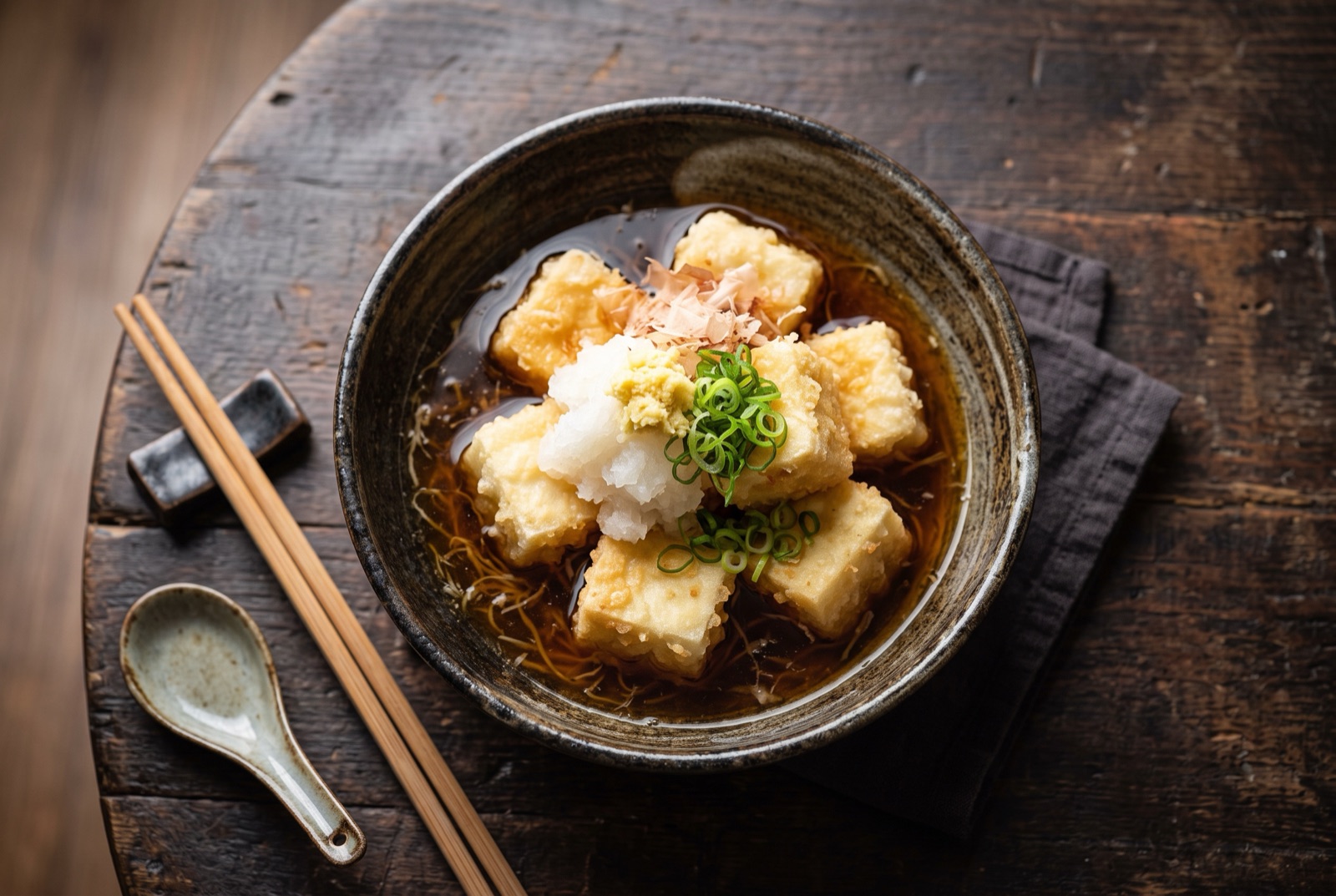
Agedashi dofu is a small, precise dish: blocks of soft tofu rolled in potato starch, fried until the outside is thin, blistered and barely coloured, then lowered into a shallow pool of warm dashi seasoned with soy sauce and mirin. For the first minute the coating is crisp and the inside is molten custard; after that the starch drinks the broth and turns slippery and slick, which is a different pleasure rather than a failure. A mound of grated daikon, a dab of ginger and a scattering of scallion sit on top to keep the whole thing from feeling heavy. It is the izakaya order that arrives while you are still deciding what else to eat.

- Gate
- JapanKanto
- Prep
- 15 min
- Cook
- 20 min
- Total time
- 1 hr 5 min incl. 30 min rest
- Serves
- 4
- Status
- Medium
- Nutrition / serving · estimated
- Calories 260 kcal
- Protein 14 g
- Carbs 18 g
- Fat 15 g
- Fiber 2 g
- Sugar 5 g
- Sodium 890 mg
Why this recipe works.
- Draining the tofu properly first, which is the difference between a crisp shell and oil spitting across the kitchen.
- Potato starch rather than cornflour, for the thin glassy coating that restaurants get and cornflour cannot match.
- A broth balanced to be sipped from the bowl at the end, not a salty sauce that overwhelms the tofu.
- Assembled at the last second, with the reasoning explained — this dish is on a timer from the moment it is plated.
Ingredients.
13 itemsFor the tofu
For the broth
To finish
Equipment
- Heavy pot or deep pan for frying
- Cooking thermometer
- Fine grater for daikon and ginger
- Slotted spoon
- Small saucepan
Instructions.
Press the tofu
Cut each block of tofu in half horizontally, lay the pieces on a tray between several layers of paper towel and rest a small plate on top. Leave for 30 minutes, changing the paper once, until the surface feels dry to the touch rather than slick.
Tip Do not weight silken tofu heavily — a plate is enough. More pressure crushes it into a dense slab.
Make the dashi
Soak the kombu in 400 ml cold water for 20 minutes, then warm until bubbles gather at the pan edges and lift the kombu out before the water boils. Add the bonito flakes, take the pan off the heat, and strain after 2 minutes once the flakes have sunk.
Season the broth
Return 350 ml of the dashi to the pan with the soy sauce and mirin and warm it until it steams, without letting it boil. Taste — it should be light enough to drink, savoury with a faint sweetness, not as salty as a dipping sauce. Keep it hot.
Heat the oil and coat
Bring 4 cm of oil to 175°C. Cut the drained tofu into 4 cm cubes, pat each one dry again, and roll it in the potato starch, tapping off every loose grain so only a thin, even film clings to the surface.
Fry until blistered
Lower in five or six cubes at a time and fry for 3–4 minutes, turning once, until the coating is set, faintly blistered and barely straw-coloured — it should sound crisp against the slotted spoon but never go golden brown. Drain on a rack, not paper.
Tip The tofu is already cooked; you are only setting the crust. Colour means the oil is too hot.
Assemble and serve at once
Pour a shallow pool of hot broth into each bowl, sit three or four cubes in it, and top with a mound of squeezed grated daikon, a small peak of ginger and a scattering of scallion. Add bonito flakes and shichimi if you like, and carry it to the table immediately — the coating starts softening within a minute.
Tips from our kitchen.
- Drain the tofu for at least 30 minutes between paper towels with a light weight on top. Wet tofu makes the starch slide off and the oil spit violently.
- Use silken or soft tofu for the classic contrast. Firm tofu fries more easily but gives you a solid, springy interior instead of the custard-like middle.
- Coat the tofu just before frying and shake off every loose grain. Starch that has sat and gone damp fries into a gummy skin.
- Keep the oil at 175–180°C. Cooler oil soaks in and the coating never crisps; hotter oil browns the starch and the tofu inside stays cold.
- Warm the broth but never boil it once seasoned — hard boiling drives off the delicate aroma of the dashi and the mirin.
- Squeeze the grated daikon lightly before topping, or the water pooling out will thin the broth in the bowl.
Substitutions.
- Potato starch (katakuriko) → Cornflour, or a 50:50 mix of cornflour and rice flour
- Cornflour gives a slightly thicker, paler crust that softens faster. Adding rice flour helps it stay crisp longer.
- Bonito dashi → Kombu soaked with 2 dried shiitake mushrooms
- Makes the dish fully vegan and adds a deeper, earthier savouriness. Soak the kombu and shiitake in cold water for at least an hour for the best result.
- Daikon radish → Grated white turnip, or thinly sliced radishes
- Neither is quite as juicy, but both bring the raw peppery bite that stops the dish feeling oily.
- Mirin → 1 tbsp dashi plus 1 tsp sugar per tablespoon
- The broth loses a little of its gloss and roundness, but the balance holds.
Variations.
- Agedashi with grated yam
- A spoonful of grated nagaimo mountain yam added to the broth, making it slightly viscous so it clings to the tofu instead of running off.
- Mushroom agedashi
- Enoki or shimeji mushrooms simmered briefly in the broth and piled over the tofu, turning a starter into a light main course.
- Ankake style
- The broth thickened with a slurry of potato starch into a glossy sauce that coats each cube — heavier, and better in winter.
Storage & reheating.
Agedashi dofu is a serve-immediately dish and does not survive storage as intended — the coating goes soft within minutes and refrigeration turns it pasty. The broth, however, keeps 4 days in the fridge and is worth making ahead; warm it gently while you fry. Fried tofu left over can be dropped into miso soup the next day, where softness is no longer a problem. Do not freeze either component; silken tofu becomes spongy and full of holes once thawed.
Serve with
Cold beer or chilled sake, alongside edamame and other small izakaya plates.
The story behind Agedashi Dofu.
The dish belongs to the long Japanese tradition of treating tofu as something to be cooked carefully rather than hidden. Tofu arrived from China with Buddhist monks, and by the Edo period it was so central to the urban diet that a cookbook devoted entirely to it, Tofu Hyakuchin, was published in 1782 and became a bestseller, listing dozens of preparations for a single ingredient. Agedashi belongs to that world: the name simply combines age, to deep-fry, with dashi, the stock it sits in.
It is also a good illustration of how Japanese cooking treats texture as a flavour in its own right. Nothing in the dish is strongly seasoned — the broth is light enough to drink, the tofu is barely salted — so what you notice is the contrast between the fragile fried shell, the almost liquid interior, and the cold, sharp rasp of grated daikon cutting the oil. That daikon is functional, not decorative: raw radish is peppery and full of water, and it resets the palate between pieces the way shredded cabbage does under a fried cutlet.
Today agedashi dofu is standard izakaya food, on the menu alongside edamame and grilled skewers, and it is one of the first dishes cooks abroad reach for when they want something Japanese that is not sushi or ramen. It also happens to be nearly vegan already — swap the bonito dashi for kombu and dried shiitake and nothing about the dish suffers, which is why it turns up so often in shojin ryori, the vegetarian temple cooking of Japanese Buddhist monasteries.
Questions, answered.
Why does my coating fall off the tofu in the oil?
Surface moisture. If the tofu is even slightly wet, the starch turns to paste and slips away as soon as it hits the fat. Press the tofu between paper towels for at least 30 minutes, pat each cube dry again just before coating, and lower it into the oil rather than dropping it, so the coating has a second to set.
Can I use firm tofu instead of silken?
Yes, and it is far easier to handle — it will not break when you turn it. The trade-off is texture: the whole point of the classic version is a crisp shell around an interior soft enough to spoon. Firm tofu gives a pleasant but ordinary fried cube. Medium or soft-firm tofu is a reasonable compromise.
Is agedashi dofu vegetarian?
Not as usually served, because the dashi is made with bonito flakes, which are dried fish. Make the broth with kombu and dried shiitake instead and the dish is vegan, with no other change needed. Restaurant versions almost always use bonito dashi, so it is worth asking.
How much broth should be in the bowl?
Enough to come about a third of the way up the tofu, roughly 60–80 ml per serving. The cubes should sit in the broth, not float in it, so the top of the coating stays crisp while the base soaks. Too much broth and the whole thing softens before it reaches the table.
Can I air-fry or shallow-fry the tofu?
Shallow-frying in 1 cm of oil works well if you turn the cubes to colour all sides, and uses far less oil. Air-frying gives a drier, more leathery crust because the starch needs immersion in hot fat to blister properly — it is edible but noticeably different from the real thing.
You might also like.
All recipes →
Keep exploring Japan.
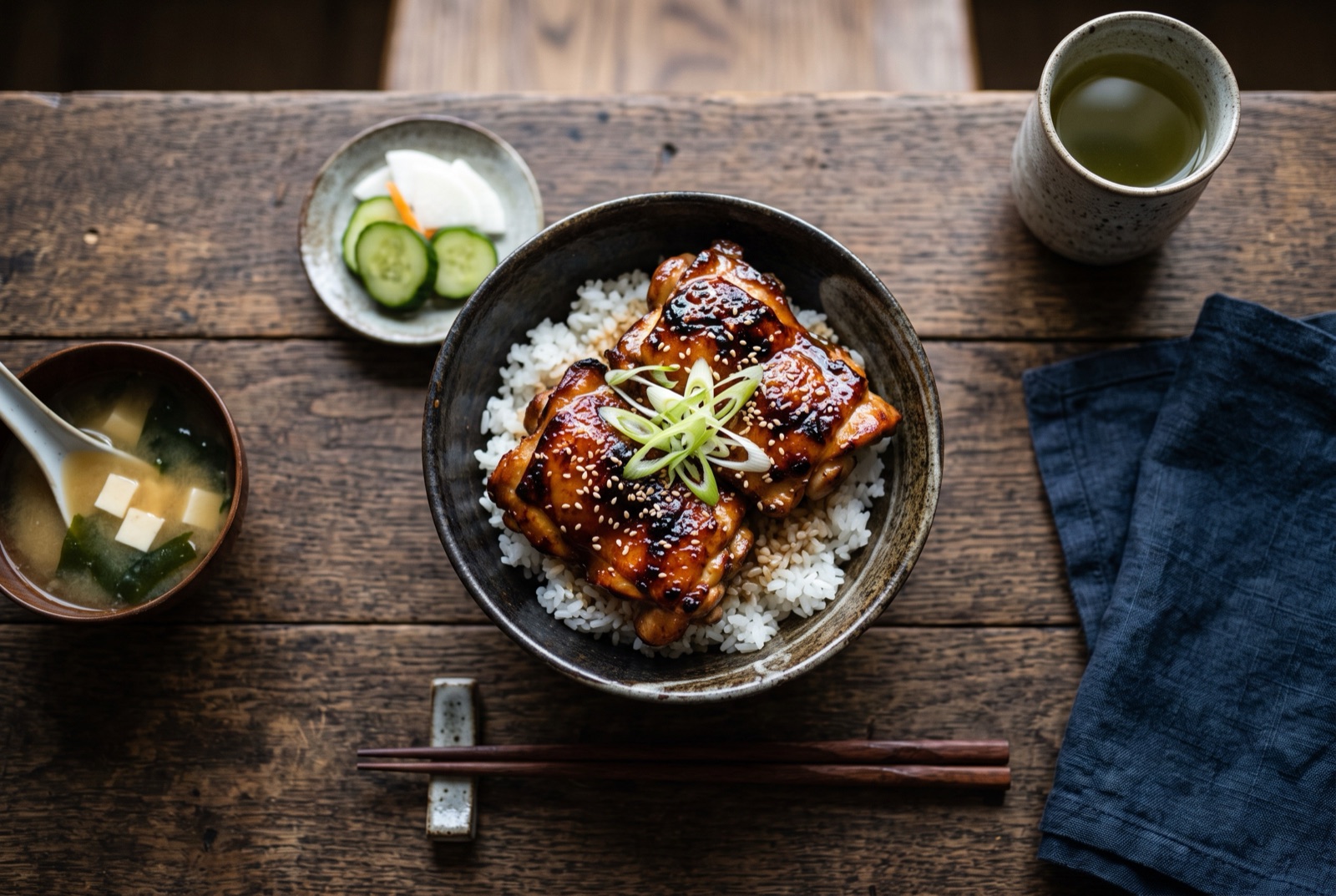
Japan has 9 more dishes in the atlas — Chicken Teriyaki and Dorayaki, and 7 more.
Recipe by The DishRoute Kitchen · published August 19, 2026 · updated August 19, 2026