Chicken Teriyaki.
Pan-Glazed, No Bottled Sauce
照り焼きチキン · Teriyaki chikin · say it: teh-ree-YAH-kee CHEE-keen
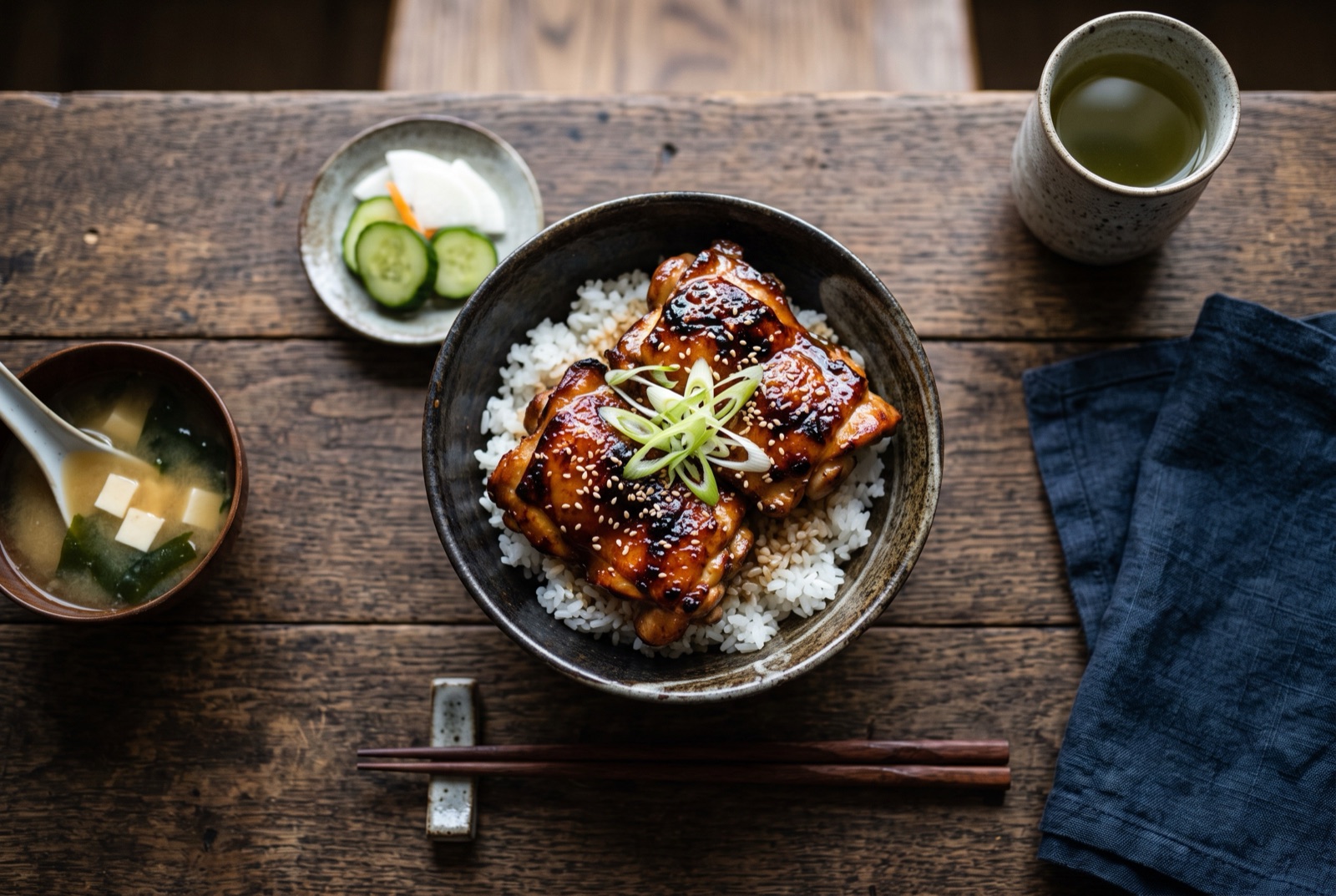
Teriyaki as cooked in Japanese homes is not a marinade and not a sauce from a bottle — it is a technique. Chicken thighs are seared skin-side down until deeply browned, then soy sauce, mirin, sake and a little sugar go straight into the hot pan and reduce around the meat until they turn into a glossy, clinging lacquer. The taste is salty-sweet in balance, with the caramel edge of reduced mirin and the savory depth of the chicken fond dissolved into the glaze. This version works at home because it needs one pan, four pantry liquids and about twenty minutes, and because the pan-reduction method gives you the shine and depth that pre-made teriyaki sauce, thickened with cornstarch, never quite manages.

- Gate
- Japan
- Prep
- 10 min
- Cook
- 20 min
- Total time
- 30 min
- Serves
- 4
- Status
- Easy
- Nutrition / serving · estimated
- Calories 420 kcal
- Protein 33 g
- Carbs 13 g
- Fat 25 g
- Sugar 10 g
- Sodium 950 mg
Why this recipe works.
- The glaze is built in the pan from soy, mirin and sake — it picks up the chicken fond, which bottled sauce cannot do.
- No cornstarch: the gloss comes from properly reduced mirin, the way it is done in Japan.
- Thighs with skin stay juicy through the glazing; the rendered fat crisps the skin first.
- One skillet, four pantry liquids, about twenty minutes — genuine weeknight territory.
Ingredients.
9 itemsFor the chicken
For the glaze
For serving
Equipment
- Heavy skillet with a lid (cast iron or stainless)
- Tongs or cooking chopsticks
- Paper towels for drying the skin
Instructions.
Dry and season the chicken
Pat the chicken thighs completely dry with paper towels, especially the skin. Season lightly with salt and pepper on both sides — lightly, because the soy glaze brings most of the salt.
Mix the glaze
Stir together the soy sauce, 3 tbsp of mirin, the sake and the sugar in a small bowl until the sugar dissolves. Keep it next to the stove — the end of cooking moves fast.
Render and crisp the skin
Set the thighs skin-side down in a barely warm skillet with the oil, then bring the heat to medium. Cook undisturbed until the skin is deep golden brown, crackling, and releases from the pan on its own, 7–9 minutes.
Tip Press the thighs flat with a spatula for the first minute so the whole skin surface touches the pan.
Cook the second side
Flip the thighs and cook until the underside is lightly browned and the meat feels firm at the thickest point, 4–5 minutes. Pour off all but a thin film of the rendered fat.
Glaze in the pan
Pour the glaze mixture into the hot pan around the chicken — it will bubble hard immediately. Simmer, turning the thighs to coat every side, until the liquid reduces to a syrup that clings to the meat with a visible shine and the bubbles turn large and slow, 2–3 minutes.
Tip Pull the pan off the heat the moment a dragged spatula leaves a brief trail in the glaze — ten seconds too long and it turns to caramel.
Rest, slice and serve
Rest the chicken on a board for 2–3 minutes so the glaze sets tacky, then slice each thigh crosswise into strips. Spoon any remaining pan glaze over the top and finish with scallions and sesame seeds. Serve with hot rice.
Tips from our kitchen.
- Dry the chicken skin thoroughly with paper towels before it hits the pan — wet skin steams and never crisps, and crisp skin is half the dish.
- Start skin-side down in a cold or barely warm pan and let the fat render slowly. Rushing the sear gives you pale, flabby skin over cooked meat.
- Pour off most of the rendered fat before adding the glaze liquids; too much fat and the sauce splits into an oily slick instead of a lacquer.
- Watch the reduction, not the clock. The glaze is done when big slow bubbles replace fast small ones and a spatula dragged through leaves a brief trail.
- If you only have sweet bottled "mirin-style seasoning", cut the sugar in the recipe by half — real hon-mirin is less sweet than the imitation.
- Rest the chicken two or three minutes before slicing so the glaze sets to a sticky sheen instead of running off with the juices.
Substitutions.
- Sake → Dry white wine, or water with an extra ½ tsp sugar
- Any inexpensive drinking sake works; cooking sake with added salt also works if you ease up on the soy. Wine is close enough.
- Mirin → 1 tbsp sake (or water) + 2 tsp sugar per tablespoon of mirin
- You lose a little of mirin's rounded depth but keep the balance. True hon-mirin is worth buying — it keeps for a year.
- Chicken thighs → Chicken breast, salmon fillet, or firm tofu
- Breast dries out faster — pull it at 63°C and let carryover finish it. Salmon teriyaki is actually the older, classic dish.
Variations.
- Buri no teriyaki
- The classical version: yellowtail (or salmon) fillets seared and glazed the same way — the fish the technique was invented for.
- Teriyaki donburi
- Sliced glazed chicken over a bowl of hot rice with the pan glaze spooned over, shredded cabbage or scallions alongside — bento-shop style.
- Ginger-garlic teriyaki
- A grated coin of ginger and one crushed garlic clove added with the glaze liquids — not traditional in Japan, but a common and good home variation.
Storage & reheating.
Keeps 3 days refrigerated in an airtight container; the glaze thickens to a jelly in the fridge and reloosens on reheating. Reheat gently in a covered pan with a spoonful of water, or microwave at medium power — high heat turns the glaze bitter. Sliced teriyaki chicken freezes well for up to 2 months and is excellent cold in a bento.
Serve with
Steamed short-grain rice, a pile of shredded raw cabbage, and miso soup — the standard Japanese teishoku set.
The story behind Chicken Teriyaki.
The word teriyaki tells you exactly what the dish is: teri means gloss or luster, and yaki means grilled or seared. It is a name for a finish, not a flavor — in classical Japanese cooking, teriyaki was a method applied mostly to fish like yellowtail (buri no teriyaki), where fillets were grilled and brushed with a reduction of soy sauce, mirin and sake until the surface caught the light. The chicken version is a later, homier development, and today teriyaki chicken is standard weeknight cooking across Japan: bento boxes, izakaya menus, family dinners.
What most of the world knows as teriyaki is a different creature. Japanese immigrants in Hawaii and the American West Coast adapted the glaze to local tastes in the mid-twentieth century, adding pineapple juice, garlic, ginger and eventually cornstarch, and by the 1990s bottled "teriyaki sauce" and Seattle-style teriyaki shops had turned the word into a marinade category. None of that is wrong as food — but it explains why bottled teriyaki tastes thick and one-note next to the real thing. In Japan the glaze is made in the pan, in the minute or two it takes to reduce, and it is never thickened with starch: the shine comes from mirin's sugars concentrating as the liquid evaporates.
That is also why the dish rewards technique over shopping. The four liquids are cheap and keep forever; the skill is in the sear (dry skin, patient browning, rendered fat poured off) and in pulling the pan off the heat the moment the glaze goes from bubbling liquid to syrup that coats the back of a spoon. Ten seconds past that point it turns to candy and scorches. Get it right and the chicken looks varnished — which is, literally, the name of the dish.
Questions, answered.
What does "teriyaki" actually mean?
It is a Japanese compound: teri (照り) means gloss or luster, and yaki (焼き) means grilled or seared. So teriyaki literally describes the finish — food seared and then glazed until it shines. In Japan it names a technique of reducing soy sauce, mirin and sake around the food, not a particular bottled sauce or flavor profile.
Can I just use bottled teriyaki sauce?
You can, but you will get a different dish. Bottled teriyaki is typically thickened with cornstarch and flavored with garlic, ginger and sometimes pineapple — an American adaptation. The Japanese method reduces soy sauce, mirin and sake in the pan so the glaze absorbs the browned chicken drippings and turns glossy from concentrated mirin sugars alone. It takes two extra minutes and three pantry bottles.
What is mirin and where do I find it?
Mirin is a sweet Japanese rice wine used almost entirely for cooking — it brings sweetness, gloss and a rounded depth that plain sugar lacks. Look for "hon-mirin" (true mirin) in Asian groceries or well-stocked supermarkets; "mirin-style seasoning" is a sweeter imitation that works if you reduce the added sugar. A bottle keeps about a year in a cool cupboard.
Why did my teriyaki glaze burn or turn into hard candy?
The glaze is mostly sugar once the liquid cooks off, and it moves from syrup to caramel to scorched in under a minute. Reduce it over medium heat, watch for the bubbles to grow large and slow, and pull the pan the moment the sauce coats the chicken with a visible sheen. If it over-reduces, a tablespoon of hot water whisked in will rescue it once or twice.
Thighs or breast for teriyaki chicken?
Thighs, ideally skin-on, are the Japanese default and the more forgiving cut: the fat keeps the meat juicy through searing and glazing, and the skin crisps and then lacquers beautifully. Breast works if you prefer it — pound it to even thickness, sear it more gently, and pull it off the heat as soon as it is just cooked through, since the glaze reduction gives it extra time in the pan.
You might also like.
All recipes →
Keep exploring Japan.
Japan has 9 more dishes in the atlas — Agedashi Dofu and Dorayaki, and 7 more.
Recipe by The DishRoute Kitchen · published August 18, 2026 · updated August 18, 2026