Butter Chicken.
Murgh Makhani
मुर्ग़ मक्खनी · Murgh makhani · say it: moorg muck-KHAH-nee
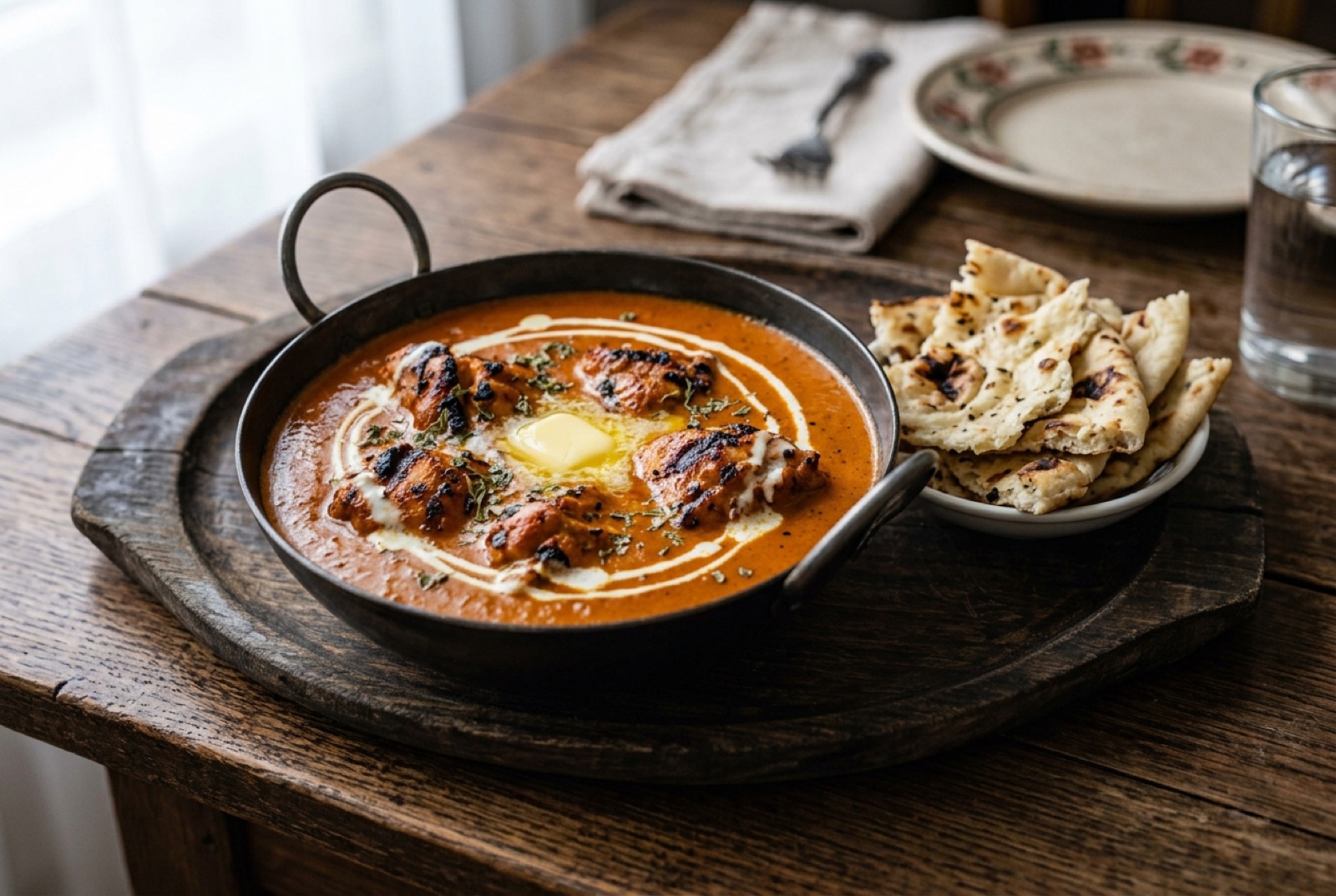
Butter chicken is tandoori chicken's second act: pieces of chicken marinated in yogurt, ginger, garlic and spices, roasted until charred at the edges, then simmered briefly in a smooth sauce of tomatoes, butter and cream. The taste is gentler than its color suggests — tangy-sweet tomato rounded off with dairy, warm garam masala, a whisper of smoke from the char, and only as much chile heat as you choose. It is famously the "gateway" Indian curry, and fairly so. This version needs no tandoor: a hot broiler gives the chicken its blistered edges, and the sauce comes together in one pan while it cooks.

- Gate
- IndiaDelhi / Punjab
- Prep
- 25 min
- Cook
- 45 min
- Total time
- 5 hr 10 min incl. 4 hr rest
- Serves
- 4
- Status
- Medium
- Nutrition / serving · estimated
- Calories 620 kcal
- Protein 42 g
- Carbs 18 g
- Fat 42 g
- Fiber 3 g
- Sugar 11 g
Why this recipe works.
- A real two-stage build — broiler-charred chicken, then the sauce — instead of poaching raw chicken in the gravy.
- The sauce is blended smooth and finished with kasuri methi, the detail that makes it taste like a Delhi restaurant's.
- Kashmiri chili powder gives the classic deep color with very little heat, so the spice level stays in your control.
- One marinade, one sheet pan, one sauce pot — no tandoor, no specialty equipment.
Ingredients.
20 itemsFor the chicken
For the sauce
For serving
Equipment
- Broiler (grill) with a rack and sheet pan
- Blender or immersion blender
- Large heavy saucepan or sauté pan
- Mixing bowl
Instructions.
Marinate the chicken
Stir the yogurt, grated garlic and ginger, Kashmiri chili, garam masala, turmeric, lemon juice and salt into a thick red marinade. Coat 800 g of chicken pieces thoroughly, cover, and refrigerate at least 4 hours, ideally overnight.
Tip Squeeze the marinade into the chicken with your hands — the yogurt tenderizes wherever it actually touches.
Broil until charred
Heat the broiler on high with a rack about 10 cm from the element. Spread the chicken on a foil-lined sheet pan in a single layer and broil 12–15 minutes, turning once, until the pieces are cooked through and blackened in spots at the edges. Keep the pan juices.
Tip You want real charred patches, not an even golden brown — they replace the tandoor's smoke.
Start the sauce
While the chicken broils, melt the butter in a large saucepan over medium heat and cook the garlic and ginger until fragrant and just turning gold at the edges, about a minute. Stir in the Kashmiri chili and garam masala and let them sizzle in the butter for 20 seconds.
Cook down the tomatoes
Add 700 g of crushed tomatoes with a good pinch of salt and simmer briskly, stirring now and then, until the sauce darkens to brick red, thickens, and butter pools at the edges, 15–20 minutes. Taste — the raw tomato sharpness should be gone.
Blend smooth
Blend the sauce (immersion blender in the pan, or carefully in a jug blender) until completely smooth and glossy. Return it to the pan over low heat; it should coat a spoon thickly.
Finish and combine
Stir in the cream and honey, then crush the kasuri methi between your palms into the sauce. Add the charred chicken with its pan juices and simmer gently, uncovered, until the sauce clings to the pieces and small bubbles just break the surface, about 5 minutes. Season with salt.
Rest and serve
Pull the pan off the heat and let it stand 5 minutes so the chicken settles into the sauce. Serve over basmati rice or with naan, scattered with cilantro and, if you like, a thin swirl of extra cream.
Tips from our kitchen.
- Use boneless thighs, not breast. Thighs survive both the broiler and the simmer; breast meat turns stringy in the sauce.
- Marinate at least 4 hours and ideally overnight — yogurt tenderizes slowly, and a 30-minute soak flavors only the surface.
- Broil close to the element and let the edges genuinely blacken in spots. Those charred bits stand in for the tandoor; pale chicken makes a flat butter chicken.
- Cook the tomato base until the fat visibly separates at the edges before blending. This step is where the raw-tomato sourness cooks out.
- Crush the kasuri methi (dried fenugreek leaves) between your palms as it goes in — it is the signature background aroma of makhani sauce and has no real substitute.
- Add the cream off a rolling boil and keep the final simmer gentle, or the sauce can split and lose its gloss.
Substitutions.
- Kashmiri chili powder → 2 parts sweet paprika + 1 part cayenne
- Matches the color and the mild warmth closely. Do not use plain cayenne alone — far too hot for the quantity needed.
- Kasuri methi → A pinch of ground fenugreek seed, or omit
- Ground seed is more bitter, so use a small pinch. Omitting works, but the sauce loses its distinctive restaurant aroma.
- Heavy cream → Full-fat coconut cream
- Makes the sauce dairy-lighter (butter remains) with a faint coconut note. Cashew cream also works and is closer in flavor.
Variations.
- Paneer makhani
- The vegetarian classic: skip the chicken and marinade, and warm cubes of pan-seared paneer in the same makhani sauce.
- Grill-charred version
- Thread the marinated chicken on skewers and cook over hot charcoal instead of the broiler — the closest home method to a true tandoor.
- Smoky dhungar finish
- A North Indian restaurant trick: rest a piece of lit charcoal in a small bowl on the sauce, add a spoon of ghee, cover 2 minutes, remove. Adds real smoke.
Storage & reheating.
Butter chicken keeps 3 days refrigerated and honestly improves overnight as the sauce settles into the chicken. Reheat gently on the stove with a splash of water or cream; a hard boil can split the sauce. It freezes well for up to 2 months — thaw in the fridge and reheat the same way, stirring the sauce back together as it warms.
Serve with
Steamed basmati rice or warm naan, with sliced red onion and lemon wedges on the side.
The story behind Butter Chicken.
Butter chicken has an unusually well-documented birthplace: Moti Mahal, a restaurant in the Daryaganj district of Delhi, in the years after the 1947 Partition of India. Its founders were Punjabi Hindu refugees from Peshawar (in present-day Pakistan) who brought the tandoor — the barrel-shaped clay oven — with them and made tandoori chicken a Delhi sensation. Butter chicken, by the restaurant's own telling, began as thrift: tandoor-roasted chicken dries out as it sits, so the cooks revived unsold pieces in a quickly made sauce of fresh tomatoes, butter and cream. The rescue outgrew the original. By the 1950s murgh makhani was on the menu in its own right, alongside its vegetarian sibling dal makhani, invented in the same kitchen on the same logic.
Exactly which founder deserves the credit is genuinely disputed — the families of Kundan Lal Gujral and Kundan Lal Jaggi, partners at Moti Mahal, have each claimed the invention, and the disagreement reached the Delhi High Court in 2024. What nobody disputes is the place, the era, and the idea: leftover tandoori chicken plus tomato, butter and cream.
From Delhi the dish followed the Punjabi restaurant diaspora around the world and became, for millions of people, the definition of Indian food — to the mild exasperation of Indians whose home cooking looks nothing like it. It also has a famous foreign descendant: British chicken tikka masala is widely considered an adaptation of murgh makhani. The two are cousins, not twins — butter chicken is tomato-forward, silkier and slightly sweet, where tikka masala leans on onion and heavier spicing. At home, the two-stage structure is what matters: char the marinated chicken properly first, because that smoky edge is the difference between butter chicken and chicken in tomato cream.
Questions, answered.
Is butter chicken the same as chicken tikka masala?
No, though they are close relatives. Butter chicken (murgh makhani) was created at the Moti Mahal restaurant in Delhi and has a smooth, tomato-forward sauce enriched with butter and cream, mildly spiced and slightly sweet. Chicken tikka masala is widely considered a British adaptation of it, typically with more onion, heavier spicing and a less silky sauce.
How spicy is butter chicken?
Mild by Indian standards — it is the dish Indian restaurants recommend to heat-shy diners. The red color comes mostly from Kashmiri chili powder and tomatoes, not from serious heat, and the butter and cream soften what little there is. To make it hotter, add cayenne or a slit green chile to the sauce rather than more Kashmiri chili.
Can I make butter chicken without a tandoor?
Yes — this is exactly what the broiler method is for. A tandoor contributes intense top-down heat and char, and a home broiler on high, with the chicken close to the element, reproduces the blistered, smoky edges well. A charcoal grill or a screaming-hot cast-iron pan are good alternatives; the one mistake is gently poaching raw chicken in the sauce, which skips the char entirely.
What is kasuri methi and why does the recipe insist on it?
Kasuri methi is dried fenugreek leaf, a North Indian herb with a savory, faintly bitter, maple-adjacent aroma. It is the background note that makes makhani sauces taste like restaurant butter chicken, added crushed at the end of cooking. Indian grocers and most large supermarkets stock it cheaply, and a packet lasts a year of curries.
Can I use chicken breast instead of thighs?
You can, with care. Breast meat cooks faster and dries out more easily, so cut it slightly larger, broil it just until the edges char, and add it to the sauce only for the final 2–3 minutes of simmering. Thighs remain the better choice because they stay juicy through both the broiler and the simmer.
You might also like.
All recipes →
Keep exploring India.
India has 9 more dishes in the atlas — Aloo Paratha and Chana Masala, and 7 more.
Recipe by The DishRoute Kitchen · published August 18, 2026 · updated August 18, 2026