Chiles en Nogada.
Stuffed Poblanos in Walnut Cream
Chiles en nogada · say it: CHEE-lehs ehn noh-GAH-dah
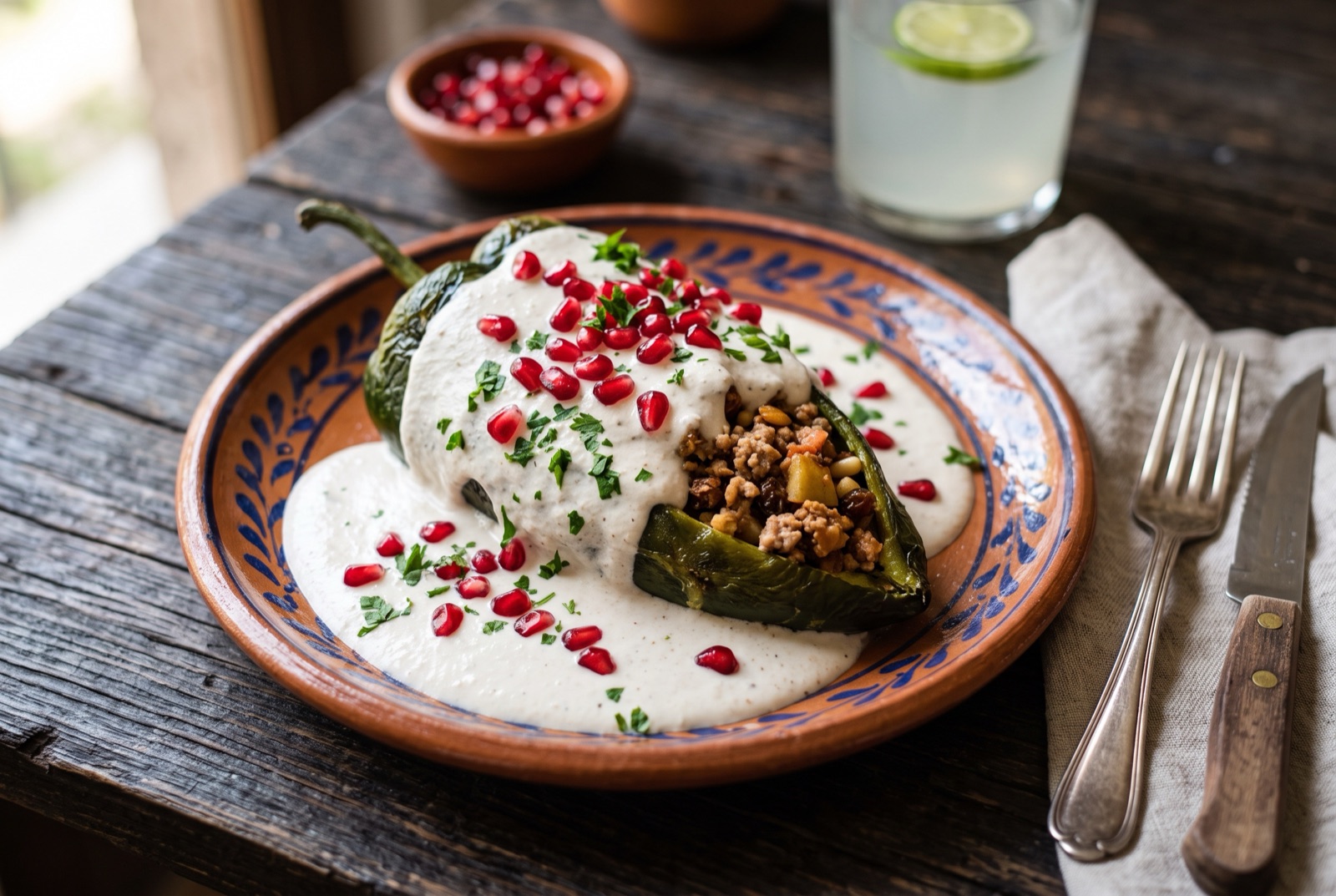
Chiles en nogada is a roasted poblano pepper filled with picadillo — minced pork cooked down with apple, peach, pear, raisins, almonds and warm spice — then covered in a cold, barely sweet sauce of peeled walnuts blended with fresh cheese and milk, and finished with pomegranate seeds and parsley. The contrast is the entire point: a warm, spiced, faintly sweet filling under a chilled, milky sauce, with pomegranate popping sharp on top and the smoky green chile holding it all together. It is served for roughly two months a year, when the walnuts and pomegranates of the Puebla highlands are both in season, and Mexicans plan meals around its arrival.

- Gate
- MexicoPuebla
- Prep
- 1 hr 10 min
- Cook
- 45 min
- Total time
- 2 hr 15 min incl. 20 min rest
- Serves
- 6
- Status
- Takes skill
- Nutrition / serving · estimated
- Calories 690 kcal
- Protein 33 g
- Carbs 34 g
- Fat 48 g
- Fiber 7 g
- Sugar 22 g
Why this recipe works.
- Explains the walnut-peeling step properly, because it is the difference between an ivory sauce and a grey one.
- Picadillo is cooked in stages so the fruit keeps its shape instead of collapsing into jam.
- Served uncoated in the modern Puebla style, with instructions for the battered version if you want it.
- Honest about seasonality and about which stories around the dish are documented and which are folklore.
Ingredients.
23 itemsFor the chiles
For the picadillo
For the nogada
To finish
Equipment
- Gas flame or grill for roasting chiles
- Blender
- Large frying pan
- Fine sieve
Instructions.
Peel the walnuts
Cover the walnut halves with boiling water and leave for 5 minutes, then drain and rub the brown skins away with your fingertips, picking the last bits from the grooves. Cover the peeled ivory nuts with milk and refrigerate while you cook.
Tip Do this first and do it properly — it takes about 30 minutes and decides the color and taste of the whole dish.
Roast and peel the chiles
Blacken 6 poblanos directly over a gas flame or under a hot grill, turning until the skin is charred and blistered all over. Seal them in a covered bowl for 10 minutes, then slip the skins off — they should come away in sheets.
Tip Do not rinse them under the tap to speed this up; you wash the roasted flavor straight down the drain.
Open and seed them
Cut a single lengthways slit in each chile from just below the stem, and lift out the seed cluster and veins through the opening, keeping the stem and the rest of the chile intact. Set them aside on a tray.
Brown the pork
Heat the lard in a wide pan and cook the minced pork over high heat, breaking it up, until the liquid has evaporated and the meat is properly browned and catching on the base, about 10 minutes. Season with salt and pepper.
Tip Do not crowd the pan. Grey, steamed mince makes a flat picadillo.
Build the picadillo
Add the onion and garlic and cook until soft, then the tomatoes, and simmer until the mixture no longer looks watery. Stir in the cinnamon and cloves, then the fruit, raisins and almonds, and cook 8–10 minutes more, until the fruit is tender at the edges but still holds its cubes.
Tip Taste and adjust: the picadillo should be savory first with sweetness arriving second, not the other way round.
Rest the filling
Take the pan off the heat and let the picadillo sit for 20 minutes. It firms up as it cools, which makes the chiles far easier to fill and stops the filling from running out on the plate.
Blend the nogada
Drain the soaked walnuts and blend them with the queso fresco, milk, sugar, salt and the sherry if using, until completely smooth and the consistency of thick pouring cream. Push it through a fine sieve if it still feels at all gritty, and chill.
Tip Add milk a spoonful at a time. Too thin and it slides off the chile instead of cloaking it.
Stuff the chiles
Fill each chile through its slit with the warm picadillo until plump but still closing over, and press the edges together so the seam almost disappears. Warm them through in a 160°C oven for 10 minutes if they have cooled.
Sauce and serve
Lay each chile seam-down on a plate, spoon the cold nogada over the middle so the green tips show at either end, and scatter generously with pomegranate seeds and parsley leaves. Serve straight away, while the chile is warm and the sauce is not.
Tips from our kitchen.
- Peel the walnuts. Pour boiling water over the halves, leave 5 minutes, then rub the brown skin off with your fingers — it accounts for nearly all the bitterness and all the grey color in a nogada.
- Roast the poblanos over an open flame until the skin is black and blistered all over, then sweat them in a covered bowl for 10 minutes so the skin slides off in sheets.
- Slit the chile down one side only and remove the seed cluster through that opening, keeping the stem attached. A chile split in half will not hold its filling.
- Cut the fruit small and even, about 8 mm dice. Large chunks stay raw in the middle and make the filling fall apart when you cut into the chile.
- The nogada is served cold or barely cool over warm chiles, never hot. Heating it makes it grainy and dulls its fresh nuttiness.
- Make the sauce the same day. Blended walnut cream oxidizes and turns beige and flat by the next morning.
Substitutions.
- Fresh walnuts (nuez de Castilla) → Ordinary shelled walnut halves, blanched and peeled
- Fresh season walnuts are milky and sweet; dried ones are drier and more tannic, so peel them thoroughly and soak them in milk for a few hours before blending.
- Queso fresco in the sauce → Soft goat cheese, or a mix of cream cheese and crème fraîche
- Goat cheese is traditional in some Puebla families and gives a tangier nogada. Cream cheese makes the smoothest sauce but the mildest flavor.
- Criollo peach and San Juan pear → A firm ordinary peach and a barely ripe pear
- The Puebla varieties are small, firm and tart. Choose underripe fruit rather than perfectly ripe, so it survives the pan.
Variations.
- Chiles capeados
- The older style: each stuffed chile is dusted with flour, dipped in stiffly beaten egg whites folded with the yolks, and fried until puffed and golden before being sauced.
- Nogada with sherry
- A splash of dry sherry blended into the walnut sauce, common in restaurant versions in Puebla. It sharpens the sauce and cuts the richness.
- Vegetarian picadillo
- The pork replaced with finely chopped mushrooms and extra almonds, cooked the same way. Not traditional, but the fruit and spice do most of the work anyway.
Storage & reheating.
Best eaten the day it is made. The stuffed chiles can be prepared a day ahead and refrigerated, then warmed in a low oven for 15 minutes before serving. The nogada should be blended within a few hours of eating; refrigerated overnight it darkens, thickens and loses its fresh walnut flavor. Do not freeze — the sauce splits completely and the roasted chiles turn to pulp on thawing.
Serve with
Nothing heavy — a plain white rice or simply warm bolillo bread, since the dish is already a full plate of sweet, savory and rich.
The story behind Chiles en Nogada.
The dish belongs to Puebla and to a specific window of the year. Fresh walnuts — nuez de Castilla — and pomegranates ripen in the Puebla and Calpan highlands from roughly August into September, alongside the criollo peaches, panochera apples and San Juan pears that go in the filling, and outside that window a cook either does without or accepts an inferior version. Restaurants advertise the day the chiles arrive, and the season overlaps neatly with Mexican independence celebrations in September.
That overlap is where the patriotic story comes from: green chile, white sauce, red pomegranate — the flag on a plate. The most-told version has Augustinian nuns of Santa Mónica in Puebla creating the dish in 1821 to honor Agustín de Iturbide after the Treaty of Córdoba, when he passed through the city on his saint's day. Historians treat this as folklore rather than record; the tricolor reading may well have been applied to an existing dish after the fact. Pueblans generally know the story is unverified and tell it anyway, which is the honest position to take here too.
The genuine arguments in Puebla are about technique. Should the chile be capeado — dipped in beaten egg and fried in a light batter — or served naked, letting the roasted chile show? Both are traditional; the uncoated version is more common now and shows off the color better. Should the nogada contain a splash of sherry, or goat cheese, or nothing but walnuts, cheese and milk? Every family has a position. What nobody disputes is the labor: peeling the papery skin off each blanched walnut half is a slow, meditative job that families do together the day before, and it is the single step that separates a smooth ivory sauce from a grey, faintly bitter one.
Questions, answered.
Why is my walnut sauce grey and bitter?
Because the walnuts were not peeled. The thin brown skin on a walnut half carries nearly all its tannin and all its color. Blanch the halves in boiling water for five minutes, then rub and pick the skin away before blending — it is tedious, takes about half an hour for this quantity, and there is no shortcut that works.
Are chiles en nogada spicy?
Barely. Poblanos are one of the mildest chiles used in Mexican cooking, and roasting them softens what little heat they carry. Very occasionally a poblano turns out unexpectedly hot — it happens with the variety — but the dish is designed around sweetness, richness and the vegetal flavor of the chile rather than around heat.
Can I make this outside the August to September season?
You can, using dried walnuts and imported pomegranate, and it will be good. It will not be the same dish Pueblans wait for, because the fresh milky walnut is the entire character of the sauce. If you cook it off season, soak the peeled walnuts in milk for a few hours first to soften their dryness.
Should the chiles be battered and fried or left plain?
Both are traditional in Puebla. The capeado version, dipped in beaten egg and fried, is the older restaurant style and gives a soft golden shell. The plain version is more common today, is much less work, and shows the green of the chile against the white sauce — which matters if you care about the tricolor presentation.
Can I prepare any of it ahead?
The picadillo actually improves made a day ahead, as the spices settle into the meat and fruit. Roast and peel the chiles the day before too, and keep them covered in the fridge. Stuff them and blend the nogada on the day itself, and warm the chiles gently before saucing.
You might also like.
All recipes →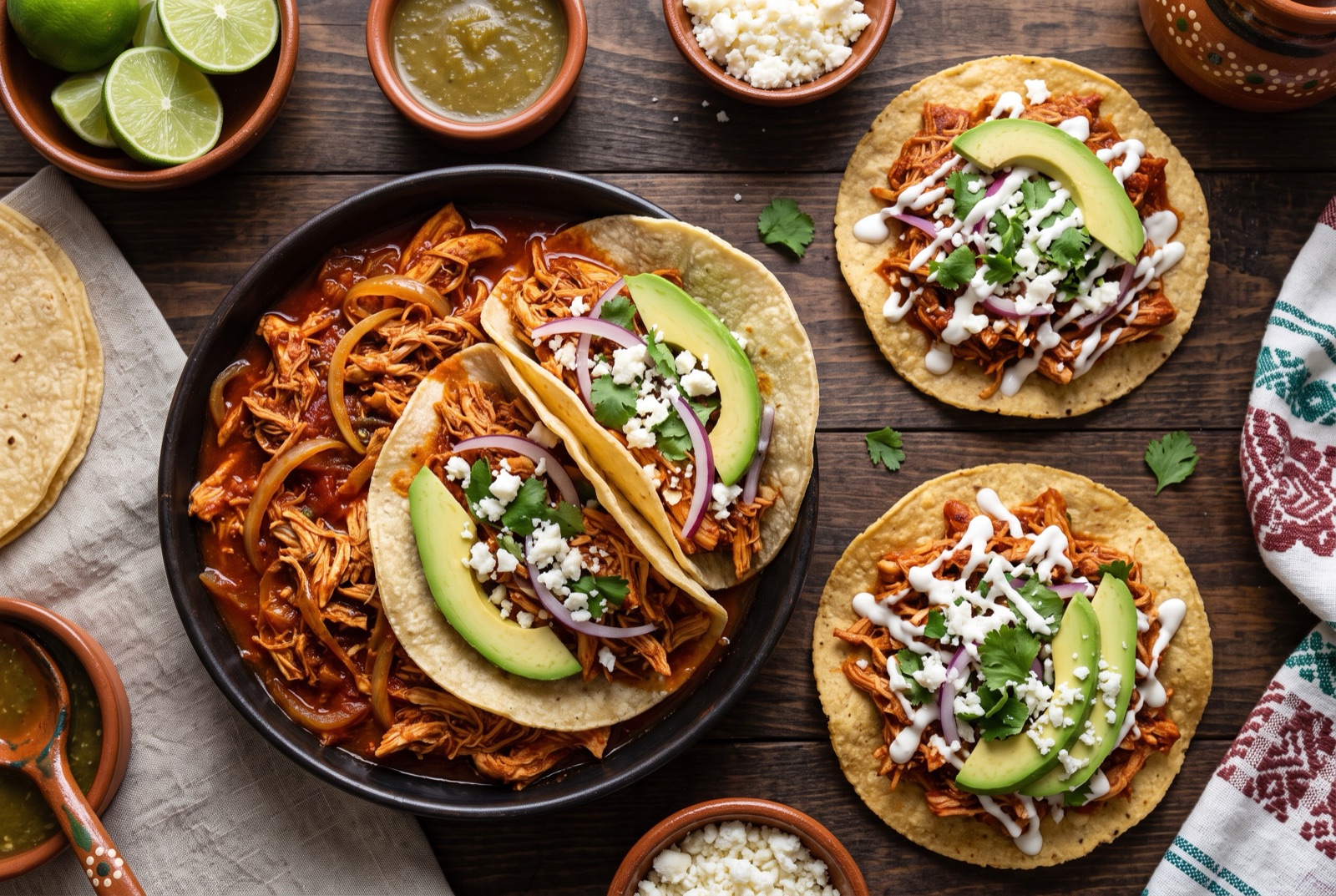
Keep exploring Mexico.
Mexico has 9 more dishes in the atlas — Chicken Tinga and Chilaquiles Verdes, and 7 more.
Recipe by The DishRoute Kitchen · published August 19, 2026 · updated August 19, 2026