Flan Napolitano.
Mexican Cream Cheese Caramel Custard
Flan napolitano · say it: flahn nah-poh-lee-TAH-noh
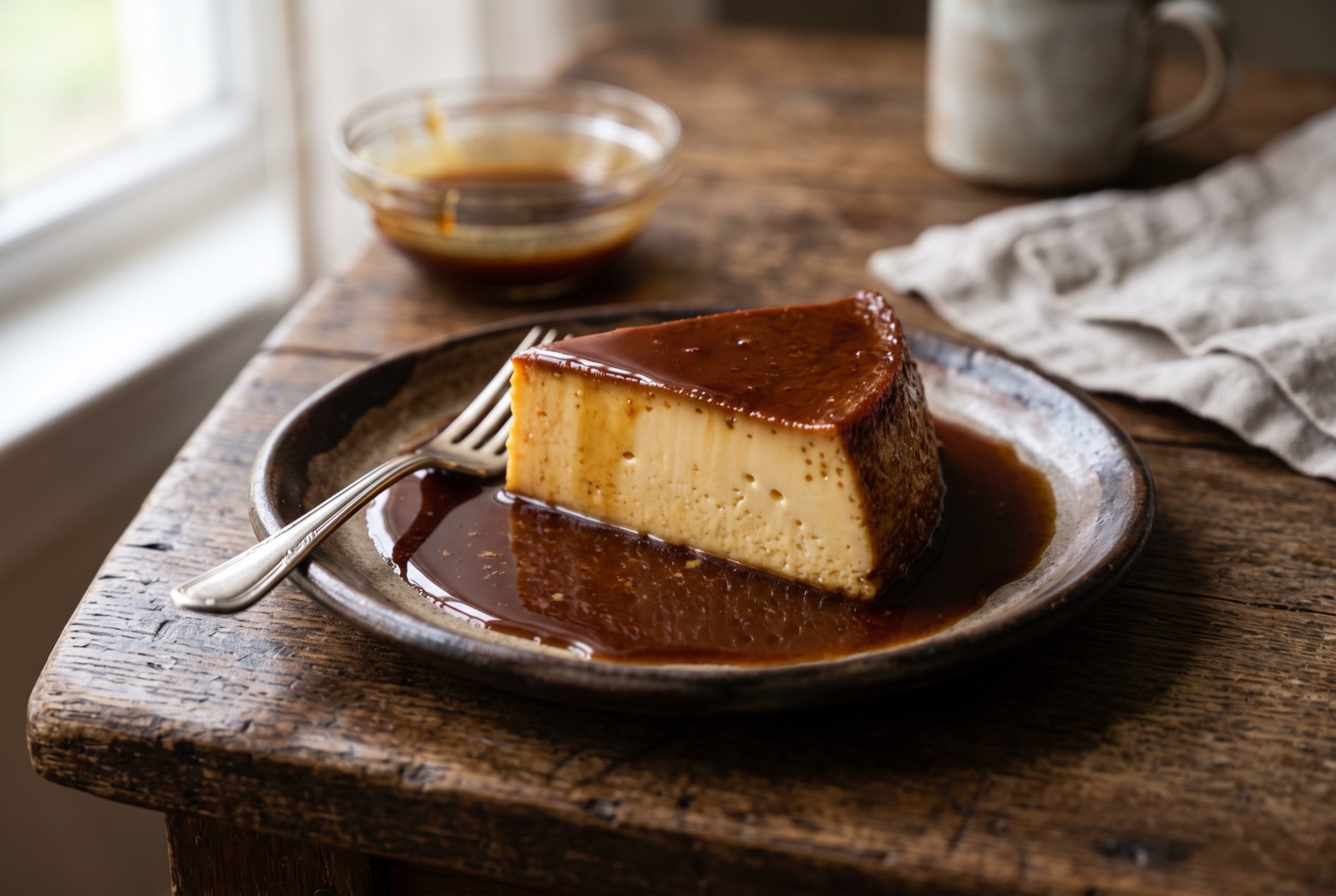
Flan napolitano is the version of caramel custard Mexican home cooks actually make, and it is noticeably firmer and richer than the wobbly Spanish original. Cream cheese and condensed milk go into the blender with the eggs, which gives the set custard a close, sliceable texture and a faint tang behind the sweetness, while the bitter caramel poured into the mould first melts during baking into a thin dark sauce. It tastes like caramel, vanilla and something close to baked cheesecake, and it is disproportionately easy: five minutes in a blender, an hour in a water bath, then patience while it chills.

- Gate
- MexicoNationwide
- Prep
- 20 min
- Cook
- 1 hr
- Total time
- 7 hr 20 min incl. 6 hr rest
- Serves
- 8
- Status
- Easy
- Nutrition / serving · estimated
- Calories 390 kcal
- Protein 10 g
- Carbs 50 g
- Fat 17 g
- Sugar 48 g
- Sodium 190 mg
Why this recipe works.
- Blender method start to finish, so the cream cheese fully disperses instead of leaving pale lumps in the set custard.
- The caramel is taken to a genuinely dark amber, which keeps the finished dessert from tasting flatly sweet.
- A strained batter and a covered water bath give a smooth surface with no bubble holes or rubbery edge.
- Clear doneness cues for the wobble, which is where most home flans go wrong in either direction.
Ingredients.
8 itemsFor the caramel
For the custard
Equipment
- Blender
- 20 cm round cake tin or flanera
- Deep roasting tray for the water bath
- Fine sieve
- Small heavy saucepan
Instructions.
Cook the caramel dark
Warm the cake tin in the oven while you work. Heat the sugar and water in a small heavy pan over medium heat without stirring, swirling the pan occasionally, for 8–10 minutes — it will pass through clear syrup and pale gold before turning the deep amber of an old copper coin and smelling faintly toasted.
Tip Stop it the moment it hits deep amber. Caramel goes from perfect to acrid in about fifteen seconds.
Line the mould
Pour the caramel straight into the warm tin and tilt it quickly so the base is evenly covered and the caramel climbs a centimetre or so up the sides. Set it aside; it will harden into a glassy sheet within a minute, which is exactly right.
Blend the custard
Put the cream cheese in a blender with the condensed milk and blend for 30 seconds until completely smooth, then add the evaporated milk, eggs, vanilla and salt and blend for another 20 seconds. Stop as soon as it is uniform — over-blending whips in air that turns into holes.
Strain and pour
Pass the batter through a fine sieve directly into the caramel-lined tin, discarding anything the sieve catches. Tap the tin gently on the counter a few times and pop any foam on the surface with a spoon.
Bake in a water bath
Cover the tin tightly with foil, set it in a deep roasting tray and pour in boiling water until it reaches halfway up the sides. Bake at 160°C for about 60 minutes, until the edges are set and only a coin-sized circle at the centre still trembles when you nudge the tray.
Tip Start checking at 50 minutes. Tins vary and an overbaked flan is dense and slightly grainy.
Chill without shortcuts
Lift the tin out of the water, uncover it and cool to room temperature, then refrigerate for at least 6 hours and preferably overnight, so the custard firms and the hard caramel dissolves into sauce.
Unmould and serve
Run a thin knife around the edge, dip the base in hot water for 30 seconds, then invert onto a rimmed plate in one decisive movement. Lift the tin away, scrape out any caramel left behind, and slice with a knife wiped clean between cuts.
Tips from our kitchen.
- Take the caramel to the colour of an old copper coin. Pale caramel is only sugar; dark caramel supplies the bitterness that balances two tins of sweet milk.
- Have the mould ready and warm before the caramel is done — it sets hard within a minute and swirling it around a cold tin is a race you lose.
- Bring the cream cheese fully to room temperature. Cold cheese never quite blends out and shows up as white speckles in the sliced custard.
- Strain the blended batter through a sieve. It takes ten seconds and removes the chalazae and any air pockets that would otherwise pit the surface.
- Cover the mould with foil in the water bath. Uncovered flan develops a tough skin and browns unevenly on top.
- Chill for a minimum of six hours, ideally overnight. A warm flan will not release cleanly and the caramel will still be a solid disc rather than a sauce.
Substitutions.
- Cream cheese → Full-fat quark, or mascarpone for a richer, milder result
- Omit it entirely and you have a perfectly good flan de vainilla — lighter, silkier, and no longer napolitano.
- Evaporated milk → 350 ml whole milk reduced to about 300 ml, or single cream
- Evaporated milk contributes a faintly cooked, caramelised dairy note. Plain milk works but the custard sets slightly softer.
- Vanilla extract → Half a scraped vanilla pod, or 1 tsp of Mexican vanilla
- If you buy vanilla in Mexico, check the label — cheap bottles sold to tourists are often coumarin-based tonka substitutes rather than vanilla.
Variations.
- Flan de café
- Dissolve two tablespoons of instant espresso in the evaporated milk before blending. The bitterness pairs naturally with the dark caramel.
- Flan de cajeta
- Line the mould with cajeta, the goat's-milk caramel of Celaya, instead of cooked sugar. Sweeter, tangier and distinctly Guanajuato.
- Flan de coco
- Replace the evaporated milk with coconut milk and fold in 60 g of desiccated coconut. Common along both Mexican coasts.
Storage & reheating.
Flan keeps 4 days covered in the refrigerator and is arguably better on day two, once the caramel has fully dissolved into a sauce. Store it in the mould and unmould only when serving — once turned out, the caramel thins and the custard dries at the edges. Do not freeze it: the custard weeps on thawing and the texture turns grainy. It is not a dessert to serve warm, so plan the chilling time rather than trying to rush it.
Serve with
Strong black coffee or café de olla with cinnamon and piloncillo.
The story behind Flan Napolitano.
Custard set over caramel is old and widely shared — the Romans made egg-and-milk dishes, medieval Iberian cooks refined them into what Spanish speakers still call flan, and Spanish colonisation carried it to every corner of the Americas. Nearly every Latin American country has a version, and most of them are defended fiercely as local. What separates the Mexican one is the tin.
Sweetened condensed milk and evaporated milk arrived as industrial products in the late nineteenth and early twentieth centuries and were transformative in hot climates without reliable refrigeration. In Mexico they were absorbed into home baking so thoroughly that they now define whole categories of dessert — flan, pay de queso, carlota de limón, the milk trio in a pastel de tres leches. Flan napolitano is that absorption at its most complete: the sugar, the milk and much of the structure come from two tins, and the cream cheese, added later, pushes the texture from custard toward cheesecake.
The name is a puzzle worth being honest about. There is no persuasive evidence linking this flan to Naples, and no traditional Neapolitan dessert it clearly descends from; the most plausible explanation is a twentieth-century commercial name that stuck, in the same way "napolitano" was attached to various products as a shorthand for rich or Italian-sounding. Mexican cooks use the term precisely and consistently — flan napolitano means the dense cream-cheese version, flan de vainilla or flan casero means the lighter one — but the geography behind the word is decoration.
What is certain is where it sits at the table. Flan is the standard closing dish of a Mexican comida, made for birthdays and Sunday meals, baked in a round mould or in a flanera with a clamped lid, and unmoulded at the table for the small moment of drama when the caramel runs down the sides. It is also the dessert most likely to be sold by the slice at a fonda, sitting on the counter under a dome, quietly outselling everything next to it.
Questions, answered.
What makes flan napolitano different from regular flan?
Cream cheese and sweetened condensed milk. Standard flan is milk, eggs, sugar and vanilla, and sets into a light, quivering custard. Flan napolitano adds cream cheese and a tin of condensed milk, giving a denser, richer, faintly tangy custard that slices cleanly like cheesecake instead of wobbling.
Why does my flan have holes and a rubbery texture?
The oven was too hot or the water bath was not doing its job. Egg custards set gently — above roughly 85°C the proteins tighten, squeeze out liquid and leave bubble holes. Bake at 160°C in a bath of hot water reaching halfway up the mould, and pull it while the centre still wobbles.
How do I know when the flan is done?
Nudge the mould. The outer two-thirds should be set and barely move, while a circle in the middle roughly the size of a coin still jiggles like loose jelly. It firms up considerably as it cools and chills, so a flan that looks fully set in the oven will be too firm on the plate.
My caramel hardened at the bottom of the mould — did I ruin it?
No, that is exactly what should happen. The caramel sets into a solid disc when it cools, then slowly dissolves into a liquid sauce as the flan chills over several hours, drawing moisture from the custard. This is why the long chill is not optional. If it is still solid after unmoulding, it needed more time in the fridge.
How do I unmould it without breaking it?
Run a thin knife around the edge, dip the base of the mould in hot water for about 30 seconds to loosen the caramel, place a lipped plate over the top and invert them together in one confident motion. Use a plate with a rim — a surprising amount of caramel sauce comes out with it.
You might also like.
All recipes →

Keep exploring Mexico.
Mexico has 9 more dishes in the atlas — Chicken Tinga and Chilaquiles Verdes, and 7 more.
Recipe by The DishRoute Kitchen · published August 19, 2026 · updated August 19, 2026