Chiles Rellenos Guatemaltecos.
Stuffed Peppers in Egg Batter
Chiles rellenos guatemaltecos · say it: CHEE-less reh-YEH-nohs
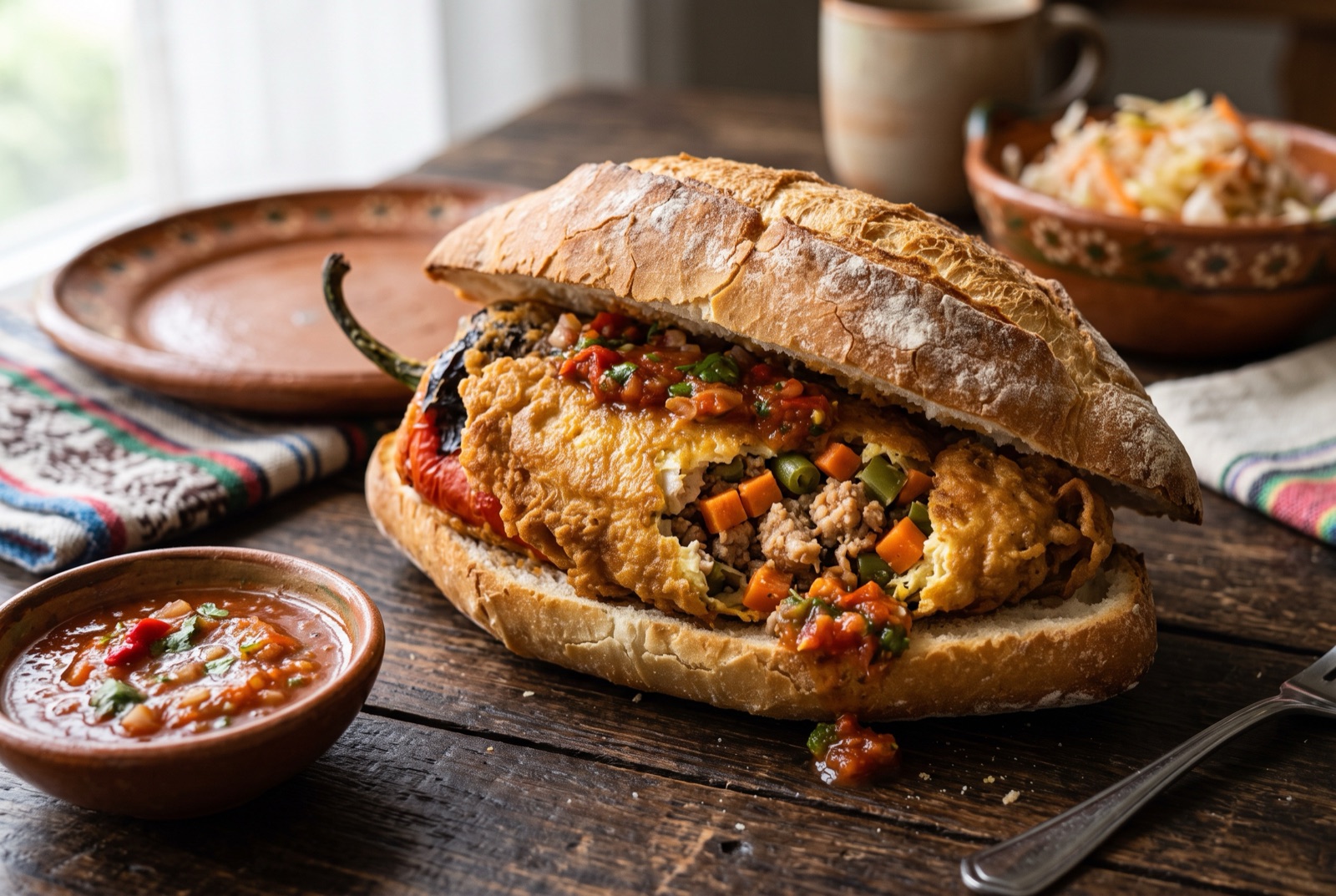
These are not the Mexican poblanos filled with cheese. The Guatemalan chile relleno is a sweet red or green pimiento pepper, charred and peeled, stuffed tight with a picadillo of minced pork and beef studded with diced carrot, green beans and potato, then dipped in egg whites whipped to peaks and shallow-fried until the coating puffs into a golden shell. It is savoury rather than spicy, faintly sweet from the pepper itself, and the fried egg jacket goes crisp at the edges and stays custardy where it meets the filling. Served with a thin tomato sauce, or — the way most Guatemalans actually eat it — jammed whole into a crusty bread roll and taken standing up.

- Gate
- GuatemalaGuatemala City and Antigua
- Prep
- 45 min
- Cook
- 40 min
- Total time
- 1 hr 25 min
- Serves
- 4
- Status
- Medium
- Nutrition / serving · estimated
- Calories 570 kcal
- Protein 33 g
- Carbs 27 g
- Fat 37 g
- Fiber 6 g
- Sugar 9 g
- Sodium 760 mg
Why this recipe works.
- The picadillo is fully cooked and seasoned before stuffing, so nothing ends up raw inside the pepper.
- Clear technique for the egg batter — whites whipped separately, yolks folded in — which is where most home attempts fail.
- Includes the bread-roll serving that is how the dish is actually eaten in Guatemala, not just the plated restaurant version.
- The vegetable-heavy filling makes a genuinely meat-free version easy without inventing anything untraditional.
Ingredients.
17 itemsFor the peppers
For the picadillo
For the batter
Equipment
- Gas burner or grill for charring
- Large mixing bowl
- Electric whisk or balloon whisk
- Wide frying pan
- Slotted spatula
Instructions.
Char and peel the peppers
Blacken the peppers directly over a gas flame or under a hot grill, turning, until the skins are blistered and charred all over — about 8 minutes. Drop them into a bowl, cover with a plate, and leave 10 minutes; the trapped steam loosens the skin so it rubs off in sheets.
Hollow them out
Rub the blackened skin away and cut one lengthwise slit in each pepper, from just below the stem to the tip. Reach in and pull out the seed core, keeping the pepper otherwise whole, then set them cut-side down on kitchen paper to drain.
Tip Leave the stem attached — it acts as a handle and holds the shoulders of the pepper together in the pan.
Cook the picadillo
Heat the oil in a wide pan and fry the onion until soft and translucent, then add the garlic and cook 30 seconds until fragrant. Add both minces and break them up, cooking until no pink remains and the meat begins to catch and brown on the base of the pan.
Add the vegetables
Stir in the carrot, potato, green beans, peas, tomato and thyme with a splash of water. Cover and cook for 15 minutes, then uncover and cook until the vegetables are tender and the mixture is dry enough to hold its shape on a spoon. Season firmly with salt and pepper and cool for 15 minutes.
Tip A wet filling makes the pepper burst in the oil. It should look like a chunky hash, not a stew.
Stuff and flour
Pack each pepper through its slit with the cooled picadillo until plump but not straining, and press the slit closed. Pat the outside dry, then roll each pepper in flour and tap off the excess so only a thin white film remains.
Whip the batter
Whisk the egg whites with the salt until they hold firm peaks that stand up when the whisk is lifted. Beat the yolks lightly and fold them through with a spatula in a few strokes, keeping the mixture pale, thick and airy.
Tip Fold, do not stir. Once the foam deflates it will not puff in the pan.
Fry
Heat 1.5 cm of oil in a wide pan over medium heat until a drop of batter sizzles steadily. Coat a pepper thickly in the egg mixture, lower it in, and fry 2 minutes a side, spooning hot oil over the top, until the shell is puffed and deep gold. Drain on a rack.
Serve
Serve hot with a thin cooked tomato sauce and white rice, or do it the Guatemalan way: split a crusty bread roll, spoon in sauce, press a whole chile relleno inside and eat it with your hands.
Tips from our kitchen.
- Char the peppers until the skin is blistered and black all over, then steam them in a covered bowl for 10 minutes. The skin will slip off in sheets instead of coming away in frustrating flakes.
- Cut one lengthwise slit and pull the seeds out through it, leaving the stem and shoulders intact. A pepper cut in half will not hold filling and will not survive the fryer.
- Dry the stuffed peppers thoroughly and dust them with flour before battering. Egg batter slides straight off a wet pepper.
- Whip the egg whites to firm peaks that hold their shape when the whisk is lifted, then fold the yolks in gently — overmixing collapses the foam and gives a flat, greasy coating.
- Fry in about 1.5 cm of oil at medium heat, not deep and not screaming hot. The coating should turn deep gold in roughly 2 minutes a side; hotter oil browns the egg before the inside heats through.
- Spoon hot oil over the top of each pepper as it fries so the exposed batter sets and puffs instead of sagging.
Substitutions.
- Sweet pimiento peppers → Small red bell peppers, or poblanos if you want mild heat
- Bell peppers are the closest widely available match in sweetness and shape. Poblanos make the dish taste noticeably more Mexican, which is fine but is a different dish.
- Mixed pork and beef → All pork, all beef, or shredded cooked chicken
- The mix gives fat from the pork and flavour from the beef. If you use only beef, add a spoonful of oil to the pan so the picadillo does not dry out.
- Egg batter → Beaten whole egg with 2 tbsp flour
- Simpler and less dramatic — you get a thin omelette-like coating rather than a puffed shell. Acceptable when you are cooking for two and cannot face whipping whites.
Variations.
- Chiles rellenos de verduras
- The Lenten version: the same carrot, green bean, potato and pea filling with no meat, bound with a little cheese instead.
- Sweet-and-sour picadillo
- Raisins, capers and a splash of vinegar stirred into the filling — a colonial Spanish touch that some Guatemalan families consider mandatory.
- Baked chiles rellenos
- Stuffed and topped with the egg mixture, then baked at 200°C for 20 minutes. Less crisp, far less oil, and much easier when you are making twelve.
Storage & reheating.
Stuffed, battered and fried peppers are best within a couple of hours, but they keep 3 days refrigerated. Reheat in a 180°C oven for 12 minutes so the coating re-crisps; a microwave turns the egg rubbery and weeps liquid. The picadillo itself keeps 4 days refrigerated and freezes for 3 months, so make the filling ahead and char, stuff and fry on the day you want to eat.
Serve with
A thin cooked tomato sauce, white rice, and crusty bread rolls for anyone who wants the street version.
The story behind Chiles Rellenos Guatemaltecos.
Chiles rellenos travel across Latin America under one name and mean something different in every country. The Spanish brought the technique of frying in whipped egg batter, called rebozado, and the Americas supplied the pepper. Mexico built its version around the dark, mildly hot poblano and cheese or picadillo. Guatemala went a different way: the pepper is a sweet pimiento with no heat at all, and the filling is a fully cooked vegetable-and-meat picadillo that is a small dish in its own right before it ever goes near a pepper.
The part that surprises visitors is the bread. Guatemalans eat chiles rellenos inside a pan francés — a small crusty roll a bit like a baguette end — squashed down so the roll soaks up the tomato sauce and the egg coating. Street stalls and comedores sell them exactly like this, wrapped in paper, and the same thing shows up at family celebrations on a plate with rice. Neither presentation is more correct; the roll is just what happens when the dish escapes the dining table.
It is fiesta food and holiday food, and it appears constantly around Independence Day in September and at Christmas, when it shares a table with tamales. Home cooks often make the filling the day before, because stuffing and frying a dozen peppers is a production line, and every family has a slightly different picadillo: some add raisins and capers for a sweet-sour note that reads as clearly colonial, some keep it plainly savoury, and a great many make a meatless version for Lent with the same vegetables and no pork at all.
Questions, answered.
How are Guatemalan chiles rellenos different from Mexican ones?
The pepper and the filling both change. Guatemala uses a sweet pimiento or bell pepper with no heat and stuffs it with a cooked picadillo of minced meat and diced vegetables, then serves it with a thin tomato sauce or inside a bread roll. Mexican chiles rellenos are usually mildly hot poblanos filled with melting cheese and sauced with a heavier tomato caldillo.
Why does my egg batter fall off during frying?
Almost always moisture. The pepper must be patted completely dry after peeling and stuffing, then dusted with a thin coat of flour so the batter has something to grip. It also helps to fry immediately after battering, since a coated pepper left sitting sweats and the coating slides.
Can I prepare chiles rellenos in advance for a party?
Yes, in stages. Char, peel and stuff the peppers up to a day ahead and refrigerate them uncovered so the surface stays dry. Whip the egg and fry only when guests arrive, since the coating loses its puff within about twenty minutes. Fried peppers can also be reheated in a hot oven for 12 minutes with acceptable results.
Do I have to peel the peppers?
Yes for the traditional texture. Charred pepper skin turns papery and separates from the flesh during frying, which lifts the egg coating off with it. Peeling also gives the sweet, silky texture that defines the dish, and the ten minutes of steaming makes it a quick job.
Are they eaten hot or at room temperature?
Both are normal. Freshly fried and hot is best for the coating, but Guatemalan buffets and street vendors regularly serve them warm or at room temperature inside a bread roll, where the tomato sauce softening the bread is part of the appeal.
You might also like.
All recipes →
Keep exploring Guatemala.
Guatemala has 9 more dishes in the atlas — Atol de Elote and Chirmol, and 7 more.
Recipe by The DishRoute Kitchen · published August 20, 2026 · updated August 20, 2026