Kubba Mosul.
Bulgur-Shelled Meat Patty from Northern Iraq
كبة موصل · say it: KUB-ba MOW-sil
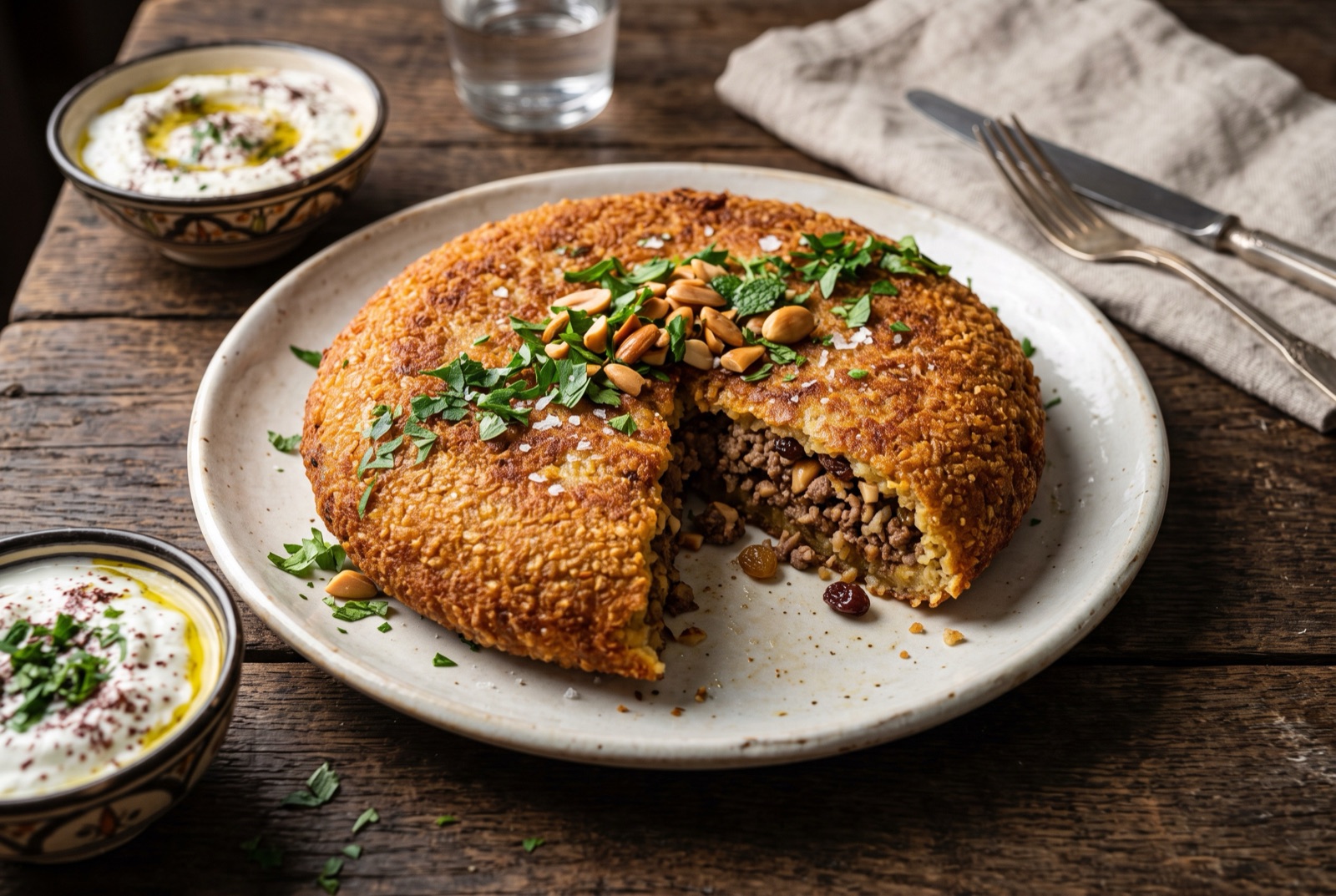
Kubba Mosul is the outsized cousin of the familiar torpedo-shaped kibbeh: instead of a small football, the bulgur shell is rolled out flat and folded around the filling into a wide, thin disc the size of a dinner plate, then fried. The shell is made from fine bulgur and ground rice worked with water until it turns into a smooth, elastic paste, and it fries to a shatteringly crisp exterior with a chewy layer just underneath. Inside is minced lamb cooked down with onion, baharat and cinnamon, sweetened with raisins and studded with almonds. Cut into wedges, it eats like savoury pie — crunchy, rich, faintly sweet, and much more forgiving to eat than to make.

- Gate
- IraqMosul, Nineveh
- Prep
- 1 hr
- Cook
- 35 min
- Total time
- 2 hr 5 min incl. 30 min rest
- Serves
- 4
- Status
- Takes skill
- Nutrition / serving · estimated
- Calories 680 kcal
- Protein 29 g
- Carbs 61 g
- Fat 36 g
- Fiber 11 g
- Sugar 10 g
- Sodium 810 mg
Why this recipe works.
- The bulgur dough worked with ice water and rested, which is what makes it elastic instead of crumbly.
- Filling cooked and fully cooled before shaping, so it does not steam the shell open from inside during frying.
- Two pan-sized discs rather than one tray-sized one — the same dish, but shapeable without professional practice.
- A patching method for the inevitable first tear, so a split shell does not end the attempt.
Ingredients.
16 itemsFor the shell
For the filling
To fry
To serve
Equipment
- Food processor (optional but helpful)
- Rolling pin and cling film
- Wide heavy frying pan
- Fish slice or wide spatula
Instructions.
Soak the bulgur
Tip the fine bulgur into a bowl, pour over the ice-cold water and leave for 30 minutes, stirring once, until the grains are fully plump and no hard specks remain when you crush one between your fingers.
Cook the filling
Heat the olive oil and fry the chopped onion for 10 minutes until soft and golden. Add the lamb, breaking it up, and cook until it loses all pink and the liquid it releases has evaporated. Stir in the cinnamon, baharat, almonds and raisins, season well, and cook 3 minutes more until it smells sweet and spiced and the pan is dry.
Tip The pan must be dry before you stop. Wet filling is the main reason shells burst.
Cool the filling completely
Stir the parsley through the filling, spread it on a plate to lose heat quickly, and refrigerate until cold, at least 20 minutes. Do not attempt to shape kubba around warm filling.
Make the shell dough
Drain any unabsorbed water from the bulgur and blitz it with the rice flour, salt and baharat in a food processor for 2 minutes, or knead by hand for 10, until it comes together as a smooth, tacky paste that holds a fingerprint and no longer cracks at the edges when pressed flat.
Tip If it cracks, add ice water a tablespoon at a time and keep working it.
Roll out the discs
Divide the dough in two. With wet hands, flatten each half between two sheets of cling film and roll it out to a round about 24 cm across and 4 mm thick. Peel off the top sheet.
Fill and seal
Spread half the cold filling over one half of each round, leaving a 2 cm border. Use the cling film underneath to fold the empty half over the filling, press the edges together with wet fingers and smooth the seam flat. Patch any tears with a pinch of dough.
Fry the first side
Heat a 5 mm depth of oil in a wide pan over medium heat until a crumb of dough sizzles steadily rather than violently. Slide in one disc and fry for 6 to 7 minutes, until the underside is a deep even gold and the surface has gone from matte to blistered and firm.
Turn and finish
Turn the disc carefully with a wide spatula, supporting it from underneath, and fry the second side for another 5 to 6 minutes. Drain on a rack rather than paper so the underside stays crisp, then fry the second disc.
Rest and cut
Let the kubba sit for 5 minutes so the filling stops steaming and settles, then cut each disc into wedges with a serrated knife. Serve hot with lemon wedges and pickles.
Tips from our kitchen.
- Use fine bulgur (number 1), not coarse. Coarse bulgur never softens into a workable paste and the shell falls apart in the pan.
- Keep a bowl of ice water beside you and wet your hands constantly while shaping — the dough sticks to dry skin and tears instantly.
- The filling must be cold, ideally refrigerated, before it meets the dough. Warm filling releases steam and blows the shell open.
- Roll the dough between two sheets of cling film to a thickness of about 4 mm; thicker and it stays doughy inside, thinner and it splits.
- If a tear opens, press a small pinch of dough over it and smooth it with a wet finger. Patched shells fry perfectly well.
- Fry in a generous film of oil over steady medium heat, not high — the shell needs six or seven minutes a side to crisp all the way through.
Substitutions.
- Fine bulgur → Fine bulgur mixed with a little semolina, up to a quarter by weight
- Semolina makes the dough easier to handle and slightly crisper, at the cost of some of the nutty bulgur flavour.
- Minced lamb → Minced beef, or a mix of the two
- Beef is leaner, so add an extra tablespoon of oil to the filling or it will taste dry against the rich shell.
- Almonds → Pine nuts or walnuts
- Pine nuts are the Levantine standard and toast faster; walnuts are more common in Kurdish versions and add a slight bitterness.
Variations.
- Baked kubba Mosul
- The disc brushed with oil and baked at 200°C for 30 minutes instead of fried. Lighter and far less fuss, though the shell stays firm rather than crisp.
- Kubba halab
- The Baghdadi relative with a shell of ground cooked rice instead of bulgur, shaped into ovals and deep-fried until the outside blisters pale gold.
- Kubba hamuth
- Small kubba simmered in a sour broth of tamarind, beetroot or dried lime rather than fried — a stew rather than a fried snack.
Storage & reheating.
Kubba is best within an hour of frying, while the shell is still crisp. Leftovers keep 2 days refrigerated and should be reheated in a dry pan or a 200°C oven for 10 minutes to bring the crust back — a microwave turns the shell to paste. Uncooked shaped discs freeze very well: layer them between sheets of baking paper, freeze flat, and fry straight from frozen over slightly lower heat for a few extra minutes a side. Fried and frozen kubba also works, but the shell never quite recovers its original crackle.
Serve with
Lemon wedges, pickled turnips or cucumbers, and a chopped tomato-and-parsley salad to cut through the fried shell.
The story behind Kubba Mosul.
Kubba, kibbeh, kubbeh — the same word travels across Iraq, Syria, Lebanon and Turkey, and it names a whole family of dishes built on a shell of ground grain around a meat filling. Iraq alone has many: kubba halab in a rice shell, kubba hamuth simmered in sour broth, kubba shorba floating in soup. What sets the Mosul version apart is purely geometry. Rather than being shaped by hand into small ovals, the dough is spread flat, filled and folded like a turnover, producing a single enormous disc that gets fried whole and cut at the table.
Mosul is wheat country in a way the rest of Iraq is not, which is why bulgur rather than rice dominates its kitchen, and the city's kubba is a point of local pride. Making it well is a genuine skill: the shell has to be thin enough to crisp but strong enough to hold, and the traditional test is that you should be able to see the filling shadowed through the dough without it splitting. Cooks who make it regularly work the bulgur paste for a long time, wetting their hands constantly, until it stops cracking at the edges when pressed.
The sweet elements — raisins and almonds in a savoury meat filling — are not a modern flourish. That combination runs through medieval Arab cookery and survives across the northern Iraqi and Levantine repertoire, and it is what keeps the dish from being merely heavy. The nuts also give the filling something to bite against, since the shell is soft on the inside. This recipe scales the disc down to a manageable pan size and makes two rather than one, which is the practical home approach; a Mosul cook making one the size of a serving tray is working with equipment and a wrist you probably do not have.
Questions, answered.
Why does my kubba shell keep cracking?
Either the bulgur has not absorbed enough water or the dough has not been worked long enough. Fine bulgur needs to sit in cold water until it is fully plump and soft, then be kneaded for several minutes so the starch develops enough tack to hold together. Wet hands are essential throughout. If it still cracks at the edges when you press it, knead in a tablespoon of ice water at a time until it stops.
What is the difference between kubba Mosul and regular kibbeh?
The shape and the size, mainly. Ordinary kibbeh is shaped by hand into small torpedoes with pointed ends and deep-fried. Kubba Mosul is rolled flat and folded into one wide, thin disc up to the size of a serving tray, then shallow-fried and cut into wedges at the table. The dough and filling are close relatives, but the flat version has far more crisp surface area relative to filling.
Can I make kubba without a food processor?
Yes, though it is more work. The bulgur dough is traditionally kneaded entirely by hand after soaking, which takes about ten minutes of steady working with wet hands. A processor simply makes the paste smoother and faster. For the filling, hand-chopping the onion finely and using shop-bought mince means no machine is needed at any stage.
Can I prepare kubba in advance?
The best approach is to shape the discs and freeze them raw, separated by baking paper, for up to two months. Fry them straight from frozen over medium-low heat, adding three or four minutes a side. You can also make the filling up to two days ahead and refrigerate it, which is helpful anyway since the filling must be completely cold before shaping.
Why are there raisins in a savoury meat filling?
Sweet and savoury together is a long-standing feature of the region's cooking, going back to medieval Arab kitchens where dried fruit, nuts and warm spices were standard in meat dishes. In kubba specifically the raisins and almonds do practical work: they break up an otherwise heavy, uniformly rich mouthful and give the soft filling some texture against the crisp shell.
You might also like.
All recipes →
Keep exploring Iraq.
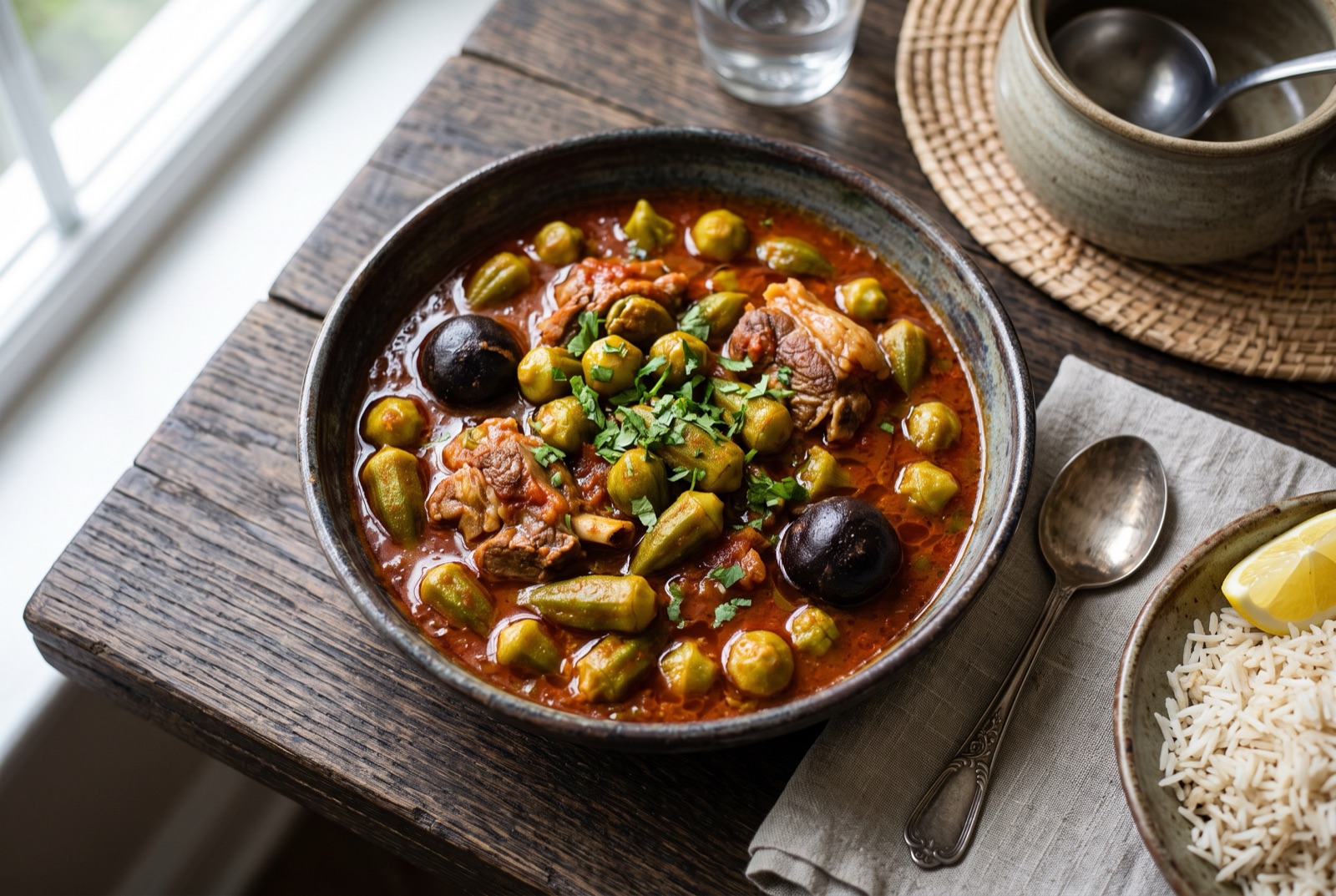
Iraq has 9 more dishes in the atlas — Bamia and Iraqi Dolma, and 7 more.
Recipe by The DishRoute Kitchen · published August 20, 2026 · updated August 20, 2026