Kafta bil Sanieh.
Lebanese Baked Kafta with Potato and Tomato
كفتة بالصينية · Kafta bil sayniyeh · say it: KAF-tah bil sah-NEE-yeh
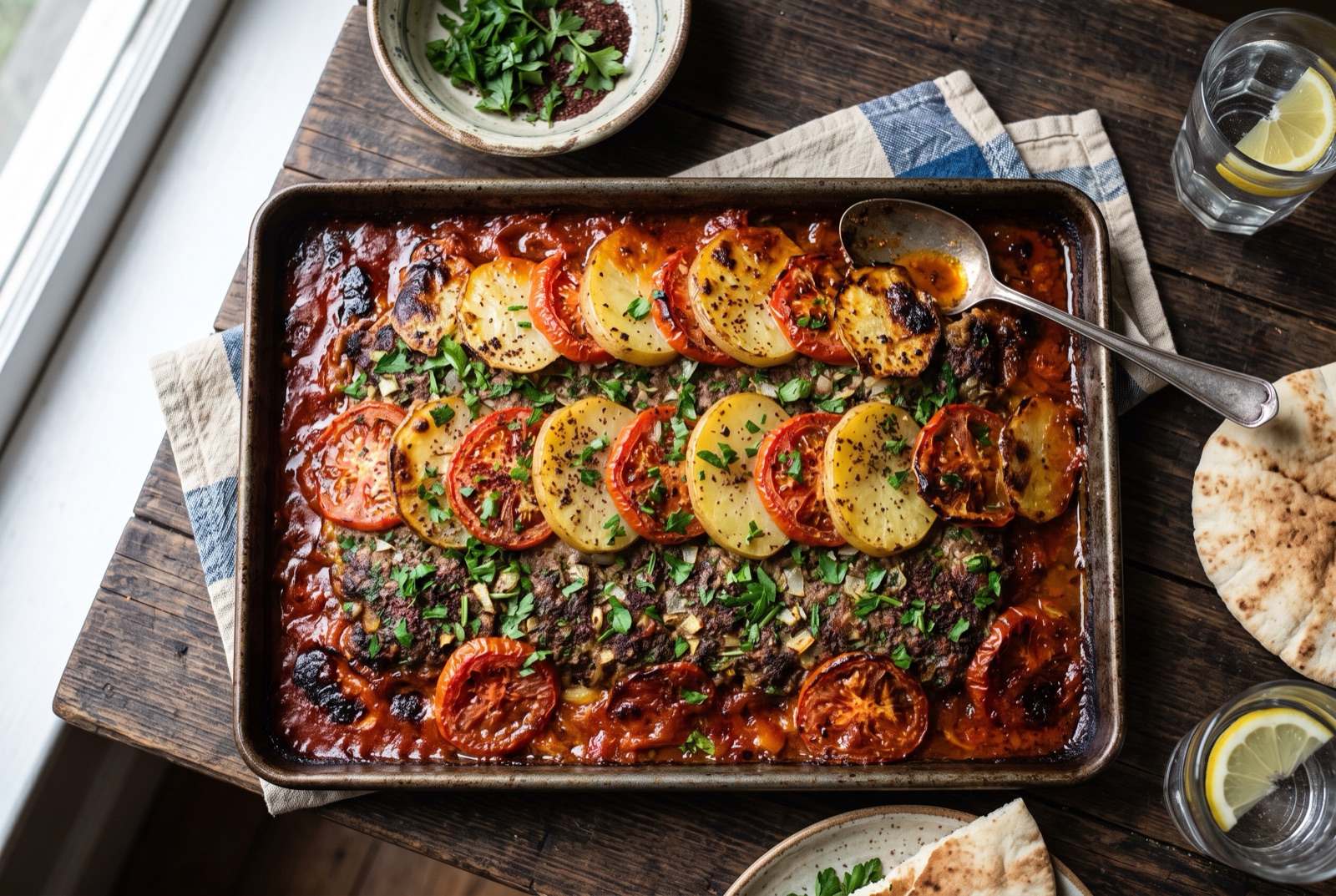
Kafta bil sanieh means kafta in the tray, and the tray is the whole idea. Minced lamb worked with a large amount of finely chopped parsley, grated onion and warm spice is pressed into a baking dish as one flat slab, then covered with overlapping slices of potato, tomato and onion and flooded with a thin tomato sauce sharpened with pomegranate molasses. It bakes for about 45 minutes, during which the meat firms, the potatoes soften and take on the fat, and the top layer scorches at the edges. The taste is savoury and slightly sour, with parsley cutting through the lamb. It is the definition of Lebanese weeknight food: one dish, one oven, rice on the side.

- Gate
- LebanonHome kitchens nationwide
- Prep
- 25 min
- Cook
- 50 min
- Total time
- 1 hr 25 min incl. 10 min rest
- Serves
- 4
- Status
- Easy
- Nutrition / serving · estimated
- Calories 590 kcal
- Protein 33 g
- Carbs 38 g
- Fat 34 g
- Fiber 6 g
- Sodium 940 mg
Why this recipe works.
- A properly high parsley ratio — the thing that separates Lebanese kafta from generic baked meatballs in sauce.
- The meat goes in as one slab rather than as balls, so it stays juicy instead of drying into pellets.
- Par-cooked potato slices, so the potatoes are actually tender when the meat is done rather than half-raw.
- Assembles cold in fifteen minutes and needs no attention in the oven — genuine one-tray weeknight cooking.
Ingredients.
16 itemsFor the kafta
For the tray
For the sauce
Equipment
- Roasting tray or round baking dish, about 30 cm
- Box grater
- Sharp knife or mandoline
Instructions.
Mix the kafta
Put 600 g of ground lamb in a bowl with the chopped parsley, squeezed grated onion, allspice, cinnamon, salt and pepper. Knead with your hands for about a minute, just until the green is evenly distributed and the mixture holds together when pressed — no longer, or it turns bouncy.
Tip Fry a teaspoon of the mix in a pan and taste it before you commit the whole tray. Under-seasoned kafta is the most common fault.
Par-cook the potatoes
Drop the potato slices into boiling salted water for 5 minutes, until they bend without breaking but a knife still meets resistance. Drain well and spread them out to steam dry.
Press the meat layer
Oil the tray with a tablespoon of the olive oil and press the kafta into it as one even slab about 1.5 cm thick, right to the edges. Score it into squares or diamonds with a knife tip, cutting most of the way through — this lets the sauce reach the middle and makes serving clean.
Layer the vegetables
Shingle the potato slices over the meat, overlapping like roof tiles, then tuck tomato slices and onion rings between and over them. Drizzle with the remaining olive oil and season the top with salt and pepper.
Mix and pour the sauce
Whisk the tomato paste, hot water, pomegranate molasses, crushed garlic, salt and pepper until smooth, then pour it evenly around the edges of the tray. The liquid should come roughly halfway up the layers, not submerge them.
Bake
Bake at 200°C for 45–50 minutes, until the potatoes are completely tender to a knife tip, the exposed tomato edges are blistered and dark, and the sauce has reduced to a glossy layer around the meat rather than a pool. Cover with foil for the first 25 minutes if your oven runs hot.
Rest and serve
Let the tray stand 10 minutes so the sauce thickens and the meat firms enough to lift out in neat squares. Serve straight from the tray with rice and plenty of the pan juices spooned over.
Tips from our kitchen.
- Squeeze the grated onion dry in your hands before it goes into the meat. Onion water makes the kafta slab loose and steamy.
- Chop the parsley by knife, not in a processor — blades bruise it into a wet green paste that stains and dulls the mixture.
- Use lamb with around 20 percent fat. Very lean mince bakes into a dry, crumbly layer no sauce can rescue.
- Slice potatoes 4–5 mm thick and no thicker, and give them a head start in boiling water so they finish with the meat.
- Pomegranate molasses is what makes the sauce taste Lebanese rather than merely tomatoey — a tablespoon is enough to notice.
- Let the tray sit 10 minutes out of the oven before serving; the sauce thickens and the slab cuts into clean squares instead of collapsing.
Substitutions.
- Ground lamb → Half ground beef, half ground lamb, or all beef
- The half-and-half mix is extremely common in Lebanese homes and slightly milder. All beef works; add an extra tablespoon of olive oil to compensate for lower fat.
- Pomegranate molasses → 1 tbsp lemon juice plus 1 tsp brown sugar
- This gets you close on sour-sweet balance, though not on the deep fruity note. Pomegranate molasses keeps for a year once opened and is worth buying.
- Lebanese seven-spice → 1 tsp ground allspice + ½ tsp cinnamon + ¼ tsp black pepper + a pinch of nutmeg
- Allspice is the dominant note in most Lebanese blends; if you only have one spice, make it that.
Variations.
- Kafta bil tahini
- Replace the tomato sauce with tahini thinned with water and lemon until it pours. It bakes to a pale, nutty, slightly grainy sauce and is the northern Lebanese preference.
- Kafta skewers
- The same mixture squeezed onto flat metal skewers and grilled over charcoal until the outside is crusted. Needs a firmer, better-kneaded mix so it grips the metal.
- Kafta bil batata w banadoura only
- The stripped-back version with no molasses and no seven-spice — just lamb, parsley, onion, salt, pepper, tomato and potato. A plainer, more everyday tray.
Storage & reheating.
Leftovers keep 3 days refrigerated and genuinely improve on day two, once the potatoes have absorbed more of the sauce. Reheat covered at 180°C for 15–20 minutes with a splash of water, or in a covered pan over low heat. It freezes acceptably for 2 months but the potato texture suffers — it turns slightly grainy on thawing — so if you are cooking for the freezer, make the tray without potatoes and add boiled ones on reheating.
Serve with
Plain vermicelli rice to soak up the sauce, flatbread, and a bowl of yogurt or a cucumber-and-mint salad on the side.
The story behind Kafta bil Sanieh.
Kafta is the Levantine cousin of every minced-meat preparation between the Balkans and India — kofta, köfte, kufteh, kūfta — and the shared root simply means something rolled or pounded. What marks Lebanese kafta out is the herb ratio. A Turkish köfte is mostly meat and onion; Lebanese kafta carries so much finely chopped flat-leaf parsley that the raw mixture looks green-flecked rather than red, and that parsley is what keeps a fatty lamb mix from tasting heavy.
The sanieh — the round metal tray — is a specific piece of Levantine domestic equipment and a specific way of cooking. Before home ovens were common, families carried filled trays to the neighbourhood bakery, the furn, where the baker slid them into the bread oven for a small fee and the household came back for them at lunchtime. That practice shaped a whole category of dishes designed to travel and to cook unattended in fierce heat: kibbeh bil sanieh, sfiha, roasted chicken and potatoes, and this one. It also explains why the dish is assembled cold and needs no attention once it is in the oven — the cook was not standing next to it.
Every Lebanese family makes it slightly differently, and the arguments are about the sauce. Some use only tomato and water; some add pomegranate molasses for sourness; some blend tahini into the liquid for a nuttier, paler sauce, which is a common Tripoli-side variation. Potato is near-universal but not compulsory, and cooks who grew up with the tahini version tend to think the tomato version is missing something, and vice versa. The recipe below is the tomato-and-molasses version, which is the one most people picture when the dish is named.
Questions, answered.
Why is my kafta dry and crumbly?
Usually lean mince, or overworking the mixture. Kafta wants around 20 percent fat; anything leaner bakes out and leaves the meat sandy. Knead only until the parsley and onion are evenly distributed — a minute or two — because prolonged working makes the protein tighten and squeeze out moisture as it bakes.
My potatoes were still hard when the meat was cooked. What went wrong?
They were sliced too thick, or they were sitting above the sauce line rather than in it. Cut them 4–5 mm thick, give them 5 minutes in boiling water before layering, and make sure the sauce comes at least halfway up the tray so the potatoes braise rather than roast dry.
Can I assemble the tray in advance?
Yes, and it is a good idea. Build the whole tray, sauce included, cover it and refrigerate for up to 24 hours, then bake straight from cold with an extra 10 minutes on the time. This is close to how the dish was traditionally handled when trays were assembled at home and carried to the neighbourhood bakery.
What is the difference between kafta and kofta?
They are the same word travelling through different languages. Kafta is the Levantine Arabic form, köfte is Turkish, kofta is used across South Asia and the Balkans. What differs is the recipe, not the concept: Lebanese kafta leans heavily on flat-leaf parsley and onion with allspice and cinnamon, while Turkish and South Asian versions use different aromatics and often bind with bread or egg.
Do I need pomegranate molasses?
Not strictly, but it is what gives the sauce its characteristic sour-sweet depth. It is a thick, dark syrup of reduced pomegranate juice, sold in Middle Eastern shops and most large supermarkets, and it keeps for about a year in the fridge. Without it, add lemon juice and a little sugar to get the sourness — the dish will be good, just less distinctive.
You might also like.
All recipes →
Keep exploring Lebanon.
Lebanon has 9 more dishes in the atlas — Foul Mudammas and Kibbeh, and 7 more.
All Lebanon recipes Lamb recipes Potato recipes Tomato recipes maindairy freegluten freehalal friendlyRecipe by The DishRoute Kitchen · published August 19, 2026 · updated August 19, 2026