Khinkali.
Georgian Twisted Soup Dumplings
ხინკალი · say it: khin-KAH-lee
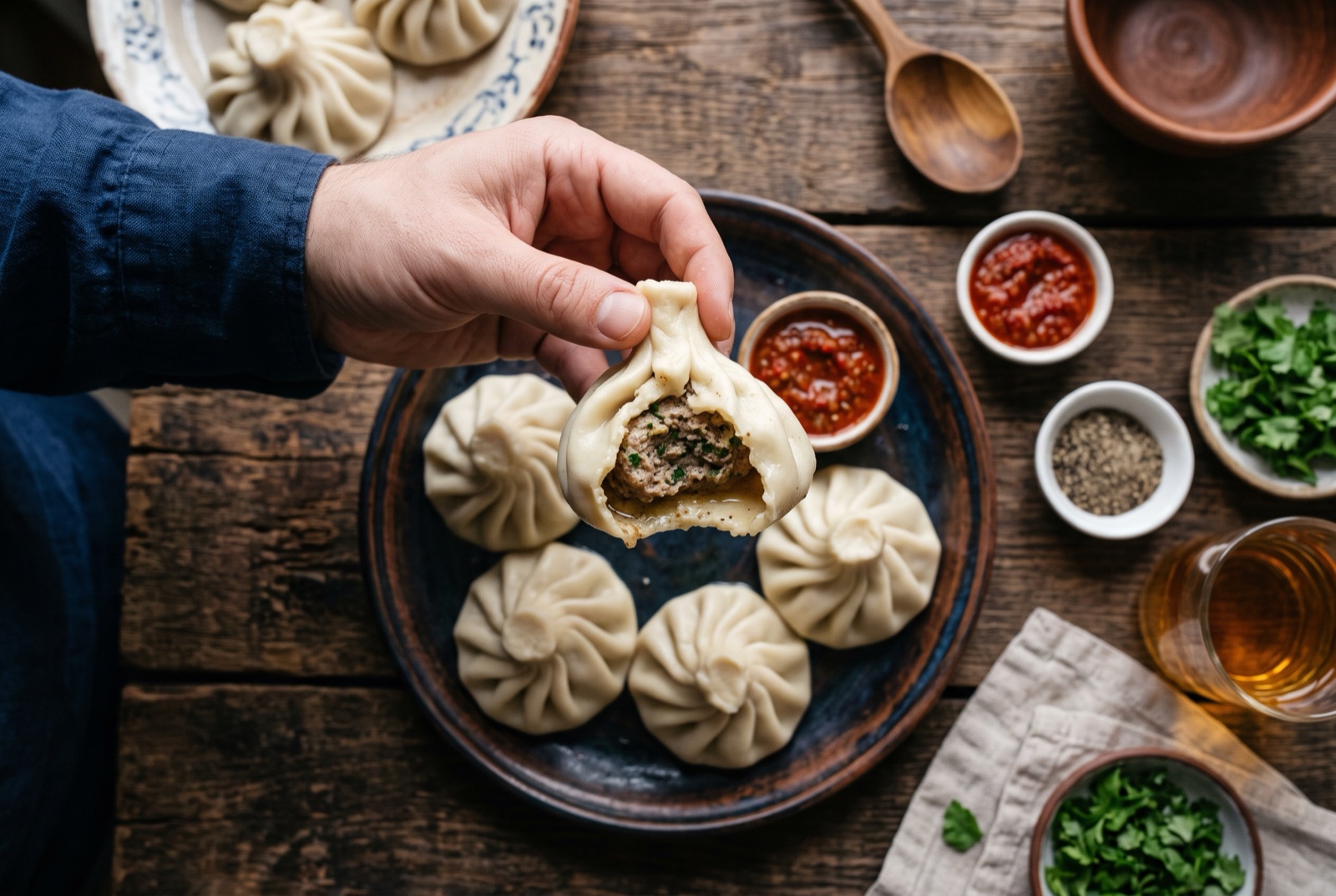
Khinkali are large, hand-pleated dumplings from the Georgian mountains, filled with coarsely minced meat that is loosened with water until it is almost a batter. As they boil, that water and the fat in the meat turn into a scalding mouthful of broth trapped inside dough thick enough to hold it. The filling tastes of coriander leaf, black pepper and a great deal of onion — clean and peppery rather than heavily spiced. Eating one is a procedure: pick it up by the twisted top knot, bite a small hole in the side, drink the broth before it escapes, then eat the body and abandon the knot. The pile of chewy knots left on the plate is how a Georgian table keeps score.

- Gate
- GeorgiaKhevsureti and Pshavi
- Prep
- 1 hr
- Cook
- 15 min
- Total time
- 1 hr 55 min incl. 40 min rest
- Serves
- 4
- Status
- Takes skill
- Nutrition / serving · estimated
- Calories 620 kcal
- Protein 33 g
- Carbs 62 g
- Fat 26 g
- Fiber 3 g
- Sodium 1100 mg
Why this recipe works.
- The filling is deliberately loosened with cold water and broth, which is what actually produces the soup inside — no aspic or gelatine trick needed.
- Dough hydration is set low and rested twice, so it rolls thin at the edge and thick at the centre without tearing under a heavy filling.
- Pleating is described as a physical action, not a diagram, so the pleats seal rather than merely decorate.
- Honest about the knot: the recipe tells you why it stays chewy and why leaving it is correct rather than wasteful.
Ingredients.
14 itemsFor the dough
For the filling
To cook and serve
Equipment
- Large wide pot
- Rolling pin
- Large mixing bowl
- Slotted spoon
Instructions.
Make a firm dough
Mix 500 g of flour with the salt, pour in the cold water, and work it into a stiff, slightly rough dough. Knead 8 minutes until it is smooth and springs back slowly when poked, then wrap it and rest 40 minutes at room temperature.
Tip This dough is deliberately drier than pasta dough. It must hold liquid without going flabby.
Beat the filling loose
Combine both minces with the grated onion, garlic, coriander, black pepper, caraway, chilli and salt. Add the ice-cold water in three additions, mixing hard with a hand or a spoon after each, until the filling is sloppy, glossy and holds a swirl when stirred. Chill it for 20 minutes.
Tip It should look almost too wet to shape. That water is the future broth.
Roll the wrappers
Divide the dough into 20 pieces and keep them covered. Roll each into a disc about 12 cm across, thinning the outer rim and leaving the middle about 2 mm thick. Dust lightly and stack with flour between them so they do not weld together.
Fill and pleat
Put a heaped tablespoon of filling in the centre of a disc, lift one edge and fold a pleat, then keep folding the rim over onto itself in the same direction, pressing each pleat firmly against the last. Aim for at least twelve pleats, gather them into a topknot and twist hard to seal.
Tip Cradle the dumpling in your palm as you pleat so the weight of the filling pulls the wrapper down instead of tearing it.
Rest, then boil
Stand the finished dumplings knot-up on a floured tray while you shape the rest. Bring a wide pot of well-salted water to a rolling boil, stir it into a whirlpool, and slide in 6–8 dumplings at a time, nudging them off the base with a slotted spoon.
Cook until the dough goes glossy
Lower the heat to a strong simmer and cook 8–10 minutes. They will float within two minutes; the tell for doneness is the dough over the filling turning shiny and faintly translucent, with the dumpling swollen and heavy in the spoon.
Drain properly and serve
Lift them out with a slotted spoon, let them drip for a few seconds, and set them knot-up on a dry warm plate — never in a bowl of liquid. Grind over plenty of black pepper and eat straight away, holding each by the knot and biting a small hole to drink the broth first.
Tips from our kitchen.
- Keep the filling cold right up to shaping. Warm fat smears into the meat and leaks out during boiling instead of melting into broth.
- Roll each disc so the rim is thin and the centre stays about 2 mm thick. A uniformly thin wrapper bursts under the weight of the liquid filling.
- Add the water to the meat in three goes, mixing hard between each, until the filling looks sloppy and holds a swirl. It will feel far too wet — that is correct.
- Boil in a wide pot with plenty of salted water and stir it into a slow whirlpool before dropping the dumplings in, so they never settle on the base and stick.
- They are done about 3–4 minutes after they float and the dough over the filling turns glossy and slightly translucent. Cut one open to check the first time.
- Serve them knot-up on a dry plate, never in liquid — pooled water on the plate makes the wrappers slimy within minutes.
Substitutions.
- Beef and pork mix → All lamb, or all beef
- Lamb is the mountain original and tastes stronger and cleaner. All beef needs a little extra fat — ask for 20% fat mince or the broth turns thin.
- Blue fenugreek (utskho suneli) → A pinch of ground fenugreek plus a pinch of dried marjoram
- Blue fenugreek is milder and more floral than Indian fenugreek, so use half the amount if substituting the ordinary kind or it turns bitter.
- Fresh coriander leaf → Flat-leaf parsley with a little celery leaf
- Not the same flavour, but a workable answer for anyone who tastes coriander as soap. Mountain-style khinkali often skip fresh herbs entirely.
Variations.
- Kalakuri (city-style)
- The Tbilisi standard: beef and pork together with a heavy hand of coriander leaf and onion. Juicier and more aromatic than the mountain original.
- Mtiuluri (mountain-style)
- Lamb only, hand-chopped rather than minced, seasoned with little more than salt, pepper and caraway. Sparse, meaty and closer to what the dish started as.
- Kartopilis khinkali
- Filled with buttery mashed potato and fried onion instead of meat. A fasting-day and vegetarian version that is genuinely common in Georgian homes.
Storage & reheating.
Cooked khinkali lose their broth as they cool and never fully get it back, so shape more than you need and freeze them raw instead. Arrange uncooked dumplings on a floured tray, freeze solid, then bag them for up to 3 months and boil from frozen, adding 3–4 minutes. Leftover cooked ones are best treated as a different dish: fry them in butter until the flat sides are crisp and brown, which is how Georgians serve them the next day and is arguably better than reheating.
Serve with
A grinder of black pepper and nothing else on the plate, with pickled vegetables and cold beer or a young amber wine alongside.
The story behind Khinkali.
Khinkali come down from the high country — Khevsureti, Pshavi and Tusheti, the cold valleys along Georgia's northern spine — where they were shepherds' food made with coarsely chopped lamb, wild herbs and nothing else. Dough was a container and a calorie source, and it was made thick on purpose: a dumpling had to survive being carried, boiled in a shared pot, and eaten with bare hands out in the open. That top knot is not decoration either. It is the handle, and it stays uneaten because the twist of dough there is dense and undercooked by the time the rest is ready.
Moving down into the cities changed the filling more than the shape. Tbilisi restaurants serve kalakuri khinkali — "city style" — with a mix of beef and pork, plenty of coriander leaf, and enough water worked into the meat to guarantee broth. Purists in the mountains still call for mtiuluri, made with lamb, no herbs beyond what grows nearby, and a filling of hand-chopped rather than ground meat. Vegetarian versions filled with mushrooms, potato or sulguni cheese are common now and are not treated as heresy, though nobody pretends they are the original.
The eating rules are real and enforced socially rather than legally. Fork and knife are considered a defeat, since piercing the dumpling loses the broth that is the whole point. Black pepper is ground generously over the top before eating and is the only condiment anyone expects. And the number of pleats matters to people who care: nineteen is the figure often quoted as the mark of a skilled maker, and while plenty of excellent khinkali have twelve, the count is a running point of pride in a country that takes its dumpling craftsmanship personally.
Questions, answered.
How does the broth get inside the dumpling?
It is not added as liquid — it is made in place. Cold water and a little stock are beaten into the raw minced meat until the filling is loose and sloppy, and during boiling that water plus the rendering fat becomes the soup. Meat that is too lean or too dry will simply never produce broth, so aim for around 20% fat.
Why are the knots left on the plate?
The twisted top is a thick wad of dough that is still doughy when the rest of the dumpling is perfectly cooked, and it doubles as the handle you hold while eating. Leaving it is normal Georgian practice, not waste — the pile of knots is how people count how many they have eaten.
My dumplings burst in the water. What went wrong?
Usually the seal, not the dough. Any gap between pleats lets water in and broth out under pressure. Pinch each pleat firmly against the last one and finish by twisting the gathered top hard enough to compress it. A pot at a rolling boil rather than a steady simmer will also tear weak seams.
Can I steam khinkali instead of boiling them?
You can, and the wrappers stay slightly firmer, but boiling is traditional and gives more even heat through a dumpling this large. If you steam, allow 18–20 minutes and line the basket well, because the heavy base sticks readily. Do not fry them raw — the interior will not cook before the outside burns.
How many khinkali is a normal portion?
Five to seven per person as a meal, since each one weighs around 70–90 g and the dough is substantial. Georgians typically order in multiples and share from a communal plate. This recipe makes roughly 20 dumplings, which feeds four people generously with a couple left for frying the next day.
You might also like.
All recipes →
Keep exploring Georgia.
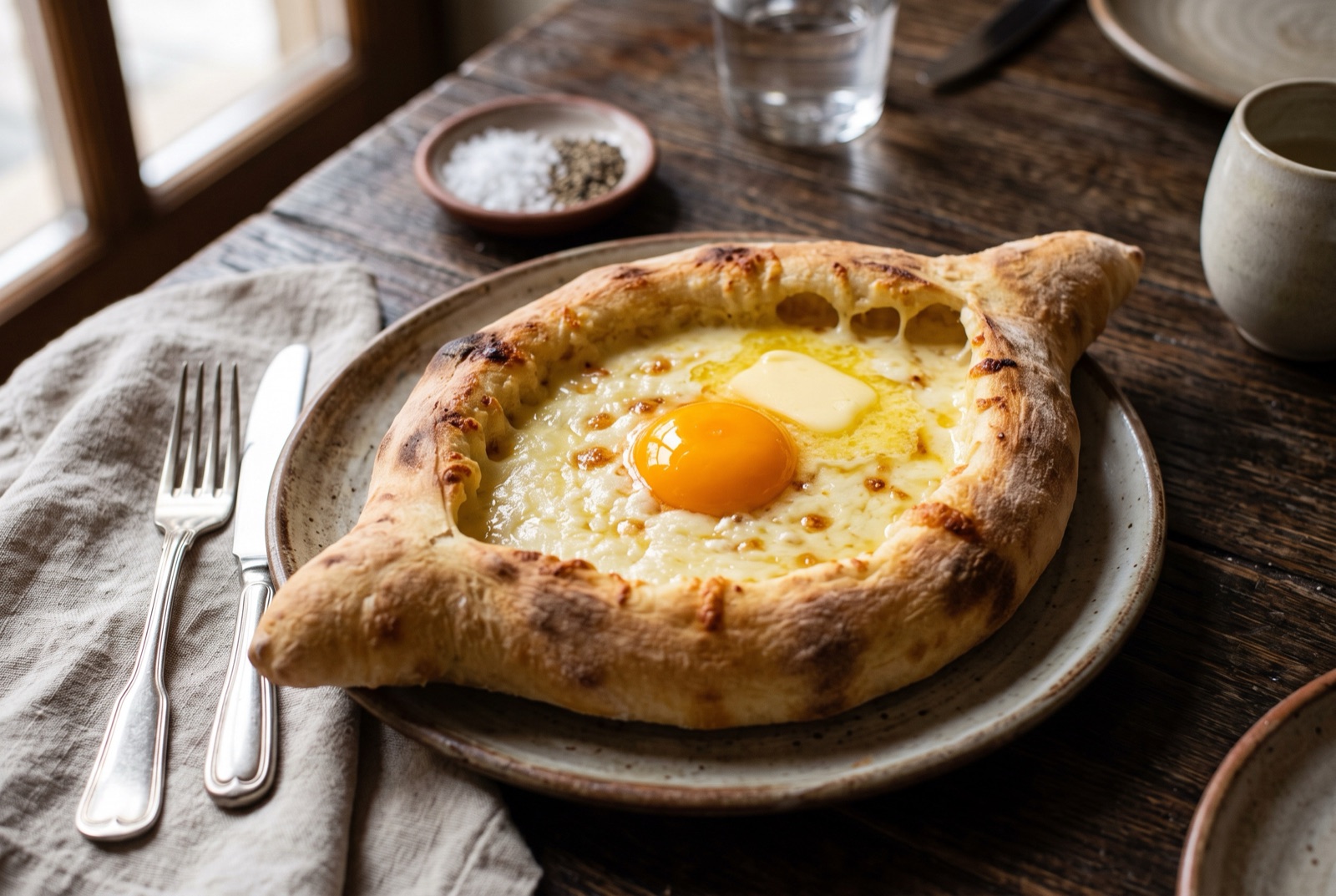
Georgia has 9 more dishes in the atlas — Adjarian Khachapuri and Badrijani Nigvzit, and 7 more.
Recipe by The DishRoute Kitchen · published August 20, 2026 · updated August 20, 2026