Adjarian Khachapuri.
Boat-Shaped Georgian Cheese Bread
აჭარული ხაჭაპური · Acharuli khachapuri · say it: ah-cha-ROO-lee kha-cha-POO-ree
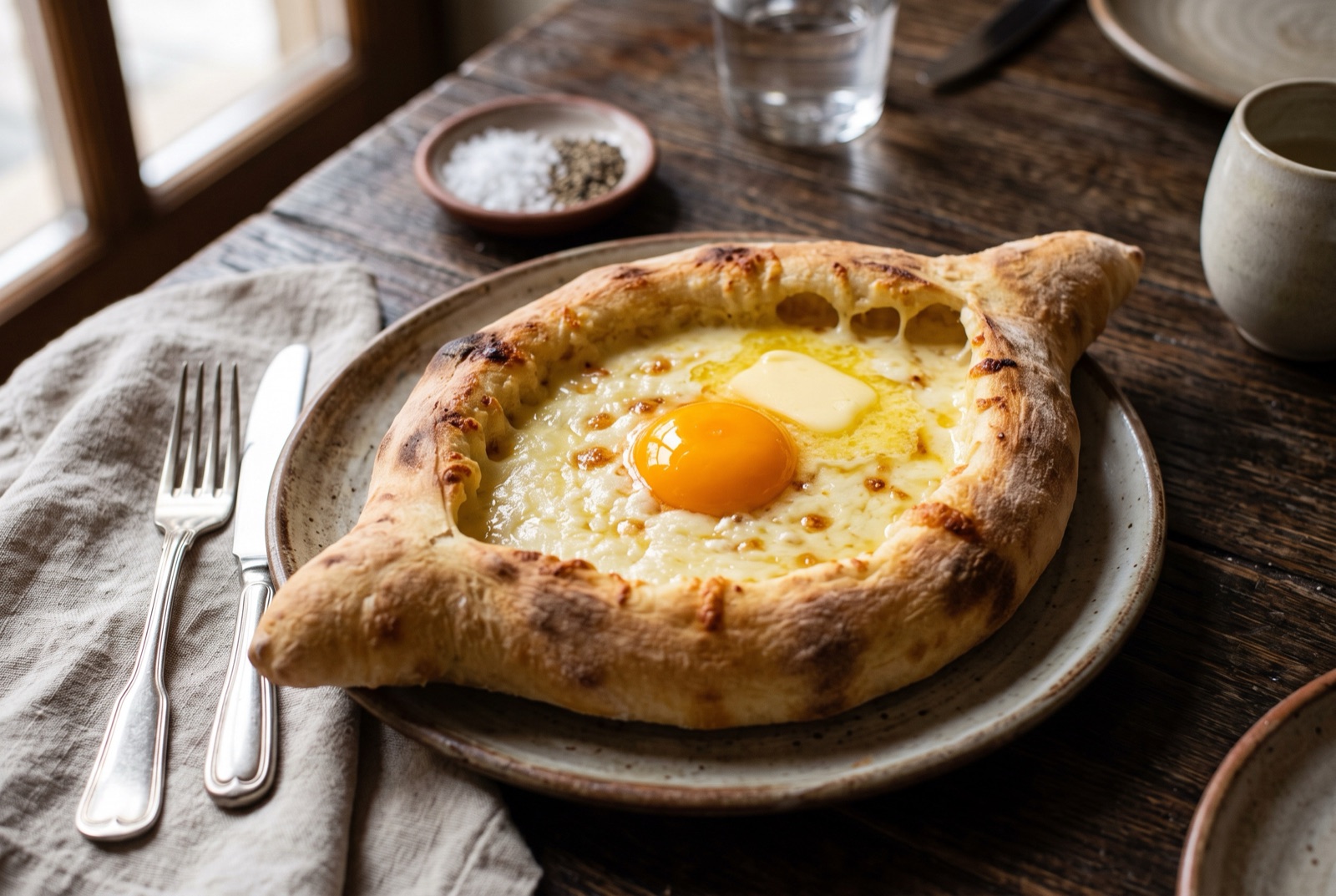
Adjarian khachapuri is a bread you finish yourself. A soft, slightly sweet yeasted dough is shaped into a long open boat, packed with a mix of salty brined cheeses, and baked until the cheese bubbles and the pointed ends go deep gold. A raw egg yolk and a knob of butter land in the middle the second it leaves the oven, and the first thing anyone does at the table is drag a fork through all three until the filling turns into a glossy, stringy custard. The taste is straightforwardly rich — salt, dairy, warm bread — with the yolk softening the sharpness of the cheese. You eat it by tearing off pieces of the raised rim and dipping them, working inward until only the base is left.

- Gate
- GeorgiaAdjara
- Prep
- 30 min
- Cook
- 15 min
- Total time
- 2 hr 15 min incl. 1 hr 30 min rest
- Serves
- 4
- Status
- Medium
- Nutrition / serving · estimated
- Calories 780 kcal
- Protein 34 g
- Carbs 72 g
- Fat 40 g
- Fiber 3 g
- Sodium 1400 mg
Why this recipe works.
- A dough enriched with milk and a little butter, so the rim stays soft the next morning instead of turning to rusk.
- The mozzarella-and-feta blend is measured to match the salt and stretch of real sulguni, not just guessed at.
- Shaping is explained by feel — where to leave the dough thick and where it must be thin — so the boat holds instead of leaking.
- The yolk goes in off the heat at the right moment, warm enough to thicken but not so hot it scrambles.
Ingredients.
12 itemsFor the dough
For the filling
To finish
Equipment
- Stand mixer or a bowl and hands
- Baking stone or heavy baking tray
- Box grater
- Rolling pin
Instructions.
Mix and knead the dough
Whisk the yeast and sugar into the lukewarm milk and leave 5 minutes until it foams. Add 450 g of flour, the salt and softened butter, then knead 8–10 minutes until the dough is smooth, soft and only just tacky — it should stretch thin enough to see light through without tearing.
Tip The dough should feel softer than pizza dough. Resist adding flour beyond a light dusting.
Let it rise
Shape the dough into a ball, put it in an oiled bowl, cover, and leave in a warm spot for 60–90 minutes until doubled and domed. A finger pressed into the surface should leave a dent that fills back only slowly.
Prepare the filling
Squeeze the grated mozzarella in a clean towel to wring out any moisture, then toss it with the crumbled feta and the beaten egg until the mixture clumps loosely. Taste it: it should be assertively salty, since the bread around it has almost none.
Heat the oven hard
Put a baking stone or an upside-down heavy tray on the middle shelf and heat the oven to 250°C, or as high as it goes, for at least 30 minutes. The base of each boat has to set fast, and a cold tray is the usual reason it turns out pale and damp.
Shape the boats
Divide the dough into 4 pieces and roll each into an oval about 25 cm long and 3–4 mm thick. Roll the two long sides inward toward the centre to make thick ropes, then pinch each pair of ends together hard and twist so they lock into pointed tips. You should have an open canoe with a raised, sturdy rim.
Tip Leave the base slightly thicker than feels necessary — it carries molten cheese for 15 minutes.
Fill and bake
Divide the cheese between the boats, mounding it level with the rim, and slide them onto the hot stone on baking paper. Bake 12–15 minutes until the crust is deep gold, the cheese is bubbling in the centre and the pointed ends have blistered and darkened at their tips.
Add yolk and butter, stir at the table
Pull the boats out, use a spoon to push a small well into the middle of the cheese, and drop a yolk and a cube of cold butter into each. Grind over black pepper and carry them straight to the table, then stir the yolk and butter through the cheese with a fork until the filling turns glossy and pale gold.
Tip Serve within a minute of adding the yolk, or it sets on the hot cheese and you lose the sauce.
Tips from our kitchen.
- Squeeze the mozzarella dry in a clean towel before mixing. Wet cheese releases water into the boat and the base steams instead of crisping.
- Leave the rim of dough noticeably thicker than the base — it has to hold molten cheese without collapsing and it doubles as the handle.
- Bake on a preheated stone or an upside-down baking tray. The base needs bottom heat fast, or it stays pale and soggy under the filling.
- Add the yolk the moment the boat comes out, then serve within a minute. Left to sit on the hot cheese, the yolk sets and you lose the sauce.
- If the cheese looks like it is browning too fast, tent the middle with foil and leave the rim exposed — the crust is what still needs colour.
- Separate the eggs while cold, then let the yolks sit out while the boats bake. A cold yolk cools the cheese and stiffens it on contact.
Substitutions.
- Sulguni and imeruli cheese → 400 g low-moisture mozzarella + 200 g feta, both coarsely grated or crumbled
- Mozzarella supplies the stretch, feta the salt and lactic tang. Georgian and Russian grocers often stock real sulguni; if you find it, use 600 g sulguni with a handful of feta.
- Raw egg yolk → Omit, or crack a whole egg into the boat and return it to the oven for 3–4 minutes
- The whole-egg version is common in Georgian bakeries too. It sets rather than stirs in, so you lose the sauce but gain a safer dish for anyone avoiding raw egg.
- Bread flour → All-purpose flour
- The boat will be a little softer and less chewy. Reduce the milk by a tablespoon or two, as weaker flour absorbs less.
Variations.
- Imeruli khachapuri
- The everyday round version: the same cheese sealed inside a disc of dough, rolled flat and cooked in a dry pan rather than baked. Faster, and the one Georgians actually make on a weeknight.
- Megruli khachapuri
- Imeruli with a second layer of cheese spread across the top before baking, so it browns into a blistered crust. Richer again, and the usual answer when someone says one cheese layer is not enough.
- Penovani khachapuri
- A puff pastry square folded over the cheese filling into a rough envelope — the Soviet-era bakery shortcut, still sold on every corner in Tbilisi.
Storage & reheating.
Khachapuri is at its best within ten minutes of leaving the oven and does not keep gracefully. Leftovers refrigerate for 2 days; reheat in a 200°C oven for 8 minutes so the base recrisps, never in a microwave, which turns the cheese rubbery and the crust damp. You can freeze shaped, unfilled dough boats for a month — thaw, fill and bake from cold, adding 3 minutes. The filled and baked bread does not freeze well because the cheese weeps on thawing.
Serve with
Nothing more than a cold pilsner or a glass of dry amber wine — the boat is a full meal and the table usually just adds pickles.
The story behind Adjarian Khachapuri.
Khachapuri is not one dish but a family of them, and the shape tells you where you are. Imereti bakes it flat and round with the cheese sealed inside. Megrelia does the same and then buries the top under another layer of cheese. Svaneti stuffs it with meat and potato. The boat belongs to Adjara, the humid Black Sea province on the Turkish border, and the story locals tell about the shape is that it echoes the fishing boats of the coast, with the yolk as the sun going down over the water. Whether that is old folklore or a good line invented for tourists is genuinely unclear, and Georgians will happily argue both sides.
What is not in doubt is the cheese. Sulguni is a brined, elastic, faintly sour cheese from western Georgia that pulls into long threads when it melts; imeruli is fresher, whiter and saltier, and it brings the tang. Most bakers use both, because sulguni alone melts into something too smooth and imeruli alone can go grainy. Outside Georgia the standard workaround is low-moisture mozzarella for the stretch plus feta for the salt and acidity, which gets you surprisingly close — closer than any single supermarket cheese will.
In Batumi and along the coast, khachapuri is not a starter but a whole meal, often ordered late at night, and the boats come in sizes up to genuinely absurd. There is an unwritten method for eating one: tear the pointed end off the boat first, use it to stir the yolk and butter through the hot cheese, then keep tearing the rim in strips and dipping. The base, soaked in cheese and egg, is eaten last with a fork. Doing it in the wrong order is not a crime, but somebody at the table will tell you.
Questions, answered.
What cheese should I use if I cannot find sulguni?
Use roughly two parts low-moisture mozzarella to one part feta by weight. Mozzarella gives the long melting stretch that defines the filling and feta supplies the salt and slight sourness of real Georgian brined cheese. Squeeze the mozzarella dry first, and skip fresh mozzarella in water entirely — it floods the boat.
Why did my boat leak cheese in the oven?
Almost always because the base was rolled too thin, the sealed ends came apart, or the boat was overfilled. Pinch the two pointed ends together hard, twisting them so they lock, and leave the base a good 3–4 mm thick. Cheese pressing against a weak seam will find its way out and burn onto the tray.
Is the egg yolk safe to eat raw?
It does not stay fully raw — it is dropped onto cheese at well over 80°C and stirred straight through, which thickens it into a sauce. If you are pregnant, feeding young children or otherwise avoiding raw egg, crack a whole egg into the boat and bake it for another 3–4 minutes until set. Pasteurised eggs are another straightforward option.
Can I make the dough the day before?
Yes, and it improves the flavour. After the first rise, refrigerate the dough covered for up to 24 hours, then bring it back to room temperature for about an hour before shaping. A cold overnight ferment gives the bread a deeper, slightly tangy taste and makes the dough easier to handle.
How do you actually eat Adjarian khachapuri?
Tear off one pointed end of the boat and use it to stir the yolk and butter through the hot cheese until everything turns glossy. Then keep tearing strips from the raised rim and dipping them into the filling. When the rim is gone, eat the cheese-soaked base with a fork. It is finger food for most of its life.
You might also like.
All recipes →
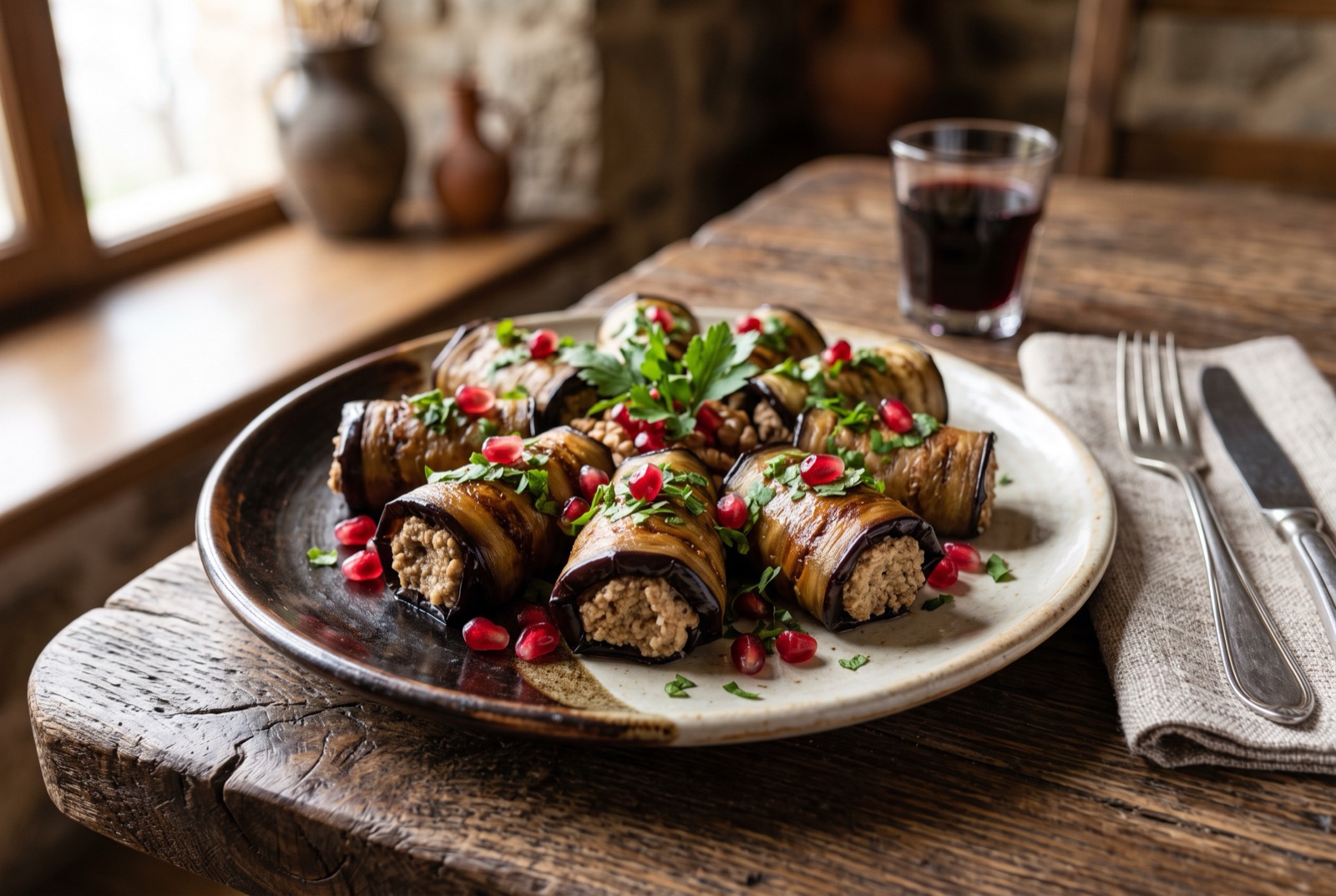
Keep exploring Georgia.
Georgia has 9 more dishes in the atlas — Badrijani Nigvzit and Chakhokhbili, and 7 more.
Recipe by The DishRoute Kitchen · published August 20, 2026 · updated August 20, 2026