Kleicha.
Iraqi Date and Cardamom Cookies
كليجة · say it: KLEE-cha
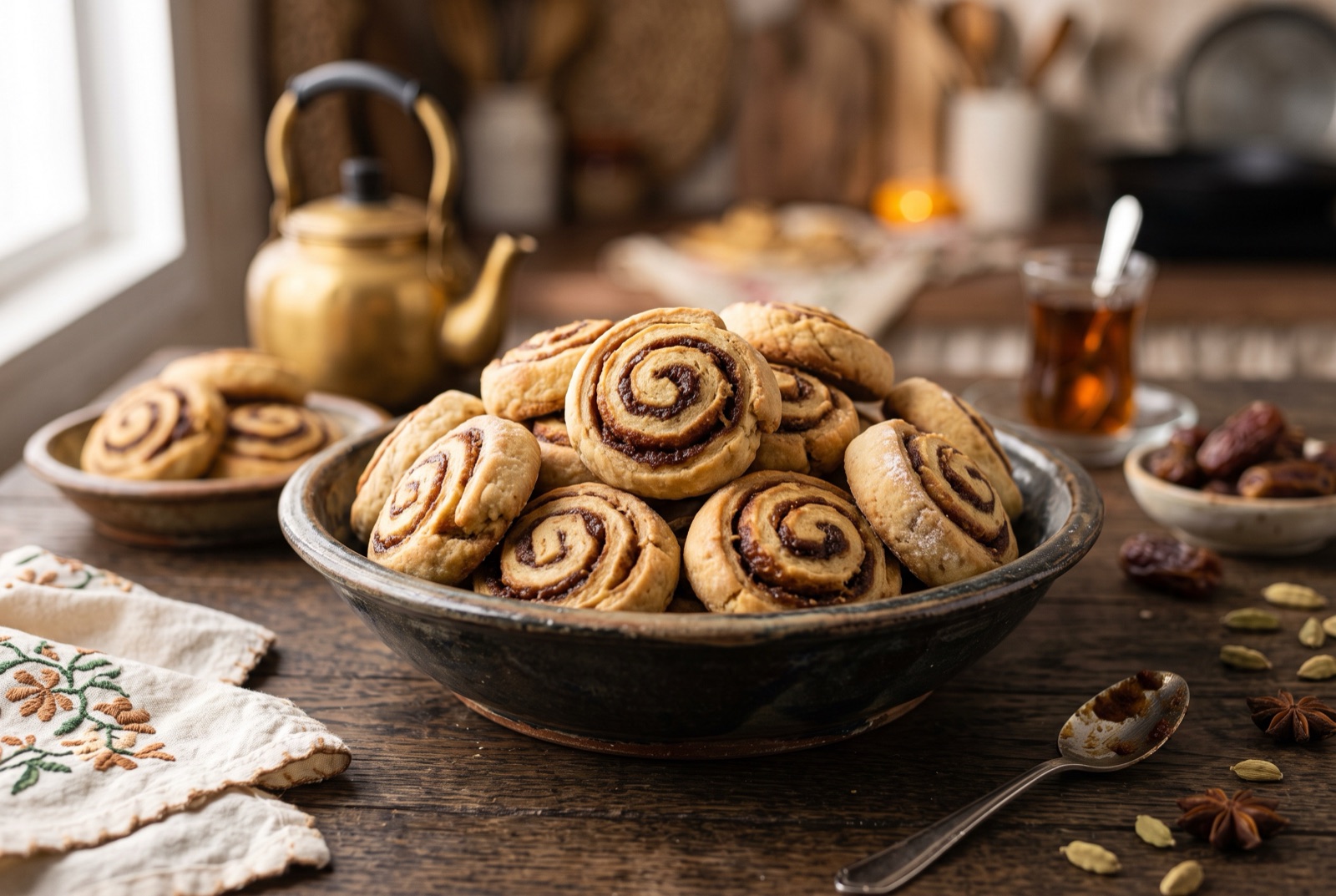
Kleicha is a short, crumbly cookie made from a dough heavy with butter or oil and perfumed with cardamom, rolled out, spread with a dark paste of dates worked soft with butter, then rolled into a log and cut into spirals. Baked, the shell is dry and sandy rather than chewy, and the date filling stays soft and slightly sticky inside — sweet, but far less so than most Western biscuits, since the sugar comes almost entirely from the fruit. There is a second classic filling of walnuts, sugar and rose water, and most households make both. It is the cookie of Eid, of visitors, and of tins kept on top of the fridge all year.

- Gate
- IraqNationwide
- Prep
- 45 min
- Cook
- 20 min
- Total time
- 1 hr 55 min incl. 50 min rest
- Serves
- 40
- Status
- Medium
- Nutrition / serving · estimated
- Calories 145 kcal
- Protein 2 g
- Carbs 21 g
- Fat 6 g
- Fiber 1 g
- Sugar 11 g
- Sodium 45 mg
Why this recipe works.
- A dough short enough to crumble properly, with the mixing method that keeps it that way instead of turning it tough.
- Date paste loosened with butter and warmed so it spreads in a thin, even layer rather than tearing the dough.
- Both classic fillings covered — date and walnut-rose water — because Iraqi households make both together.
- Cutting and baking guidance that stops the spirals unravelling in the oven.
Ingredients.
14 itemsFor the dough
For the date filling
To finish
Equipment
- Rolling pin
- Serrated knife
- Two baking trays
- Baking paper
Instructions.
Make the dough
Rub the softened butter into the flour, sugar, cardamom, salt, yeast and fennel seeds with your fingertips until the mixture looks like damp sand with no visible lumps of butter. Pour in the lukewarm milk and bring it together with a few turns of a spoon, stopping the moment it forms a single soft mass.
Tip Do not knead. This is a short dough and working it is what makes kleicha hard.
Rest the dough
Wrap the dough and leave it at room temperature for 30 minutes. It will not rise much — the resting relaxes it so it rolls out without springing back, and the yeast gives the baked cookie its characteristic slight tenderness.
Prepare the date filling
Warm the date paste with the butter, cardamom and cinnamon in a small pan over low heat, mashing with a fork, for about 4 minutes until it is glossy, uniformly dark and soft enough to spread like thick jam. Let it cool to just warm.
Roll and fill
Divide the dough into four. Roll each piece on a lightly floured surface into a rectangle roughly 20 by 30 cm and about 3 mm thick, then spread a quarter of the date filling over it in a thin even layer, leaving a 1 cm clear border along one long edge.
Roll into logs
Starting from the filled long edge, roll each rectangle up tightly into a log, pressing gently as you go so no air gap forms down the middle, and seal the bare edge underneath. Chill the logs for 20 minutes.
Slice the spirals
Cut each chilled log into 1 cm rounds with a serrated knife, using a light sawing motion rather than pressing down. Set them cut side up on lined trays with 2 cm between them.
Glaze and bake
Brush the tops with beaten egg and scatter with sesame seeds if using. Bake at 180°C for 18 to 20 minutes, until the edges are pale gold and the surface has lost its shine — the centres should still look slightly soft.
Cool completely
Leave the cookies on the tray for 5 minutes to firm up, then move them to a rack and cool fully. They go from soft to properly short and sandy only once cold, so resist judging the texture straight from the oven.
Tips from our kitchen.
- Bring the dough together the moment it holds and stop. Kneading develops gluten and turns a short cookie into a hard one.
- Warm the date paste gently with the butter until it is spreadable and glossy; cold paste drags and tears the rolled dough.
- Roll the dough to about 3 mm. Thicker and the ratio of dough to filling is wrong; thinner and it splits as you roll it up.
- Chill the filled logs for 20 minutes before slicing — cold logs cut into clean rounds, warm ones squash into ovals.
- Use a serrated knife and a gentle sawing motion rather than pressing straight down, which flattens the spiral.
- Take them out while they still look slightly underdone in the centre; kleicha firms up considerably as it cools and overbaked ones go hard.
Substitutions.
- Date paste → Whole soft dates, pitted and blitzed with a splash of hot water
- Medjool dates give the softest paste. If your dates are dry, soak them in hot water for 10 minutes first and drain well.
- Butter → A neutral oil or a mix of oil and ghee
- Many Iraqi recipes use oil, which gives an even sandier, more crumbly cookie that keeps longer. Use 180 ml of oil in place of 220 g of butter.
- Cardamom → Cardamom plus a pinch each of fennel seed and nigella
- A very common household blend that gives the dough a savoury, aniseed edge behind the sweetness.
Variations.
- Kleichat joz
- The walnut version: chopped walnuts mixed with sugar, cinnamon and rose water, spooned onto discs of dough and folded into half-moons with a crimped edge.
- Kleichat halqoum
- Plain spiced dough with no filling, rolled into rings or stamped flat discs, and eaten with tea. The least sweet of the family and the everyday version.
- Coconut kleicha
- Desiccated coconut, sugar and a little rose water used as the filling — a more modern variation but now firmly part of the Eid assortment in many households.
Storage & reheating.
Kleicha keeps exceptionally well, which is the point of a cookie baked in bulk before a holiday: up to three weeks in an airtight tin at room temperature, and the date filling actually softens the shell slightly over the first few days. Keep the date and nut versions in separate layers or separate tins, since the moisture from the date filling migrates. Do not refrigerate them — the cold dries the crumb out. Baked kleicha freezes for three months in a sealed container; thaw at room temperature and refresh at 160°C for 4 minutes to bring back the sandy texture.
Serve with
Small glasses of strong black tea, or Arabic coffee with cardamom — kleicha is not eaten alone.
The story behind Kleicha.
Kleicha is claimed, with reason, as Iraq's national cookie, and its lineage is usually traced back a very long way — Iraqi writers often connect it to the sweet date-filled cakes of ancient Mesopotamia, and while nobody can prove a direct line, the combination of wheat, dates and warm spice has been available in this exact landscape for several thousand years. Date palms grow across the south, date paste is a pantry staple, and a cookie built from cheap flour and abundant fruit makes obvious sense.
It is above all festive baking. Kleicha is made in enormous quantities in the days before Eid al-Fitr and Eid al-Adha, usually by several people working together, because rolling and cutting a few hundred cookies is not a solo job. Iraqi Christians make it for Easter and Christmas as well, so it crosses the country's communities rather than belonging to one. The tins are then brought out for every visitor through the holiday, always with tea.
The shapes carry meaning of a loose, traditional sort. The date version is rolled into a log and sliced into rounds, so each cookie shows a dark spiral. The nut-filled version is often shaped into a half-moon, and a plain spiced version is pressed into flat discs stamped with a pattern. What holds them together is the dough: enriched, fragrant with cardamom and sometimes fennel or nigella, and deliberately short so it crumbles rather than snaps. Getting that texture is mostly about not overworking it — kleicha dough should be brought together and then left alone.
Questions, answered.
Why did my kleicha come out hard instead of crumbly?
Almost certainly overworked dough or overbaking. Kleicha dough should be mixed only until it comes together in a mass and then stopped — every extra minute of kneading develops gluten and moves the cookie from short and sandy toward tough and biscuity. Pull them from the oven when the edges are set and the centres still look slightly pale; they continue to firm for several minutes on the hot tray.
Can I use shop-bought date paste?
Yes, and most Iraqi households do. Look for the blocks sold in Middle Eastern shops, which are pure compressed dates. Break the block up and warm it with butter over low heat until it is soft and spreadable. If you can only find whole dates, pit them and blitz them with a splash of hot water to the same consistency — the result is essentially identical.
Why do my spirals unravel during baking?
The log was rolled too loosely, or the slices were cut too thick. Roll the filled sheet tightly from the long side, pressing gently as you go so there is no air gap down the centre, then chill the log before slicing so it holds its shape under the knife. Cut rounds about 1 cm thick and set them cut side up with a little space between them so they can spread without pushing into each other.
How long does kleicha keep?
Up to three weeks in an airtight tin at room temperature, which is exactly why it is made in large batches before Eid. The high fat content and low moisture in the dough keep it from going stale quickly. Store the date-filled and nut-filled versions separately, since moisture from the dates will soften a nut cookie sitting next to it, and never refrigerate them.
Is kleicha only made for Eid?
It is most strongly associated with Eid al-Fitr and Eid al-Adha, when families bake it in bulk and set out tins for every visitor. But Iraqi Christian families make it for Easter and Christmas too, and plainer unfilled versions are baked year-round as an everyday accompaniment to tea. The festive association is about scale and occasion rather than the cookie being off-limits the rest of the year.
You might also like.
All recipes →
Keep exploring Iraq.
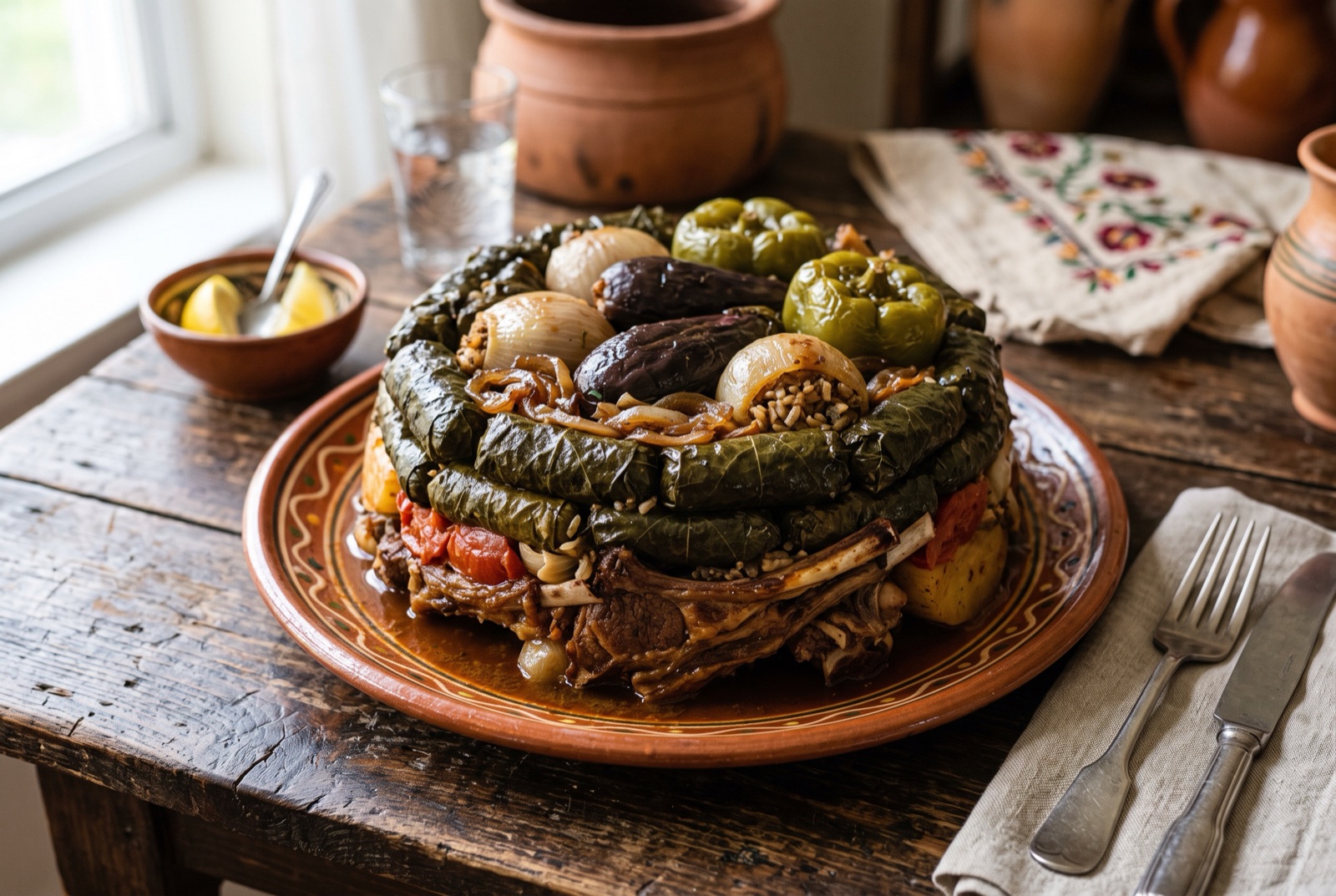
Iraq has 9 more dishes in the atlas — Bamia and Iraqi Dolma, and 7 more.
Recipe by The DishRoute Kitchen · published August 20, 2026 · updated August 20, 2026