Kahi wa Geymar.
Iraqi Buttery Pastry with Clotted Cream
كاهي وقيمر · say it: KAA-hee wa GAY-mar
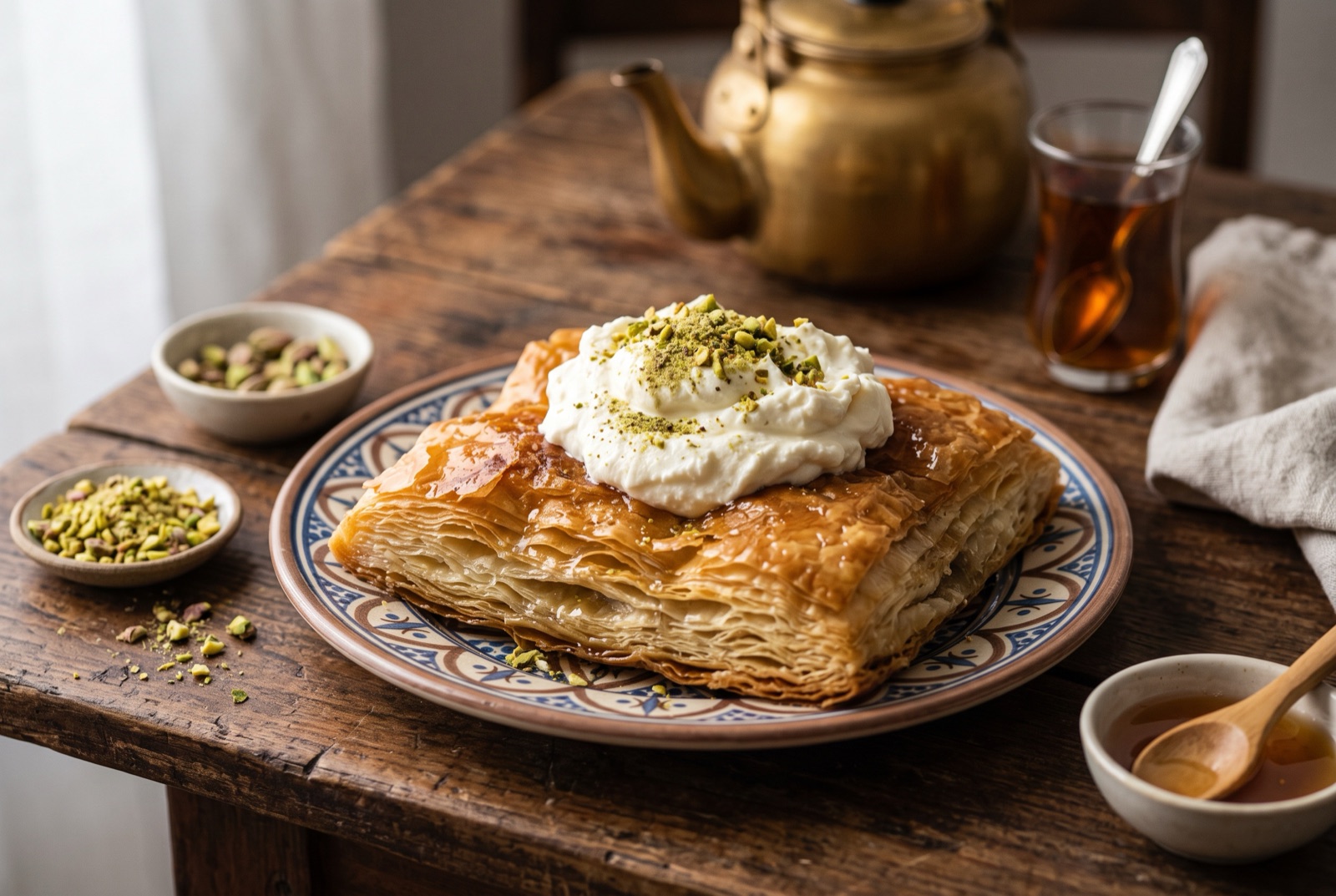
Kahi is a sheet of very thin dough brushed with clarified butter, folded and rolled so it bakes into dozens of brittle layers, then drenched in a light sugar syrup scented with cardamom and rose water while still hot. Geymar is the thick, slightly tangy clotted cream traditionally skimmed from simmered water-buffalo milk, spooned over the top in a cool slab that starts to melt into the warm pastry. Eaten together they are crisp, buttery, sweet and rich all at once, cut through by the faint sourness of the cream. It is a breakfast dish in Iraq — sold from dedicated shops in the early morning — and it is not remotely a light one.

- Gate
- IraqBaghdad
- Prep
- 40 min
- Cook
- 25 min
- Total time
- 2 hr 5 min incl. 1 hr rest
- Serves
- 6
- Status
- Medium
- Nutrition / serving · estimated
- Calories 720 kcal
- Protein 9 g
- Carbs 72 g
- Fat 45 g
- Fiber 2 g
- Sugar 38 g
- Sodium 320 mg
Why this recipe works.
- A rested, properly relaxed dough that can actually be stretched thin instead of tearing on the first pull.
- Clarified butter between the layers rather than oil, which is what gives kahi its flavour and not just its crunch.
- Hot pastry, warm syrup, cold cream — the temperature contrast the dish depends on, spelled out in the method.
- Honest about geymar: what it is, what the substitutes actually taste like, and what Iraqis do when there is none.
Ingredients.
11 itemsFor the pastry
For the syrup
To serve
Equipment
- Large smooth work surface
- Pastry brush
- Baking tray
- Small saucepan for the syrup
Instructions.
Make and rest the dough
Mix the flour, salt and lukewarm water into a soft, slightly sticky dough and knead for 6 minutes until it is smooth and stretches without tearing when pulled gently. Rub it with a spoonful of the clarified butter, cover, and rest for a full hour at room temperature.
Tip Do not skip or shorten the rest. An unrested dough will fight you and tear the moment you stretch it.
Make the syrup
Bring the sugar, water and cracked cardamom to a boil, then simmer for 6 minutes until the syrup coats a spoon thinly and a drop pulled between finger and thumb makes a short thread. Stir in the lemon juice and rose water and set aside somewhere warm.
Stretch the dough thin
Divide the dough into three. Oil the work surface lightly, flatten one piece and stretch it outward from the centre with the backs of your hands, working around the edges, until it is a large sheet thin enough to see your hand through. Small holes are acceptable.
Butter and fold
Brush the whole sheet generously with warm clarified butter, then fold it in from both long sides to make a strip, brush again, and roll or fold the strip into a flat rectangle roughly the size of your palm. Repeat with the other two pieces.
Tip Warm butter, not hot. Hot butter melts through the dough and glues the layers into one.
Rest, then flatten
Rest the folded pieces for 15 minutes so the dough relaxes again, then press each one out gently with your palms into a flat round about 1 cm thick. Do not use a rolling pin — it compresses the layers you just built.
Bake until it shatters
Set the rounds on a buttered tray, brush the tops with more clarified butter and bake at 200°C for 20 to 25 minutes, until deep golden brown and visibly puffed into separated layers. Tap one — it should sound papery and crack rather than thud.
Syrup while hot
Pour the warm syrup over the pastry the moment it comes out of the oven, in a thin stream across the whole surface. It should hiss faintly and disappear into the layers within a few seconds rather than pooling on top.
Serve with cold cream
Cut the pastry into pieces, pile a cold slab of geymar or clotted cream on top of each and serve immediately, with date syrup on the table. The cream should still be cold when it reaches the plate.
Tips from our kitchen.
- Rest the dough for a full hour before stretching. Under-rested dough springs back and tears no matter how carefully you handle it.
- Stretch on a lightly oiled surface, not a floured one — oil lets the dough slide and thin out, flour makes it grip and rip.
- You should be able to see the shadow of your hand through the stretched sheet. If you cannot, keep going; thickness here is the whole game.
- Clarify the butter properly and use it warm but not hot; hot butter melts the dough sheet and welds the layers together.
- Pour the syrup warm over hot pastry, not cold over cold, or it sits on the surface and never penetrates the layers.
- Serve the geymar straight from the fridge in a cold slab. The contrast against the hot pastry is half the point of the dish.
Substitutions.
- Geymar → English clotted cream, or mascarpone loosened with a little double cream
- Clotted cream is the closest widely available match. Neither has geymar's slight sourness, so a squeeze of lemon into mascarpone gets you nearer.
- Hand-stretched dough → Ready-made filo, layered with clarified butter, 8 sheets deep
- Not the same texture — filo is drier and more brittle — but a legitimate shortcut that makes the dish achievable on a weekday.
- Sugar syrup → Date syrup (dibis) or honey, spooned over rather than poured
- Very common in Iraq, especially with geymar. Date syrup is darker and less sweet, and pairs better with the cream than plain sugar does.
Variations.
- Kahi with dibis
- Skipping the syrup entirely and serving the plain baked pastry with date syrup and geymar side by side, so each bite is assembled at the table. Common in the south.
- Savoury kahi
- The same pastry baked without syrup and eaten with white cheese and tea — a less sweet breakfast, and how some Baghdad shops serve it to regulars.
- Zalabia-style finish
- The pastry fried in shallow ghee rather than baked, which gives a heavier, more caramelised result with a crisper edge and a chewier centre.
Storage & reheating.
Kahi does not keep — it is crisp for perhaps an hour and soft thereafter, which is why Iraqi shops bake it continuously and close by lunchtime. If you must hold it, keep the unsyruped pastry uncovered at room temperature for up to a day and refresh it at 190°C for 5 minutes before syruping and serving. Never refrigerate syruped pastry; it goes limp and sticky. Unbaked stretched-and-folded dough can be wrapped tightly and frozen for a month, then baked from frozen with an extra five minutes. Geymar or clotted cream keeps sealed in the fridge for up to five days.
Serve with
Very sweet black tea in small glasses, and a bowl of date syrup on the table for anyone who wants more sweetness.
The story behind Kahi wa Geymar.
Baghdad has a breakfast culture built around a small number of shops that do exactly one thing. Kahi shops open before dawn, bake trays of pastry in rotation through the morning, and sell it by weight with geymar in a bowl on the side and a pot of very sweet tea. People eat standing up or sitting on plastic stools, and the whole transaction takes ten minutes. By early afternoon the shops are shut.
The pastry itself belongs to a family of hand-stretched laminated doughs that runs across the region — related in technique to the layered pastries of Iran, Turkey and the Levant, and worked in the same way: a soft dough rested until it is completely relaxed, then stretched, oiled, folded and rested again so the fat separates the sheets. The key fat is clarified butter or ghee, which is why the finished pastry tastes as it does and why substituting oil produces something crisp but hollow.
Geymar is the part that is genuinely hard to reproduce outside Iraq. It is made by simmering rich water-buffalo milk very slowly and skimming the thick, wrinkled layer that forms on the surface, chilled overnight until it sets into something between clotted cream and fresh butter — dense, faintly sour, and far higher in fat than any dairy sold in most supermarkets. English clotted cream is the closest available match and is genuinely good in this dish; mascarpone loosened with cream is a reasonable second. Neither has the specific tang of geymar, and no recipe should pretend otherwise. Iraqis eat kahi with date syrup or honey instead of geymar when it is not available, which is the honest fallback and also delicious.
Questions, answered.
What is geymar and what can I use instead?
Geymar is Iraqi clotted cream, traditionally made by simmering water-buffalo milk very gently and skimming the thick layer that forms, then chilling it overnight until it sets. It is dense, extremely rich and slightly sour. English clotted cream is the closest available substitute and works very well; mascarpone loosened with double cream and a squeeze of lemon is a workable second choice. Iraqis also happily eat kahi with date syrup alone when no geymar is around.
Can I use filo pastry instead of making the dough?
Yes, and it is a reasonable shortcut. Stack about eight sheets of filo, brushing each with clarified butter, and bake until deep gold. The result is drier and more brittle than real kahi, which has a slight chew from the stretched dough, but the syrup and cream do most of the work in the finished dish and nobody will be disappointed.
Why did my pastry come out soggy?
Usually too much syrup, or syrup that was cold when it went on. Warm syrup poured over hot pastry is absorbed quickly and evenly; cold syrup pools and sits. Use less than feels right, pour it in a thin stream over the whole surface rather than in one spot, and serve within minutes. Kahi is meant to be eaten immediately, and it loses crispness within the hour regardless of technique.
How thin does the dough actually need to be?
Thin enough to see the shadow of your hand through it. This is the difference between many delicate layers and a thick, bready pastry. Getting there requires a fully rested dough — at least an hour, and longer does no harm — and an oiled work surface so the sheet slides rather than grips. Small tears are fine and will not be visible after folding.
Is kahi eaten for breakfast or dessert?
Breakfast, firmly. Dedicated kahi shops in Baghdad open before dawn and are typically closed by early afternoon, and it is eaten with very sweet black tea, often standing at the counter. Outside Iraq it reads as a dessert because of the syrup and cream, and there is nothing wrong with serving it that way, but it belongs to the morning in its home country.
You might also like.
All recipes →
Keep exploring Iraq.
Iraq has 9 more dishes in the atlas — Bamia and Iraqi Dolma, and 7 more.
All Iraq recipes Flour recipes Butter recipes Heavy cream recipes breakfastdessertvegetariannut freeRecipe by The DishRoute Kitchen · published August 20, 2026 · updated August 20, 2026