Macedonian Ajvar.
Roasted Red Pepper Relish
Ајвар · say it: EYE-var
Ajvar is a thick relish of roasted red peppers, cooked slowly with oil and salt until almost all their water has gone and what is left is dense, sweet and faintly smoky, somewhere between a spread and a very concentrated sauce. It has no thickener, no tomato and, in the classic Macedonian version, very little else — the texture comes entirely from hours of stirring over low heat. Spread on bread with white cheese it is breakfast; alongside grilled meat it is the standard condiment; and in most households it is made once a year in enormous quantity, in the open air, as a family operation.
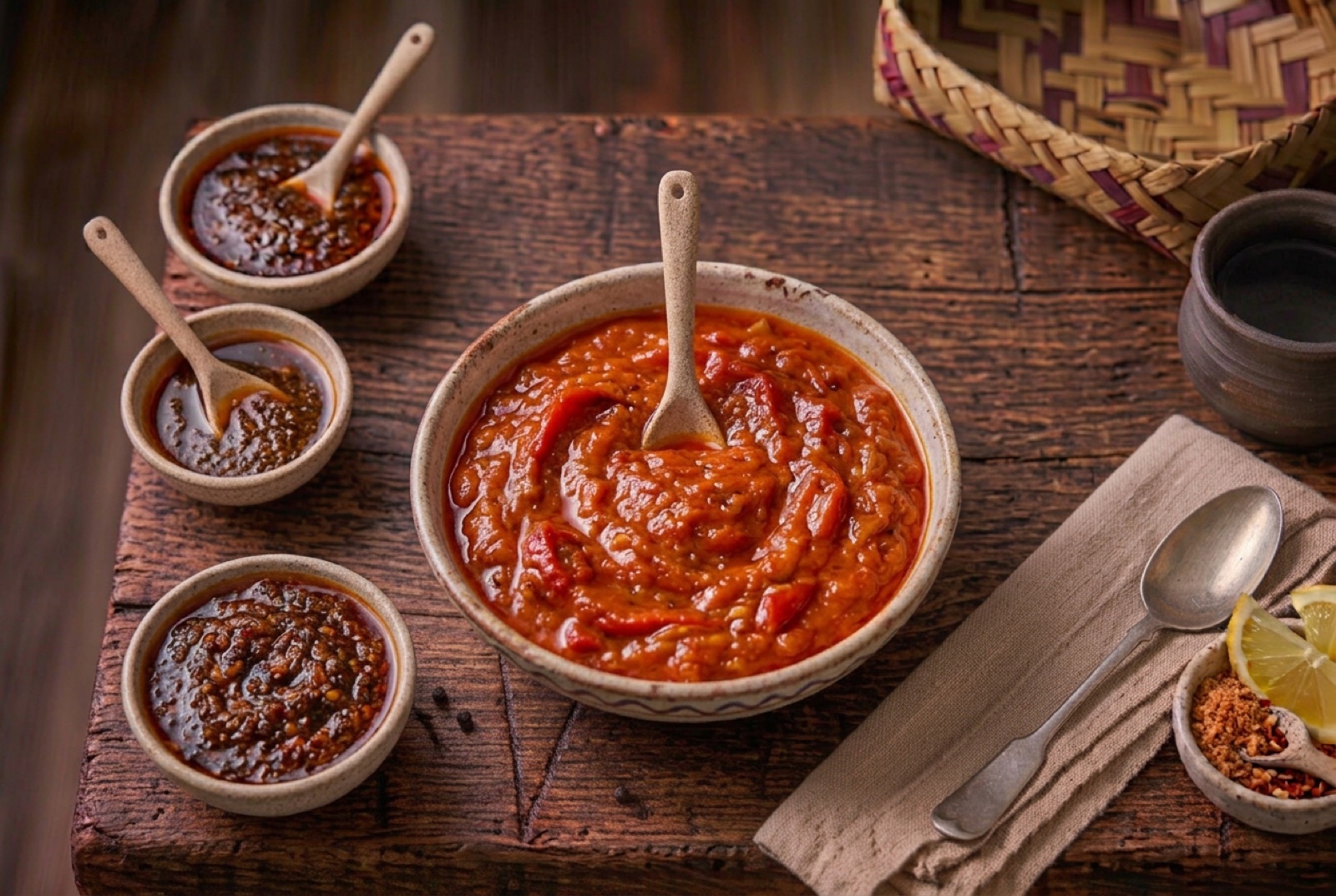

- Gate
- North MacedoniaNationwide, with Pelagonia and the Vardar valley growing the peppers
- Prep
- 1 hr
- Cook
- 2 hr 30 min
- Total time
- 3 hr 45 min incl. 15 min rest
- Serves
- 12
- Status
- Takes skill
- Nutrition / serving · estimated
- Calories 210 kcal
- Protein 3 g
- Carbs 12 g
- Fat 17 g
- Fiber 4 g
- Sugar 8 g
- Sodium 480 mg
Why this recipe works.
- Uses a scaled-down home-oven method that still gives the long reduction the flavour depends on.
- Explains how to tell when the ajvar is genuinely done rather than just hot, using the spoon-trail test.
- Weighs the peppers before and after peeling so you know what yield to expect from a given crate.
- Covers safe jarring for a preserve with no vinegar in it, which is where most home versions go wrong.
Ingredients.
8 itemsFor the ajvar
Equipment
- Large baking trays or a grill
- Wide heavy-bottomed pan
- Blender or food mill
- Sterilised jars with lids
Instructions.
Roast the peppers
Lay the whole peppers on baking trays and roast at 240°C, or grill over live coals, turning every 8 to 10 minutes, until the skins are blistered and blackened over most of their surface and the flesh has slumped. Roast the aubergine and chillies alongside if using.
Tip Pale, evenly cooked peppers are underdone. You want real black patches.
Steam and peel
Pile the hot peppers into a large bowl, cover tightly and leave for 15 minutes. Then pull off the stems and skins, which should slip away in sheets, and strip out the seeds. Work over a colander and do not rinse anything under the tap.
Drain thoroughly
Leave the peeled flesh in the colander for at least 30 minutes and discard every drop of the juice that collects. You should be left with roughly a third of the weight you started with — around 1.4 kg from 4 kg of peppers.
Blend or mince
Pass the drained flesh through a food mill, or pulse it in a blender to a coarse purée with a little visible texture rather than a smooth paste. Over-blending traps air and gives the finished ajvar a pale, foamy look.
Reduce slowly
Tip the purée into a wide heavy pan with half the oil and the salt. Cook over low heat for 90 minutes to 2 hours, stirring every few minutes and adding the remaining oil in stages, until the mixture darkens to brick red and stops spitting steam.
Tip Use a splatter guard. Reducing ajvar throws scalding purée a surprising distance.
Test for doneness
Drag a wooden spoon across the base of the pan. When the trail stays open for two full seconds before closing, and a spoonful mounded on a cold plate releases no watery ring around its edge, the ajvar is finished.
Season and jar
Stir in the garlic, vinegar and black pepper and cook a final 5 minutes so the garlic loses its raw edge. Ladle boiling hot into sterilised jars, seal immediately, invert for 5 minutes, then wrap in a blanket and let them cool slowly overnight.
Tips from our kitchen.
- Buy thick-walled, deeply red, ripe peppers. Thin-walled ones give you a watery purée that never thickens no matter how long you cook it.
- Roast the peppers until the skins are genuinely blackened and blistered in large patches — timid roasting means the skins will not peel and you lose the smoky note entirely.
- Steam the hot peppers under a lid or in a covered bowl for 15 minutes. The trapped steam lifts the skin away from the flesh and turns peeling from a chore into a quick job.
- Never rinse the peeled peppers under the tap. It washes away the roasted flavour and adds back the water you are about to spend two hours removing.
- Drain the peeled flesh in a colander for at least 30 minutes and discard the juice, or the cooking time doubles.
- Stir often and use a long-handled spoon. Reducing ajvar spits like lava and the bottom scorches the moment you stop paying attention.
Substitutions.
- Kurtovska kapija peppers → Long red Romano or ramiro peppers
- These are the closest widely available match. Standard bell peppers work but are less sweet and thinner-walled, so expect a paler, less concentrated result.
- Sunflower oil → A mild olive oil
- Sunflower is traditional and neutral. Strongly flavoured extra-virgin olive oil competes with the peppers and can turn bitter over a long cook.
- Fresh chilli → A teaspoon of chilli flakes, or omit
- Ajvar is made both mild (blag) and hot (luta) in North Macedonia. Neither is more authentic; decide based on who is eating it.
Variations.
- Лут ајвар (hot ajvar)
- Two or three hot red chillies roasted and puréed along with the sweet peppers, giving a slow heat that builds rather than bites immediately.
- With aubergine
- One roasted aubergine per two kilos of peppers, which lightens the colour, softens the texture and stretches the yield. Common in Serbia and Bosnia, less so in North Macedonia.
- Coarse ajvar
- The peppers chopped by hand or run through a coarse mincer instead of blended, so the finished relish has visible texture rather than a smooth body.
Storage & reheating.
Ajvar packed boiling hot into sterilised jars, sealed and left to cool slowly under a blanket keeps for a year in a cool dark place, which is the whole point of making it. Once a jar is opened, keep it refrigerated with a thin film of oil poured over the surface and use it within about 3 weeks. If you are not confident about jarring, simply refrigerate the finished ajvar in a sealed container for up to a month, or freeze it in small portions for 6 months — freezing costs you nothing in texture.
Serve with
Fresh white bread and crumbled brined cheese for breakfast, or alongside grilled meat, sausages and roasted potatoes.
The story behind Macedonian Ajvar.
Every autumn across North Macedonia and the surrounding countries, the same scene repeats: crates of long red peppers stacked on a terrace, a wood fire or a gas burner outdoors, a wide black pan, and several people working in shifts. This is ajvarenje, the ajvar-making, and it is a social event as much as a preserving task. The peppers are roasted until blackened, sweated under a cover so the skins lift, then peeled and seeded by hand — the slowest, dullest and most talked-about part of the job. What follows is hours of stirring over low heat while the purée spits, darkens and reduces, and then jarring the finished ajvar while it is scalding.
The pepper matters. The traditional variety is a long, thick-walled, deep-red type known regionally as kurtovska kapija or vezena, which ripens late, has enough flesh to survive roasting and carries a lot of natural sugar. Thin-walled peppers produce watery ajvar and everyone knows it, which is why the peppers are bought by variety and not by price. Quantities are serious: twenty or thirty kilos per household is unremarkable, because ajvar reduces to roughly a quarter of its starting weight and because a family will get through a jar a week all winter.
Origin arguments are unavoidable here. Ajvar is made across North Macedonia, Serbia, Bosnia, Croatia, Kosovo and Bulgaria, and each will tell you it is theirs. The honest answer is that it belongs to the whole region — the name comes from Turkish havyar, the same root as caviar, which was once applied loosely to salted relishes — and that regional versions genuinely differ, with more or less aubergine, garlic and chilli depending on where you are. Macedonian ajvar is typically pepper-forward, cooked long, and only lightly seasoned. This recipe scales that operation down to something a home oven can handle, which means a smaller yield and a shorter afternoon, but the same method.
Questions, answered.
Which peppers make the best ajvar?
Long, thick-walled, fully ripe red peppers — the variety known as kurtovska kapija in the Balkans, or Romano and ramiro peppers elsewhere. Thickness of flesh is what determines whether you end up with a dense spread or a thin sauce, and full ripeness supplies the sweetness that balances the smoke from roasting.
How long does ajvar really need to cook?
For this home-scale quantity, roughly 90 minutes to 2 hours of gentle simmering with regular stirring. Traditional outdoor batches of twenty kilos run for four hours or more. The test is not the clock: drag a spoon across the bottom of the pan, and if the trail holds open for a couple of seconds before closing, it is done.
Is ajvar Macedonian, Serbian or Bosnian?
It is genuinely shared across the region and no single country invented it. Versions are made throughout North Macedonia, Serbia, Bosnia, Croatia, Kosovo and Bulgaria, with real differences in whether aubergine, garlic or chilli are included. The word itself comes from Turkish havyar, meaning a salted relish, which points to the shared Ottoman-era kitchen rather than any one nation.
Why is my ajvar watery?
Three likely causes: thin-walled peppers, rinsing the peeled flesh under the tap, or not draining it before cooking. All three add or retain water that you then have to boil off. If it has already happened, keep cooking on low heat and stirring — the only fix is time.
Can I skip peeling the peppers?
You should not. Roasted pepper skin does not break down and leaves tough transparent flakes suspended through the finished ajvar, which ruin the texture on bread. Steaming the peppers for 15 minutes after roasting makes the skins slip off in large pieces and cuts the job down to a few minutes per kilo.
You might also like.
All recipes →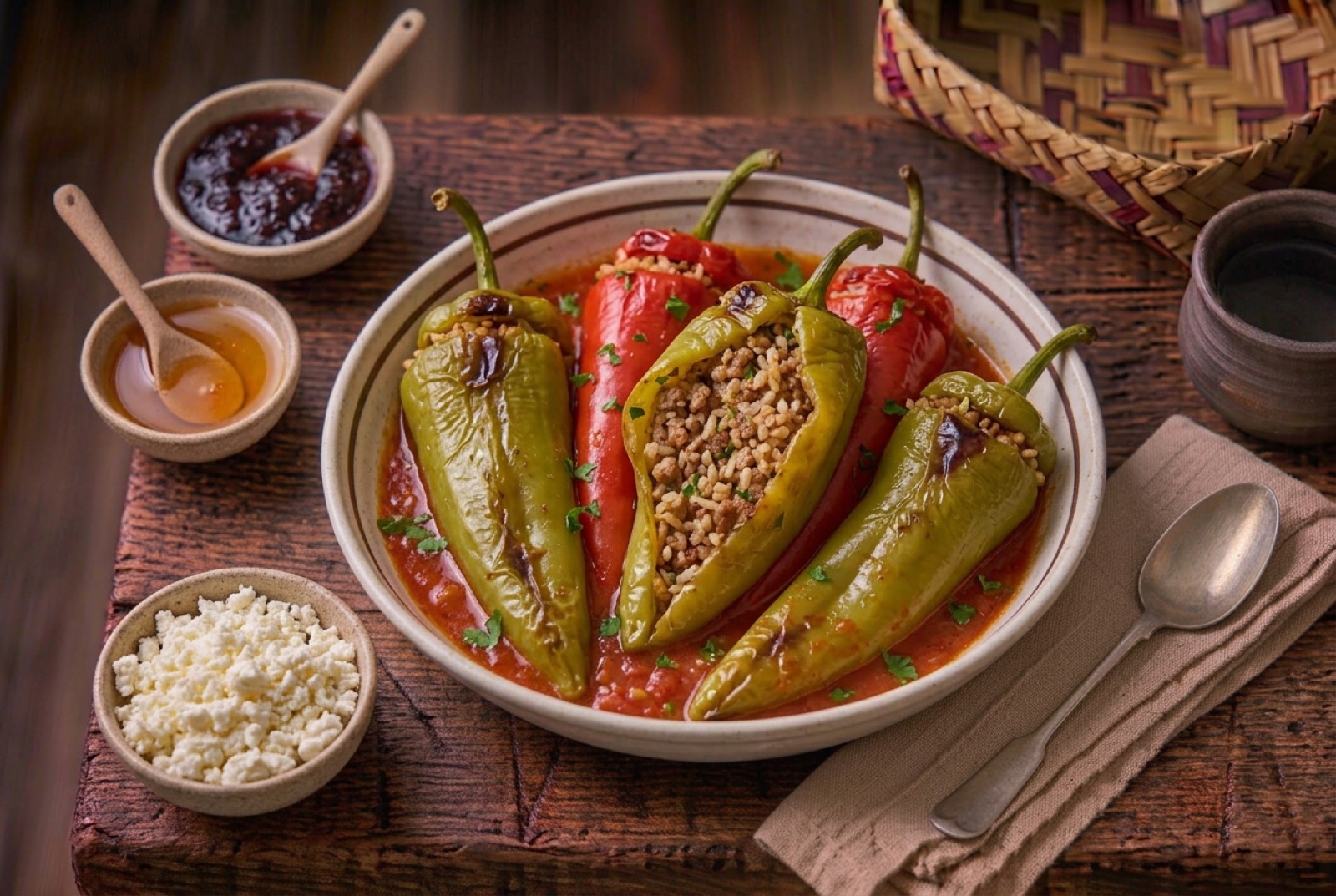
North Macedonia1 hr 30 min
Polneti Piperki
Macedonian Stuffed Peppers in Tomato
North Macedonia2 hr 55 min
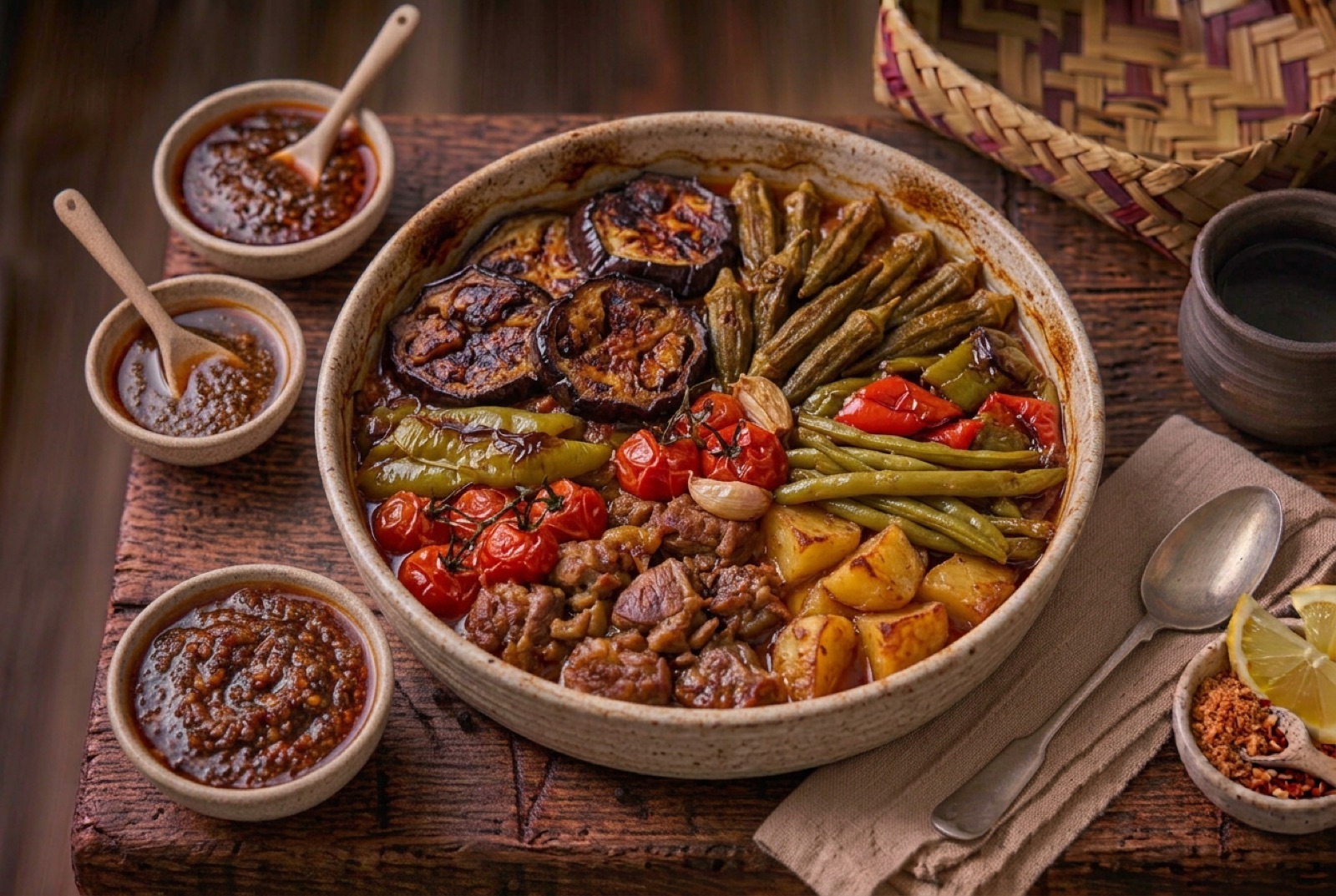
Turli Tava
Macedonian Mixed Vegetable and Meat Bake
North Macedonia10 hr 20 min
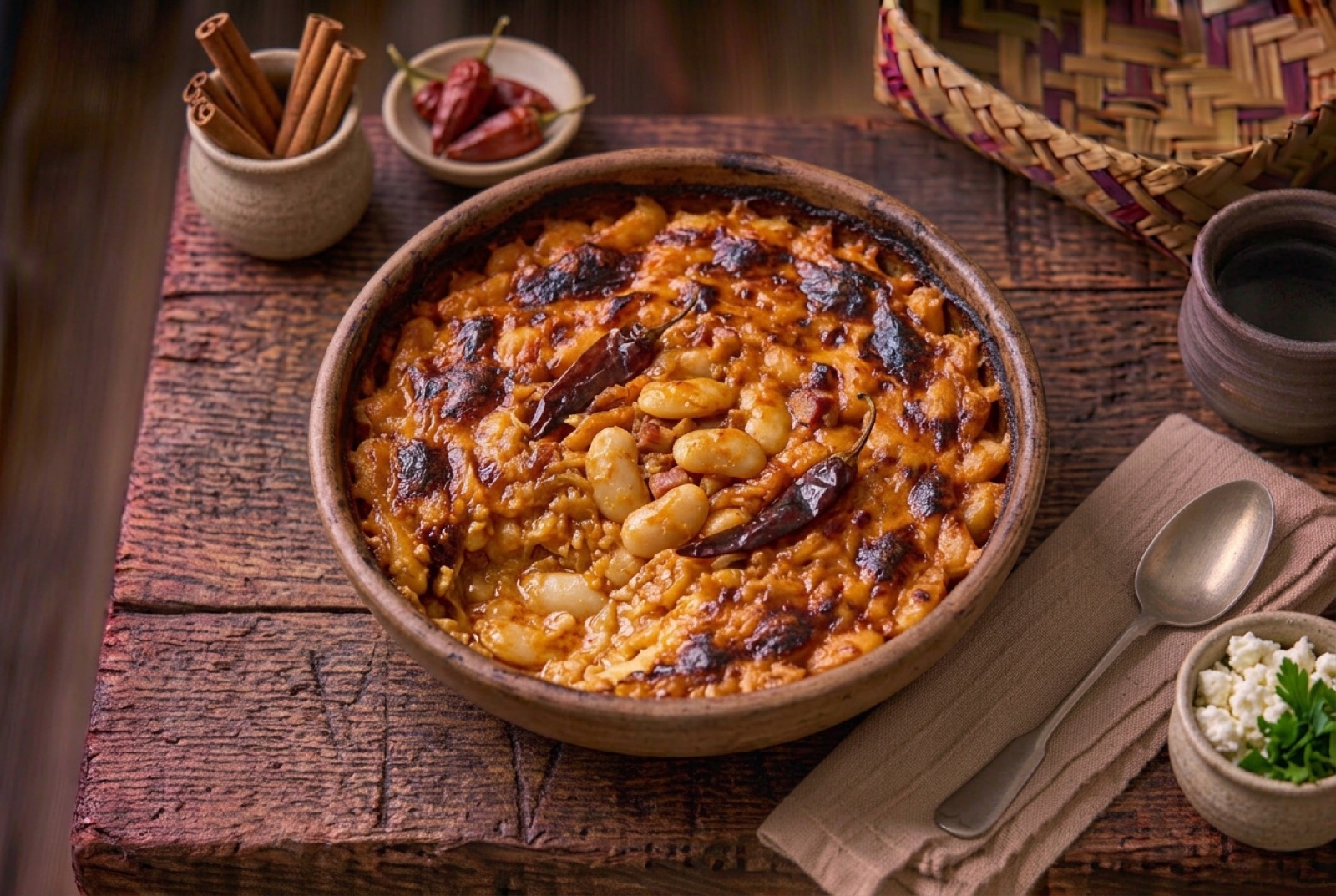
Tavče Gravče
Macedonian Clay-Pot Baked Beans
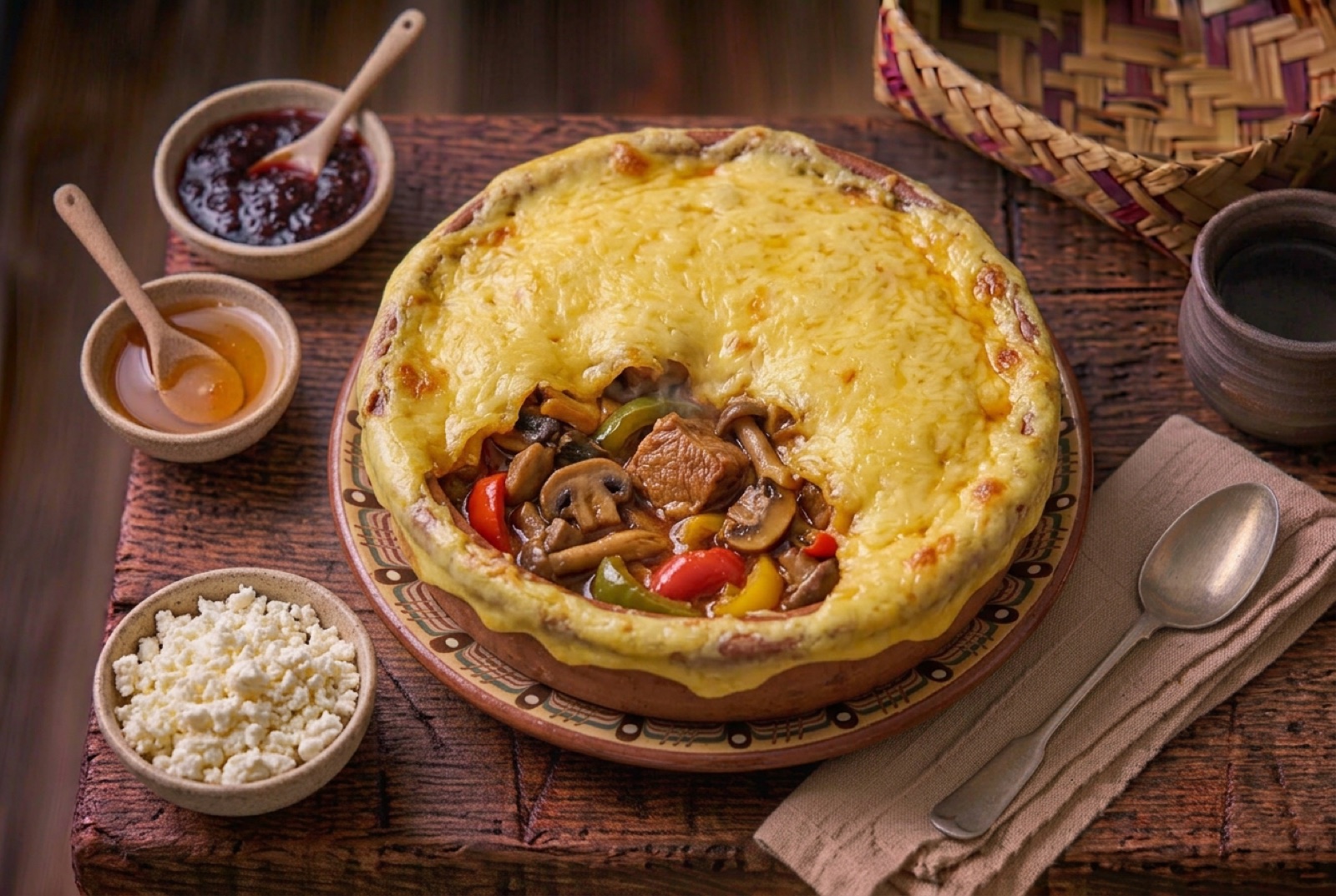
North Macedonia1 hr 55 min
Selsko Meso
Macedonian Village Pork and Mushroom Pot
Keep exploring North Macedonia.
North Macedonia has 9 more dishes in the atlas — Mekici and Pastrmajlija, and 7 more.
All North Macedonia recipes Bell pepper recipes Garlic recipes Olive oil recipes saucesideappetizervegetarianvegangluten freedairy freenut freeRecipe by The DishRoute Kitchen · published August 20, 2026 · updated August 20, 2026