Ropa Vieja Panameña.
Shredded Beef in Criollo Sauce
Ropa vieja panameña · say it: ROH-pah VYEH-hah pah-nah-MEH-nyah
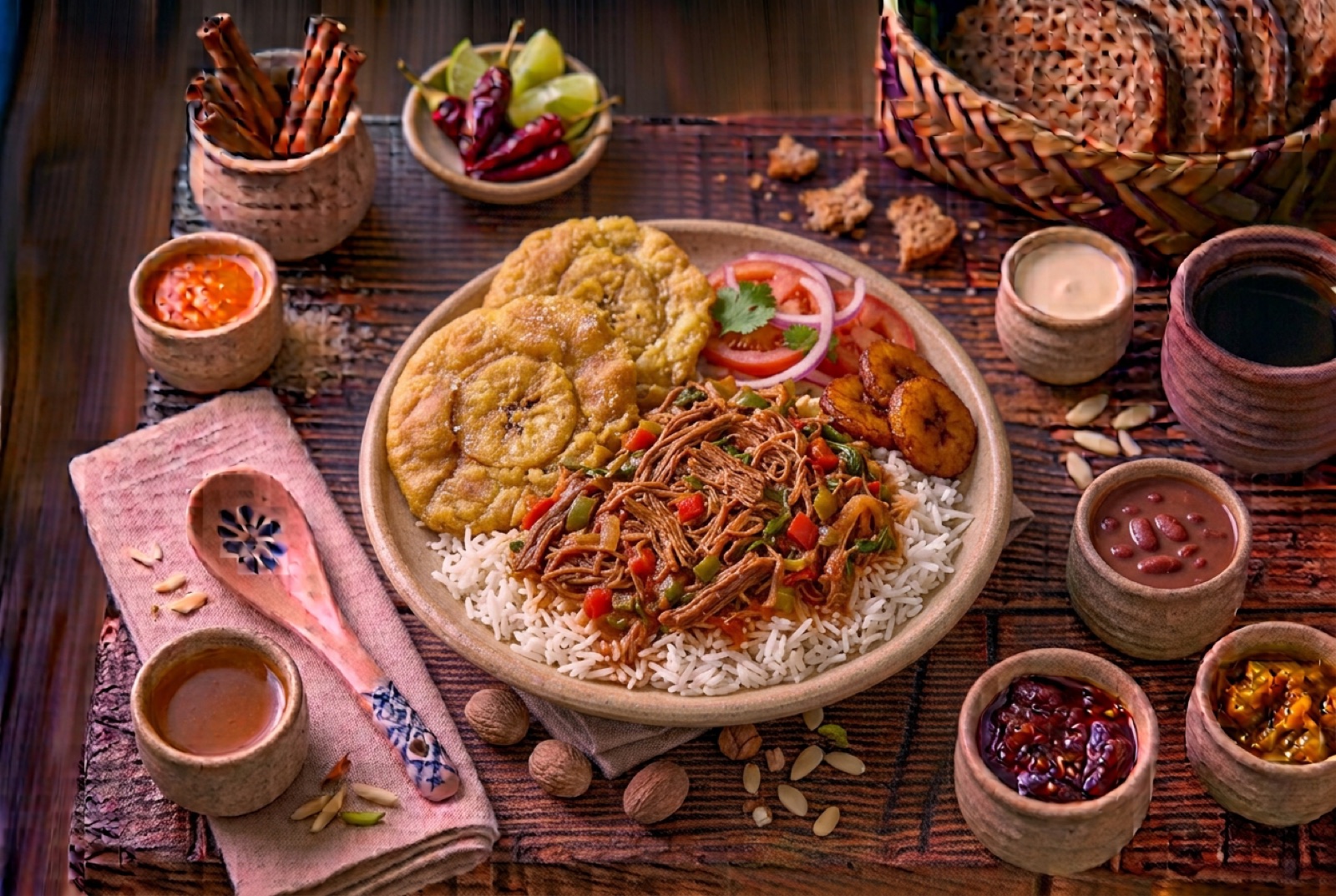
Ropa vieja is beef boiled soft, pulled into long threads with two forks, and returned to a bright tomato-and-pepper sauce until every strand is coated. The Panamanian version is looser and wetter than the Cuban one — more sauce, less reduction, and a heavy hand with culantro, the long serrated herb that tastes like cilantro turned up and given a bitter edge. What you get is soft, savory, faintly sweet from cooked onion and pepper, sharp at the finish from lime. It is not fancy food and it is not trying to be: this is the plate that appears at fondas and family tables across the country at midday, ladled over white rice with a couple of patacones on the side. The name means "old clothes," which is exactly what a mound of shredded beef in red sauce looks like.

- Gate
- PanamaPanama City and the interior
- Prep
- 20 min
- Cook
- 2 hr
- Total time
- 2 hr 20 min
- Serves
- 4
- Status
- Easy
- Nutrition / serving · estimated
- Calories 420 kcal
- Protein 44 g
- Carbs 14 g
- Fat 21 g
- Fiber 3 g
- Sugar 8 g
- Sodium 720 mg
Why this recipe works.
- Boiling the beef first gives you tender threads and a pot of broth that goes straight back into the sauce.
- Culantro is used the way Panamanians actually use it — in quantity, and added at two stages.
- The sauce is kept deliberately loose so it soaks the rice instead of sitting on top of it.
- Cheap cuts only: flank or skirt, cooked long, which is how this dish was designed to work.
Ingredients.
17 itemsFor boiling
For the sauce
To finish
Equipment
- Large pot for boiling the beef
- Wide sauté pan or Dutch oven
- Two forks for shredding
- Fine sieve or skimmer
Instructions.
Boil the beef
Put 900 g of beef in a pot with the halved onion, crushed garlic, bay leaves, whole culantro leaves and salt. Cover with water by 5 cm, bring to a boil, then drop to a bare simmer and cook 90 minutes, until a fork twisted into the meat separates the fibres with no resistance.
Tip Skim the grey foam off in the first ten minutes and the broth stays clear enough to use in the sauce.
Shred while warm
Lift the beef onto a board and strain the broth into a jug, keeping about 500 ml. Let the meat cool just enough to handle, then pull it into long threads with two forks, following the grain. Discard any hard fat or gristle you find.
Build the sofrito
Heat the oil in a wide pan over medium heat and cook the sliced onion and pepper strips for 8 minutes, stirring, until the onion is translucent and the peppers slump and smell sweet rather than grassy. Add the chopped garlic and cook one minute more, just to the point where it smells toasted.
Cook down the tomato
Stir in the chopped tomatoes, tomato paste and oregano and cook 10 minutes over medium heat, pressing the tomatoes against the pan, until the mixture darkens from bright red to brick and a spoon dragged across the base leaves a track that fills slowly.
Return the beef
Add the shredded beef and 300 ml of the reserved broth, tuck in the whole habanero if using, and simmer uncovered for 15 minutes. The sauce should stay loose enough to pour — add more broth whenever it tightens past that.
Tip Do not let the chile burst. Lift it out the moment the skin looks wrinkled and glossy.
Finish and season
Remove the chile, stir in the chopped culantro and taste. Correct with salt, black pepper and a squeeze of lime until the sauce tastes sharp at the front and sweet underneath. Serve over white rice with the remaining lime wedges.
Tips from our kitchen.
- Flank and skirt shred best because their muscle fibres run long and straight — chuck works but gives shorter, chunkier threads.
- Shred the beef while it is still warm; cold meat tightens up and fights the forks.
- Save every drop of the cooking broth. If the stew tightens on the stove, it is the only thing you should use to loosen it.
- If you can only find cilantro, use double the volume and add it late — culantro is stronger and survives cooking, cilantro does not.
- Drop the habanero in whole and unbroken for aroma without real heat, and lift it out before it bursts.
- Season the sauce at the very end, after the meat has gone back in — the broth is already salted and it concentrates.
Substitutions.
- Culantro → Three times the amount of cilantro, added in the last five minutes
- Culantro (recao) is sold at Latin and Caribbean grocers, often frozen. Cilantro is a fair stand-in for aroma but has none of culantro's bitterness or staying power under heat.
- Ají chombo (habanero) → Half a jalapeño, seeds removed, or leave it out
- The chile is there for fruity perfume rather than burn. Panamanians usually keep the heat on the table as a bottled sauce, so leaving it out is not a compromise.
- Flank steak → Beef chuck or brisket, boiled 30 minutes longer
- Both shred well, though into shorter fibres. Chuck also renders more fat into the broth — skim it before making the sauce.
Variations.
- With olives and capers
- A city version that borrows from the tamal seasoning: a handful of green olives and a spoon of capers stirred in at the end for salt and sharpness.
- Ropa vieja de pollo
- The same sauce built on poached chicken breast or thigh, shredded the same way — faster, lighter, and common in fondas as a second option.
- Dry-style
- Cooked down hard until the sauce clings and the edges of the meat begin to fry, closer to the Cuban treatment. Better inside a tortilla or on bread than over rice.
Storage & reheating.
Ropa vieja improves overnight and keeps 4 days refrigerated. Reheat in a covered pan over low heat with a splash of the reserved broth or water, since the shredded meat drinks up sauce as it sits. It freezes very well for up to 3 months — freeze it wetter than you want it, because the sauce tightens on thawing. Do not reheat repeatedly; the threads break down into mush after the second or third round.
Serve with
White rice, patacones and a wedge of lime — and a spoonful of the pot broth over the rice if you have it to spare.
The story behind Ropa Vieja Panameña.
Ropa vieja travelled to the Americas from Spain, most likely from the Sephardic kitchens of the Iberian peninsula, where cooks stretched leftover boiled meat into a second meal by shredding it and stewing it with vegetables. It landed hardest in the Caribbean, and today Cuba treats it as a national dish. Panama, sitting on the isthmus where Caribbean, Pacific and Spanish colonial cooking all collided, made its own version and kept it as everyday food rather than a symbol.
The Panamanian difference is mostly a matter of consistency and herb. Cuban ropa vieja is usually cooked down until the sauce clings tight to the meat, often with cumin, olives and a splash of dry wine. The Panamanian plate stays soupier — you want sauce to run into the rice — and the defining aroma is culantro rather than cumin. Culantro, called recao elsewhere in the region, grows in backyards across Panama and goes into nearly everything savory; a Panamanian cook reaches for a fistful of it the way a French cook reaches for a bay leaf. Ají chombo, the local habanero-type chile, may be dropped in whole for perfume and fished out before it splits.
The dish also reflects how Panamanian home cooks treat beef. Cheap, hard-working cuts — falda, or skirt and flank — are the norm, and boiling them slowly does two jobs at once: it tenderises the meat and produces a pot of broth that gets used for rice, soup or the sauce itself. Nothing gets thrown away. Served with white rice, and usually with fried ripe plantain or patacones, ropa vieja is the kind of lunch that is measured in how much sauce is left on the plate at the end.
Questions, answered.
What cut of beef should I use for ropa vieja?
Flank steak or skirt steak are the standard choices because their long, parallel muscle fibres pull apart into the classic ropey threads. Chuck, brisket or beef shank also work and are often cheaper, but they shred into shorter pieces and need roughly half an hour more simmering to reach the same tenderness.
How is Panamanian ropa vieja different from the Cuban version?
Panamanian ropa vieja is looser and more tomato-forward, built to be spooned over white rice with sauce to spare, and it leans on culantro as its main herb. The Cuban version is generally reduced until the sauce grips the meat and is seasoned with cumin, olives and often a splash of dry wine. Both are legitimate; they are simply built for different plates.
Can I make ropa vieja ahead of time?
Yes, and it is arguably better the next day once the threads have absorbed the sauce. Cook it through, cool it, and refrigerate up to four days. Reheat gently with extra broth or water to bring it back to a spoonable consistency, because it thickens considerably in the fridge.
What is culantro and is it the same as cilantro?
No. Culantro is a different plant with long, serrated leaves that grows in a flat rosette, common across Panama, the Caribbean and northern South America. It tastes like a stronger, slightly bitter cilantro and holds its flavour through long cooking, which cilantro does not. Latin and Asian grocers sell it fresh or frozen.
Why is my shredded beef dry?
Almost always because the sauce was reduced too far or the meat sat in the fridge and absorbed everything. Shredded beef has enormous surface area and drinks liquid fast. Keep a cup of the cooking broth aside and add it back whenever the pan looks tight, both at the end of cooking and on reheating.
You might also like.
All recipes →
Keep exploring Panama.
Panama has 9 more dishes in the atlas — Arroz con Guandú y Coco and Carimañolas, and 7 more.
Recipe by The DishRoute Kitchen · published August 20, 2026 · updated August 20, 2026