Chupe de Camarones.
Arequipa River Prawn Chowder
Chupe de camarones · say it: CHOO-peh deh kah-mah-ROH-ness
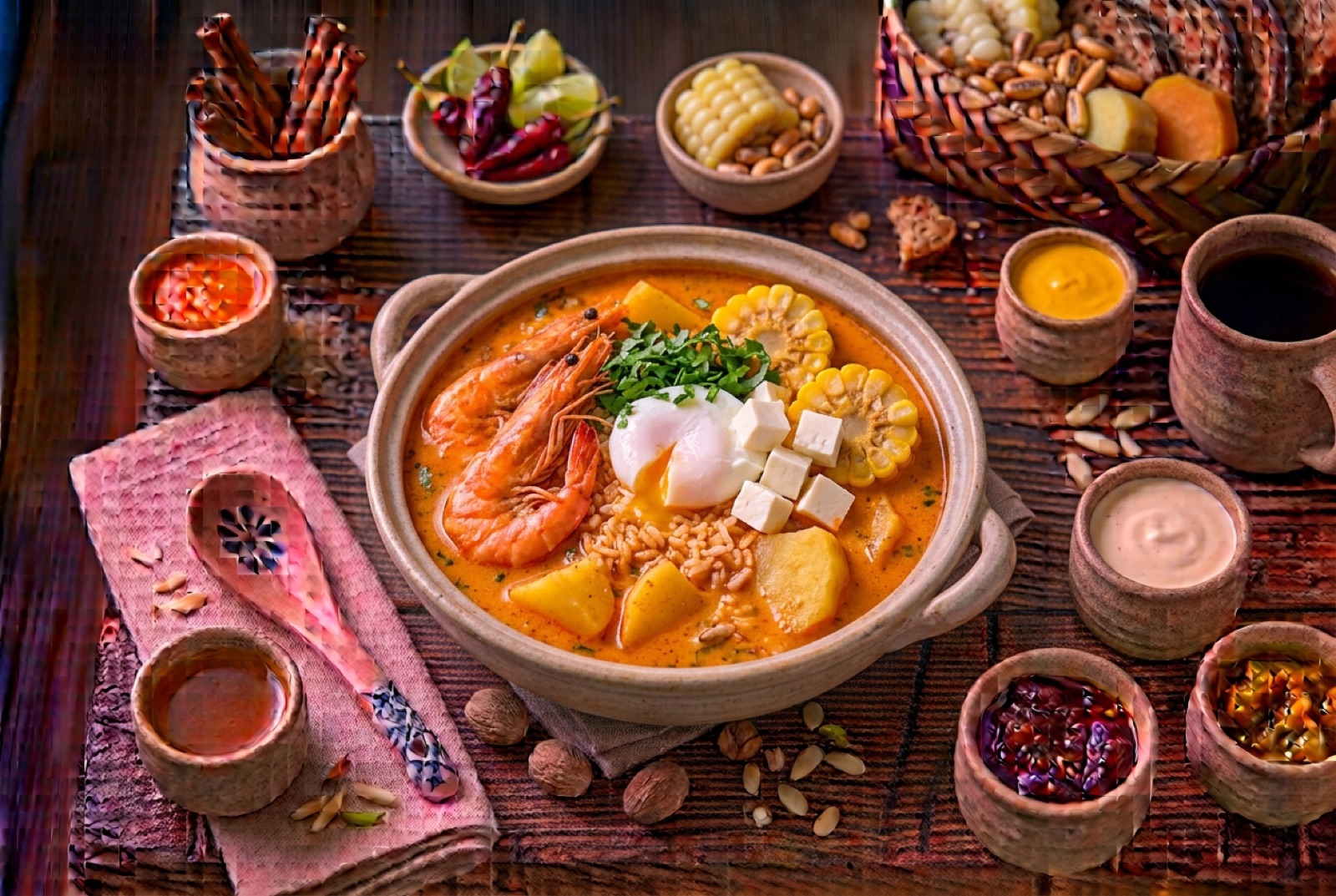
Chupe de camarones is a thick, orange-tinted chowder from Arequipa in which almost everything on an Andean market table ends up in the same pot — potatoes, corn, rice, peas, broad beans, milk, fresh cheese and river prawns. The flavour comes from the prawn heads, crushed and fried at the start so their coral stains the fat, and from ají panca and amarillo, which give warmth rather than real heat. It is rich but not heavy: milk goes in at the end, the broth stays loose, and an egg poached directly in the soup breaks over everything as you eat. One bowl is dinner, and Arequipeños would tell you it is also a cure.

- Gate
- PeruArequipa
- Prep
- 30 min
- Cook
- 45 min
- Total time
- 1 hr 15 min
- Serves
- 4
- Status
- Medium
- Nutrition / serving · estimated
- Calories 590 kcal
- Protein 45 g
- Carbs 52 g
- Fat 22 g
- Fiber 6 g
- Sugar 12 g
- Sodium 1050 mg
Why this recipe works.
- Prawn heads are fried and pounded into the base, which is the single technique that separates this from a milky vegetable soup.
- The milk goes in off the boil at the end, so the broth stays smooth instead of curdling against the acid and the ají.
- Eggs are poached directly in the soup the way a picantería does it, one per bowl, not scrambled through the pot.
- Honest about river prawns: what you lose with sea prawns and how to claw some of it back with the shells.
Ingredients.
19 itemsFor the prawn base
For the soup
To finish
Equipment
- Large heavy pot or Dutch oven
- Ladle for crushing the prawn heads
- Sieve
- Wide bowls for serving
Instructions.
Separate heads from tails
Twist the heads off the prawns and set them aside; peel the tails, keeping the shells with the heads, and refrigerate the peeled tails. If any heads hold dark orange coral, scrape it into a small bowl — that is the most concentrated flavour in the dish.
Fry the heads for colour
Heat the oil in a large pot over high heat and fry the heads and shells for 4–5 minutes, pressing down hard with a ladle, until they turn brick red and the oil beneath them stains a clear orange. Crush them thoroughly against the base of the pot before moving on.
Tip This is the step people skip and then wonder why their chupe is white. Push it until the pot smells strongly of shellfish.
Build the aderezo
Add the onion and cook for 6 minutes until soft and translucent, then stir in the garlic, grated tomato, both ají pastes, cumin and oregano. Fry for 5 minutes more, stirring, until the mixture darkens and a film of orange oil separates around the edge of the pan.
Simmer and strain
Pour in 1.5 l of stock, bring to a simmer and cook for 15 minutes to draw everything out of the shells. Strain the broth into a clean pot, pressing firmly on the solids with a ladle, and discard the shells.
Cook the vegetables and rice
Return the broth to a simmer, add the potatoes, corn rounds and rice, and cook for 15 minutes until a knife slides into a potato with no resistance and the rice has swollen and thickened the broth slightly. Add the peas for the last 4 minutes.
Poach the eggs in the soup
With the soup at a bare simmer, crack the eggs in one at a time, spacing them apart, and leave them undisturbed for 3–4 minutes until the whites set opaque and the yolks are still soft. Do not stir the pot while they cook.
Add prawns, milk and cheese
Slide in the peeled prawn tails and any reserved coral and cook for 2 minutes, just until they curl and turn opaque. Take the pot off the heat, stir in the milk and the cubes of queso fresco, and let the residual warmth soften the cheese without melting it.
Tip Off the heat means off the heat. Even a gentle boil after the milk goes in will split the broth.
Season and serve blisteringly hot
Taste and correct with salt and plenty of black pepper, then scatter the chopped huacatay or mint. Ladle into wide bowls so each one gets an egg, a piece of corn, prawns and cheese, and serve at once with bread.
Tips from our kitchen.
- Buy prawns with heads on even if you have to go to a fishmonger for them. The heads are where the colour, the fat and most of the flavour live.
- Fry the heads hard for a few minutes until they turn brick red and the oil beneath them stains orange, then crush them with the back of a ladle before adding liquid.
- Add the milk at the very end and never let it boil. Once it boils against the ají and prawn acids it splits into grainy flecks that will not come back together.
- Cut the potatoes large, around 4 cm. Small dice disintegrates and turns the whole soup into a thick porridge.
- Cook the rice in the soup, not separately. It releases starch that gives the chowder its proper body — but use only a small handful or the whole pot sets solid.
- Salt at the end. Between the prawn stock and the cheese there is more salt in the pot than you expect.
Substitutions.
- River prawns (camarones de río) → Head-on sea prawns, langoustines, or freshwater crayfish
- Crayfish are the closest in flavour and shape. If only headless prawns are available, buy shell-on, fry the shells hard and simmer them for 20 minutes to make a quick stock — you will get some colour if not the full depth.
- Ají amarillo and ají panca paste → 1 tbsp smoked paprika, 1 tsp tomato paste and half a deseeded jalapeño
- Neither Peruvian chilli is very hot; they supply colour, fruit and a faint smokiness. Jarred pastes keep for months and are stocked by most Latin grocers.
- Huacatay → A sprig of mint plus a little cilantro, added at the end
- Huacatay is the Andean black-mint marigold and has no direct equivalent. Mint gets you the cooling note without the resinous edge.
- Queso fresco → Firm feta rinsed of its brine, or halloumi cut small
- You want cubes that soften in the hot broth without melting into strings. Anything that melts smoothly will disappear into the soup.
Variations.
- Chupe de pescado
- The same base built on firm white fish instead of prawns, common along the coast and considerably cheaper. Add the fish in the final five minutes.
- Chupe de viernes
- The Lima Lenten version, generally richer in milk and cheese and often including chuño, the freeze-dried Andean potato, alongside the fresh ones.
- Chupe verde
- A highland variation coloured with a paste of huacatay, paico and other herbs, giving a green rather than orange soup with a much more aromatic finish.
Storage & reheating.
Chupe keeps 2 days refrigerated but changes as it sits: the rice and potato drink the broth and it thickens into something closer to a stew. Loosen it with a splash of stock or water when reheating and warm it gently, never at a boil, or the milk will split. Do not freeze it — milk, potato and prawn all suffer badly, and the prawns turn rubbery. Reheat only what you will eat, and poach fresh eggs each time rather than reheating them.
Serve with
Crusty bread for the broth, a bowl of ají sauce on the side, and nothing else — the soup is the meal.
The story behind Chupe de Camarones.
Chupe is an old Quechua-derived word for a substantial soup, and Peru has dozens of them — chupe de pescado, de quinua, de zapallo, de olluco. This is the aristocrat of the family, and it belongs specifically to Arequipa, the white volcanic-stone city in the southern highlands with the most self-contained regional cuisine in the country. Its natural home is the picantería, a type of Arequipeño eating house descended from chicherías that brewed corn beer, where cooking is done over wood in clay pots and the menu rotates by the day of the week. Picantería cooking was recognised by the Peruvian state as cultural heritage in 2015, and chupe de camarones is the dish most people order there.
The prawns are the point and they are not ordinary shrimp. Camarones de río are freshwater crayfish-like prawns from the Majes, Ocoña and Camaná rivers that drain the Andes into the Pacific, with large heads full of orange coral and a sweeter, more mineral flavour than sea prawns. Their season is regulated — river fishing closes for several months a year to let stocks recover — so Arequipeño cooks are used to working around scarcity. The heads matter more than the tails: crushed into the sofrito, they release fat-soluble colour and a concentrated shellfish flavour that no amount of stock replaces. If you make this with headless supermarket prawns, the soup will be pleasant and pale, and it will not taste like Arequipa.
Around this core sits the Andean pantry doing what it does everywhere in Peru: potatoes of several types, choclo with its big starchy kernels, habas, and a spoonful of rice for body. The milk and fresh cheese are colonial additions, the ají is pre-Columbian, and huacatay ties the two halves together. In much of Peru the soup also carries a Catholic timetable — a Friday dish, especially during Lent, when meat was avoided and the rivers and sea supplied dinner instead. It arrives at the table volcanically hot in a wide clay bowl, and the egg is cracked into the pot at the last minute so it sets in the broth rather than in a separate pan.
Questions, answered.
What are camarones de río and can I use regular shrimp?
Camarones de río are freshwater prawns from the rivers of southern Peru, with big coral-filled heads and a sweeter, more mineral flavour than marine shrimp. Regular sea prawns work perfectly well as a substitute, and crayfish come closest of all. Whatever you use, buy them head-on or at least shell-on, because the shells carry most of the colour and flavour.
Why did my soup curdle?
The milk boiled. Dairy proteins coagulate when heated too far, and the acidity from tomato, chilli and shellfish makes it happen sooner. Add the milk off the heat at the very end, stir it in, and warm the pot only until steam rises. If it has already split, the flavour is fine even though the texture is grainy.
How spicy is chupe de camarones?
Mild. Ají panca is a dark, fruity dried chilli with very little heat, and ají amarillo is moderately hot but used in small quantity here. The soup should taste warm and savoury rather than fiery. Peruvians add heat at the table from a separate bowl of ají sauce, which is a better approach than loading the pot.
Do I have to poach the eggs in the soup?
It is the traditional method and it is worth doing — the egg picks up the flavour of the broth and the yolk enriches the bowl when you break it. But if you are nervous about it, or serving a crowd, poach the eggs separately and slide one into each bowl at the last moment. The result is nearly the same.
Can I make this ahead for a dinner?
Yes, in stages. Build the soup up to the point before the milk and cheese go in, then cool and refrigerate it for up to two days. On the night, reheat gently, add the prawns for their few minutes of cooking, stir in the milk off the heat and poach the eggs. Doing the last steps fresh is what keeps the prawns tender and the broth smooth.
You might also like.
All recipes →
Keep exploring Peru.
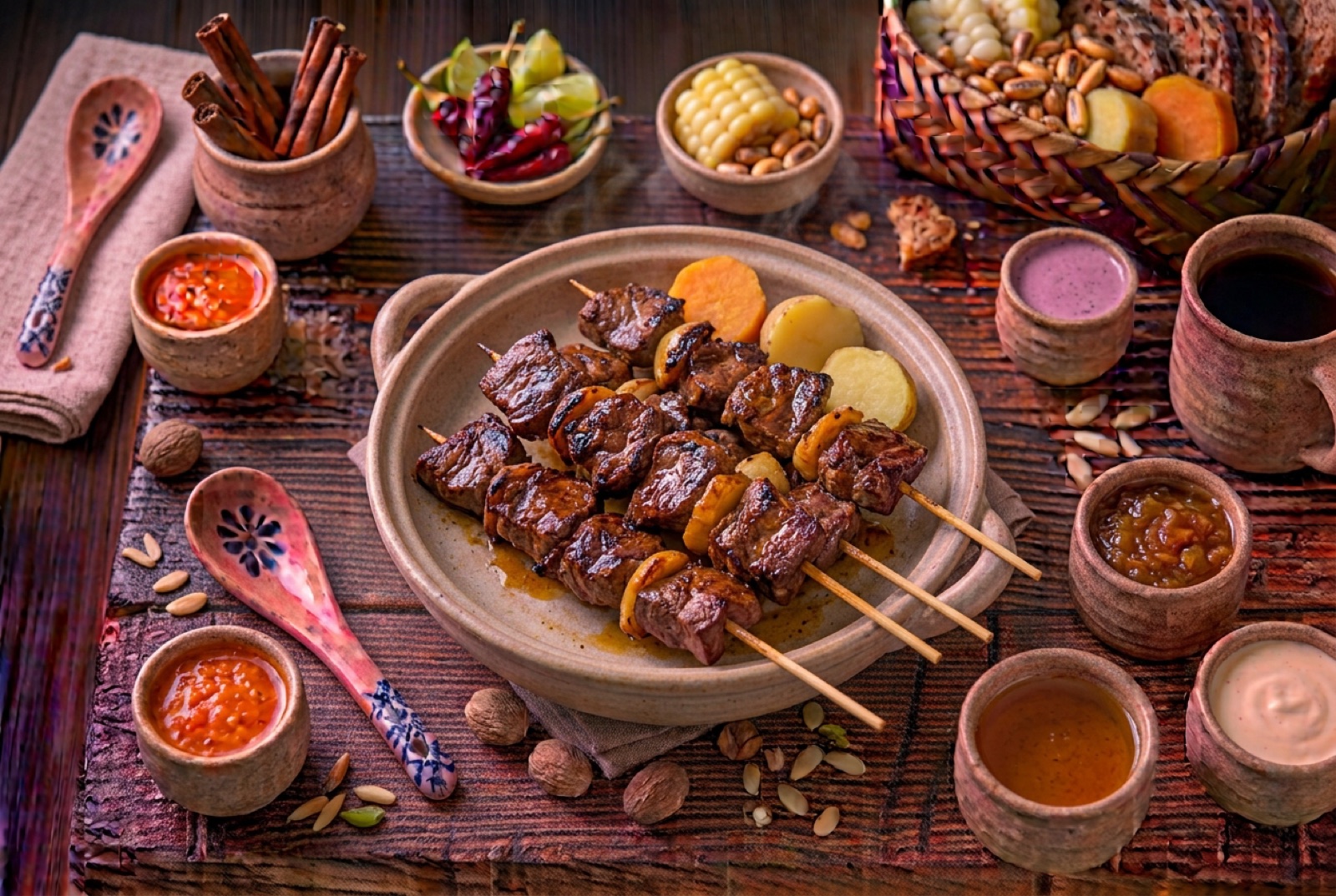
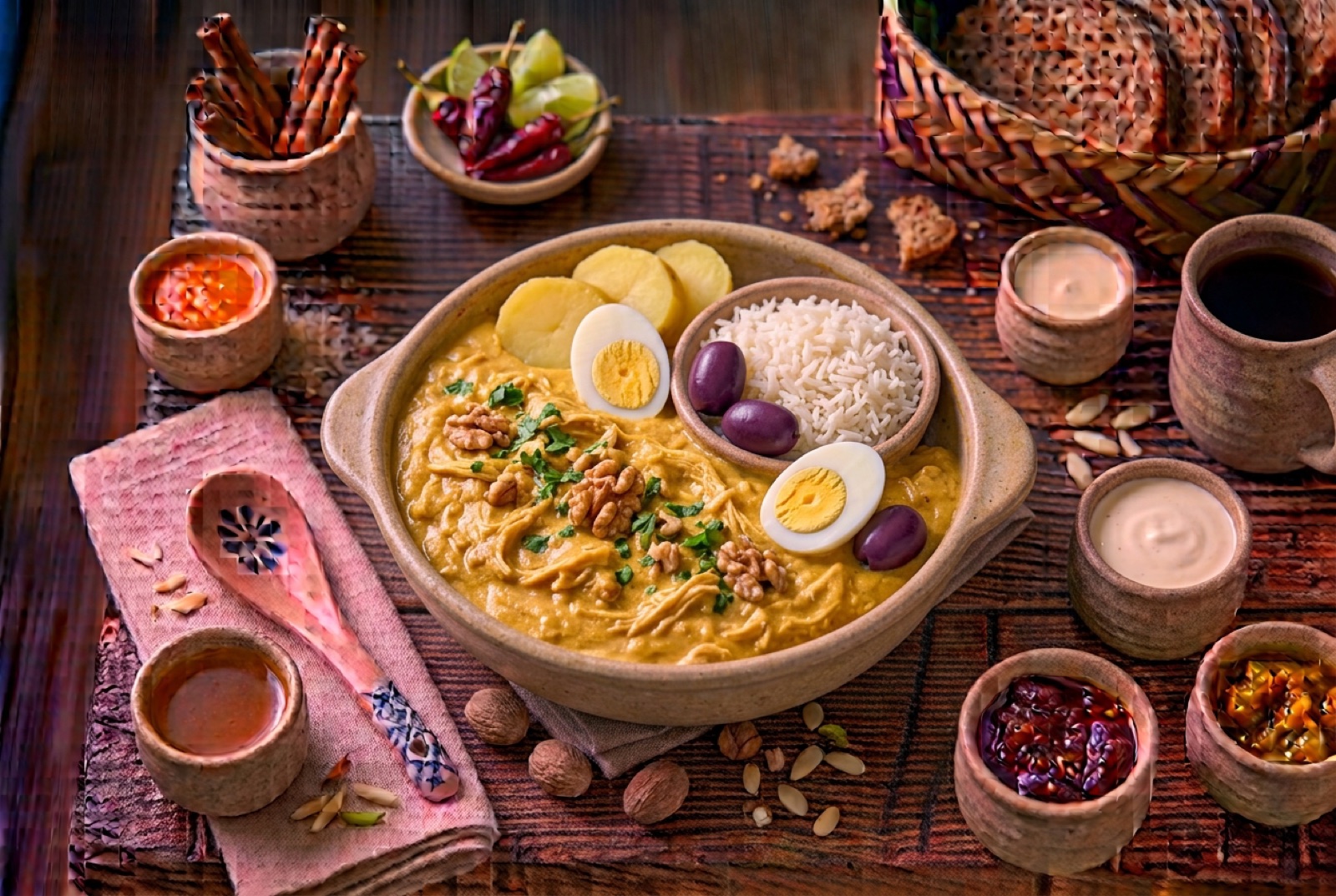
Peru has 9 more dishes in the atlas — Ají de Gallina and Anticuchos de Corazón, and 7 more.
Recipe by The DishRoute Kitchen · published August 19, 2026 · updated August 19, 2026