Knefeh.
Lebanese Semolina Cheese Pastry in Syrup
كنافة · say it: k'NEH-feh
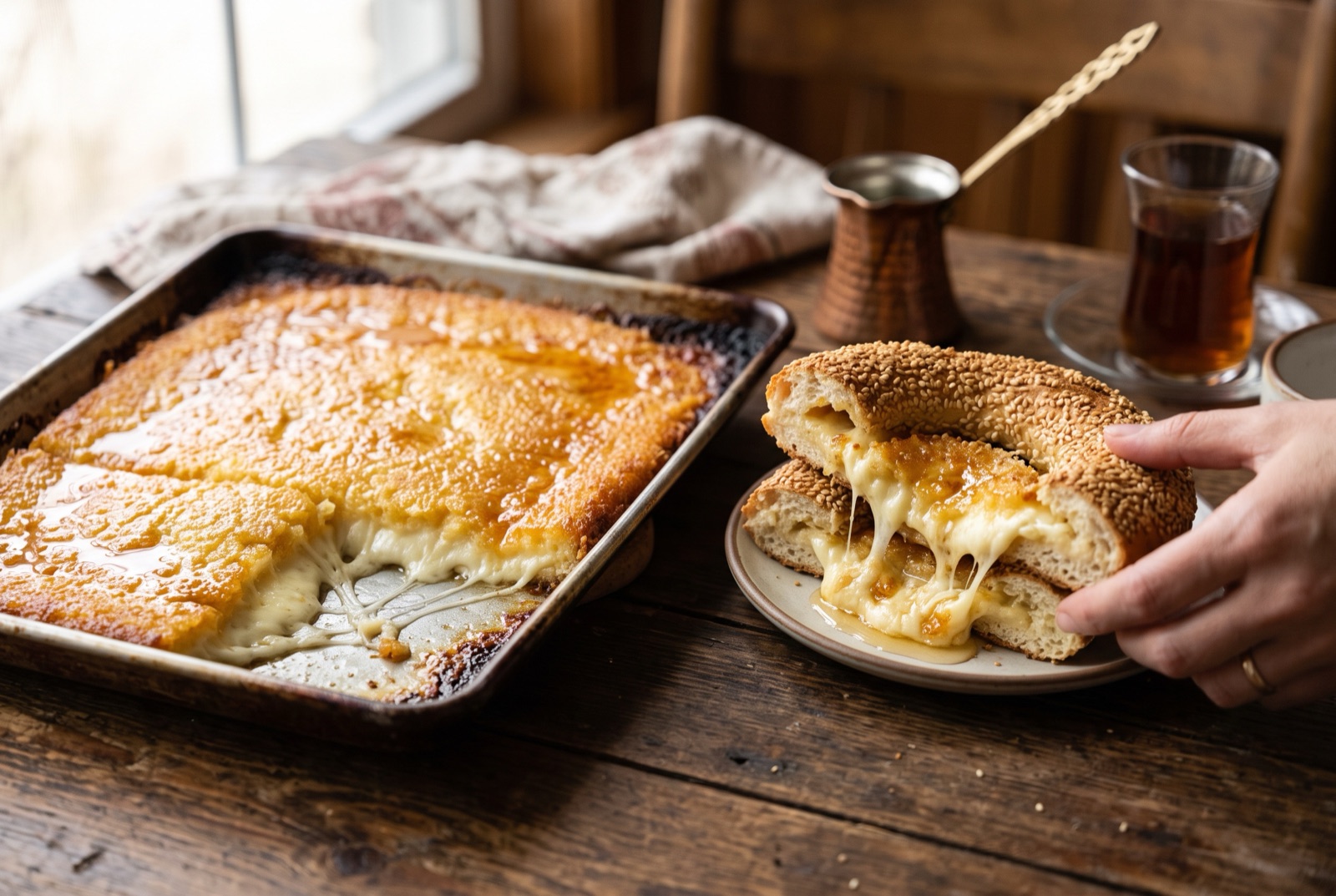
Knefeh is a hot cheese dessert: a layer of mild, unsalted white cheese baked under a golden semolina crust, turned out upside down and soaked in cool orange-blossom syrup while it is still molten. Cut into it and the cheese pulls in long threads; the crust stays sandy and buttery against it, and the syrup runs into every crack. The flavor is sweet but not cloying, because the cheese is deliberately bland and slightly salty and the syrup is perfumed rather than sugary. In Lebanon it is not an after-dinner sweet at all — it is breakfast, sold from morning shops and clamped inside a ring of sesame ka'ak bread to be eaten standing up with a glass of tea.

- Gate
- Lebanon
- Prep
- 25 min
- Cook
- 30 min
- Total time
- 1 hr 55 min incl. 1 hr rest
- Serves
- 6
- Status
- Medium
- Nutrition / serving · estimated
- Calories 620 kcal
- Protein 21 g
- Carbs 72 g
- Fat 28 g
- Fiber 2 g
- Sugar 48 g
- Sodium 640 mg
Why this recipe works.
- Uses supermarket cheese honestly: low-moisture mozzarella cut with ricotta gives the stretch and mildness of akkawi without a specialist shop.
- The syrup goes on cold onto hot pastry, which is the correct direction and the reason the crust drinks it in without turning soggy.
- A semolina crust worked with butter by hand, so it bakes sandy and separate rather than setting into a hard cake layer.
- Explains the desalting step for real akkawi properly, so the version with authentic cheese also works first time.
Ingredients.
15 itemsFor the syrup (ater)
For the cheese layer
For the crust
To finish
Equipment
- 26–28 cm round metal cake tin or shallow baking dish
- Pastry brush
- Small saucepan for the syrup
- Large flat serving plate for inverting
Instructions.
Make and chill the syrup
Bring the sugar, water and lemon juice to a boil, then simmer for 8 minutes until the syrup coats a spoon in a thin film and a drop rolls slowly off the back rather than running. Take it off the heat, stir in the orange blossom and rose water, and refrigerate until properly cold.
Tip The lemon juice stops the sugar crystallising as it cools. Do not add the blossom waters while the pan is boiling — the perfume evaporates straight off.
Prepare the cheese
Grate the mozzarella coarsely, press the ricotta in a sieve to shed any loose whey, then fold them together with your fingertips until evenly mixed. If you are using brined akkawi, soak it first in several changes of cold water for 4–8 hours, until a tasted corner is only faintly salty, then squeeze it dry.
Rub the crust together
Combine the semolina, sugar, salt and achiote in a bowl, pour over the melted ghee and rub it through with your fingertips until every grain is coated and the mixture feels like damp sand. Sprinkle in the warm milk and toss lightly — it should clump when squeezed but still fall apart, never form a dough.
Line the pan crust-side down
Brush the tin heavily with ghee, right up the sides. Tip in the semolina mixture and press it into an even layer across the base with the flat of your hand, firm enough to hold together but not compacted hard — this is the top of the finished knefeh, so keep the surface flat and level.
Add the cheese and bake
Spread the cheese over the crust in an even layer, leaving a 1 cm border clear so it does not weld to the tin, and press it down gently. Bake at 200°C for 25–30 minutes, until the edges bubble and the crust smells nutty and toasted — lift a corner with a knife and it should be deep golden brown against the pan.
Invert while molten
Run a knife around the edge, lay a large flat plate over the tin and flip the whole thing over in one confident movement. The browned semolina crust is now on top with the cheese stretching beneath it. Work fast — the flip must happen while the cheese is still fully melted.
Tip Wear oven gloves and commit. A hesitant flip is how knefeh ends up half in the tin.
Drench and serve
Ladle the cold syrup evenly over the hot pastry, starting at the center and working out, until it pools slightly at the base — the crust should hiss faintly as it drinks. Scatter the pistachios over the top, cut into wedges with a firm downward press, and serve immediately with extra syrup on the side.
Tips from our kitchen.
- Make the syrup first and refrigerate it. Cold syrup on hot knefeh soaks in cleanly; hot syrup on hot pastry makes a wet, heavy tray.
- If you can find akkawi or Nabulsi cheese, soak it in cold water for 4–8 hours, changing the water every hour or two, until a tasted corner is barely salty. Undersoaked cheese ruins the dessert; oversoaked cheese goes rubbery.
- Use low-moisture block mozzarella, not fresh mozzarella in brine. The wet kind releases a puddle of water under the crust.
- Grease the pan generously with ghee and, if you want the classic look, tint it with a pinch of achiote rather than food dye — the orange color comes through the crust as it bakes.
- Serve within fifteen minutes of leaving the oven. Once the cheese cools below stretching temperature the dish is finished, and reheating gives you a rubbery layer instead of threads.
- Cut with a firm downward press rather than a sawing motion, so the crust stays put instead of dragging across the cheese.
Substitutions.
- Akkawi cheese → 500 g low-moisture mozzarella + 150 g ricotta
- Mozzarella supplies the stretch, ricotta the soft milky body akkawi has. Middle Eastern grocers stock real akkawi in brine, and it is worth the detour if there is one near you.
- Coarse semolina crust → 300 g kataifi (shredded phyllo), tossed with melted ghee
- This makes knefeh khishneh instead — the rough-topped version, equally traditional. Rub the strands with ghee until every thread is coated, then press half under and half over the cheese.
- Orange blossom water → Rose water alone, or half of each
- Both are traditional and the balance is a matter of household preference. Add them off the heat — boiling drives the perfume straight out of the pan.
Variations.
- Knefeh khishneh
- The coarse version, topped with buttered kataifi strands instead of semolina, so the surface bakes into crisp golden threads over the melted cheese.
- Knefeh bi ka'ak
- The Lebanese breakfast form: a wedge slipped inside a sesame-crusted ka'ak bread and eaten by hand, with the bread absorbing the escaping syrup.
- Knefeh bil ashta
- Filled with ashta, the thick clotted milk cream, instead of cheese. Sweeter, softer and served in smaller portions — there is no cheese pull, by design.
Storage & reheating.
Knefeh does not keep, and pretending otherwise leads to disappointment. The cheese stretches once — after it cools and sets, reheating gives a rubbery, oily layer rather than threads. Eat it the day it is baked, ideally within the hour. What you can prepare ahead is the syrup, which keeps a month refrigerated in a sealed jar, and the crust mixture, which can be rubbed together and refrigerated for 2 days. Assemble and bake only when people are ready to eat.
Serve with
Sesame ka'ak bread for stuffing, extra syrup in a jug, and strong unsweetened tea or Arabic coffee to cut the sugar.
The story behind Knefeh.
Knefeh is one of those dishes with no clean birth certificate, and the claim is fought over across the whole eastern Mediterranean. The loudest and best-supported case belongs to Nablus in Palestine, where knafeh nabulsiyeh — made with the local sheep's-milk jibneh nabulsiyeh, tinted orange and topped with shredded kataifi pastry — is a civic identity as much as a food, produced in enormous trays and treated as the city's signature. Lebanon, Syria, Jordan, Egypt and Turkey all make their own versions with equal conviction, and Turkish künefe from Hatay, built between two layers of kataifi and cooked in a copper dish over direct heat, is protected as a regional specialty in its own right. Which came first is not something anyone can honestly settle.
The Lebanese branch splits into two textures worth knowing. Knefeh khishneh is the rough one, made with shredded kataifi strands over the cheese; knefeh na'ameh is the smooth one, where the topping is coarse semolina worked with butter into a fine sandy crust — that is the version below, and the one most associated with the Lebanese breakfast counter. Both use the same underlying trick: a cheese that melts into stretchy ropes without weeping oil or turning to rubber, traditionally akkawi from the coastal city of Acre, or the fresher, sweeter Nabulsi.
The eating ritual is as fixed as the recipe. A wedge is lifted onto a plate, the shop hands you a ka'ak — the sesame-crusted purse-handle bread sold on every corner — and the knefeh goes inside it, syrup and all, so the bread soaks up what escapes. Nobody eats it cold and nobody reheats it a second time; the cheese only stretches once. It appears at Ramadan, at weddings and at ordinary weekday mornings without changing character, which is a fair sign of how deep it sits in the routine.
Questions, answered.
What cheese is used for knefeh?
Traditionally akkawi, a mild white brined cheese from the Palestinian coastal city of Acre, or Nabulsi from Nablus. Both are salty from their brine and must be soaked in several changes of cold water before use. Outside the region, low-moisture block mozzarella mixed with ricotta is the closest widely available match: mozzarella provides the stretch, ricotta the soft milky texture.
Where does knefeh come from — Lebanon or Palestine?
It is genuinely contested. The best-documented claim is Nablus in Palestine, where knafeh nabulsiyeh is a civic emblem made with local sheep's-milk cheese. Lebanon, Syria, Jordan, Egypt and Turkey all have long-standing versions, and Turkish künefe from Hatay carries its own regional protection. There is no reliable evidence naming a single origin, so the fair answer is that knefeh is a shared eastern Mediterranean dessert with strong local variants.
Why is my knefeh swimming in liquid?
Almost always the cheese. Fresh mozzarella packed in brine or water releases a great deal of liquid as it melts, and undersoaked brined cheese does the same. Use low-moisture block mozzarella, pat any cheese dry before layering, and drain soaked akkawi thoroughly. Pouring hot syrup over the pastry instead of cold syrup will also flood it.
Can I make knefeh ahead of time?
Only in parts. The syrup keeps a month in the fridge and the buttered semolina crust mixture keeps 2 days, so assembly takes minutes when guests arrive. The baked dish itself cannot be made ahead — the cheese pull disappears permanently once it cools, and reheated knefeh is rubbery. Bake it when people are already at the table.
Why do I flip the knefeh out of the pan?
Because it is built upside down. The semolina crust goes into the bottom of the pan where it browns against the hot metal in ghee, with the cheese on top of it. Inverting onto a serving plate puts that browned crust where you want it — on top, catching the syrup — with the molten cheese underneath.
Is knefeh eaten hot or cold?
Hot, always, and soon. The whole point is the contrast between a warm sandy crust and cheese that stretches when you lift a piece, and that window lasts roughly fifteen minutes out of the oven. In Lebanon it is most often eaten at breakfast, straight from the shop, stuffed into a sesame ka'ak bread rather than served on a plate.
You might also like.
All recipes →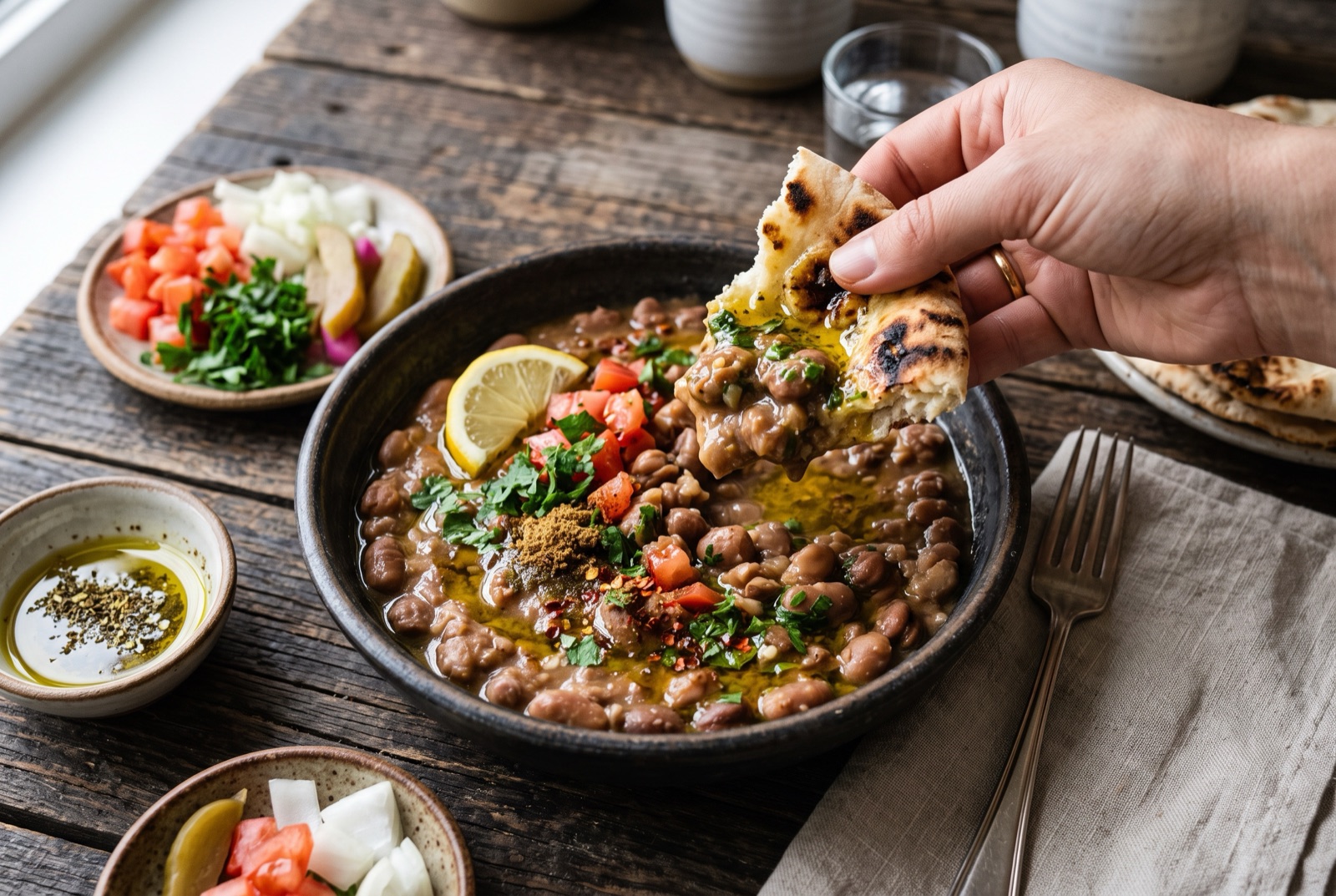
Keep exploring Lebanon.
Lebanon has 9 more dishes in the atlas — Foul Mudammas and Kafta bil Sanieh, and 7 more.
Recipe by The DishRoute Kitchen · published August 19, 2026 · updated August 19, 2026