Manakish Za'atar.
Lebanese Za'atar Flatbread
مناقيش بالزعتر · Manaqish bi za'atar · say it: mah-NAA-eesh bee ZAH-tar
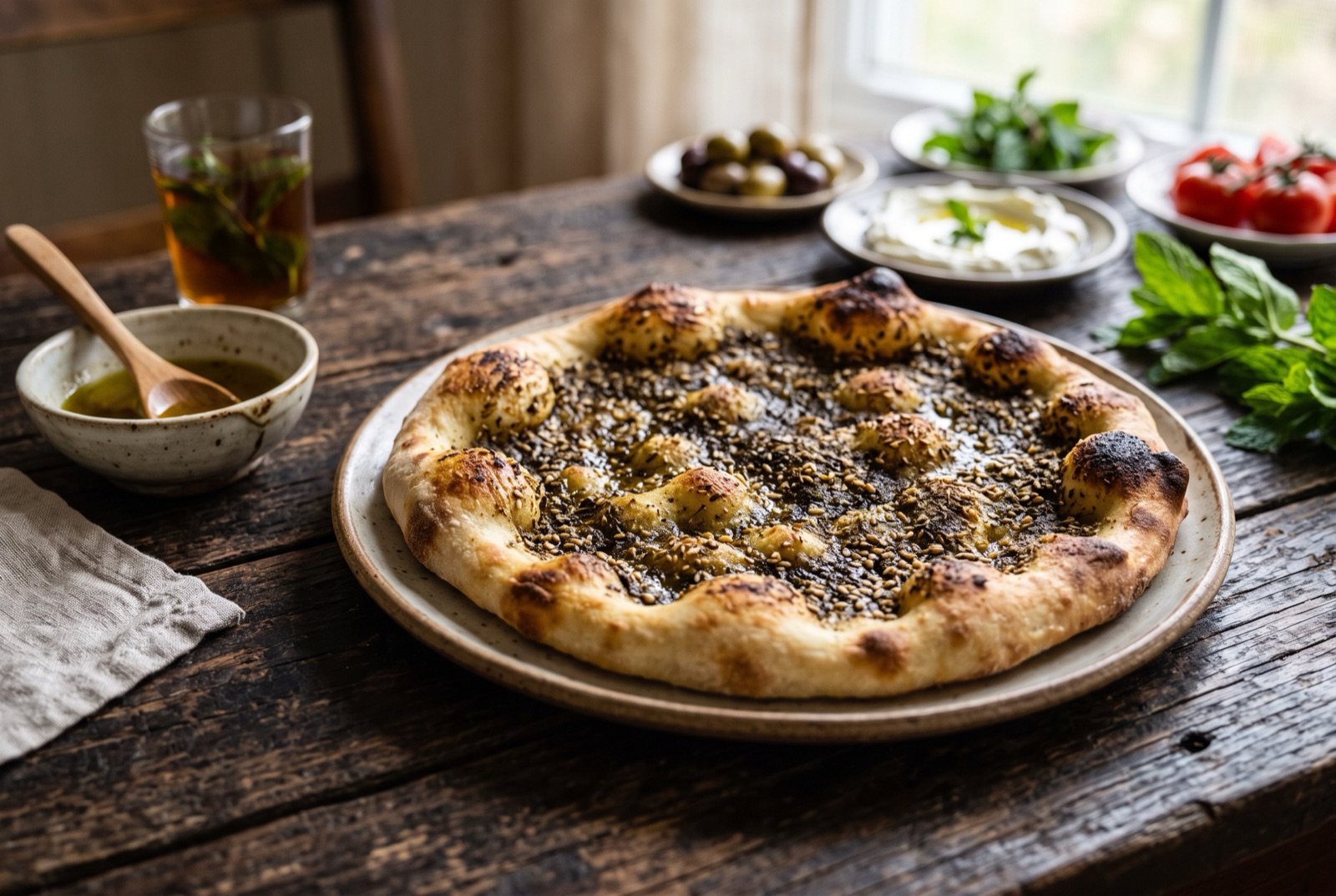
Manakish is a soft flatbread wearing a coat of za'atar. The dough is an easy, well-oiled bread dough; the topping is nothing more than the dried herb blend loosened with enough olive oil to spread like paint. In a screaming oven it takes six or seven minutes: the base stays pliable and slightly chewy, the rim puffs and freckles brown, and the za'atar goes from dusty to fragrant, tasting green, sour from sumac and toasty from sesame. Lebanese people eat it hot from the bakery in the morning, folded in half around cucumber, tomato and mint, or plain with sweet tea. The name comes from naqasha, to engrave — the fingertip dimples that stop the middle from ballooning.

- Gate
- LebanonBeirut and Mount Lebanon bakeries
- Prep
- 25 min
- Cook
- 20 min
- Total time
- 2 hr 15 min incl. 1 hr 30 min rest
- Serves
- 4
- Status
- Medium
- Nutrition / serving · estimated
- Calories 470 kcal
- Protein 10 g
- Carbs 60 g
- Fat 21 g
- Fiber 4 g
- Sodium 760 mg
Why this recipe works.
- A 65 percent hydration dough with olive oil in it, so the base stays soft for hours instead of turning to cracker.
- The correct za'atar-to-oil ratio: a spreadable slurry, not a dry dusting that burns and not a puddle that slides off.
- Stretched by hand and dimpled, so the middle stays flat and the rim puffs — the shape that defines a real manoushe.
- Written for a domestic oven at its maximum, with the preheated-steel workaround for the heat a bakery oven has and yours does not.
Ingredients.
9 itemsFor the dough
For the topping
To serve
Equipment
- Baking steel, pizza stone or heavy upturned tray
- Large mixing bowl
- Bench scraper
Instructions.
Mix the dough
Whisk the flour, yeast, sugar and salt in a large bowl. Pour in the warm water and olive oil and stir with a spoon until no dry flour remains and you have a shaggy, sticky mass. Leave it 10 minutes to hydrate before touching it again — this alone does a third of the kneading for you.
Knead until smooth
Turn the dough onto a lightly oiled surface and knead for 8–10 minutes, until it stops tearing, feels satiny under your palm and springs back slowly when pressed. Round it, drop it into an oiled bowl and cover.
First rise
Leave the dough somewhere warm for 60–90 minutes, until roughly doubled and domed, with a webbed structure visible when you peel back an edge. Meanwhile, stir the za'atar and olive oil into a loose, spreadable paste and leave it to sit.
Tip The za'atar paste should slump slowly off a spoon. If it stands up in a mound, add more oil.
Preheat hard
Put a baking steel, stone or upturned heavy tray on the upper-middle shelf and heat the oven to its maximum, 250–275°C, for at least 45 minutes. This is not optional; a cooler oven gives pale, tough manakish.
Divide and stretch
Knock the dough back and divide it into 8 pieces, rounding each one and resting them under a cloth for 10 minutes. Working with one at a time on a lightly floured surface, press and stretch it by hand into a round about 20 cm across and 5 mm thick, then dimple it firmly all over with your fingertips, leaving a 1 cm rim untouched.
Top and bake
Spread a generous tablespoon of the za'atar paste over each round, right to the dimpled edge, and slide it onto the hot surface. Bake 6–8 minutes, until the rim is puffed with brown freckles, the underside is spotted and dry, and the topping smells green and toasted rather than raw. Bake one or two at a time.
Stack and serve
Slide each bread onto a plate and cover the growing stack with a clean cloth so they steam gently and stay foldable. Eat hot, folded around cucumber, tomato and mint if you want the full breakfast version.
Tips from our kitchen.
- Get the oven and a steel or stone as hot as they physically go, at least 45 minutes of preheating. Manakish is ruined by slow baking.
- Mix the za'atar with oil at least 10 minutes before use so the herb hydrates; a fresh mix tastes dusty and scorches faster.
- Dimple the dough hard with your fingertips over the whole surface except a 1 cm rim. Undimpled dough inflates into a balloon.
- Stretch, do not roll. A rolling pin flattens the gas out of the rim and gives you a stiff, uniform disc instead of a bread.
- Bake one at a time on the hottest surface you have. Two on a tray means neither gets full heat and both go pale.
- Stack the finished breads on a plate under a clean cloth. The trapped steam keeps them soft and foldable.
Substitutions.
- Za'atar blend → 3 tbsp dried thyme + 2 tbsp toasted sesame seeds + 1½ tbsp ground sumac + ½ tsp salt
- A workable home blend if you cannot buy za'atar. It will not have the wild hyssop note of a good Levantine mix, but it is far better than plain thyme.
- Baking steel or stone → An upturned heavy baking tray, preheated for 45 minutes
- Less thermal mass so the base browns less, but it works. What does not work is a cold tray slid into a hot oven.
- Instant yeast → 20 g fresh yeast, or 9 g active dried yeast bloomed in the warm water for 10 minutes
- Same result, slightly different timing. Active dried needs the blooming step or it never fully wakes up.
Variations.
- Manakish jibneh
- The cheese version: shredded akkawi soaked to remove salt, or a mix of mozzarella and a little feta, spread to the rim and baked until it bubbles and browns in patches.
- Cocktail
- Half za'atar, half cheese on the same round — the compromise ordered by anyone who cannot decide, and by most children in Lebanon.
- Manakish kishk
- Topped with kishk, a powder of bulgur fermented in yogurt, mixed with onion, tomato and oil. Sour, funky and much loved in the mountains; an acquired taste elsewhere.
Storage & reheating.
Manakish is at its best within the hour and noticeably duller the next day. Keep leftovers wrapped at room temperature for a day and revive them for 3 minutes in a hot oven, never a microwave, which makes them leathery. The shaped, untopped dough rounds freeze well between sheets of paper for a month; thaw, top and bake as usual. You can also refrigerate the dough after its first rise for up to 48 hours, which improves the flavour — bring it back to room temperature for an hour before shaping.
Serve with
Sliced cucumber, tomato, olives, fresh mint and spring onion tucked inside and folded over — the standard Lebanese breakfast fold, with sweet black tea.
The story behind Manakish Za'atar.
The manoushe is the anchor of the Lebanese morning. Every neighbourhood has a furn, a bakery with a wide oven, and from around six in the morning it produces trays of flatbreads to order: za'atar, cheese, a mix of the two called cocktail, spiced lamb sfiha, or the pungent red kishk made from fermented bulgur and yogurt. Customers stand and wait, and the bread is folded in paper and eaten walking. The bakery also runs as an oven-for-hire — people bring their own trays of food to be baked, a habit that long outlived the absence of home ovens.
Za'atar itself is two things at once, and confusing them causes a lot of disappointment. It is a wild herb — a hyssop and thyme relative that grows across the Levantine hills and is protected as a wild-picked plant in some places — and it is also the blend built from that dried herb with sumac, toasted sesame seeds and salt. Blends vary sharply: some are heavy with sumac and almost purple, some are green and herb-dominated, Palestinian mixes often lean on more sesame, and Jordanian ones can be earthier. Lebanese households frequently buy from one specific supplier and stay loyal for decades.
Manakish is Levantine rather than exclusively Lebanese — Syria, Palestine and Jordan all have their own morning flatbread cultures and would not accept a Lebanese monopoly on it. Lebanon's contribution is scale and export: the manoushe is the item that Lebanese bakeries abroad open with, and it has become a shorthand for Lebanese breakfast in the same way that a croissant stands in for France. It is also honest, cheap food — flour, oil, herbs — which is part of why it survived every economic collapse the country has been through.
Questions, answered.
What exactly is za'atar?
Two things. Za'atar is the name of a wild Levantine herb related to hyssop, oregano and thyme, and it is also the name of the blend made from that dried herb with ground sumac, toasted sesame seeds and salt. When a recipe says za'atar it almost always means the blend. Mixes differ a lot between families and countries, so if you dislike one brand, try another before deciding you dislike za'atar.
Why did my manoushe puff up into a hollow balloon?
You did not dimple it enough. Press your fingertips firmly all over the surface, leaving only a narrow rim untouched, so the trapped steam has nowhere to lift a single dome. Rolling the dough too thin also encourages ballooning, because a thin, even sheet inflates more readily than a slightly irregular hand-stretched one.
Why is my za'atar topping bitter or burnt?
Either the mix was too dry or the bake was too long. Za'atar contains sesame seeds, which scorch quickly, so it needs enough olive oil to form a loose paste that protects the herb. Bake hot and fast — six to eight minutes at maximum heat — rather than at a moderate temperature for fifteen, which dries the topping out before the bread is done.
Can I make manakish in a frying pan?
Yes, and it is a decent workaround. Heat a heavy dry pan over medium-high, lay the topped dough in it, cover with a lid for 3 to 4 minutes until the base is spotted brown, then finish under a hot grill for a minute to set the top. The rim will not puff as dramatically as in an oven, but the bread is soft and the za'atar cooks properly.
Is manakish Lebanese or Syrian or Palestinian?
It is Levantine, and all of those countries make it as part of everyday bakery culture. There is no meaningful case for a single national inventor of flatbread topped with a local herb blend. Lebanon is the country whose bakeries exported the manoushe most widely, which is why it is best known internationally as a Lebanese item.
You might also like.
All recipes →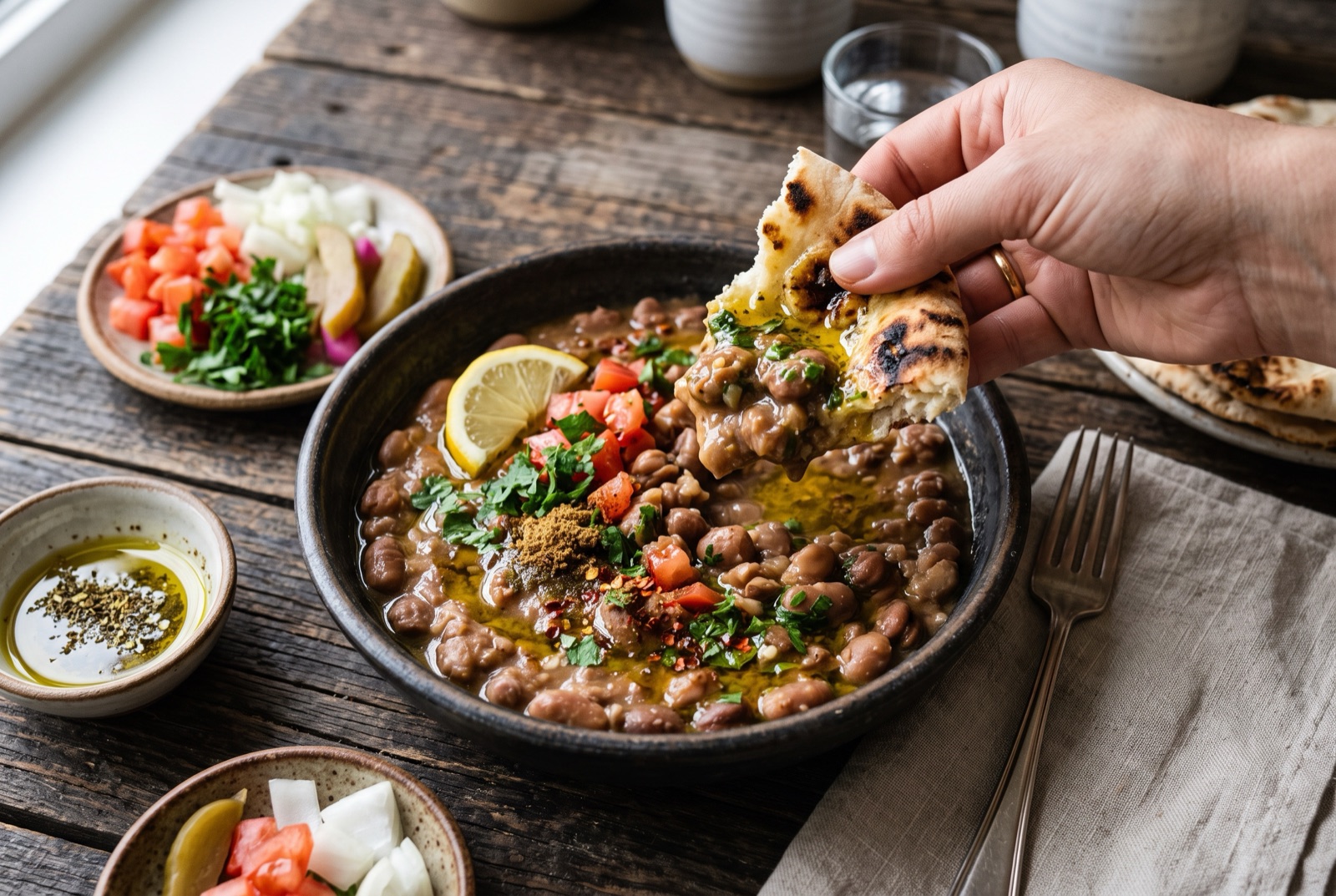
Keep exploring Lebanon.
Lebanon has 9 more dishes in the atlas — Foul Mudammas and Kafta bil Sanieh, and 7 more.
All Lebanon recipes Flour recipes Olive oil recipes Thyme recipes breadbreakfaststreet foodvegetarianvegandairy freeRecipe by The DishRoute Kitchen · published August 19, 2026 · updated August 19, 2026