Haleem.
Wheat, Barley and Shredded Beef Porridge
حلیم · Haleem · say it: huh-LEEM
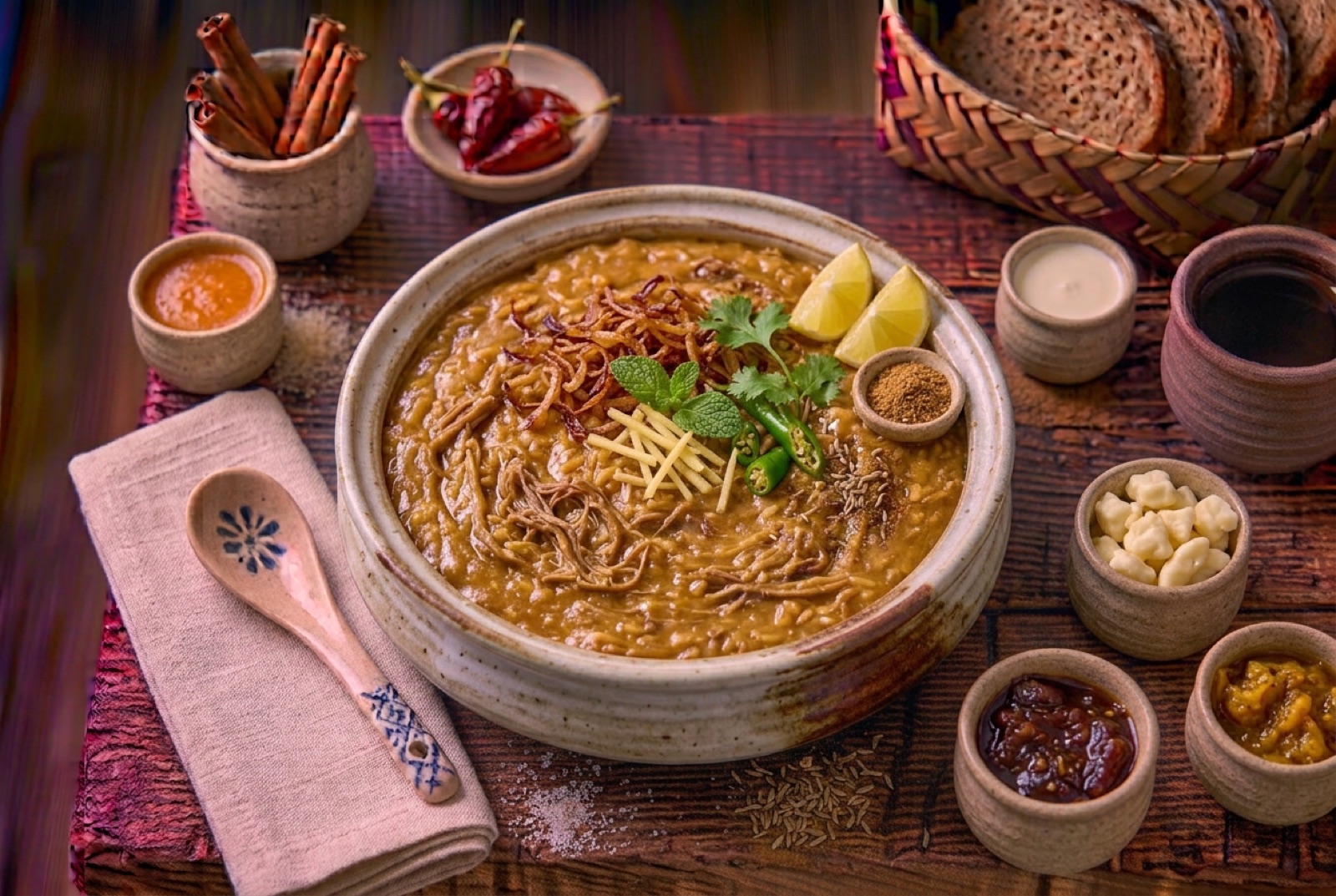
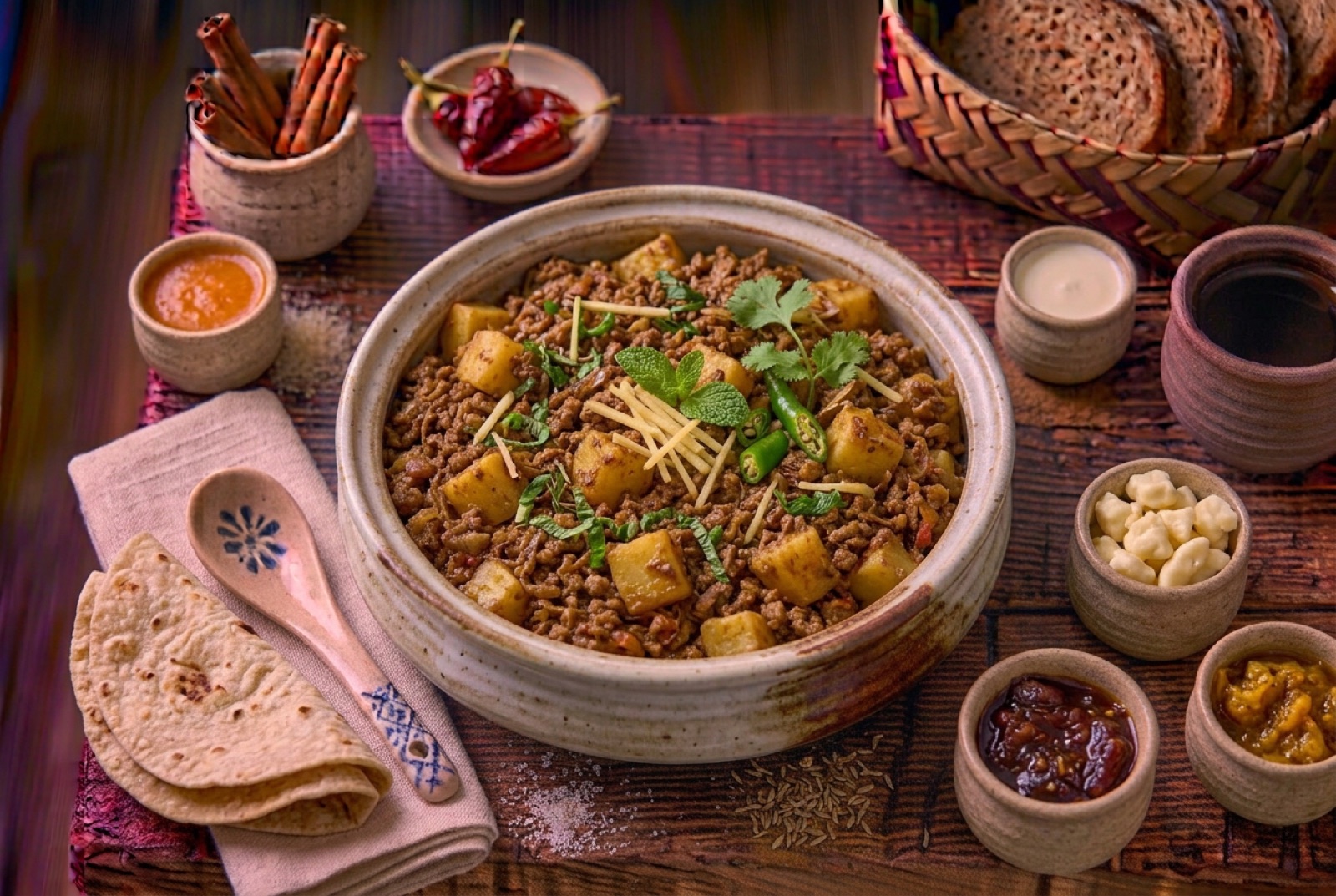
Haleem is a savoury porridge in which cracked wheat, barley and several kinds of lentil are cooked to collapse alongside slow-braised beef, and then beaten hard with a wooden masher until nothing in the pot is recognisable any more. Done properly it pulls in strands when you lift the spoon, holds its shape briefly on the plate and then slumps. The taste is mild, wheaty and deeply meaty rather than hot, which is why it always arrives buried under fried onions, ginger matchsticks, green chile, cilantro, chaat masala and lemon. It is the food of Ramadan evenings, the thing that goes in first after a day without water.

- Gate
- PakistanKarachi and Hyderabad, Sindh
- Prep
- 30 min
- Cook
- 4 hr 30 min
- Total time
- 13 hr incl. 8 hr rest
- Serves
- 8
- Status
- Takes skill
- Nutrition / serving · estimated
- Calories 540 kcal
- Protein 34 g
- Carbs 48 g
- Fat 24 g
- Fiber 9 g
- Sodium 760 mg
Why this recipe works.
- Uses the full grain and lentil mix rather than a shortcut single dal, which is where the texture actually comes from.
- Spells out how far past soft the grains must go, and how to tell when the beating is finished.
- Cooks the meat separately so it can be shredded properly instead of hiding in half-cooked chunks.
- Gives realistic timings for a home pot and a pressure-cooker route for a weeknight.
Ingredients.
21 itemsFor the grains
For the meat
To serve
Equipment
- Very large heavy pot
- Second pot for the meat
- Wooden masher, pestle or sturdy potato masher
- Slotted spoon
Instructions.
Cook the grains down
Drain the soaked wheat, barley and all the lentils, put them in a large pot with two litres of water and a good pinch of salt, and simmer covered for about 2 hours. Stir every 20 minutes and top up with hot water when the surface looks dry.
Tip They are done when you can smear a grain flat between two fingers with no resistance at all, not when they merely taste cooked.
Fry the onions
While the grains cook, melt the ghee in a second pot and fry the sliced onions over medium heat for 20 to 25 minutes, until deep amber and crisp. Lift out half onto paper for the garnish and leave the rest, with all the ghee, in the pot.
Braise the beef
Add the ginger and garlic paste to the onions and ghee, fry for a minute, then add the beef and brown it. Stir in the chile powder, turmeric and coriander, then the whisked yogurt off the heat. Return to the heat, add a litre of water, cover and simmer for 2 hours until the meat pulls apart with two forks.
Shred the meat
Lift the beef out while it is still hot and shred it along the grain into hair-fine threads using two forks or your fingers. Keep every drop of the gravy left in the pot — that is where the spice lives.
Combine and beat
Tip the collapsed grains into the meat gravy, add the shredded beef and the garam masala, and start crushing everything against the side of the pot with a wooden masher. Work for 20 to 30 minutes over low heat, adding hot water whenever it stiffens.
Tip The moment to stop is when you can no longer identify a single lentil and a spoonful lifted from the pot pulls away in strands.
Finish and check
Simmer another 20 minutes, stirring often so the bottom does not catch, until a slick of ghee separates and sits on the surface. Adjust the salt and loosen with hot water until a spoonful slumps slowly rather than holding its shape.
Load the bowls
Ladle into bowls and top each with the reserved fried onions, ginger matchsticks, green chile, cilantro, a pinch of chaat masala and a hard squeeze of lemon. Serve with hot naan and let everyone re-season as they eat.
Tips from our kitchen.
- Soak the cracked wheat and barley overnight and the lentils for at least four hours. Unsoaked grain will still be gritty long after the meat has gone to pieces.
- Shred the beef while it is still warm, pulling it along the grain into hair-fine threads. Cold meat tears into chunks that never break down in the pot.
- Beat the mixture against the side of the pot with a wooden masher or the end of a rolling pin, not with a whisk. You are crushing grain, not aerating it.
- Blend with an immersion blender only in short bursts if at all. Over-blending gives a smooth baby-food texture and kills the strands that define haleem.
- Keep a kettle of hot water beside the pot. Haleem thickens fast at the end and stiff haleem tastes stodgy; it should slump slowly off a tilted spoon.
- Fry double the onions you think you need. Half go into the pot and half go on top, and the fried onion on top is not a garnish but a main flavour.
Substitutions.
- Cracked wheat (dalia) → Pearl barley increased to make up the weight, or coarse bulgur
- Bulgur is pre-steamed so it collapses much faster — soak it only briefly and add it an hour later than the recipe says, or it turns to gruel.
- Beef chuck → Boneless lamb shoulder or bone-in goat
- Lamb haleem is common in Punjab and slightly sweeter. If using bone-in meat, cook it whole and pick the bones out before shredding.
- Four separate lentils → Any two of chana dal, red lentils and split mung
- Chana dal is the one to keep whatever else you drop — it holds shape longest and gives the finished haleem its body rather than its softness.
Variations.
- Daleem
- The Karachi street version, looser and more lentil-forward, sold by weight from vats and beaten thinner so it can be eaten with naan rather than a spoon.
- Chicken haleem
- A faster home version using boneless chicken thighs added in the last hour. Lighter and less gelatinous, and it needs an extra spoon of ghee to compensate.
- Vegetarian haleem
- Meat replaced with extra chana dal and shredded jackfruit or mushrooms for fibre. Not traditional in Pakistan, but the grain technique and garnish carry it.
Storage & reheating.
Haleem keeps four days refrigerated and sets almost solid when cold — you should be able to stand a spoon in it. Reheat with a generous splash of hot water, breaking it up over low heat and stirring until it loosens back to a slow-falling consistency, then check the salt, which always needs a lift after chilling. It freezes very well for three months in portions. Add the fried onions and fresh garnishes only at the moment of serving; frozen and reheated garnishes go soft and taste of nothing.
Serve with
Naan or plain roti, with bowls of fried onion, ginger matchsticks, green chile, cilantro, chaat masala and lemon wedges so every spoonful can be re-seasoned.
The story behind Haleem.
Haleem descends from harees, an Arabian dish of wheat and meat pounded to a paste that is still cooked from Oman to the Gulf and appears in some of the oldest surviving Arabic cookbooks. It travelled east with Arab traders and Muslim rule, picked up lentils, ginger and a full garam masala in the Deccan, and emerged as haleem — a dish that keeps the technique of the original and almost none of its plainness. Hyderabad in India remains the most famous haleem city, but Karachi and the Sindhi city of Hyderabad make it in enormous quantities and the version below sits in that Pakistani tradition.
Its association with Ramadan is not sentimental, it is practical. A bowl of haleem delivers slow-releasing wheat starch, lentil protein and meat fat in a form that requires almost no chewing, which is exactly what a body wants at iftar after a fifteen-hour fast. During the month, dedicated haleem stalls appear on street corners across Pakistani cities, stirring vats with wooden paddles the length of an oar, and it is also cooked in vast batches for Muharram and distributed free as niyaz.
What divides good haleem from mediocre haleem is the beating. The grains and lentils must go past soft into complete structural collapse, and the meat must be shredded so finely that it disappears into the mass. The Urdu word cooks use is ghotna, to pound or churn, and it is done with a wooden masher called a ghotni against the side of the pot for a long time. A haleem you can see individual lentils in has simply not been beaten enough. The other test is the surface: correctly made, a slick of ghee separates and sits on top, and the pot smells of fried onion before it smells of spice.
Questions, answered.
Why is my haleem grainy instead of smooth and stringy?
The grains have not gone far enough. Cracked wheat and barley need to cook well past the point where they seem done, until the individual grains have lost their shape entirely, which can take four hours in an open pot. Insufficient soaking is the usual cause, followed by not beating the mixture long enough at the end. Ten more minutes of hard mashing against the side of the pot often fixes what looks like a failed batch.
Can I make haleem in a pressure cooker?
Yes, and it is the normal weeknight method in Pakistan. Pressure-cook the soaked grains and lentils with water for about 25 minutes at full pressure and the meat separately for around 40 minutes. Then combine, and still give it the full open-pot beating and simmer, because pressure softens the grain but does not break it down into the paste that defines the dish.
Why is haleem eaten during Ramadan?
Because it suits the moment. After a full day without food or water, haleem provides slow-digesting wheat starch, lentil protein and meat fat in a soft form that is easy on an empty stomach and does not need chewing. It also scales enormously well, which matters when mosques and stalls are feeding hundreds at iftar. During Ramadan, haleem vats appear on street corners across Pakistani cities from late afternoon.
What is the difference between haleem and harees?
Harees, still cooked across the Arabian Peninsula, is the older and much plainer dish: wheat and meat pounded together with little more than salt and ghee. Haleem is what happened when harees reached South Asia and gained lentils, browned onions, ginger, garlic and a full garam masala, along with the loaded garnish plate. Same technique, an entirely different flavour.
Do I need a wooden masher to make haleem?
No, but you need something blunt and sturdy. The traditional ghotni is a wooden pestle with a flat end, used to crush the grains against the side of the pot. The end of a wooden rolling pin, a sturdy potato masher or a wooden spoon pressed hard all work. What does not work well is a blender, which gives a uniformly smooth paste instead of the stringy, uneven texture haleem should have.
You might also like.
All recipes →
Keep exploring Pakistan.
Pakistan has 9 more dishes in the atlas — Balochi Sajji and Chana Chaat, and 7 more.
All Pakistan recipes Beef chuck recipes Lentils recipes Pearl barley recipes mainhalal friendlydairy freeRecipe by The DishRoute Kitchen · published August 20, 2026 · updated August 20, 2026