Okonomiyaki.
Osaka Savory Cabbage Pancake
お好み焼き · Okonomiyaki · say it: oh-koh-noh-mee-YAH-kee
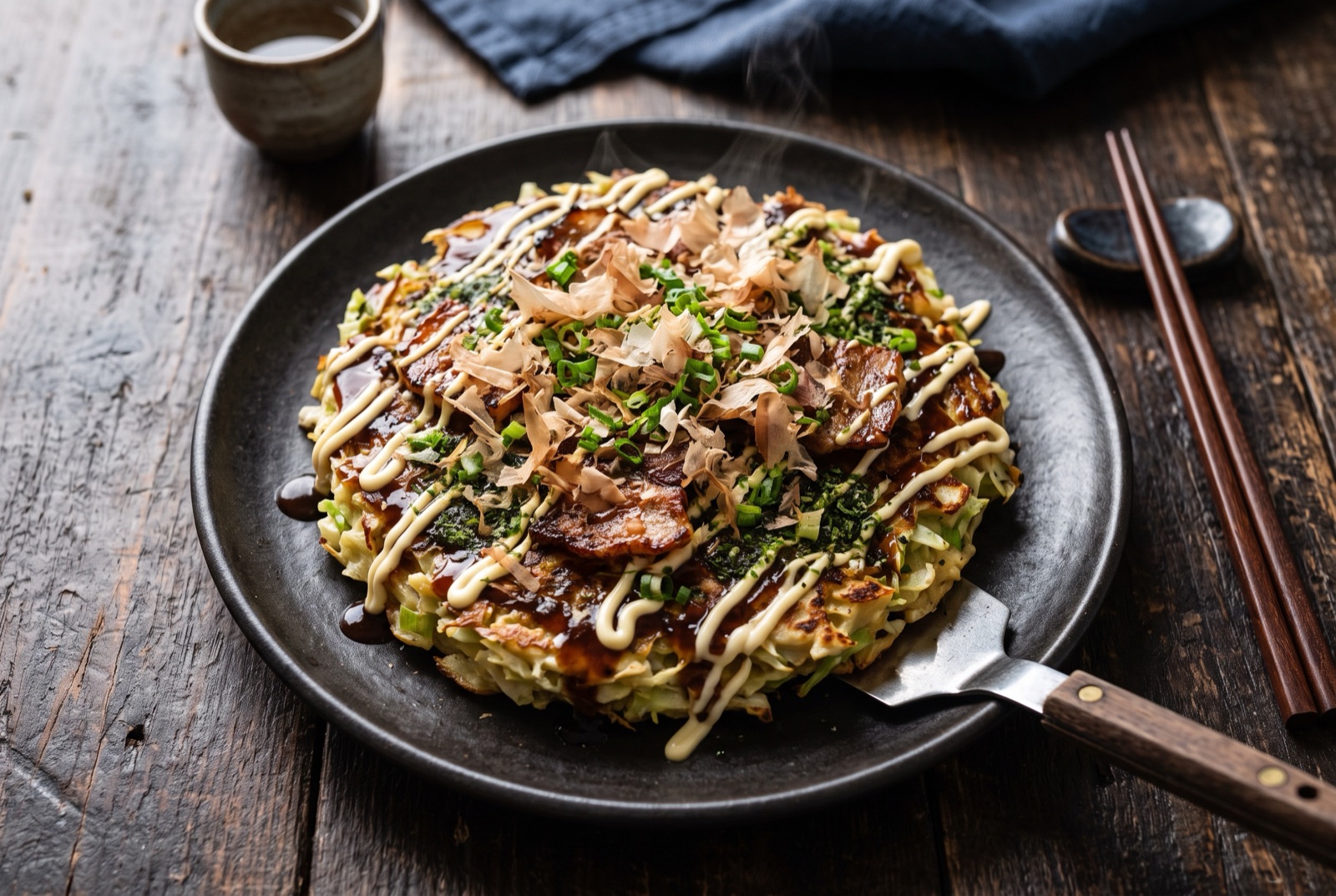
Okonomiyaki is a fat, savory pancake in which the batter is barely a supporting act — the bulk of it is finely shredded cabbage, held together by just enough dashi-seasoned flour and egg to keep the disc intact on the griddle. The cabbage half-steams inside while the outside browns, so the texture runs from crisp edge to sweet, juicy middle. On top go four things that make it unmistakable: dark, fruity okonomi sauce, thin ribbons of Japanese mayonnaise, a dusting of green aonori seaweed, and bonito flakes that curl and wave in the rising heat. It is Osaka food at its most direct: cheap, filling, cooked in front of you, and endlessly adjustable.

- Gate
- JapanKansai (Osaka)
- Prep
- 25 min
- Cook
- 30 min
- Total time
- 55 min
- Serves
- 4
- Status
- Medium
- Nutrition / serving · estimated
- Calories 520 kcal
- Protein 21 g
- Carbs 49 g
- Fat 27 g
- Fiber 5 g
- Sugar 9 g
- Sodium 1100 mg
Why this recipe works.
- Dashi in the batter, not just water — the pancake tastes seasoned all the way through instead of only on top.
- Cabbage cut fine and folded in at the last moment, so it stays sweet and juicy rather than weeping into the batter.
- A homemade okonomi sauce from four pantry bottles, for when the Otafuku bottle is not in reach.
- Honest heat management: how to cook a 2 cm thick pancake through without scorching the outside, on a normal home pan.
Ingredients.
16 itemsFor the dashi
For the batter
For the pancakes
To finish
Equipment
- Large non-stick or cast-iron frying pan (24–26 cm)
- Two wide spatulas
- Large mixing bowl
- Sharp knife for shredding cabbage
Instructions.
Make a quick dashi
Soak the kombu in 250 ml cold water for 20 minutes, then heat until small bubbles cling to the pan sides and the water smells faintly of the sea — lift the kombu out before it boils. Add the bonito flakes, take the pan off the heat, wait 2 minutes until the flakes sink, and strain. Cool to room temperature.
Tip Boiling kombu makes the stock slippery and bitter. Pull it the moment the water is about to bubble.
Mix the batter base
Whisk the flour, salt and cooled dashi in a large bowl until smooth and about as thick as pancake batter, then whisk in the eggs and the grated nagaimo if using. Rest it in the fridge for 20 minutes so the flour hydrates and the batter loses its raw floury smell.
Prep the cabbage
Shred the cabbage into fine 3–5 mm ribbons, discarding the thick core, and toss it with the sliced scallions. Keep it in a separate bowl — do not add it to the batter yet, or it will start weeping water.
Combine and portion
Heat the pan over medium-low with a film of oil. Only now fold a quarter of the cabbage into a quarter of the batter, lifting and turning until every shred is coated in a thin film — the mix should look like cabbage barely held together, not cabbage swimming in liquid.
Cook the first side
Mound the mixture into the pan and shape it into a disc about 18 cm across and 2 cm thick without pressing down. Lay slices of pork belly flat over the top, cover, and cook 5–6 minutes until the underside is deep golden and the edges have set and stopped looking wet.
Tip Resist flattening it. The air trapped between cabbage shreds is what keeps the middle light.
Flip and finish
Slide two spatulas under the pancake and turn it in one decisive movement so the pork lands against the pan. Cook uncovered 5–6 minutes more, until the pork is crisp at the edges and a skewer pushed into the centre comes out hot and clean rather than sticky.
Dress and serve
Turn the pancake pork-side up onto a plate. Brush over the okonomi sauce, zigzag the mayonnaise across it, and shower with aonori and a generous handful of bonito flakes so they curl in the steam. Add pickled ginger, cut into wedges and eat immediately, then repeat with the remaining batter and cabbage.
Tips from our kitchen.
- Shred the cabbage fine, around 3–5 mm, and cut it rather than grating it — grated cabbage releases water and turns the batter soupy.
- Mix the cabbage into the batter only when the pan is already hot. Batter left sitting on salted cabbage draws out liquid and the pancake will not hold together.
- Do not press the pancake down with the spatula. Squeezing collapses the steam pockets that keep the middle light, and you get a dense wheat disc.
- Medium-low heat for most of the cook. High heat browns the outside in three minutes while the centre stays raw and gluey.
- Nagaimo (grated mountain yam) is the classic secret for a fluffy interior — if you can find it, grate 3 tablespoons into the batter; without it the pancake is slightly denser but still very good.
- Flip once, confidently, with two spatulas or a plate. Repeated flipping tears the crust that holds everything together.
Substitutions.
- Okonomi sauce → 3 tbsp ketchup + 2 tbsp Worcestershire sauce + 1 tbsp oyster sauce + 1 tsp sugar
- Whisked together this lands close: sweet, tangy and dark. Bottled Otafuku sauce is thicker and more fruity from dates and apple, and is worth buying if a Japanese grocer is nearby.
- Japanese (Kewpie) mayonnaise → Regular mayonnaise loosened with a squeeze of rice vinegar and a pinch of sugar
- Kewpie is made with egg yolks only and rice vinegar, so it is richer and sharper. The tweak gets you most of the way there.
- Thin-sliced pork belly → Streaky bacon, thin-sliced pork shoulder, or peeled shrimp
- Bacon adds smoke that is not traditional but works. For a seafood version, scatter small shrimp or squid rings into the batter instead.
- Bonito flakes and dashi → Kombu-only dashi and extra aonori
- Makes the pancake vegetarian if you also skip the pork. Add a few dried shiitake to the soaking kombu for more depth.
Variations.
- Hiroshima-yaki
- Layered rather than mixed: a thin crepe, a heap of cabbage and sprouts, pork, a nest of fried yakisoba noodles, and a fried egg slid underneath before flipping the whole stack.
- Negiyaki
- The Osaka cousin made with a mountain of sliced scallions in place of cabbage, cooked thinner and usually served with soy sauce and citrus rather than sweet sauce.
- Modan-yaki
- Standard Osaka okonomiyaki with a portion of cooked yakisoba noodles pressed onto the pancake before flipping — heavier, and the usual order for a hungry table.
Storage & reheating.
Cooked okonomiyaki keeps 2 days refrigerated, undressed — add sauce, mayonnaise and flakes only when serving, since they go soggy overnight. Reheat in a dry pan over medium-low for 3–4 minutes per side, or in a 180°C oven for 10 minutes; the microwave turns the crust rubbery. The batter base can be made and chilled a few hours ahead, but keep the cabbage separate and fold it in just before cooking.
Serve with
Cold beer or barley tea, and a bowl of miso soup on the side to cut the richness of the sauce and mayonnaise.
The story behind Okonomiyaki.
The name says a lot: okonomi means "what you like" and yaki means "grilled", and the dish is built around that permission. Its ancestors are the thin wheat-flour crepes cooked on hot plates in Japan for centuries, but the pancake as it exists now took shape in the twentieth century, and firmly during and after the Second World War, when rice was scarce and wheat flour arrived as relief supply. A cabbage-heavy batter stretched a little flour into a meal, and the stalls that fed working neighbourhoods with it became the okonomiyaki-ya of today.
Two cities argue about the right way to make it. Osaka, in Kansai, mixes everything together — cabbage, batter, egg — and cooks a single mounded disc, which is the version most people outside Japan meet and the one below. Hiroshima builds instead: a paper-thin crepe first, then a mountain of cabbage, then bean sprouts, pork, a nest of fried yakisoba noodles, and an egg fried and slid underneath the whole tower. Hiroshima cooks will point out that theirs takes real skill with two spatulas; Osaka cooks will point out that theirs actually tastes of cabbage. Both are correct, and the rivalry is friendly enough to be a tourism slogan in both cities.
What has not changed is the setting. Many okonomiyaki restaurants seat you at a counter built around a teppan, the flat steel griddle, and either cook in front of you or hand you the bowl and let you do it yourself while you drink beer. The sauce bottles, mayonnaise squeezers and shakers of aonori sit on the table like condiments at a diner. It is not ceremonial food and was never meant to be — it is the dish you eat with friends when nobody wants to decide on anything more complicated.
Questions, answered.
Why did my okonomiyaki fall apart when I flipped it?
Almost always too much liquid or too little cooking on the first side. The batter should be thick enough to coat the cabbage like a heavy paste, not pour. Let the first side cook a full 5–6 minutes until the edge looks set and dry and a spatula slid underneath lifts the whole disc as one piece before you attempt the flip.
What is the difference between Osaka and Hiroshima okonomiyaki?
Osaka-style mixes cabbage, batter and egg in a bowl and cooks one thick pancake. Hiroshima-style layers the ingredients on the griddle instead — thin crepe, cabbage, sprouts, pork, fried noodles and a separate fried egg — building a tall stack that is flipped as a unit. Hiroshima versions almost always include yakisoba noodles; Osaka ones only do when you order modan-yaki.
Do I need nagaimo mountain yam?
No, but it changes the texture. Grated nagaimo makes the interior noticeably lighter and slightly custardy, which is what restaurant okonomiyaki tastes like. Without it the pancake is a little denser and more bready — still good, and most home cooks outside Japan make it this way.
Can I make okonomiyaki vegetarian?
Yes. Leave out the pork and make the dashi from kombu and dried shiitake instead of bonito flakes, then skip the bonito topping and use extra aonori seaweed. Check the sauce too, since Worcestershire and oyster sauce contain anchovy and shellfish; a vegetarian Worcestershire plus a little soy sauce works instead.
Why do the bonito flakes move on top?
They are paper-thin shavings of dried, smoked bonito, so light that steam rising from the hot pancake lifts and curls them. It looks alarming the first time and is completely normal — when the flakes stop dancing, the pancake has cooled to comfortable eating temperature.
You might also like.
All recipes →
Keep exploring Japan.
Japan has 9 more dishes in the atlas — Agedashi Dofu and Chicken Teriyaki, and 7 more.
Recipe by The DishRoute Kitchen · published August 19, 2026 · updated August 19, 2026